Free-Ranging Dogs: An Overview
The most important demographic fact about dogs is one the Western pet world almost never starts with. Most dogs on Earth are not suburban pets, sport dogs, or clinic-managed companions. Raymond and Lorna Coppinger argued in Dogs and later What Is a Dog? that roughly 75 to 80 percent of the species lives as village dogs or street dogs rather than as closely managed household pets. That estimate has been echoed in later free-ranging dog literature and in Bhadra-lab summaries that describe free-ranging dogs as the global majority. Lord et al. 2021 pushed the same correction from another angle in "Most Dogs Are Not NATIVE Dogs," warning that dog science overgeneralizes from a narrow pet-dog slice. Boitani and Ciucci 1995 compared feral dogs and wolves as distinct social ecologies rather than as the same animal in different scenery. Sen Majumder et al. 2016 showed that urban free-ranging dogs in India den preferentially near humans, underscoring that these populations are not simply failed wolves on the outskirts of civilization. Bhattacharjee et al. 2018 and 2020 then demonstrated that dogs living outside formal ownership still read human intentions and pointing cues in sophisticated ways. Documented
That cluster of findings changes the baseline picture of the species. It tells us that the typical dog is an animal living in loose association with human settlements, surviving largely on human-derived resources, breeding with limited control, resting a great deal, and navigating mixed dog-human social environments without constant direct management. Ambiguous
Several categories matter here. Village dogs usually live near settlements, scavenge, receive some tolerance or feeding, and reproduce freely. Observed-JB Street dogs are urban versions of the same broad condition. Feral dogs exist, but truly human-avoidant populations are rarer than the word "feral" suggests. Working free-range dogs, such as livestock guardians and hunting dogs, live with human communities while still exercising substantial daily autonomy.
For JB, the critical point is interpretive rather than magical. The documented claim is that free-ranging dogs are the ecological majority and that many adults in those populations function with lower visible behavioral pathology than heavily managed pet populations often do. The further claim that this looks like the Five Pillars operating in ambient form is a JB reading and should stay in heuristic voice.
What It Means
The Western Pet Dog Is a Minority Case
Once the numbers are stated plainly, a lot of dog discourse looks upside down. The modern Western companion dog is real, important, and culturally visible, but it is not the species default. Lord et al. 2021 criticized dog science for depending too heavily on narrow, affluent samples. The Coppingers made the same point narratively by describing the global dog as a scavenger living at the edge of human settlement. Bhadra and colleagues, working in India, built an empirical program around free-ranging populations precisely because pet dogs are not a neutral baseline for the species. Documented When the everyday dog in the world is loosely owned, community-fed, partly tolerated, and minimally trained, any theory claiming to explain "what dogs are like" from the pet minority alone starts on shaky ground.
This matters because many Western arguments quietly assume the household pet is the original condition and everything else is an unfortunate deviation. The ecological record suggests almost the reverse. The village dog condition is closer to the long-running species niche, while the modern indoor pet with intensive formal training is a recent cultural overlay.
Free-Ranging Dogs Occupy the Commensal Niche
Boitani and Ciucci 1995 drew an important contrast between wolf life and dog life. Wolves depend on cooperative hunting, stable family groups, and tight breeding structure. Free-ranging dogs usually do not. Their ecology is organized around scavenging, flexible association, and access to human-generated food. Sen Majumder et al. 2016 found free-ranging dogs denning near humans, which is a strong clue about where safety and resources are concentrated. Vanak and Gompper, the Coppingers, and Bhadra-lab papers all describe the same broad reality: dogs thrive in anthropogenic environments because human settlements are their niche.
That niche selects for different talents than wolf life selects for. A successful village dog has to read people, avoid unnecessary conflict, conserve energy, exploit waste streams, and move through social ambiguity. It does not need to bring down elk with coordinated pack attacks. It needs to survive near us.
The strongest documented conclusion here is modest and powerful: the dog is a human-adjacent scavenging social species, not a household wolf waiting to be managed with wolf myths. JB's broader philosophical reading grows out of that fact but should not be confused with the fact itself.
The Behavioral Picture Is More Orderly Than Pop Culture Suggests
People who have never read this literature often imagine free-ranging dogs as chaotic, frantic, and constantly aggressive. Field studies paint a more textured picture. Boitani and Ciucci described dog groups as flexible and opportunistic rather than continuously embattled. Cafazzo et al. 2010 found recognizable dominance relations in a free-ranging group near Rome, but those relations were context-linked and did not resemble the cartoon alpha model imported into pet training culture. Bonanni et al. 2017 described age-graded hierarchies and social tolerance that appeared to reduce overt conflict. Pal's work in India described parental care, gradual weaning, and ordinary puppy development in populations that were not being pedagogically managed by humans. Bhattacharjee and Bhadra's research showed sophisticated social decisions toward humans without any formal teaching protocol.
The common thread is not utopia. These dogs face hunger, disease, traffic, and mortality. The common thread is that adult behavior is often socially functional without looking method-driven. Rest, scavenging, brief signal use, flexible spacing, and low-drama coexistence appear far more often than cinematic constant struggle.
JB's Interest Is Comparative, Not Romantic
The free-ranging dog matters to JB because it provides a living comparison class. If pet dogs in over-managed homes are dysregulated, hyper-reactive, socially clumsy, or dependent on constant cueing, one honest question is whether the problem lies in the species or in the keeping system. The free-ranging evidence does not prove that every village dog is a behavioral ideal. It does show that dogs can develop into calm, socially competent adults without formal training industries standing over them.
That is the point of contact with the Five Pillars. The underlying observation is documented or observed in the literature. The inference that free-ranging development illustrates a calm floor, ambient mentorship, prevention through ordinary structure, and precise low-drama correction is JB's synthesis. The category is useful precisely because those two layers can be kept separate.
Why It Matters for Your Dog
Families usually encounter dogs inside a very narrow frame. The puppy comes into a climate-controlled house, sleeps in a crate or pen, eats from a curated bowl, walks on a leash, and then gets told that its future depends on methods, classes, and protocols. None of that is inherently wrong. Trouble begins when people assume the dog itself only becomes functional through those interventions. The free-ranging record gives households permission to ask a better question: what does the species look like when ordinary life does most of the developmental work?
That question matters because so many companion-dog problems are interpreted as proof that the animal needs more technique rather than a different environment. If the global majority of dogs spend large portions of the day resting, observing, loafing near known resources, and moving through social situations without constant excitement, then the typical Western pattern of chronic stimulation may be stranger than families realize. A pet dog who cannot settle may not be showing an inherent canine need for more action. The dog may be showing what happens when a scavenging, social, conflict-avoiding species is raised in an over-cued and under-regulating setting.
Goldens make this visible in ordinary family life. A young Golden who follows people from room to room, watches the kitchen, tracks household rhythm, and settles best when adults are calm is not malfunctioning. The dog is behaving like a human-attuned social animal. Households often become anxious because they were told the answer must be more drills, more entertainment, or more tiring the dog out. The free-ranging literature suggests another possibility. Dogs may need a more legible daily ecology before they need a more technical behavior plan.
This does not mean pet homes should imitate street life. A village dog can die of rabies, parasites, starvation, blunt trauma, poisoning, or persecution. A responsible American home should not try to recreate those costs. The lesson is comparative. Free-ranging dogs show which parts of dog life seem species-congruent: mixed social exposure, routine access to human presence, low-intensity movement, a lot of rest, brief and meaningful social signaling, and gradual practical learning through daily participation. Ambiguous
That comparison helps families judge advice more sanely. When a trainer talks as if a dog is fundamentally a performance project, the free-ranging evidence suggests caution. Most dogs on Earth are not coached through life one microbehavior at a time. They acquire competence through a broad ecological channel. When a behavior problem emerges in a pet home, it is therefore reasonable to ask whether the home has become too abstract, too exciting, too isolated from adult models, or too dependent on verbal management.
Human expectations also shift when this demographic reality is understood. Owners often feel shame because their puppy is not a polished little robot after a few weeks. The village dog literature shows a species that matures through exposure, consequence, social feedback, and time. That should lower panic and raise respect for developmental process. A good home still teaches. It just stops acting as if deliberate lessons are the whole causal engine.
Another practical gain is relief from wolf mythology. The same people who forget the free-ranging dog often overremember the wolf. They imagine rank contests, leadership takedowns, and constant status negotiation. Free-ranging dog ecology points elsewhere. The daily dog problem is usually not how to defeat a would-be alpha. It is how to help a domesticated scavenger-social animal live in a human household without chronic confusion or excess arousal.
Families can also learn from the quietness of free-ranging competence. A dog who knows how to move around humans, avoid cars, keep distance, approach food cautiously, use other dogs' signals, and preserve energy is not announcing that competence theatrically. Much of dog maturity is ordinary and visually unimpressive. The training market thrives on visible interventions, but the species may depend more on invisible developmental stability than on visible eventfulness.
This is why JB keeps returning to environment. A pet home still has to manage safety, veterinary care, and civic responsibility. Leashes, fences, recall, and handling matter. Yet the deeper question is whether the household lets the dog become the kind of organism the species already tends to become when life is coherent. A dog who sleeps deeply, watches quietly, takes social information from adults, and does not live at the edge of emotional ignition may be closer to the ecological norm than a dog who is constantly busy and constantly managed.
The free-ranging comparison is especially clarifying when families are told that every desirable behavior must be trained into existence. Some things do have to be taught directly. Many others emerge when the dog is living inside a sane social and sensory world. That distinction matters because it changes where adults put their effort. Instead of turning every gap into a formal lesson, they can first look at pace, arousal, routines, adult conduct, and social exposure.
One more practical lesson is humility about pathology. If the global majority of dogs can become usable adults without intensive formal schooling, then widespread dysfunction in pet populations cannot automatically be blamed on a lack of tricks. It may reflect isolation, over-confinement, chronic emotional noise, poor developmental timing, and human inconsistency. Free-ranging dogs do not erase genetics or suffering, but they do widen the causal frame in a very healthy way.
That is why this entry sits at the front of the subcategory. It changes the picture of the dog before any narrower argument begins. Once families see that the average dog is not the polished Western pet, they can ask much better questions about what a dog actually needs from people.
What This Means for a Just Behaving Family
JB families should take the free-ranging dog as a reference point, not as a lifestyle recommendation. The point is not to release a pet dog into the street or to pretend hardship is good for dogs. The point is to study what canine adulthood often looks like when development happens through ordinary social life rather than through heavy methodization.
That perspective immediately supports the Calmness pillar. Free-ranging adults spend a great deal of time resting, scanning, and moving efficiently rather than performing constant excitement. It also supports Mentorship. Puppies in these systems are not isolated in a human-only training bubble. They grow up amid older dogs, humans, traffic, food sites, and recurring community patterns.
Prevention matters here too. A lot of village-dog competence appears to come from what the environment never asks them to rehearse. They are not constantly cued into frenzy and then drilled back out of it. Their lives are often quieter and more repetitive in the healthiest sense of the word.
For a JB home, the usable lesson is to build a household that does more developmental work ambiently. Let adult calmness matter. Let the puppy observe daily life. Keep signals sparse and meaningful. Avoid needless arousal loops. Teach necessary civic skills, but do not confuse technique with the entire fabric of development.
Structured Leadership also becomes clearer in this light. The adult's role is not to dominate the dog but to organize the environment so the dog can settle into sane species-typical functioning. That is a much higher standard than simply winning compliance.
The free-ranging baseline also protects the family from exaggeration. JB can responsibly say that the global ecology of dogs is more compatible with a raising model than a method-first model. JB should not say the literature has already experimentally validated every Pillar by name. The observations are strong. The philosophical synthesis remains a synthesis.
That disciplined reading is exactly what makes the category useful. Families can borrow the insight without borrowing the danger. They can preserve vaccines, fencing, nutrition, and longevity while still learning from the oldest living pattern of dog life on Earth. Documented
The strongest takeaway is simple. Before asking what technique the dog needs, ask what kind of daily world the dog is living in. Free-ranging dog research suggests that question is closer to the root.
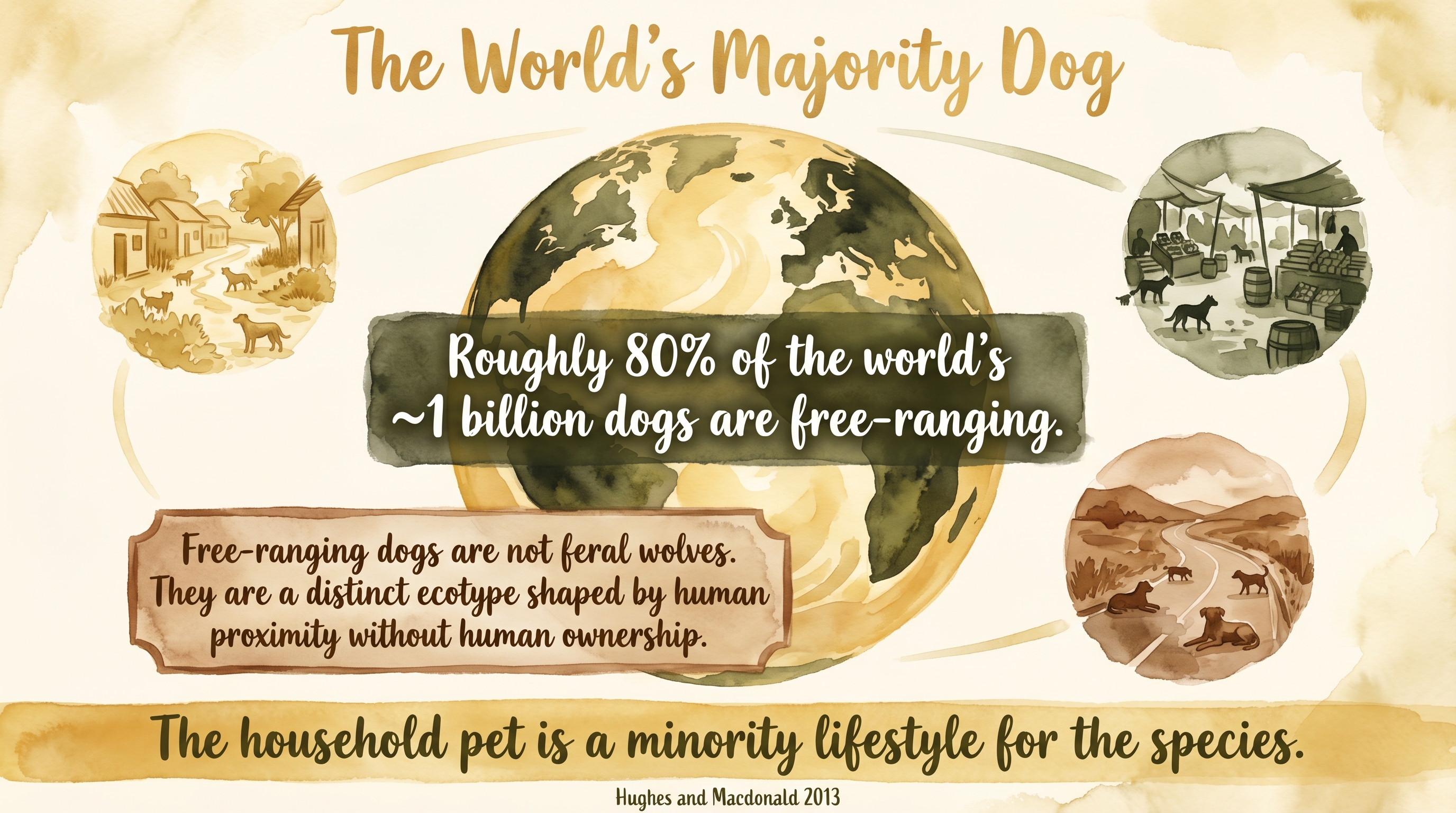
The household pet is a minority lifestyle for the species.
Key Takeaways
- Most dogs in the world do not live as Western household pets, which changes the species baseline for behavior questions.
- Free-ranging dogs are best understood as human-adjacent scavenging social animals rather than as household wolves.
- Field research shows socially functional adult behavior can emerge without formal training industries directing it.
- JB's claim that this ambient developmental pattern resembles the Five Pillars is an interpretive synthesis built on documented observations.
The Evidence
This entry uses observed claim-level tags beyond the dedicated EvidenceBlocks below. These tags mark JB program observation or practice-derived claims that need dedicated EvidenceBlock coverage in a later content pass.
This entry uses ambiguous claim-level tags beyond the dedicated EvidenceBlocks below. These tags mark claims where the literature remains unsettled or multiple interpretations coexist.
- Coppinger and Coppinger (2001, 2016)global domestic dog populations
Argued that roughly three quarters or more of dogs live as village or street dogs rather than as tightly managed household pets. - Lord et al. (2021)global dog populations
Warned that most dog science over-samples Western companion animals and under-represents the species majority. - Boitani and Ciucci (1995)feral dogs and wolves
Showed that dog social ecology differs sharply from wolf family-pack ecology and is organized around a different niche. - Sen Majumder et al. (2016) and Bhattacharjee et al. (2018, 2020)free-ranging dogs in India
Documented denning near humans and flexible use of human social cues in dogs without formal training histories.
No published study directly tests the practical implications of free-ranging dogs: an overview for domestic dog raising programs. The application to household dog raising remains an interpretive synthesis rather than a directly tested intervention finding.
SCR References
Sources
- Coppinger, R., and Coppinger, L. (2001). Dogs: A New Understanding of Canine Origin, Behavior, and Evolution.
- Coppinger, R., and Coppinger, L. (2016). What Is a Dog?
- Boitani, L., and Ciucci, P. (1995). Comparative social ecology of feral dogs and wolves. Ethology Ecology and Evolution.
- Lord, K. A., et al. (2021). Most Dogs Are Not NATIVE Dogs. Integrative and Comparative Biology.
- Sen Majumder, S., et al. (2016). To be or not to be social: Foraging associations of free-ranging dogs in an urban ecosystem. Acta Ethologica.
- Bhattacharjee, D., Sau, S., and Bhadra, A. (2018). Free-ranging dogs understand human intentions and adjust their behavioral responses accordingly. Frontiers in Ecology and Evolution.
- Bhattacharjee, D., et al. (2020). Free-ranging dogs are capable of utilizing complex human pointing cues. Frontiers in Psychology.