Canine Cognition and the Five Pillars
This entry is a synthesis file, not a direct report of one experimental program. The documented pieces underneath it are substantial. Hare et al. 2002 and Salomons et al. 2021 show dogs' unusual readiness to use human communicative cues. Topal et al. 1998, Horn et al. 2013, and Schoberl et al. 2016 show that humans can function as secure bases and safe havens for dogs. Fugazza and related social-learning work show that dogs and puppies learn through observation of humans and conspecifics. Nagasawa et al. 2015, Andics et al. 2014, Muller et al. 2015, and Albuquerque et al. 2016 show that dogs are sensitive to gaze, voice, and emotional signals in human interaction. Those findings are documented. The JB claim that the Five Pillars name the relational conditions canine cognition is most prepared to thrive inside is an interpretive synthesis built from those findings. Heuristic
That difference must stay explicit. No one study tested the Five Pillars as a package. Documented The evidence arrives in streams: attachment, social learning, emotion recognition, human cue use, and physiological co-regulation. JB is asking whether those streams converge in a way that makes the pillars look biologically coherent.
This entry argues that they do, while also insisting that coherence is not the same thing as direct laboratory validation.
That difference is not a weakness in the philosophy. It is what keeps the philosophy from pretending to be something it is not. A good synthesis can guide action without claiming to be a controlled experiment in disguise.
That is also why this file matters as governance, not only as argument. Category 7 would be easier to write if every result were simply labeled proof of the pillars. It would also be less trustworthy. A synthesis entry earns its keep by showing families how to reason from several strong literatures without erasing the distance between evidence and philosophy.
What It Means
Mentorship Has the Strongest Direct Support
If one pillar has the clearest cognitive-science footing, it is Mentorship. Dogs use humans as information sources in Hare 2002 and Miklosi 2003. Puppies learn from human and canine demonstrators in Fugazza et al. 2018. Do As I Do research shows that observational learning can support durable retention and transfer. Documented These findings do not prove every sentence JB says about mentorship. They do strongly support the core idea that upward-looking social learning is a normal canine channel, not an invented fantasy.
That gives Mentorship a better scientific status than a simple vibe word. It corresponds to a real learning architecture in the species.
Structured Leadership Also Has Strong Grounding
Attachment research provides the core here. Documented Topal 1998, Horn 2013, Solomon 2018 and 2019, and Schoberl 2016 all support the claim that humans can function as secure bases, safe havens, and stress modulators for dogs. That fits JB's parent-not-playmate framework far better than a dominance-rival picture. The heuristic step is saying this entire cluster justifies the full JB term Structured Leadership. The documented step is that secure-base organization is real and biologically meaningful in dogs.
That is already enough to make the pillar plausible as more than philosophy branding.
The safest way to read the cognition literature is not that it proves the Five Pillars word for word. It is that it shows dogs are built for a style of life in which adult guidance, emotional stability, and social readability matter deeply.
Calmness, Prevention, and Indirect Correction Require More Synthesis
Calmness has substantial but slightly more indirect support. Dog emotion-recognition work, oxytocin-gaze work, owner-state synchrony, and attachment physiology all show that the dog is reading and regulating through human affective state. Heuristic That supports the practical importance of calm adults strongly. The step from those findings to the full JB Calmness pillar is still interpretive, but it is an evidence-rich interpretation.
Prevention is present in the cognition literature more by implication than by direct naming. A species that learns through observation, early social referencing, and attachment-mediated security can plausibly be steered most effectively by what is established early rather than by repairing every pattern after the fact. Still, the strongest direct prevention evidence comes more fully from developmental and learning literature outside this exact subcategory. That is why the pillar should be linked here carefully.
Indirect Correction sits in a similar position. Dogs are sensitive to subtle social cues, gaze, posture, and emotional valence. That supports the plausibility of low-drama communication carrying weight. What the field does not directly show is that JB's full distinction between Indirect Correction and punishment was itself tested as a domestication or cognition construct. The fit is plausible, not directly proven.
The Slippage Risk
The main risk in this kind of file is rhetorical inflation. Because so many cognitive findings align with JB intuitions, it becomes tempting to speak as if the whole architecture is now documented. It is not. The documented findings are powerful but distributed. JB's contribution is integrative. If that is stated openly, the synthesis is honest and useful. If it is hidden, the entry stops being trustworthy.
This is one of the places where philosophical discipline matters as much as enthusiasm.
It also matters because credibility accumulates through restraint. Families and reviewers are more likely to trust the stronger claims when the weaker ones are openly marked as interpretive. The pillars do not need false certainty to be compelling. They need transparent confidence bands.
That transparency is part of the practical message too. A family does not have to wait for perfect proof before acting on a coherent synthesis, but it should know which parts are bedrock and which parts are inference. The best philosophy is not the one that sounds most absolute. It is the one that keeps its footing while still being useful.
Why It Matters for Your Dog
For families, this synthesis matters because it turns a cluster of separate studies into a practical picture of the dog in the home. Heuristic The dog is not merely obeying or disobeying commands. The dog is watching adults, regulating through adults, learning from models, checking emotional tone, and using specific humans as secure bases. That picture makes the pillars feel less like abstract philosophy and more like a way of organizing life around how dogs actually seem to work.
Mentorship matters because the dog is not only reinforced by outcomes. The dog is socially educated by what competent adults look like. Structured Leadership matters because the dog needs a stable anchor, not merely a controller. Calmness matters because the dog is reading emotional volatility whether anyone intended to teach it or not.
That has direct consequences in everyday life. A family that lowers the emotional temperature of the home, becomes more readable, and treats adult conduct as curriculum is likely to change the dog's developmental conditions in a real way. The literature does not guarantee perfect outcomes. It does give strong reason to think these are the right variables to care about.
Goldens make this especially intuitive because so many are visibly social learners and emotional readers. Their sensitivity can be a gift in a well-organized house and a problem in a disorganized one. The cognition literature explains why the same breed can feel angelic in one home and dysregulated in another without needing to invoke mystical differences in soul or intention.
The synthesis also helps families avoid shallow method debates. If the dog is using the human as a secure base, model, and emotional barometer, then technique cannot be evaluated in a vacuum. The surrounding relational system matters. A method that appears efficient in a narrow moment may still be working against the broader cognitive architecture the species relies on.
There is a confidence benefit too. Families often know, intuitively, that their state matters and that their dog learns by living with them. Scientific literature can make that intuition feel more legitimate. It says they are not imagining the depth of the dog's social orientation. They are noticing something real.
At the same time, the synthesis guards against magical thinking. The pillars are not a guaranteed formula, and the studies do not certify every application. The right result is not blind faith. It is evidence-informed conviction with clear edges.
The synthesis also helps adults decide where to put their energy first. If the dog's cognition is strongly shaped by social reference, attachment, and affective reading, then changing the adult side of the relationship is not a soft secondary intervention. It is often the central one. Many homes improve less from adding more technique than from making the human environment more coherent.
This is probably the most useful place to stand. Adults can take the pillars seriously because the dog-cognition evidence points toward them, while still respecting the fact that philosophy integrates more than any single paper can prove.
That stance also changes how families evaluate themselves. If the dog's cognitive world is built around adults as reference points, then adult improvement becomes a serious intervention rather than a side note. Becoming calmer, more readable, and more structured is not self-help theater. It is part of shaping the actual cognitive environment the dog lives inside.
It further changes what counts as a meaningful failure. When a dog becomes messy, it may not mean the philosophy is wrong. It may mean the home has not yet supplied the consistent conditions that the philosophy assumes are powerful. A synthesis entry cannot prove that in every case, but it gives families a stronger rationale for looking there first rather than jumping immediately to harsher or more mechanical explanations.
It also reframes progress. A dog who becomes easier to settle, easier to guide, and less socially chaotic may be improving through multiple channels at once: better attachment use, cleaner observational learning, steadier emotional signaling, and more reliable adult reference points. The pillars look more credible when those improvements are understood as a coordinated shift in environment rather than as one isolated trick finally landing.
That coordinated view is especially important for avoiding slippage. If one pillar appears to help, it can be tempting to declare the whole philosophy scientifically settled. A better reading is that several cognition findings point in compatible directions, which is why coherent environmental change can produce broad improvement without yet functioning as a direct experimental validation of the entire package.
That coherence matters.
What This Means for a Just Behaving Family
JB families should use this entry as a confidence map. It shows why the pillars fit canine cognition well enough to guide action, even though the exact package remains a synthesis.
That means Mentorship, Calmness, and Structured Leadership can be treated as especially well grounded in this literature. Prevention and Indirect Correction can also be defended, but with more interpretive caution.
Practically, the home should act on what the cognition field makes plain: adults are live reference points in the dog's world. Their signals, stability, and example are all part of the dog's learning environment.
JB should keep saying that clearly without pretending every inferential step has been directly tested. That honesty does not weaken the philosophy. It strengthens trust in it.
It also gives families a practical order of operations. Start with the pillars most strongly grounded here by becoming more readable, more regulated, and more worth observing. Let those changes reshape the social environment before assuming the dog needs a more elaborate method stack. That sequence fits the evidence better than jumping immediately to technical escalation.
For families, the gain is substantial. They can raise the dog in a way that fits both intuition and evidence without needing false scientific overstatement.
That is the right closing note for this first half of Category 7.
It is also a useful governance note for JB itself. The stronger the philosophy becomes, the more important it is to keep document-level discipline about what is documented, what is observed, and what is heuristic. This entry exists partly to model that standard.
For JB internally, that governance point is not secondary. A philosophy that wants to stay credible over time has to keep naming its evidence ceilings out loud. The more attractive the synthesis becomes, the more important that discipline gets.
That is also a service to families. Clear confidence boundaries do not make the philosophy harder to trust. They make it easier to use without mythology. People can act with conviction when they know which parts are documented, which parts are observed, and which parts are reasoned synthesis.
That governance standard is itself part of the practical usefulness. A family can hold the pillars confidently when it knows the confidence is being managed honestly. Clear limits do not weaken the framework. They keep it sturdy enough to guide real life without leaning on false certainty.
That kind of disciplined confidence is part of the philosophy's usefulness. Families can act on a coherent synthesis more steadily when they know the evidence claims are being kept within their proper bands.
That keeps synthesis useful instead of inflated.
That is how philosophy stays useful without becoming careless.
That is the right kind of disciplined confidence.
That is how a synthesis stays ambitious without becoming sloppy.
That matters in real homes.
It should.
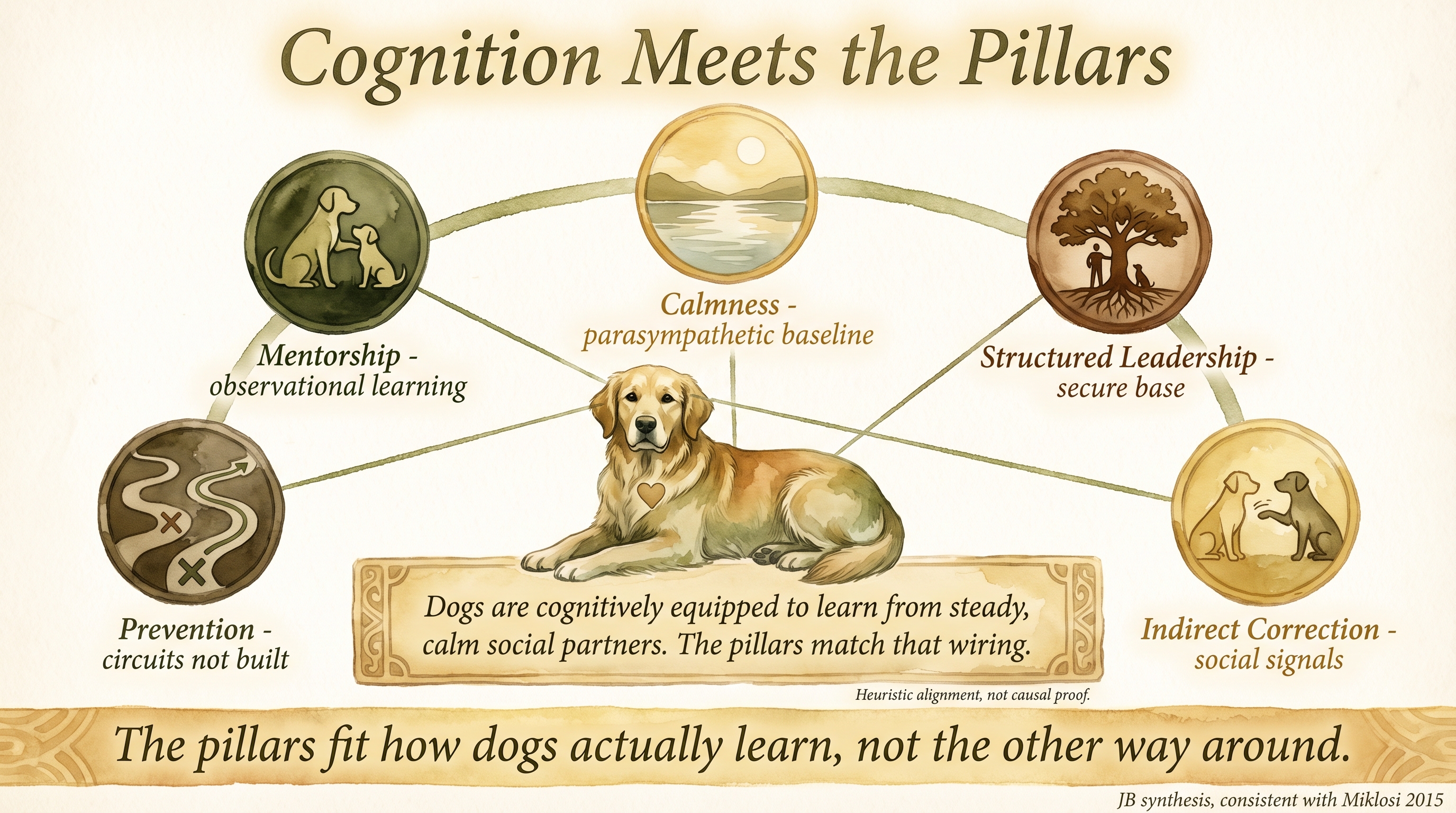
The pillars fit how dogs actually learn, not the other way around.
Key Takeaways
- Canine cognition research does not directly test the Five Pillars as a package, but it strongly supports several of the capacities the pillars assume.
- Mentorship and Structured Leadership are the best-grounded pillars in this literature, with Calmness also strongly supported through affective and regulatory findings.
- Prevention and Indirect Correction fit the cognition evidence more by cumulative inference than by direct one-study validation.
- For JB families, the key practical result is that adult conduct is part of the dog's actual cognitive environment.
The Evidence
This entry uses documented claim-level tags beyond the dedicated EvidenceBlocks below. These claims should remain tied to the entry Sources and SCR references during the next evidence-chain authoring pass.
- Hare, Miklosi, and Salomons traditionsdogs and wolves
Support human-directed cue use and cooperative communication as strong canine biases. - Topal, Horn, Solomon, and Schoberl traditionsdogs
Support secure-base, safe-haven, and relational-regulation functions in dog-human bonds. - Fugazza and social-learning literaturedogs and puppies
Support observational learning and model-based acquisition as genuine canine capacities. - Nagasawa, Andics, Muller, and Albuquerque traditionsdogs
Support the dog's sensitivity to gaze, voice, and emotional information in human interaction.
No published study directly tests the practical implications of canine cognition and the five pillars for domestic dog raising programs. The application to household dog raising remains an interpretive synthesis rather than a directly tested intervention finding.
SCR References
Sources
- Hare, B., et al. (2002). The domestication of social cognition in dogs. Science.
- Topal, J., et al. (1998). Attachment behavior in dogs: a new application of Ainsworth's Strange Situation Test. Journal of Comparative Psychology.
- Horn, L., Huber, L., and Range, F. (2013). The importance of the secure base effect for domestic dogs. PLOS ONE.
- Fugazza, C., et al. (2018). Social learning from conspecifics and humans in dog puppies. Scientific Reports.
- Nagasawa, M., et al. (2015). Oxytocin-gaze positive loop and the coevolution of human-dog bonds. Science.
- Andics, A., et al. (2014). Voice-sensitive regions in the dog and human brain are revealed by comparative fMRI. Current Biology.