What Cross-Cultural Evidence Tells Us About Dog Training
This is the capstone entry for Category 7, and its job is to keep documented observation and JB interpretation clearly separated. The documented layers are substantial. Free-ranging dogs across the world often become socially workable adults without formal training industries directing their development. Village-dog and street-dog studies show ordinary competence emerging through ecological life rather than through method stacks. Koster's hunting-dog literature shows useful working dogs learning through immersion in subsistence life. Livestock guardian traditions documented by the Coppingers, Rigg, and later applied predator-management work show reliable function built through early placement with stock and ongoing environmental fit. Kirby and Chira's global cross-cultural sample shows that dog treatment varies with role and that intensive modern training culture is not the historical universal. Those underlying points are documented or observed. The JB claim that formal training is usually secondary to ambient developmental environment, and that the Five Pillars are a naming of those ambient conditions, is a heuristic synthesis built on top of that record. Heuristic
That distinction has to stay visible because this is exactly where good philosophy can become careless. Cross-cultural evidence is powerful, but it does not say every modern method is useless or every traditional arrangement is superior. It says something narrower and more disruptive: dog functionality has long existed outside method-heavy training culture, which means method cannot be the sole or primary explanation.
This matters because it changes the argument with the industry. The strongest anti-industry position is not "training never helps." The strongest position is "training is often a supplement riding on top of more fundamental developmental conditions."
That is a much harder claim to dismiss because history and ecology keep pointing in the same direction.
What It Means
Functional Dogs Long Predate Training Culture
The first conclusion is historical proportion. Dogs guarded flocks, accompanied hunts, moved through camps, lived in villages, and integrated into households for millennia before certification bodies, puppy classes, clickers, and formal professional training identities existed. Heuristic The cross-cultural and free-ranging entries in this category do not treat that as a romantic slogan. They treat it as a recurring empirical fact.
Once that is admitted, the strongest industry claim becomes impossible to sustain. Modern training methods may be useful, but they cannot be the original source of dog functionality because dog functionality plainly predates them.
Ambient Environment Appears to Be the Primary Variable
Across free-ranging and cross-cultural evidence, one pattern recurs. Dogs develop inside worlds. Those worlds differ in hardship, kindness, labor demand, and moral quality, but the role of ambient environment is unmistakable. Village puppies grow up amid ordinary community life. Hunting dogs grow up inside hunting practice. Guardian dogs grow up with stock. Camp dogs grow up inside kinship-rich settlement life. The through-line is not the presence of a universal method. It is the presence of a coherent developmental world.
That is the core empirical pressure JB is responding to. If the world is doing the main shaping, then training should be understood as a minor layer unless the dog is learning a specialized task.
Training Still Has a Legitimate but Narrow Place
A responsible synthesis has to resist overreach. Deliberate training can be extremely valuable for cooperative care, recall, leash walking, service tasks, handling tolerance, sports, and safety-critical household skills. Some behavior problems genuinely need structured intervention. Heuristic The cross-cultural record does not erase any of that.
What it does challenge is the inflation of training into the central theory of dog development. The evidence keeps suggesting a different order: first the relationship, ecology, and routine; then the method.
The cross-cultural record supports a documented claim that workable dog-human relationships existed long before the modern training industry. JB's stronger philosophical move is to say that when training becomes the center of dog life, it can obscure the older developmental logic that made the relationship possible in the first place.
The Five Pillars Are Best Read as a Naming Layer
This is the most interpretive part of the argument and the place where rhetoric has to stay disciplined. The category does not prove that dogs or pastoralists consciously enacted the Five Pillars by name. The category shows repeated patterns that resemble what JB has named: adult-guided development, calmer baselines than modern pet culture often expects, prevention through environmental organization, and sparse socially legible correction. Observed-JB The Pillars are JB's naming layer for those patterns, not a phrase found in the primary literature.
That is a strength if handled honestly. A philosophy can be interpretive and still useful. It simply must not pretend to be a direct quote from science.
It also means the right standard for the philosophy is coherence rather than counterfeit certainty. If the Pillars organize the historical and ecological evidence better than a method-first framework does, that is a serious achievement even before any direct package-level test exists.
Another implication is emotional economy. Families spend enormous energy trying to choose perfect methods while underinvesting in the home conditions that methods will sit on top of. Cross-cultural evidence suggests that reversal is backwards. The home is the main terrain. Method is later traffic on the terrain.
Cross-cultural evidence therefore changes not only theory, but household triage. It tells adults to inspect the life before they worship the method.
Why It Matters for Your Dog
For families, the practical meaning of this synthesis is large. It says that if a household wants a functional dog, the first thing to examine is not the sophistication of the training plan. The first thing to examine is the total developmental environment. Is the dog living in an atmosphere that teaches steadiness, role clarity, rest, adult readability, and social coherence? Or is the dog living in an atmosphere that teaches arousal, dependence on constant direction, and chronic emotional noise?
This is liberating because it takes pressure off consumers without lowering standards. A family does not have to buy into the entire modern training economy to raise a good dog. It does have to take dog development seriously enough to shape the home itself. Heuristic That is a higher and more honest demand.
Goldens make this especially relevant because they are so often raised inside an emotional-intensity model masquerading as enrichment. Families play constantly, talk constantly, soothe constantly, stimulate constantly, and then are surprised when the adolescent dog feels socially juvenile and unable to settle. The cross-cultural evidence suggests that a different question should come first: what kind of social world is this dog being asked to mature inside?
The synthesis also helps adults choose where to invest effort. A calmer entry routine, clearer boundaries around food and greetings, more opportunity for quiet observation, less dramatic correction, and stronger adult follow-through may do more long-range good than adding yet another protocol. Training still matters. It simply matters differently once the environment is understood as primary.
Another practical gain is relief from false guilt. Many excellent families feel inadequate because they are not "doing enough training." What they may actually be lacking is confidence in quieter variables: rhythm, emotional steadiness, adult example, and prevention. The historical and ecological record gives those quieter variables more authority.
This synthesis also protects households from going too far in the other direction. The answer is not anti-training purism. A dog living in a traffic-heavy American suburb needs deliberate civic skills that many free-ranging or traditional dogs did not need in the same way. The right conclusion is not no training. The right conclusion is right-sized training.
Right-sized training means the method serves the relationship and the environment rather than replacing them. It means specific skills are taught clearly, but the household does not imagine that skill work alone can generate maturity, calmness, or social competence in a dog whose daily world is disordered.
That is one reason this cross-cultural capstone is so useful. It gives families a principled basis for refusing two bad options at once: blind faith in method culture and sloppy anti-method romanticism.
The most practical result may be this: if the dog's life looks developmentally sane, training becomes lighter, cleaner, and more supplemental. If the dog's life looks developmentally chaotic, training becomes heavier, more desperate, and less effective. History and ecology both point toward that pattern.
This can change how adults allocate emotional energy. Heuristic Instead of panicking that they are not doing enough technique, they can ask whether the home itself is teaching well. That is a more foundational question and, in many cases, a more hopeful one.
That is why JB's order of operations matters so much. If the household builds calmness, role clarity, prevention, and readable adult conduct first, training becomes more proportionate and less desperate. The historical and ecological record does not make that ordering trivial. It makes it unusually plausible.
That reordering is both simpler and more demanding. Simpler, because it clarifies priorities. More demanding, because it makes the family responsible for the day, not just for isolated lessons.
That does not make every household problem easy. It does make the causal hierarchy clearer. When the family improves the daily world first, whatever training remains usually has firmer ground to stand on. When the family ignores the daily world, technique is asked to perform a much larger repair than it can usually manage.
The household consequence is practical. When the family improves atmosphere, role clarity, and prevention, training usually becomes less inflated because it no longer has to carry the whole developmental burden by itself.
The family can use that insight without becoming rigid. The point is not to ban all technique or pretend every household can solve every issue through atmosphere alone. The point is to stop letting technique become the first explanatory layer when history, ecology, and development all suggest it should usually be later in the chain.
What This Means for a Just Behaving Family
JB families should use this capstone as a hierarchy of causes. Start with the daily world. Start with adult conduct. Start with role clarity, calmness, and prevention. Then use training where a real skill gap remains.
That ordering fits the cross-cultural record well. It also fits the free-ranging evidence from earlier in the category. Dogs seem to become functional most reliably when life itself teaches first and technique serves afterward.
Mentorship, Calmness, Structured Leadership, Prevention, and Indirect Correction all become easier to understand in this frame. JB is not claiming to have invented a method superior to other methods. JB is claiming to have named an older developmental logic that method culture often overlooks.
The evidence ceiling still matters. The category documents cross-cultural diversity, non-modern routes to dog competence, and the primacy of ambient developmental conditions in many contexts. JB's strongest philosophical formulation remains heuristic and should stay labeled that way.
That does not weaken the framework. It keeps it trustworthy. Families can act on a coherent interpretation more confidently when they know the interpretation is not pretending to be direct proof.
Seen that way, households gain a more durable decision rule: improve the ordinary day until it starts teaching the dog by itself, then add targeted skill work only where the day cannot carry the load.
In practical terms, the message is simple. Raise first. Train second. Protect the dog from a bad atmosphere before trying to program around the consequences of that atmosphere later.
That ordering is not anti-science. It is the most science-respectful way to read the broader evidence. Ecology, development, cross-cultural history, and free-ranging behavior all keep telling the same story: the dog's life context is doing more causal work than modern dog culture usually admits.
The result is not anti-training. It is anti-inflation. Cross-cultural evidence keeps insisting that the dog became a functional species with humans under conditions much larger than the modern training industry, and families should let that larger context discipline what they expect methods to accomplish.
That is the lasting pressure this category places on the training question. Any method account that ignores the bigger developmental world is probably too small.
That is why this capstone matters. It does not try to abolish training. It tries to put training back into proper proportion by setting it inside the larger developmental and historical record the category has assembled.
That closing order of causes is one of the most useful gifts the whole category offers families. It tells them where to spend their courage first: on the ordinary atmosphere of the home, on the quality of adult conduct, and on the daily environment that keeps teaching the dog long after any formal exercise is over. That is a bigger and steadier leverage point than most methods can offer by themselves, especially across the long developmental arc of family life and household maturity. It gives families somewhere realistic to begin, and somewhere honest to return when method culture gets too loud.
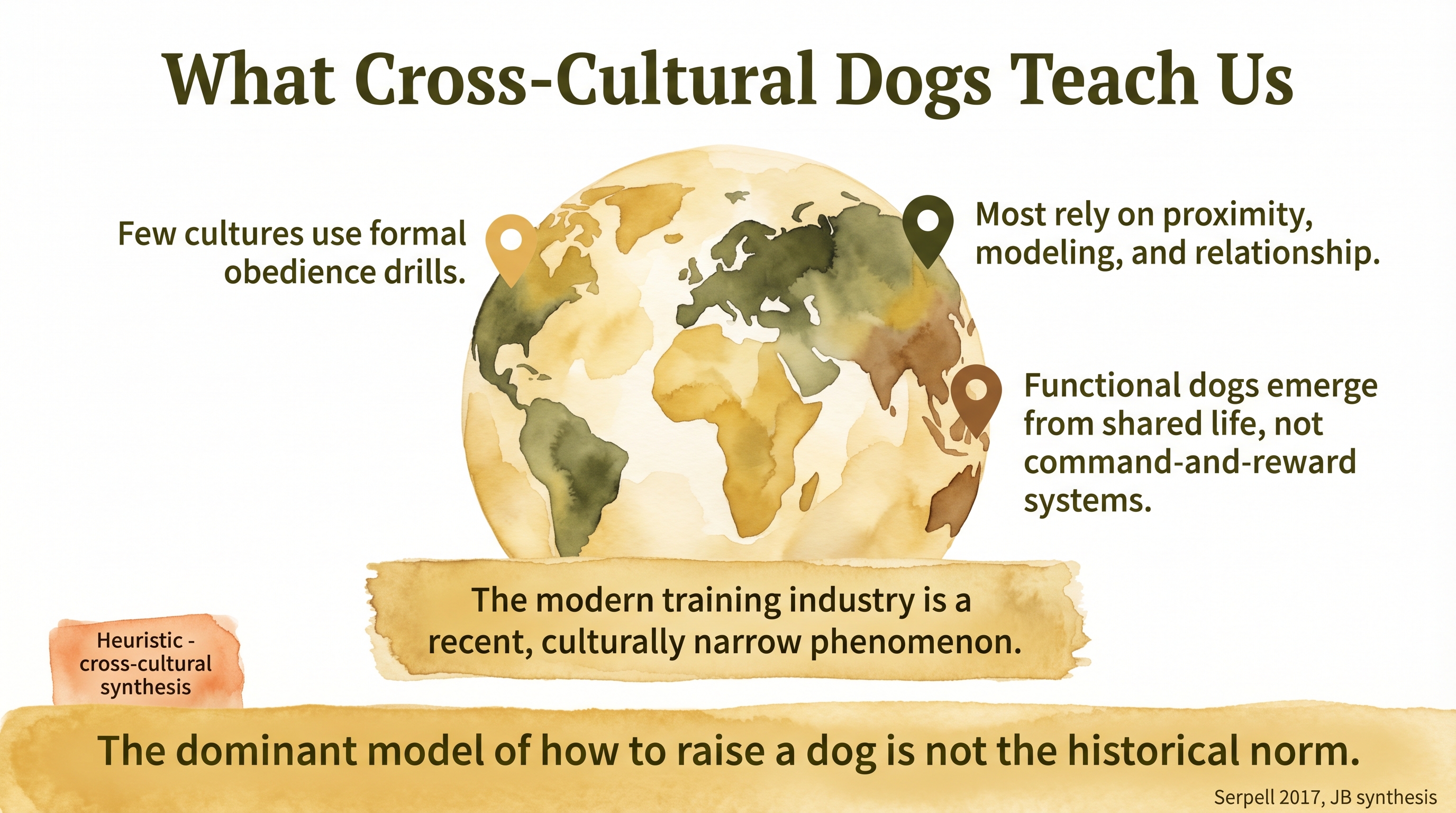
The dominant model of how to raise a dog is not the historical norm.
Key Takeaways
- Cross-cultural evidence does not show training is useless; it shows training is usually secondary to the larger developmental world.
- Functional dogs clearly existed long before modern training institutions, which limits what the industry can claim about necessity.
- JB's Five Pillars are best presented here as an interpretive naming of recurring ecological and historical patterns.
- For families, the practical order is environment first, adult conduct second, and method third.
The Evidence
This entry uses observed claim-level tags beyond the dedicated EvidenceBlocks below. These tags mark JB program observation or practice-derived claims that need dedicated EvidenceBlock coverage in a later content pass.
- Free-ranging dog literature across Dispatch 9village and street dogs
Shows socially workable adult dogs developing outside modern training infrastructure. - Koster hunting-dog literatureIndigenous and subsistence hunting dogs
Shows complex working competence emerging through immersion in work life. - Coppinger, Rigg, and LGD literaturelivestock guardian dogs
Shows reliable guardian function built through placement, bonding, and repeated environmental fit. - Kirby, Chira, Serpell, and related ethnographic sourcescross-cultural human-dog relationships
Show that modern training culture is historically partial rather than universally foundational.
No published study directly tests the practical implications of what cross-cultural evidence tells us about dog training for domestic dog raising programs. The application to household dog raising remains an interpretive synthesis rather than a directly tested intervention finding.
SCR References
Sources
- Chira, R. M., Kirby, K. R., et al. (2023). Function predicts how people treat their dogs in a global sample. Scientific Reports.
- Serpell, J. A. (2021). The indispensable dog. Frontiers in Psychology.
- Koster, J. M. (2009). Hunting dogs in the lowland Neotropics. Journal of Anthropological Research.
- Coppinger, R., and Coppinger, L. (2001). Dogs: A New Understanding of Canine Origin, Behavior, and Evolution.
- Rigg, R. Livestock guarding dogs: their current use worldwide.