Cross-Cultural Human-Dog Relationships: An Overview
The modern Western pet relationship is real, emotionally significant, and culturally influential, but it is not the only way humans and dogs have lived together, and it may not even be the most informative default for understanding the species. Serpell's anthropological writing since the 1980s has emphasized that human-animal relationships vary widely by ecology, labor, symbolism, kinship, and subsistence needs. Chira, Kirby, and colleagues' 2023 global HRAF study extended that claim quantitatively by analyzing a large cross-cultural sample and showing that dog treatment varies systematically with function. Hunting, guarding, herding, transport, and companionship do not produce identical dog-human arrangements. Smith and Litchfield 2009, Bennett and Archer-Lean 2023, and related work on Aboriginal camp dogs describe dog keeping embedded in kinship and place rather than in Western ownership-and-control models. Jervis et al. 2018 showed that free-roaming dogs on a Northern Plains tribal reservation were understood simultaneously as protectors, kin, and community members. Serpell 2021 also argued that the human-dog relationship is historically indispensable because dogs have repeatedly occupied practical and social roles beyond modern pet sentiment. Documented
The key point is not that all cultures treat dogs gently or identically. Many do not. The key point is that functional dog-human partnerships have existed across climates, economies, and moral worlds without depending on the training-industry apparatus that modern Western pet culture often treats as inevitable.
That observation matters for JB because it widens the comparison class. Documented If households want to know what produces usable dogs, the answer cannot be limited to twentieth century obedience manuals and twenty-first century certification culture.
Cross-cultural evidence makes the field older, broader, and much less method-centric. Documented
What It Means
Dog-Human Relationships Vary by Function
The Chira and Kirby global sample matters because it moved beyond anecdote. Across more than one hundred societies, dog treatment varied with role. Dogs used for hunting, guarding, or herding were integrated differently from dogs kept mainly as companions. That should be obvious, but dog culture often forgets it. People talk as though there is one correct dog relationship and everyone else is deviating from it. The cross-cultural record says otherwise. Form follows function.
This is important because it reveals the Western companion model as one specialization among many. It is not the timeless essence of dog keeping.
Kinship, Utility, and Personhood Often Coexist
A modern reader may assume that utility and affection are opposites, but the ethnographic record often treats them as intertwined. Serpell has long noted that animals can be both emotionally valued and practically necessary. Chira and Kirby's findings on dog personhood and utility support that combination rather than breaking it apart. Documented Jervis et al. 2018 described reservation dogs as protectors and kin. Australian camp-dog work places dogs inside collective norms and social belonging while also recognizing the practical realities of free-roaming life.
This mixed status matters because it undermines a narrow transactional reading and a narrow sentimental reading at the same time. Dogs are often neither mere tools nor mere furry children.
Formal Training Culture Is Historically Contingent
One of the most important lessons of cross-cultural dog history is that functional dogs have existed for thousands of years without clickers, certification bodies, puppy classes, or industrial-scale advice markets. Documented Indigenous hunting dogs, livestock guardians, camp dogs, village dogs, transport dogs, and settlement-edge companions all demonstrate some version of that point. Modern training can be useful. The record simply does not support the claim that formal method culture is the singular source of dog functionality.
That matters because it restores proportion. Training becomes one human invention among many rather than the origin of the relationship itself.
The cross-cultural record strongly suggests that dogs and humans were living in workable relationships long before modern training institutions existed. JB's further claim is that the methodized industry often mistakes a late cultural overlay for the foundation of dog-human life.
The Comparison Is Strategic, Not Antiquarian
This category is not here to make readers admire anthropology from a distance. It is here because comparison changes what counts as normal. If modern pet households are generating large amounts of fear, overdependence, reactivity, and chronic management needs, then broader human-dog history becomes relevant. It shows that the present arrangement is not the only arrangement and that the variables shaping dogs may be larger than training discourse often allows.
Cross-cultural evidence therefore functions as a reality check. It makes modern dog culture less absolute.
It also changes what counts as a serious question. Instead of asking only which method best modifies the already-given pet dog, the record invites a broader question: what kinds of human communities have historically produced stable dog roles, and what were those communities doing long before anyone built a professional advice economy around dogs?
Another result of this wider view is methodological caution. If dog-human success has taken many forms across history, then any present-day system claiming universal necessity should be treated skeptically until it proves that necessity rather than merely assuming it.
The broader lesson is that history can keep a family from mistaking current fashion for species truth. That is already a major practical gain.
Why It Matters for Your Dog
For families, this overview matters because it relieves a subtle pressure. Modern dog culture often implies that responsible people must adopt a specific package of methods, products, classes, and philosophies to produce a functional animal. Cross-cultural evidence shows that humans have lived successfully with dogs in many ways. The household does not need to copy an Indigenous camp, a Siberian hunting camp, or a Pyrenean sheep pasture. It does need to stop acting as though the current Western advice economy is the only historically serious source of canine competence.
That broader frame changes how families evaluate everyday goals. A dog does not have to look like a sport prospect or an obedience project to be functional. Across cultures, the valued dog may be one who tracks quietly on a hunt, warns at the edge of camp, rests near children, moves with livestock, or simply coexists reliably in a community. Many of those outcomes are less about flashy precision and more about maturity, role-fit, and social legibility.
Goldens benefit from this perspective because the breed is often absorbed into a particularly modern version of dogness: class-enrolled, gear-heavy, praise-saturated, entertainment-rich, and constantly interpreted through techniques. Cross-cultural evidence reminds families that a good dog may be defined more by steadiness, usefulness, and relational coherence than by its mastery of a large skill catalog.
This matters especially when families feel they are failing because they are not enjoying method culture. A family may be devoted, calm, observant, and consistent, yet feel inferior because they are not running endless protocols. The ethnographic record suggests those deeper household qualities may be much closer to the real foundation of dog-human success than current branding would have them believe. Documented
Another practical gain is that the overview loosens the false opposition between affection and structure. Many traditional dog relationships involve both. Dogs can be loved, named, housed near or with humans, and treated as socially meaningful while still being expected to work, wait, accompany, guard, or respect boundaries. That is encouraging for JB because it means "parent, not playmate" is not a bizarre anti-affection stance. It is one durable version of how highly valued dogs have often been held in human communities.
The cross-cultural record also helps households understand why overpersonalization can create problems. When dogs are treated only as emotional dependents and not as developing mammals with role needs, the relationship can become lopsided. Many societies historically avoided that imbalance by embedding dogs in practical daily life. Modern homes can borrow that insight by giving the dog a coherent place in routine rather than only a stream of emotional attention.
This overview further protects families from nostalgia errors. Not every traditional dog-keeping practice should be admired or copied. Many involved harsh culling, preventable disease, food scarcity, or rough correction. The lesson is not that older equals better. The lesson is that functional dog-human life is older and broader than the present industry frame.
That is a freeing realization. It means families can evaluate advice against history instead of assuming all wisdom flows from the latest professionalized layer. It also means they can ask whether their home is producing the sort of calm, socially grounded dog that many older human-dog relationships seem to have depended on without making classes the center of the story.
The best practical use of this overview is therefore comparative humility. The household dog in Massachusetts is not the same as the camp dog in Arnhem Land or the hunting dog in Bosawas, but all belong to the same species. If the species has repeatedly thrived in relationships built around proximity, participation, and ordinary guidance, then those variables deserve much more respect in the family home.
The overview also helps families resist shallow universals. Advice that sounds self-evident inside one cultural setting may be highly contingent when viewed historically. That does not make local advice worthless. It simply means the household should ask whether the advice describes a species truth or merely a recent cultural fashion.
This broader horizon also helps adults calm down. A family does not need to recreate every historical dog tradition. It needs to absorb the underlying lesson that dogs repeatedly do best in human communities where role, rhythm, and ordinary social meaning are clearer than modern consumer culture often makes them.
That historical humility is valuable in itself because it makes the home less reactive to dog-culture churn and more answerable to the animal in front of it.
What This Means for a Just Behaving Family
JB families should read cross-cultural evidence as a broad support for the claim that dog-human functionality predates and exceeds the modern training industry. The relationship came first. Formal method culture came much later.
That does not make training worthless. It does make training secondary. A home that gets the relationship, atmosphere, and developmental environment badly wrong cannot assume a technique stack will repair everything.
Structured Leadership is one of the clearest takeaways here. Many durable human-dog arrangements across cultures combine affection, expectation, and role clarity. Mentorship also fits well because dogs often learn by accompanying capable adults in ordinary life rather than by being pulled out of life for repeated abstraction.
For a JB family, the practical invitation is simple. Build a household where the dog has a real place, a stable rhythm, and adults worth reading. Use methods where they genuinely help, but do not confuse the existence of methods with the origin of dog maturity.
JB should keep its rhetoric disciplined. The cross-cultural record documents diversity of dog roles and shows that modern training culture is not universal or necessary for every functional outcome. JB's stronger philosophical claim about Historical Divergence remains an interpretive layer built on that record.
Even with that limit, the overview changes the field of vision. It makes the present look smaller and the human-dog relationship look older, wider, and more biologically grounded.
That is a healthy effect for any family philosophy. A broader evidence horizon reduces panic, reduces method worship, and encourages adults to build a home that fits the dog as a social mammal rather than a consumer hobby object.
That is a major practical correction. It means the home should be judged less by how closely it resembles current dog fashion and more by whether it gives the dog a usable place in human life. Cross-cultural history makes that standard feel older, wider, and more serious.
It is difficult to overstate how useful that is. Once the present stops pretending to be the whole story, a family can build more calmly and more honestly.
The practical force of that correction should not be underestimated. A family who knows the present is only one cultural arrangement among many can hold modern tools more lightly, think more historically, and make more disciplined choices about what the dog actually needs from the people in the home. That is a major gain in both confidence and realism.
The overview therefore does more than broaden knowledge. It recalibrates seriousness. A household that gives the dog a stable place in human life may be participating in a much older and sturdier tradition than one that simply accumulates contemporary technique. That historical depth can make families calmer and more disciplined in the present.
It further reminds households that a dog can be deeply at home in human life without being turned into a perpetual project. Cross-cultural evidence keeps restoring that possibility.
For many households, that is a deeply stabilizing correction in the middle of a noisy culture.
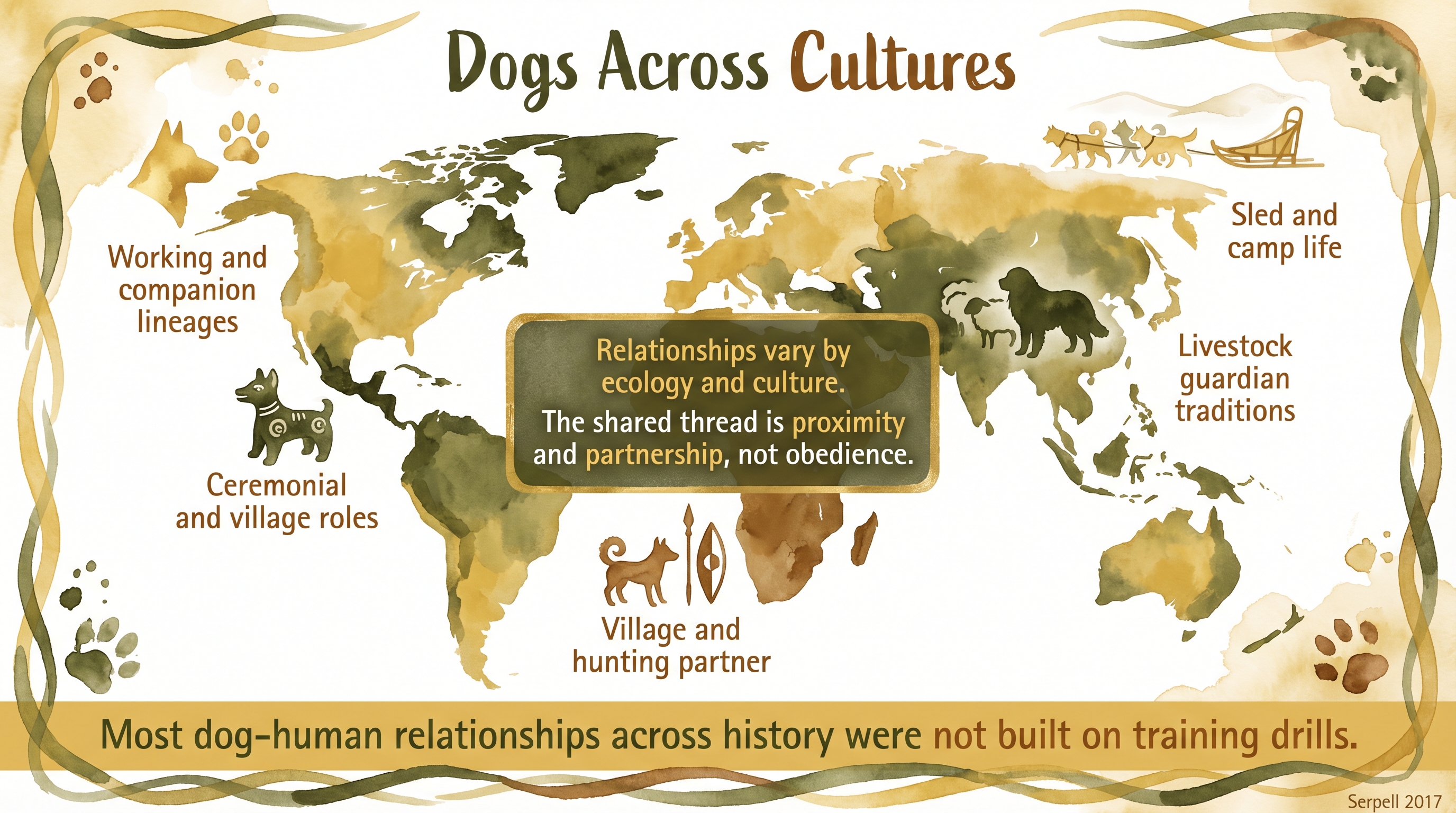
Most historical dog-human relationships were not built on training drills.
Key Takeaways
- The Western pet relationship is one form of dog-human life, not the whole story.
- Across cultures, dog treatment changes with role, ecology, and social meaning.
- Functional dogs long predate certification culture, puppy classes, and modern training industries.
- For JB, this widens the comparison class and makes modern method culture look historically partial rather than foundational.
The Evidence
- Chira, Kirby, et al. (2023)cross-cultural human societies and dogs
Found that dog treatment and integration vary systematically with function across a global sample. - Serpell (1987, 2021)cross-cultural human-animal relationships
Argued that dogs occupy varied practical and social roles across societies rather than one universal modern pet role. - Smith and Litchfield (2009) and Bennett and Archer-Lean (2023)Indigenous Australian communities and camp dogs
Described dog management as embedded in kinship, place, and collective norms rather than a Western control model. - Jervis et al. (2018)free-roaming reservation dogs
Showed that dogs can be understood simultaneously as protectors, kin, and community members in Indigenous contexts.
No published study directly tests the practical implications of cross-cultural human-dog relationships: an overview for domestic dog raising programs. The application to household dog raising remains an interpretive synthesis rather than a directly tested intervention finding.
SCR References
Sources
- Chira, R. M., Kirby, K. R., et al. (2023). Function predicts how people treat their dogs in a global sample. Scientific Reports.
- Serpell, J. A. (1987). Human and animal companionship. Anthrozoos.
- Serpell, J. A. (2021). The indispensable dog. Frontiers in Psychology.
- Smith, B., and Litchfield, C. (2009). A review of the relationship between Indigenous Australians, dingoes, and domestic dogs. Anthrozoos.
- Bennett, B., and Archer-Lean, C. (2023). Understanding camp dogs: the relationship between Aboriginal culture and western welfare. AlterNative.
- Jervis, L. L., et al. (2018). Dog ownership and free-roaming dogs on a Northern Plains tribal reservation. Anthrozoos.