Village Dog Ecology and Behavior
Village dogs live in the ecological middle ground between strict ownership and full ferality. They are associated with human settlements, but they are not managed in the way suburban pet dogs are managed. Raymond and Lorna Coppinger treated this as the normal dog condition rather than as a social failure. Boitani and Ciucci 1995 described feral and village-like dog populations as scavenger-based systems distinct from wolf ecology. Pal's field work in West Bengal documented free-ranging dogs resting near markets, lanes, and homes, breeding freely, and relying heavily on human-associated food rather than on coordinated hunting. Sen Majumder et al. 2016 found that free-ranging dogs in India preferentially denned near humans, showing that human proximity itself is a resource. Bhadra-lab work later documented that these dogs also attend closely to human social signals, which makes sense in a settlement-edge niche. The ecological picture is therefore coherent across authors: village dogs live because human settlement produces waste, shelter opportunities, and predictable social exposure, and dogs that can move through that world efficiently survive. Documented
Several behavioral facts recur in this literature. Village dogs spend much of the day resting. Their movement is usually tied to food search, mate search, or repositioning around human activity rather than to long-distance patrol. Their diet is dominated by scavenging from refuse, scraps, feces, carrion, and opportunistic handouts. Reproduction is not tightly monopolized in the wolf sense. Mortality is substantial, especially in puppies, but adults that survive are often physically competent and socially adept.
That matters because it replaces a fantasy dog with an ecological dog. Village dogs are not pets without manners. They are animals occupying the niche dog evolution has favored for a very long time.
The JB reason for studying them is straightforward. If one wants to know what canine behavior looks like outside method-saturated Western households, village dogs are a much better place to start than a classroom or a leash aisle. Documented
What It Means
The Ecology Is Commensal Before It Is Companion
The term "village dog" matters because it names a relationship rather than merely a lack of ownership. Documented These dogs are not isolated from humans. They live on the margins of human settlements, using our waste streams, spatial routines, and tolerated presence as the substrate of their lives. Coppinger described dogs as commensal scavengers rather than as miniature wolves, and village dog ecology is where that thesis becomes visible. Boitani and Ciucci 1995 likewise emphasized that dog life in human-shaped settings depends less on hunting coordination and more on flexible exploitation of anthropogenic resources.
This is why attempts to define dogs only through the pet relationship are so distorting. The companion dog is one cultural branch. The commensal village dog is a far older and much broader ecological branch.
Daily Time Budgets Are Quiet and Economical
One of the most useful corrections the literature offers is that village dogs are not constantly busy. Pal, Boitani, and later urban free-ranging studies repeatedly describe extensive resting and low-energy waiting. Energy conservation is rational in a scavenging niche where food is patchy and expensive movement can be dangerous. Dogs may reposition around markets, garbage points, or feeding times, but much of life is spent conserving calories and monitoring the environment rather than pursuing nonstop action.
That quiet rhythm is one reason pet-dog advice can become so misleading. Owners are often told that the default dog is overflowing with undirected energy and must be continually worn out. Village dog ecology suggests that a great deal of normal dog life is actually patient, opportunistic, and low-drama.
Diet, Reproduction, and Survival Follow Settlement Logic
Village dog diets are typically dominated by human food waste, not by successful predation on wild prey. Coppinger used this repeatedly to argue against simplistic wolf analogies. Pal's Indian dogs were scavengers first. Boitani and Ciucci described the same shift in energetic terms: dog social life no longer revolves around bringing down large prey because the niche no longer requires it.
Reproduction also looks different from wolf life. Multiple animals may breed. Litters are born in sheltered spaces near people, structures, or debris piles. Puppy survival is often low, and this is where romanticism has to stop. Paul and Bhadra 2017 showed mothers balancing energetic cost and offspring care under difficult conditions. Bhattacharjee et al. 2017 documented weaning conflict and milk theft, which is exactly the sort of real developmental friction a settlement-edge species has to manage.
Village dogs do not demonstrate that life is easy. They demonstrate that much of normal adult dog function is organized around energy economy, conflict minimization, and low-arousal coexistence rather than constant stimulation.
Human Interaction Is Usually Ordinary Rather Than Dramatic
Perhaps the most important village-dog observation is how untheatrical many dog-human interactions are. Free-ranging dogs in long-standing settlement contexts are often neither wildly affiliative nor constantly hostile. They read local human behavior, keep workable distance, approach where food is predictable, and retreat when threat rises. Bhattacharjee, Sau, and Bhadra 2018 showed that free-ranging dogs adjusted their responses according to human intention cues. Earlier Bhadra-lab work showed age-related plasticity in following human pointing, meaning that dog-human competence is shaped by living in this interface, not by formal classes.
That ordinary coexistence is part of the ecology. A village dog cannot survive by misreading every person or by escalating every interaction. Social competence is not decorative in this niche. It is survival equipment.
Why It Matters for Your Dog
Families usually think ecology is abstract and training is practical. In reality, ecology often turns out to be the practical layer underneath behavior. Observed-JB Village dogs remind us that the dog is built for a settlement-edge life of observation, waiting, scavenging, and selective engagement. When a pet household creates the opposite conditions, with chronic confinement, chronic stimulation, chronic novelty, and chronic verbal management, it should not be surprising when behavior becomes noisy.
Consider how many pet-dog problems are about baseline state rather than isolated skills. A dog paces, hovers, cannot settle, startles easily, explodes at minor change, and needs constant occupation. Documented The usual response is to add more events. Village dog ecology suggests another question first: has the home made calm idleness feel unsafe or unavailable? A species that normally spends long periods resting near predictable resources may deteriorate when every hour is made behaviorally expensive.
Goldens are a useful example because their friendliness can hide ecological mismatch. A Golden may look eager and cooperative while quietly becoming overstimulated by endless activity, play, cues, and social demands. Many families think the dog needs more because the dog keeps participating. A village-dog frame encourages adults to notice whether the dog can simply exist well in the home without being constantly engaged.
The village-dog literature also sharpens how families think about food. Scavenging animals are opportunists, not moralists. A lot of pet advice creates a fantasy dog who should interact with food only inside formal exercises or only when invited into carefully scripted contingencies. Village dogs show the opposite heritage. Dogs are built to notice food, remember food sites, assess people around food, and economize effort. That does not mean stealing should be permitted in a house. It means management and prevention are often more intelligent than moral outrage.
Another practical lesson concerns social density. Village dogs generally grow up in dog-rich and human-rich environments. That does not produce utopia, but it does mean many adults have long practice reading distance, movement, and ordinary community cues. Pet puppies, by contrast, are often raised in startling social poverty and then expected to be polished in crowded settings after a few artificial outings. Owners sometimes interpret the resulting awkwardness as stubbornness. An ecological reading sees developmental deprivation first.
Rest deserves more attention as well. The field descriptions of village dogs sprawled near shops, thresholds, alleys, and gathering points are not signs of failure. They are signs that rest is part of successful dog life. A household dog who never learns to lie down and monitor the world quietly may be missing something species-basic. Building that capacity may matter more than teaching another flashy task.
Village-dog ecology also protects families from overreading aggression. Because people imagine street life as permanently violent, they may assume any dog-dog tension proves dogs require heavy control. Field studies show plenty of conflict, but they also show spacing, ritual, avoidance, and tolerance. A pet dog does not need to love every dog. It does need enough stability to move through ordinary social contact without living in perpetual alarm.
The scavenger niche further reframes enrichment. Owners often interpret enrichment as ever more novelty. Free-ranging ecology points toward a broader idea: usable information, predictable routines, meaningful sniffing, stable resting places, low-cost observation, and occasional foraging opportunities. That is not less enriching than constant novelty. For many dogs it is more coherent.
A village-dog comparison also makes it easier to reject the false choice between structure and freedom. Village dogs are not lawless in any deep sense. Their lives are full of ecological constraints: dominant animals, food distribution, human traffic, danger zones, maternal withdrawal, and limited safe resting spaces. The lesson is not laissez-faire. The lesson is that structure can be ambient rather than theatrical.
For a household, that means some of the most valuable behavioral work happens in the background. A calm room, a predictable rhythm, a clear feeding pattern, restful adult dogs, quieter entrances and exits, and lower signal clutter may do more for long-term behavior than many discrete lessons do. Village dogs help families see that because their competence is often built by daily life rather than by curriculum.
The comparison even changes how families should think about success. A functional dog may be one who can rest near activity, move through the house without constant permission, read routine human motion, accept ordinary novelty, and recover quickly from mild disturbance. Those are ecological achievements. They may matter more than whether the dog performs a long list of named cues on demand.
Village ecology also helps adults think better about boredom. A pet dog lying quietly near a doorway or under a table is often assumed to be understimulated unless given a task. The settlement-edge record suggests a different reading. Quiet surveillance, intermittent sniffing, short repositioning, and ordinary watchfulness are not necessarily deficits. They may be the dog's species-normal way of inhabiting a socially relevant environment. When households respect that instead of interrupting it constantly, many dogs seem to become more coherent rather than less.
What This Means for a Just Behaving Family
JB families should read village-dog ecology as a reminder that the dog is not fundamentally a lesson-delivery system. The species is adapted to a life where routine exposure, social density, low-drama human presence, and practical environmental structure carry a great deal of developmental weight.
That has immediate implications for Mentorship and Calmness. A puppy raised in a quieter, more dog-literate, more predictable household is closer to the ecological grain of the species than a puppy raised in chronic entertainment culture. Village dogs do not grow up in formal lesson blocks. They grow up in the middle of life.
Prevention looks different in that frame. The goal is not to let a pet dog scavenge through trash piles or roam traffic. The goal is to stop creating artificial arousal habits that later require endless correction. A household that never rehearses chaos is already borrowing an ecological lesson from village dogs.
Structured Leadership matters too. Humans in a JB home should organize access, rhythm, rest, and boundaries so that the puppy has a stable world to orient to. That is much closer to ecological stewardship than to performance coaching.
The caution is just as important. Village-dog life includes disease, hunger, injury, and high juvenile mortality. Documented JB is not romanticizing hardship. The project is to keep the safety advantages of modern care while recovering the developmental sanity of an older canine niche.
Seen that way, village-dog ecology is not background color. It is a practical challenge to the idea that behavior must always be installed through technique. Sometimes the better question is what kind of everyday world allows dogness to organize itself well.
That question is especially useful during the first year. Instead of assuming every concern requires a formal exercise, the family can ask whether the puppy is getting enough ordinary contact with adult rhythm, enough uneventful observation, enough rest near household activity, and enough low-stakes repetition for the home to become intelligible. Those are ecological inputs, and the village-dog comparison suggests they are not optional luxuries.
A village-dog lens also encourages adults to become calmer interpreters of their own success. If the dog can settle more deeply, move with more patience, recover faster from mild disturbance, and stop needing constant audience participation, the household is probably moving in the right direction even if the dog is not becoming more performative. That is a far healthier metric for many family dogs than nonstop visible responsiveness.
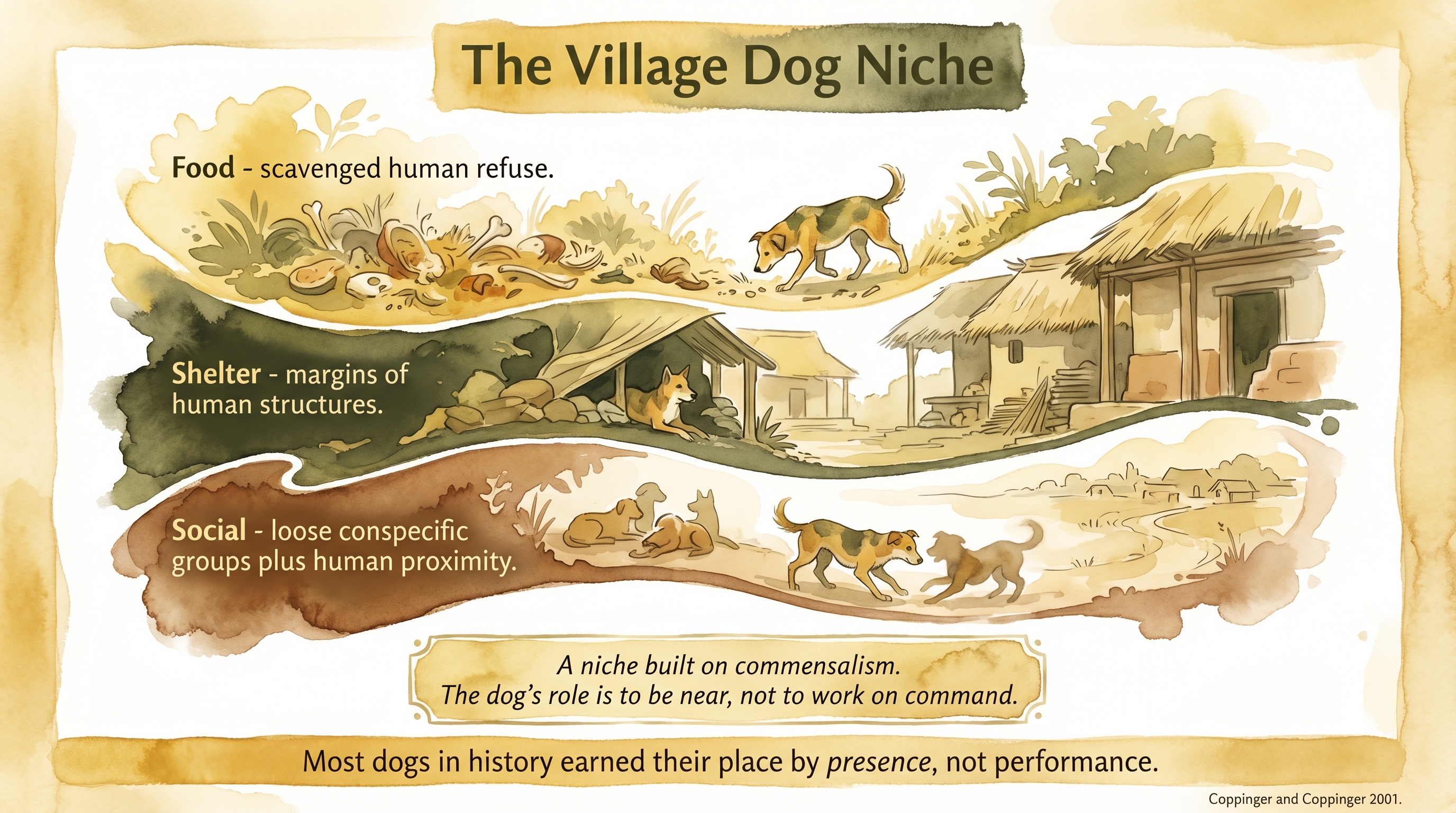
Most dogs in history earned their place by presence, not performance.
Key Takeaways
- Village dogs are defined by a commensal relationship with human settlements, not by total separation from people.
- Their time budgets are typically quiet and economical, with heavy emphasis on rest and opportunistic movement.
- Diet and reproduction follow settlement logic rather than wolf-pack hunting logic.
- For JB, village-dog ecology is useful because it shows how much adult competence can emerge from ambient life conditions.
The Evidence
This entry uses observed claim-level tags beyond the dedicated EvidenceBlocks below. These tags mark JB program observation or practice-derived claims that need dedicated EvidenceBlock coverage in a later content pass.
- Coppinger and Coppinger (2001, 2016)global village dogs
Described the dog as a commensal scavenger whose ancestral and current niche is tied to human settlements and food waste. - Boitani and Ciucci (1995)feral dogs and wolves
Contrasted dog scavenger ecology with wolf hunting ecology and highlighted key differences in reproduction and grouping. - Pal (1998, 2005) and Paul and Bhadra (2017)free-ranging dogs in India
Documented parental care, weaning dynamics, and ordinary daily life in unmanaged dog populations. - Sen Majumder et al. (2016) and Bhattacharjee et al. (2017, 2018)free-ranging dogs in India
Showed denning near humans and flexible use of human cues in dogs living without formal training.
No published study directly tests the practical implications of village dog ecology and behavior for domestic dog raising programs. The application to household dog raising remains an interpretive synthesis rather than a directly tested intervention finding.
SCR References
Sources
- Coppinger, R., and Coppinger, L. (2001). Dogs: A New Understanding of Canine Origin, Behavior, and Evolution.
- Coppinger, R., and Coppinger, L. (2016). What Is a Dog?
- Boitani, L., and Ciucci, P. (1995). Comparative social ecology of feral dogs and wolves. Ethology Ecology and Evolution.
- Pal, S. K. (2005). Parental care in free-ranging dogs, Canis familiaris. Applied Animal Behaviour Science.
- Paul, M., and Bhadra, A. (2017). Clever mothers balance time and effort in parental care: A study on free-ranging dogs. Royal Society Open Science.
- Sen Majumder, S., et al. (2016). To be or not to be social: Foraging associations of free-ranging dogs in an urban ecosystem. Acta Ethologica.
- Bhattacharjee, D., et al. (2017). Free-ranging dogs show age related plasticity in their ability to follow human pointing. PLOS ONE.