Street Dog Social Structure
Street dogs are often described as packs, but the literature supports a much looser picture than that word suggests. Boitani and Ciucci 1995 contrasted feral dog social ecology with wolf family structure and argued that dogs typically do not form the same permanent, generationally layered hunting units that wolves do. Cafazzo et al. 2010 studied a free-ranging group near Rome and found dominance relations that tracked age, sex, and competitive context, with submissive behavior serving as the clearest signal of status. Bonanni et al. 2017 later described age-graded hierarchies and substantial social tolerance in packs of free-ranging dogs, again emphasizing regulation through ritual rather than through constant fighting. Pal's Indian field observations added another angle: free-ranging dogs often live in overlapping home ranges and fluid associations rather than in rigidly closed units. Bradshaw, Blackwell, and Casey 2009 then used this wider ethological literature to argue that dominance is a real but narrow descriptor in dog-dog interactions, not a universal theory of dog-human relationships. Observed-JB
Taken together, these findings do not say street dogs are egalitarian or structureless. They say dog social organization is flexible, context-bound, and ecologically shaped. Dogs can have priority relations, but those relations do not automatically amount to the cinematic alpha model that twentieth century training culture popularized.
That distinction matters because many popular dog theories imported both the wrong wolf model and the wrong dog model at the same time.
Street-dog social structure is therefore valuable for two reasons. It helps describe what dogs actually do with each other under free-ranging conditions, and it strips some of the false drama out of the dominance stories people tell about companion dogs.
What It Means
Loose Groups Are Not Wolf Family Packs
The first correction is structural. Wolves usually depend on family-based cooperative hunting, coordinated territorial defense, and breeding patterns organized around one reproductive pair. Street dogs usually do not. Food sources are patchy, human-derived, and individually accessible more often than large prey is. That ecological shift changes the value of tight cohesion. Boitani and Ciucci 1995 emphasized this directly: dog groups are more fluid, less cooperative in prey capture, and less dependent on exclusive breeding structure.
Bonanni's work in Rome showed group life, but not in the old romantic wolf sense. Dogs associated with each other, tolerated each other, and showed predictable relationship patterns, yet the system was looser and more opportunistic than the public imagination suggests. Street dogs often have partial group stability without functioning as coordinated military units.
Dominance Exists, but It Is Narrower Than Pop Ideology Made It
Cafazzo et al. 2010 is important precisely because it does not say dominance is imaginary. It reports that some dominance relationships can be measured in free-ranging dogs and that submissive behavior is a useful indicator of those relations. Observed-JB Bonanni et al. 2017 also found age-linked rank patterns. The key is what these findings do not justify. They do not justify treating dominance as the master explanation for every dog behavior. They do not justify projecting linear rank contests into ordinary dog-human life. They do not justify the alpha-performance rituals that flooded pet culture for decades.
Ethology is often more modest than ideology. A context-specific social descriptor became a universal lifestyle myth when it moved into popular training culture. The street-dog literature helps put it back in scale.
Conflict Is Often Managed Through Distance and Ritual
One striking feature of these studies is how much social order is maintained without continuous violence. Documented Bonanni described social tolerance and ritualized submission reducing escalation. Cafazzo found that dominance signals were associated with specific competitive contexts, especially around resources, not with endless ambient terror. Pal's free-ranging dogs likewise reveal a world in which space, withdrawal, waiting, and ordinary deference often do more work than outright battle.
This matters because it changes the imagined model of canine competence. Dogs do not need to be in constant open conflict to have structure. Much of their social organization depends on spacing, timing, and signal economy.
Street-dog research does not document a pet-dog need for human alpha theater. If anything, it suggests that real canine structure often works through stable expectation, conflict reduction, and economically used signals rather than through constant rank performance.
The Dog Training Industry Borrowed the Wrong Lesson
The old dominance frame in pet training combined Schenkel-era captive wolf misreadings with a flattened view of dog social life. Modern wolf biology corrected one side of that error. Free-ranging dog studies corrected the other. Documented Bradshaw 2009, Cafazzo 2010, Bonanni 2017, and later review work make a careful point: dogs can show rank-related behavior, but the sweeping trainer claim that the household must be run as a rank battlefield is not supported.
That is why the street-dog literature belongs in the same conversation as the dominance-history files in Category 6. The issue is not whether hierarchy-related behavior exists anywhere. The issue is whether the ideology built on top of that word fits actual dogs. It does not.
Another important implication follows from that mismatch. When people borrow rank language from field biology and then apply it indiscriminately to couches, food bowls, or eye contact with humans, they are usually flattening away the specific ecological context that gave the original observations meaning. Street-dog structure is real, but it is not a permission slip for social fantasy.
Why It Matters for Your Dog
For households, the most immediate benefit of this literature is diagnostic sanity. Families are constantly told to interpret behavior through status struggle. The dog goes through a doorway quickly, guards a toy, resists handling, jumps on the couch, or stares during conflict, and someone says the dog is trying to dominate the family. Street-dog social ecology gives families good reason to slow down. Many of those behaviors have more specific causes: resource defense, arousal, fear, habit, excitement, frustration, conflict over space, or weak environmental structure.
That change in frame matters because the wrong story creates the wrong response. A family who thinks the dog is mounting a rank challenge often escalates theatrically. They loom, pin, grab, stare, or engage in ritual contests over status. Street-dog research suggests dogs are more likely to need clear boundaries, calm control of resources, and conflict-minimizing adult behavior than a human reenactment of fake pack leadership.
Goldens are especially vulnerable to bad dominance stories because their friendliness can coexist with moments of overconfidence, mouthiness, adolescent pushiness, or resource tension. A family may overread those moments as proof that the dog thinks it runs the household. The field evidence points toward a much less melodramatic interpretation. Dogs have preferences, strategies, anxieties, and learned patterns. Those are not the same thing as a political coup.
Another practical lesson concerns multi-dog homes. Street-dog literature shows that dogs can maintain social order without perfect equality. Some animals get priority around food or resting spaces. Some younger dogs defer to older ones. Some relationships are simply more compatible than others. Families often panic when they see asymmetry and assume it proves abuse or impending disaster. The more careful reading is that asymmetry can be normal if it remains low-drama and predictable.
That does not mean adults should let dogs settle everything themselves. A human household is not a self-managing dog colony. The point is that social stability often depends more on rhythm, spacing, and conflict prevention than on enforcing absolute sameness. Families can help by managing food, rest, movement, and access so the dogs do not have to negotiate everything under pressure.
The street-dog record also speaks to how correction should be understood. Much canine social order is maintained through brief displacement, subtle claiming of space, ritualized submission, and non-injurious communication. That looks very different from the punishment-heavy interpretations many owners inherit. It suggests that quieter, earlier, and more spatial interventions may fit dog social processing better than repeated emotional confrontations do.
A related gain is humility about dog parks and forced sociality. Street dogs do not behave as if every dog must be everyone's friend. Associations are selective, often based on repeated coexistence in the same area. Companion dogs are often thrown into dense contact with strangers and then judged morally if they do not adore it. Free-ranging social structure suggests that stable low-conflict coexistence may be a more natural target than indiscriminate sociability.
This ecology also helps families understand why overmanagement can backfire. If dogs are adapted to manage much of their social world through early signals, spacing, and routine, then households that constantly interrupt every microinteraction can create more noise than order. Human involvement is important. Hyperinvolvement is not always the same thing as guidance.
The same literature helps adults think better about leadership. In a sane home, human leadership should make dog-dog life less politically expensive. The adult controls bottlenecks, feeding order, greeting intensity, resting access, and proximity pressure before tension becomes dramatic. That is far more effective than waiting for a full conflict and then framing the aftermath as a dominance test.
One more practical correction deserves mention. The existence of rank relations among free-ranging dogs does not rescue dominance training. In fact, it often undermines it. The studies show that real canine order is subtle, relational, and context-specific. Documented The training-market version is crude, global, and human-centered. Those are not interchangeable.
Families usually relax once they see this clearly. The dog does not need an alpha. The dog needs a household where resources, movement, and expectations are organized well enough that status drama never has to become the operating principle.
This perspective also improves how families read ordinary dog-dog asymmetry. One dog may choose a doorway first, hold a favored resting place, or carry more social confidence without the home needing to convert that reality into a moral emergency. The adult's job is not to erase every difference. It is to prevent those differences from hardening into chronic stress, rehearsal of guarding, or repeated forced confrontations.
What This Means for a Just Behaving Family
JB families should treat street-dog social structure as a warning against false analogies. Dogs do have social asymmetries and context-bound priority relations. That is not the same thing as a household rank war.
Structured Leadership is the right bridge here. The adult's job is to create a low-conflict human family structure that the dog can live inside, not to imitate an exaggerated alpha role. Calmness matters too, because conflict reduction is one of the real outputs of stable organization.
This literature also supports Indirect Correction more naturally than punishment-heavy methods. Street-dog order often depends on brief, specific, socially legible interventions rather than on sustained coercion. That is an observed pattern, even if JB's full philosophical distinction between correction and punishment remains a broader synthesis.
For families, the usable lesson is practical. Manage resources early. Respect asymmetry without dramatizing it. Interrupt tension before it becomes a fight. Stop reading ordinary canine friction as a referendum on who rules the house.
JB should keep its evidence language disciplined. The field documents loose groups, context-linked dominance, ritualized submission, and conflict reduction. JB's further claim that calm parental human leadership maps best onto the dog's needs is a heuristic reading built on those observations.
That is still a strong and useful conclusion. It replaces a lot of folklore with a calmer picture of what dogs actually seem to require.
It also gives families a better way to judge intervention. If the home is reducing social friction, lowering the cost of sharing space, and preventing repetitive conflict around food, greetings, or rest, then leadership is probably being exercised well. Street-dog research implies that stability is not measured by how often adults win confrontations. Observed-JB It is measured by how little open confrontation is needed.
A JB household can therefore be both structured and untheatrical. That combination is not a compromise. It is closer to the kind of order the field studies actually describe.
That is a useful north star for multi-dog homes in particular. If the dogs can rest, pass one another, share adult attention without chronic pressure, and recover quickly from minor disputes, the household is likely closer to canine social sanity than a home where adults are constantly staging control exercises. Street-dog ecology keeps the goal simple: lower the social cost of living together.
This also gives the family a more peaceful definition of success. The adult has done well when tension is easier to interrupt, asymmetry is less politically expensive, and everyone can occupy the home without constant negotiation. Street-dog structure keeps pointing toward that kind of low-drama order, which is one reason the file matters so much for companion dogs.
That is a calmer and more rigorous target for any family trying to build order without mythology.
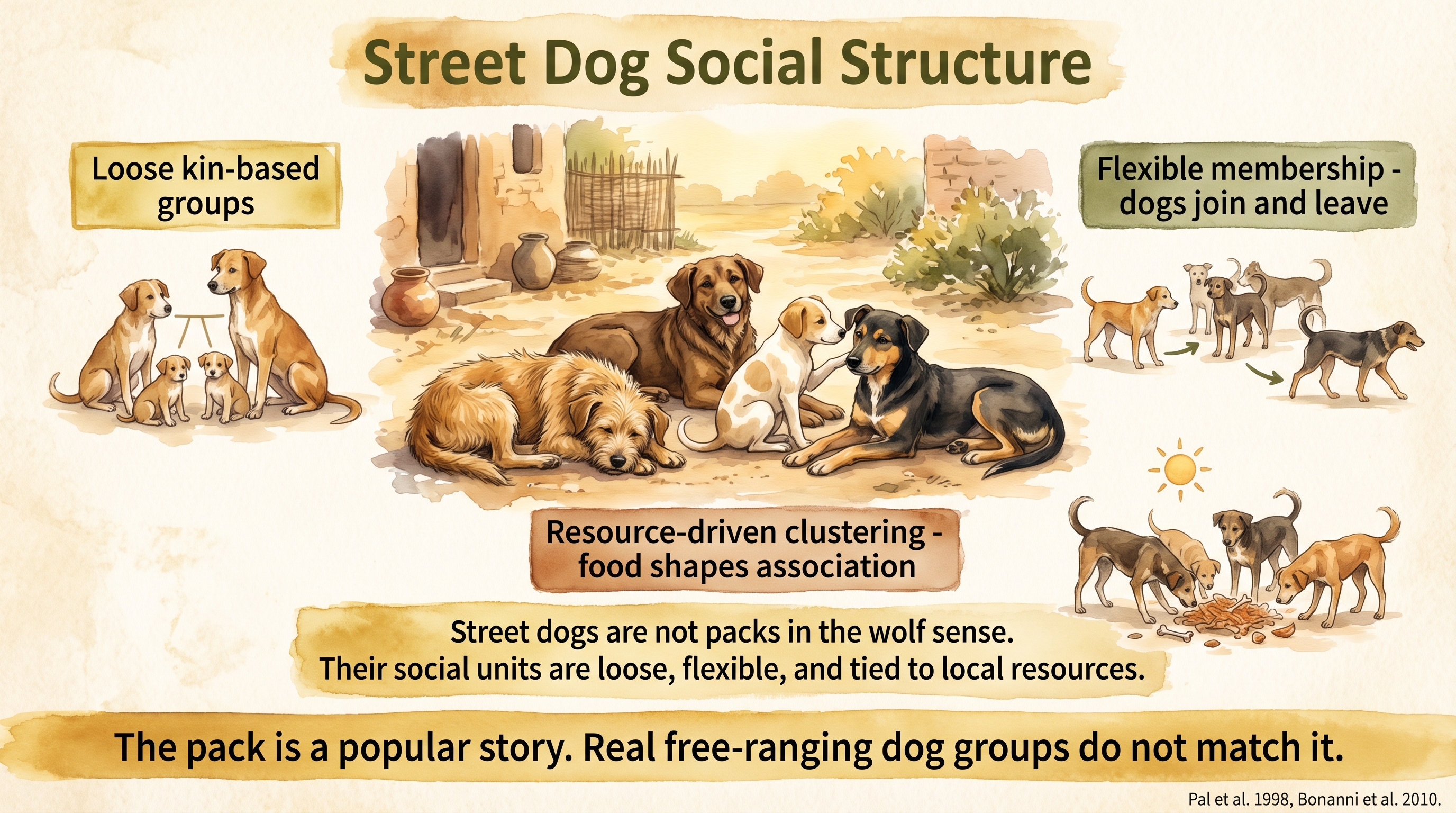
The pack is a popular story. Real free-ranging dog groups do not match it.
Key Takeaways
- Street dogs often live in loose, flexible groups rather than in wolf-style permanent hunting packs.
- Dominance relations can exist among dogs, but they are narrower and more context-specific than popular training culture suggested.
- Conflict is often managed through space, timing, and ritualized submission rather than through constant open aggression.
- For JB, the practical lesson is to organize the household to reduce conflict rather than to stage alpha contests.
The Evidence
This entry uses documented claim-level tags beyond the dedicated EvidenceBlocks below. These claims should remain tied to the entry Sources and SCR references during the next evidence-chain authoring pass.
- Boitani and Ciucci (1995)feral dogs and wolves
Showed that dog groups differ from wolf family packs in cohesion, breeding structure, and hunting ecology. - Cafazzo et al. (2010)free-ranging dogs near Rome
Found measurable dominance relations linked to age, sex, and competition, with submission as the most reliable indicator. - Bonanni et al. (2017)packs of free-ranging dogs
Described age-graded dominance hierarchies and social tolerance that reduced overt conflict. - Bradshaw, Blackwell, and Casey (2009)domestic dog ethology
Argued that dominance can be a narrow ethological construct but becomes misleading when inflated into a dog-human training ideology.
No published study directly tests the practical implications of street dog social structure for domestic dog raising programs. The application to household dog raising remains an interpretive synthesis rather than a directly tested intervention finding.
SCR References
Sources
- Boitani, L., and Ciucci, P. (1995). Comparative social ecology of feral dogs and wolves. Ethology Ecology and Evolution.
- Cafazzo, S., et al. (2010). Dominance in relation to age, sex, and competitive contexts in a group of free-ranging domestic dogs. Behavioral Ecology.
- Bonanni, R., et al. (2017). Age-graded dominance hierarchies and social tolerance in packs of free-ranging dogs. Behavioral Ecology.
- Bradshaw, J. W. S., Blackwell, E. J., and Casey, R. A. (2009). Dominance in domestic dogs: useful construct or bad habit? Journal of Veterinary Behavior.
- Pal, S. K., Ghosh, B., and Roy, S. (1998). Agonistic behaviour of free-ranging dogs. Applied Animal Behaviour Science.