The Coppinger Model of the Dog
Raymond and Lorna Coppinger changed dog thinking by insisting that the dog should be understood ecologically before it is understood sentimentally or methodologically. In Dogs: A New Understanding of Canine Origin, Behavior, and Evolution in 2001, and later in What Is a Dog? in 2016, they argued that the domestic dog is best read as a commensal scavenger living at the edge of human settlement, not as a miniature wolf and not as a species whose essence is revealed through modern training culture. Their model linked several claims together: dogs self-selected into the human niche through reduced fear and settlement-edge scavenging, most dogs in the world still live as village or street dogs, much of behavior emerges developmentally rather than being installed by training, and functional working dogs are often produced by the right rearing environment more than by elaborate formal technique. Lord, Larson, Coppinger, and Karlsson 2020 later complicated the older domestication-syndrome literature, while Bergstrom et al. 2022 and other ancient-DNA papers challenged simple versions of the original domestication pathway. Yet the Coppinger correction about what kind of animal a dog is remains one of the most important in the field. Documented
The model mattered because it changed the starting question. Instead of asking "How do humans train dogs?" the Coppingers kept asking "What animal has dog evolution actually produced?"
That shift has consequences for everything downstream, including welfare, training, development, and the meaning of companion life.
For JB, the attraction is obvious. The Coppingers did not formulate the Five Pillars, but they offered one of the clearest scientific frameworks for why a development-first and ecology-first reading of the dog might be closer to reality than a method-first reading.
What It Means
The Dog Is a Commensal Scavenger, Not a Pet-Wolf Hybrid
At the center of the Coppinger model is a plain ecological claim. Dogs evolved by adapting to life around human settlement. The niche rewarded reduced flight distance, tolerance of human proximity, success at scavenging, and flexible social behavior in anthropogenic environments. Documented That is why the Coppingers kept returning to village dogs. They saw the global dog not as the exception to pet culture, but as the key to the species.
This was a major correction to popular dog rhetoric. If the dog is fundamentally a commensal scavenger, then many stories built on the wolf-pack analogy are already starting from the wrong animal.
Development Does More Work Than Training Culture Admits
The Coppingers were also influential because they emphasized developmental timing and environmentally released behavior. In the working-dog and motor-pattern parts of their framework, they argued that much of what dogs do appears because particular systems mature and meet the right environment. Herding, guarding, chasing, or settlement-edge scavenging are not created from nothing by clever handlers. Training can shape expression, but it is not the origin of the whole repertoire.
That is one reason their work resonated so strongly with later JB concerns. If behavior emerges from ecology plus development, then the surrounding world does much more causal work than many training narratives allow. Documented
Livestock Guardian Dogs Strengthened the Model
The Coppingers' work with livestock guardian dogs gave the model practical credibility. Traditional LGD programs do not usually manufacture guarding through obedience-school technique. Puppies are placed with stock early, raised inside the flock environment, and allowed to mature into the role with adult dogs and livestock as the main social field. The Coppingers repeatedly described this as developmental placement rather than technical invention. The environment is not incidental. The environment is the method.
That observation became one of the cleanest bridges between free-ranging ecology and working-dog function. It suggested that some of the most reliable dogs on Earth are built through early niche alignment, not through abstract behavior programming. Documented
The Coppinger model does not prove the Five Pillars directly. It does provide one of the strongest scientific reasons to treat the dog as a species whose functional behavior is best understood through niche, development, and long coexistence with humans.
The Model Has Limits, but the Core Correction Still Holds
Not every part of the Coppinger framework survived untouched. Ancient-DNA work complicated simple origin stories. Some researchers argue early hunter-gatherer partnership and pup adoption played more of a role than a pure dump-heap scenario suggests. Lord et al. 2020 also challenged some classical domestication-syndrome assumptions. Documented Even sympathetic readers now treat the exact initiating pathway as unresolved rather than closed.
Still, the deepest Coppinger correction remains intact. Dogs are not best understood as failed wolves or as blank pets waiting for human software. They are a domesticated, human-adjacent scavenging species whose current global ecology still reflects that history. That core insight continues to organize good questions.
It also explains why the Coppingers remain influential even where particular claims are debated. A framework can lose explanatory certainty around one pathway and still preserve the most valuable reorientation it offered. In this case, the reorientation was from mythology about control toward ecology, development, and niche.
A final implication from Section B is methodological humility. The more accurately the dog is described as a commensal, developmentally shaped species, the less plausible it becomes that any one technique family can explain canine functionality by itself. The organism is larger than the method.
The upshot is that species literacy changes expectations before it changes techniques. Families begin looking for environmental leverage, developmental fit, and household readability instead of expecting every solution to arrive as a method tweak.
Why It Matters for Your Dog
For families, the Coppinger model matters because it changes what kind of dog they think they are living with. Many families alternate between two myths. One myth imagines the dog as a wolf at heart and therefore assumes that status struggles and domination metaphors are central. The other imagines the dog as a blank companion animal whose behavior is largely the product of training technology. The Coppinger view rejects both. Your dog is a domesticated animal shaped by a long settlement-edge history around people.
That becomes practical very quickly. A species shaped by scavenging, waiting, human relevance, flexible sociality, and environmental learning may not need to be micromanaged into functionality as often as families are told. It may need a sane niche, a stable rhythm, and competent adults more than it needs endless behavioral engineering.
Goldens fit this especially well because they often look like the perfect product of modern training mythology while actually benefiting deeply from the older ecology. They do not merely need things to do. They need a world they can read, predictable human behavior, enough rest, enough ordinary participation, and an adult social field that does not constantly destabilize them.
The Coppinger model also helps families judge what training can and cannot do. Training is not useless. Civic skills, household safety, and specific tasks matter. What the model challenges is training inflation. If the environment and developmental history are doing most of the real work, then technique becomes a supplement to the world rather than the substitute for it.
Another practical lesson is that behavior problems may be more environmental than families think. The Coppingers repeatedly argued that many pet-dog pathologies are artifacts of the keeping system: confinement, deprivation, chronic under-social exposure, and lifestyles far removed from the ordinary dog niche. That does not explain every problem, but it broadens the family's causal imagination. Sometimes the question is not "How do I train this out?" but "What conditions are producing it?"
The livestock-guardian example is useful here too. Many families intuitively understand that a guardian dog becomes a guardian by growing up in the right place around the right social partners. The Coppinger model asks why that same developmental common sense disappears when people talk about family dogs. If environment can be the method for LGDs, perhaps it matters more widely than the market admits.
This also changes how families should think about maturity. A dog who is constantly managed, constantly cued, and constantly stimulated may look skilled while remaining ecologically unstable. A dog who can settle, watch, wait, and function in the ordinary flow of household life may be showing a deeper kind of success. The Coppinger model helps families give that quiet maturity the weight it deserves.
There is also relief in this picture. Owners do not have to become miniature behavior engineers to raise a good dog. They do need to take the dog's species seriously. That is a demanding standard, but it is a saner one.
The model further helps adults understand why some problems stay stubborn when treated only as training deficits. If the underlying mismatch is ecological, then more cues may create more surface control without touching the generating cause. A species reading changes the order of operations. First ask what world the dog is trying to inhabit. Then decide what teaching is still needed.
That is a hard lesson for modern consumers because method culture is easier to buy than species literacy is. Yet the Coppinger framework keeps pushing in the same direction: the dog will often make more sense once the household stops treating behavior as detachable from niche. Observed-JB
The same species picture also changes what families should celebrate. Quiet fit with household life, patient waiting, low-friction coexistence, and social readability may be closer to ecological success than a long list of impressive but context-thin performances. The Coppinger model makes that easier to trust.
That also gives families permission to value quiet domestic maturity more than technical impressiveness. A dog who fits life well may be showing the ecology-first success the framework would predict.
A family that grasps this point will usually start asking better questions. Instead of asking only how to make the dog comply faster, it asks how to make the home more species-sensible, how to reduce ecological mismatch, and how to support the sort of quiet domestic functionality the framework predicts should matter. That shift in questioning is one of the most practical gifts the Coppinger model offers.
What This Means for a Just Behaving Family
JB families should treat the Coppinger model as a major piece of scientific grounding for the project's Evolutionary Foundation. The dog is a human-adjacent scavenging social species whose behavior is deeply shaped by ecology and development. That much can be stated strongly.
The next step must stay disciplined. JB's claim that the Five Pillars name the functional conditions of that ecology is an interpretive extension, not a sentence lifted directly out of Coppinger. Heuristic That distinction keeps the philosophy honest.
Practically, the model supports a home that does more developmental work ambiently. Build a sane daily rhythm. Let the puppy live inside readable adult conduct. Use training for true skill gaps, but do not confuse it with the primary engine of dog formation.
Mentorship, Calmness, and Structured Leadership all look more plausible against this background. They fit a species that matured alongside humans in a stable niche rather than a species that only becomes manageable after intense method application.
The biggest warning the Coppingers offer is against category error. If people misunderstand what a dog is, they will misunderstand what a dog needs. JB's whole value depends on not making that mistake.
That is why this file matters so much. It is not only about two influential authors. It is about the species picture that sits underneath everything else.
For a JB family, that means philosophy should remain answerable to organism. The project only stays sane if it keeps asking what kind of animal the dog appears to be and what sort of life that animal seems built to live beside humans.
Keeping that question active is one of the best protections against method inflation. It returns the household from technique back to species, which is exactly where good raising has to begin.
That is also why the Coppinger model remains so useful for JB even where it is not final. It functions as a brake on overcomplication. Before adding another explanatory layer, it asks whether the simpler ecological account has been taken seriously enough.
In that sense, the model is not only a theory about origins. It is a continuing reminder that before families ask what trick or protocol comes next, they should ask what kind of animal the dog is and what kind of world that animal is trying to use. That question keeps later choices cleaner.
That is one reason the model remains so durable. It keeps pulling attention back toward the animal and away from the market wrapped around the animal.
One more reason the framework remains useful is that it helps adults resist overcomplication. When the dog starts making less sense, the first repair is often not a more elaborate method. It is a clearer return to species, niche, and development.
Species realism is a sturdier starting point for families.
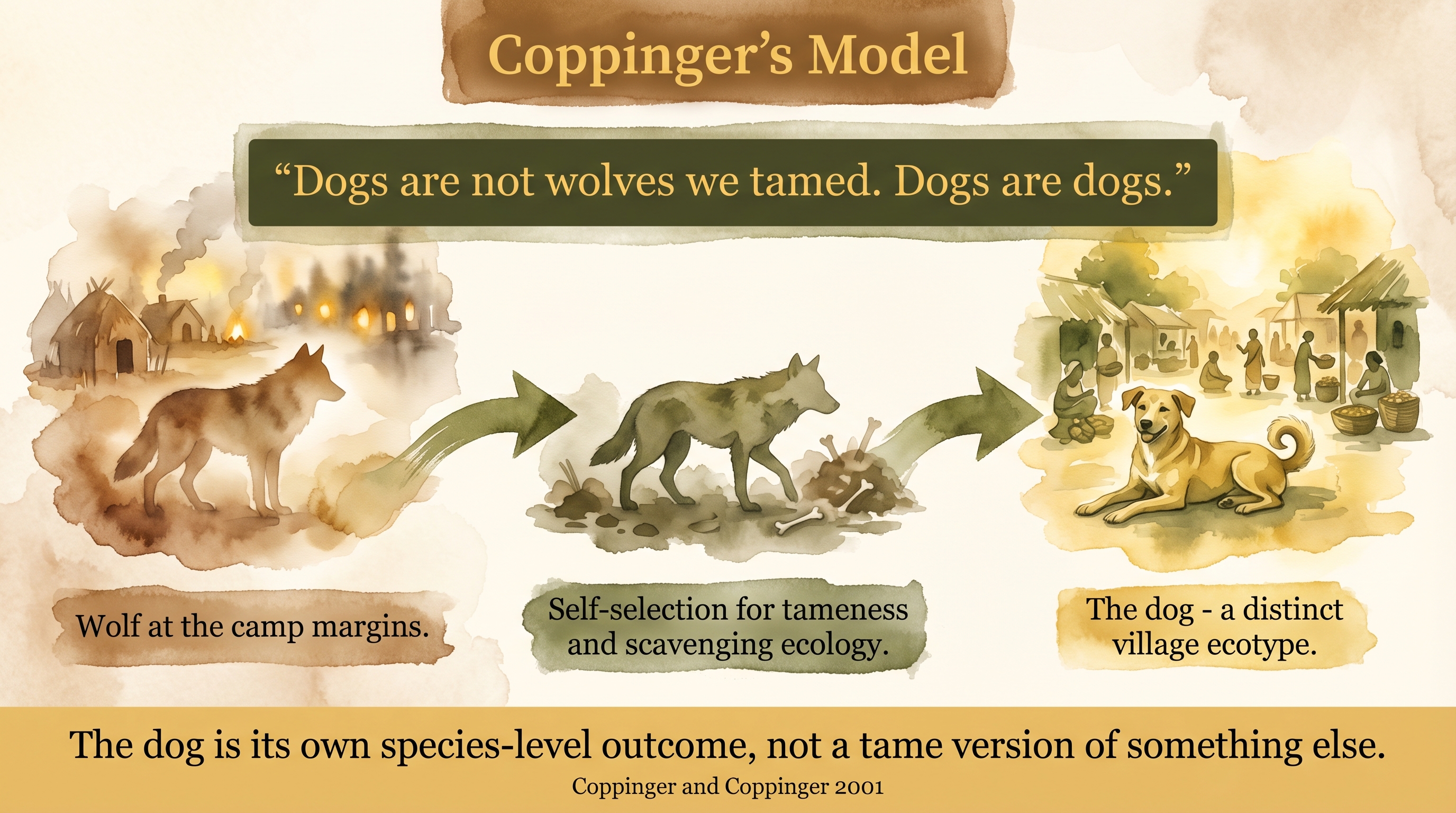
The dog is its own outcome, not a tame wolf.
Key Takeaways
- The Coppingers shifted the field toward an ecology-first understanding of dogs.
- Their strongest lasting correction is that dogs are not best understood as household wolves.
- The model places far more causal weight on development and niche than modern training culture usually does.
- For JB, the Coppinger framework is a major influence, but JB's full pillar-level synthesis remains its own interpretation.
The Evidence
This entry uses observed claim-level tags beyond the dedicated EvidenceBlocks below. These tags mark JB program observation or practice-derived claims that need dedicated EvidenceBlock coverage in a later content pass.
This entry uses heuristic claim-level tags beyond the dedicated EvidenceBlocks below. These tags mark JB interpretive application rather than direct study findings.
- Coppinger and Coppinger (2001)domestic dogs
Argued that dogs are best understood through evolution, niche, and developmental timing rather than through wolf analogy or training myths. - Coppinger and Coppinger (2016)global dog populations
Re-emphasized village dogs, commensal ecology, and developmental explanation as core to dog science. - Lord et al. (2020)fox domestication and domestication theory
Complicated older domestication-syndrome narratives while leaving broader ecology-first questions intact. - Bergstrom et al. (2022) and related ancient-DNA workancient wolves and dogs
Challenged overly simple origin stories but did not overturn the importance of long human-associated dog evolution.
No published study directly tests the practical implications of the coppinger model of the dog for domestic dog raising programs. The application to household dog raising remains an interpretive synthesis rather than a directly tested intervention finding.
SCR References
Sources
- Coppinger, R., and Coppinger, L. (2001). Dogs: A New Understanding of Canine Origin, Behavior, and Evolution.
- Coppinger, R., and Coppinger, L. (2016). What Is a Dog?
- Lord, K. A., Larson, G., Coppinger, R. P., and Karlsson, E. K. (2020). The history of farm foxes undermines the animal domestication syndrome. Trends in Ecology and Evolution.
- Bergstrom, A., et al. (2022). Grey wolf genomic history reveals a dual ancestry of dogs. Nature.
- Coppinger, R., and Coppinger, L. (1995). Interactions between livestock guarding dogs and wolves. In Ecology and Conservation of Wolves in a Changing World.