Free-Ranging Dogs and Human Interaction
Free-ranging dogs live in an unusually demanding social environment because humans are both their main ecological opportunity and one of their main sources of danger. That pressure makes dog-human interaction on the street especially informative. Bhattacharjee et al. 2017 showed age-related plasticity in free-ranging dogs' ability to follow human pointing. Bhattacharjee, Sau, and Bhadra 2018 found that these dogs adjusted their behavior according to whether a human's approach looked friendly, neutral, or threatening. Bhattacharjee et al. 2020 then showed that free-ranging dogs could use complex pointing cues, not only simple proximal gestures. Banerjee and Bhadra's later work on time-activity budgets and resting sites showed that dogs also reorganize their movement and rest around human activity. Sen Majumder et al. 2016 documented denning and social positioning near human settlements, reinforcing the ecological point that people are built into the dog's landscape. Marshall-Pescini, Cafazzo, Viranyi, and Range 2017 helped place this in a bigger framework by arguing that dog behavior toward humans reflects both domestication and lifetime experience. Observed-JB
The practical significance of this literature is large. These are not pet dogs rehearsed into human attentiveness in kitchens or classrooms. They are free-ranging animals navigating a mixed world of feeding, threat, ambiguity, tolerance, and punishment. When those dogs still show fine-grained sensitivity to human gesture, intention, and reliability, it tells us something important about the species.
It tells us that human relevance is not an artificial layer pasted onto the dog from the outside. It is part of what the dog has become.
For JB, that does not prove every relational claim. It does strongly support the view that dogs are built to read humans socially, and that this reading happens outside formal training systems.
What It Means
Free-Ranging Dogs Use Human Signals Opportunistically
Bhattacharjee et al. 2017 found that free-ranging dogs could use dynamic proximal pointing and that adult performance changed across trials depending on whether following the cue had paid off. That is a sophisticated result because it shows neither blind obedience nor total indifference. The dogs were not merely domestic robots. They were evaluating a human cue in light of outcome and experience.
Bhattacharjee et al. 2020 extended the story by showing that free-ranging dogs could use more complex human pointing cues as well. This matters because it narrows the gap between pet-dog cognition studies and free-ranging cognition studies. Ambiguous The ability is not confined to dogs living in intimate one-to-one home relationships.
Human Intention Matters, Not Just Food Presence
The 2018 intention paper is especially useful because it tested more than food attraction. Free-ranging dogs responded differently to friendly, neutral, and threatening human approaches, which shows they are reading something about the person rather than only the bait. Documented A dog living on the street cannot afford to treat every outstretched human hand as identical. Some people feed. Some chase. Some strike. The species' success in this niche depends on subtle discrimination.
That is one reason the free-ranging record is so important for broader dog-human theory. It shows social cognition in a real survival context, not only in controlled lab paradigms.
Experience Shapes Expression Without Creating the Capacity from Nothing
Marshall-Pescini and Range's review tradition is helpful here because it resists oversimplification. Dogs appear biologically prepared for human-oriented social behavior, but the exact way that preparedness gets expressed depends on ecological and developmental experience. Free-ranging dogs are a strong example of that interaction. They live among humans constantly, yet the quality of those interactions is highly variable. Their responses therefore become finely tuned to local human reality.
This is one reason free-ranging dogs are a better model than either household pets alone or wolves alone. They reveal what dog-human cognition looks like when survival is tied to reading people well but not cushioned by private ownership.
The free-ranging literature strongly suggests that dogs benefit from precise, interpretable human signals because they are constantly evaluating what a human means in contexts where the stakes are real. That supports JB's emphasis on readable adults, even though the full philosophical extension remains interpretive.
The Relationship Is Ecological Before It Is Sentimental
A modern Western reader may want to translate all of this into affection language, but the better first frame is ecological. Free-ranging dogs attend to humans because humans are relevant. Relevance includes food, risk, shelter, routine, and social information. Banerjee and Bhadra's work on daily patterns and resting places shows that dogs reorganize behavior around human flow. Documented Sen Majumder's denning results show that the dog's settlement-edge life is physically oriented toward people. The cognition studies show that this orientation extends into detailed signal use.
The picture that emerges is not "dogs love humans, therefore dogs read them." It is deeper than that. The species has become one that must read humans well to function in its ordinary niche.
That framing also protects the literature from sentimentality. A dog may be highly responsive to people without being uniformly trusting or uniformly affiliative. Free-ranging success depends on precise discrimination, which is exactly what these studies keep finding.
One more implication follows from all of this. The dog-human channel in free-ranging life is not built around endless redundancy. It is built around relevance. The animal watches because the human matters. That makes legibility and honesty much more central than raw frequency of signaling.
One more implication follows. The dog's human-reading system appears built around consequence in the broad ecological sense, not around decorative chatter. That makes the quality of human relevance more important than the quantity of human signaling.
Why It Matters for Your Dog
For families, this literature matters because it challenges the idea that meaningful human-dog communication only appears after careful formal training. Free-ranging dogs, who have never been through puppy class or marker-word drills, still read human gesture, interpret human intention, and modify their behavior according to experience with specific humans. That should lower the temptation to imagine communication as a manufactured product. The channel is already there.
That does not mean all humans communicate well. In fact, the literature implies the opposite. Because dogs are so attentive to human relevance, poor human signaling can do real damage. A confusing adult, an emotionally volatile adult, or an inconsistent adult is not speaking into a void. The dog is reading constantly, which means noise is costly.
Goldens make this extremely visible. Many Golden families have the experience of being watched all the time. The dog tracks movement in the kitchen, notices when someone is leaving a room, reads tone during family disagreement, and changes behavior depending on how a person approaches. Caregivers sometimes treat that sensitivity as cute but secondary. The free-ranging literature suggests it is much closer to the center of dogness than people think.
Another practical lesson is that the dog's reading of people is conditional and adaptive, not blindly trusting. Free-ranging adults in Bhattacharjee's work were more likely to follow cues when previous trials had paid off. That is a useful family lesson. Trust grows through reliability. If adults repeatedly lure, fake, bluff, threaten, or contradict themselves, they should not be surprised when the dog becomes skeptical or conflicted.
This is also why relationship quality matters so much for correction and guidance. A dog who already reads human intention well will process even small changes in posture, voice, timing, and approach differently depending on context. That does not prove every JB claim about indirect correction, but it does make the general idea far more plausible than a blank-behavior model would.
The free-ranging findings also help families avoid a false contrast between cognition and ecology. Families often hear about gesture reading as if it were a cute laboratory superpower. On the street it is a survival skill. That should make adults take their own signal quality more seriously. A clear hand motion, consistent body line, quiet pause, or honest follow-through can matter far more than repeated chatter because the dog is built to use relevance, not verbal volume.
That point becomes even clearer when one remembers how costly errors can be for a free-ranging dog. Misreading the intentions of a stranger, overcommitting to the wrong approach, or missing a useful invitation can have direct consequences. The dog's human-reading system was not shaped for amusement. It was shaped for function.
A second gain is humility about the dog's memory of human types. Free-ranging dogs live in worlds where some neighborhoods feed, some threaten, and some fluctuate. Companion dogs do the same on a smaller scale. They learn which family member bluffs, which guest is intrusive, which walker is calm, and which child is noisy. When families act as though the dog should respond identically to everyone, they ignore how experience-dependent canine social life actually is.
Families can further use this literature to think about fear more constructively. A dog who hesitates around a stranger or watches a new person closely may not be refusing sociability. The dog may be doing precisely what an animal adapted to mixed human risk should do: assess first, commit later. Good raising helps that assessment remain calm and workable instead of spiraling into pathological fear.
The same body of research helps explain why adult state matters so much in routine life. Documented Because dogs do not just hear our words, they weigh our intention, movement, and predictability. A home with quieter, more readable adults is therefore not merely nicer. It is cognitively easier for the dog to live in.
That is why these street studies matter far beyond street dogs. They reveal a species-level pattern: dogs live by reading people, and they do so even without our official training cultures.
They also suggest that trust is cumulative. A dog who repeatedly experiences coherent human follow-through is likely to keep using the human channel confidently. A dog who repeatedly experiences bluffing, contradiction, roughness, or intrusive unpredictability may still watch people intensely, but what the dog learns from that watchfulness can be very different.
The practical consequence is that households should stop treating communication as a separate training event. The dog is already treating the adults as socially important. Better communication often begins when the family becomes steadier, quieter, and easier to predict in the ordinary flow of life.
It also means the family should treat miscommunication as developmentally expensive. A dog who repeatedly discovers that people bluff, contradict themselves, or flood the channel with meaningless repetition is learning something important about whether humans are worth following closely over time.
What This Means for a Just Behaving Family
JB families should treat the dog's attention to human intention as a biological asset that should be protected, not drowned in noise. The dog does not need humans to create social relevance from scratch. Humans need to become worthy of the relevance the dog already grants them.
Signal Precision is the most obvious philosophical bridge. If free-ranging dogs are constantly discriminating among human gestures, attitudes, and reliability, then sparse, honest, legible signaling in a home makes deep species sense.
Mentorship also gains support here. Dogs are not only moved by rewards and punishments. They are socially oriented to what humans mean and how humans behave. The field documents that clearly enough to matter.
For a JB family, the practical use is simple. Become easier to read. Let posture, pace, and follow-through line up. Avoid flooding the dog with words that do not carry reliable information. Stop assuming that louder means clearer.
JB should still keep the evidence ceiling explicit. The free-ranging literature documents human cue use, intention reading, and experience-sensitive adjustment. The larger claim that this fully validates JB's relationship-first philosophy remains an interpretive synthesis.
Even so, the documented layer is already strong enough to change daily life. A species that reads people this well deserves adults who take their own legibility seriously.
That puts real responsibility on the household. Adults are not merely cue dispensers standing outside the dog's world. They are moving features inside the world the dog is constantly interpreting. A JB family should therefore treat tone, pace, approach, and follow-through as part of the dog's daily education rather than as background noise.
This is one reason calmness matters so much. If the communication channel is already open, the smartest improvement may simply be to distort it less. Free-ranging dog research makes that recommendation look much more like species realism than sentimental preference. Documented
A JB family can therefore treat adult readability as an ethical obligation, not just as a training tip. The dog is already oriented toward human meaning. The household should honor that by making its behavior more coherent, not by burying the channel under emotional noise and endless redundant cues. Ethology makes that obligation concrete.
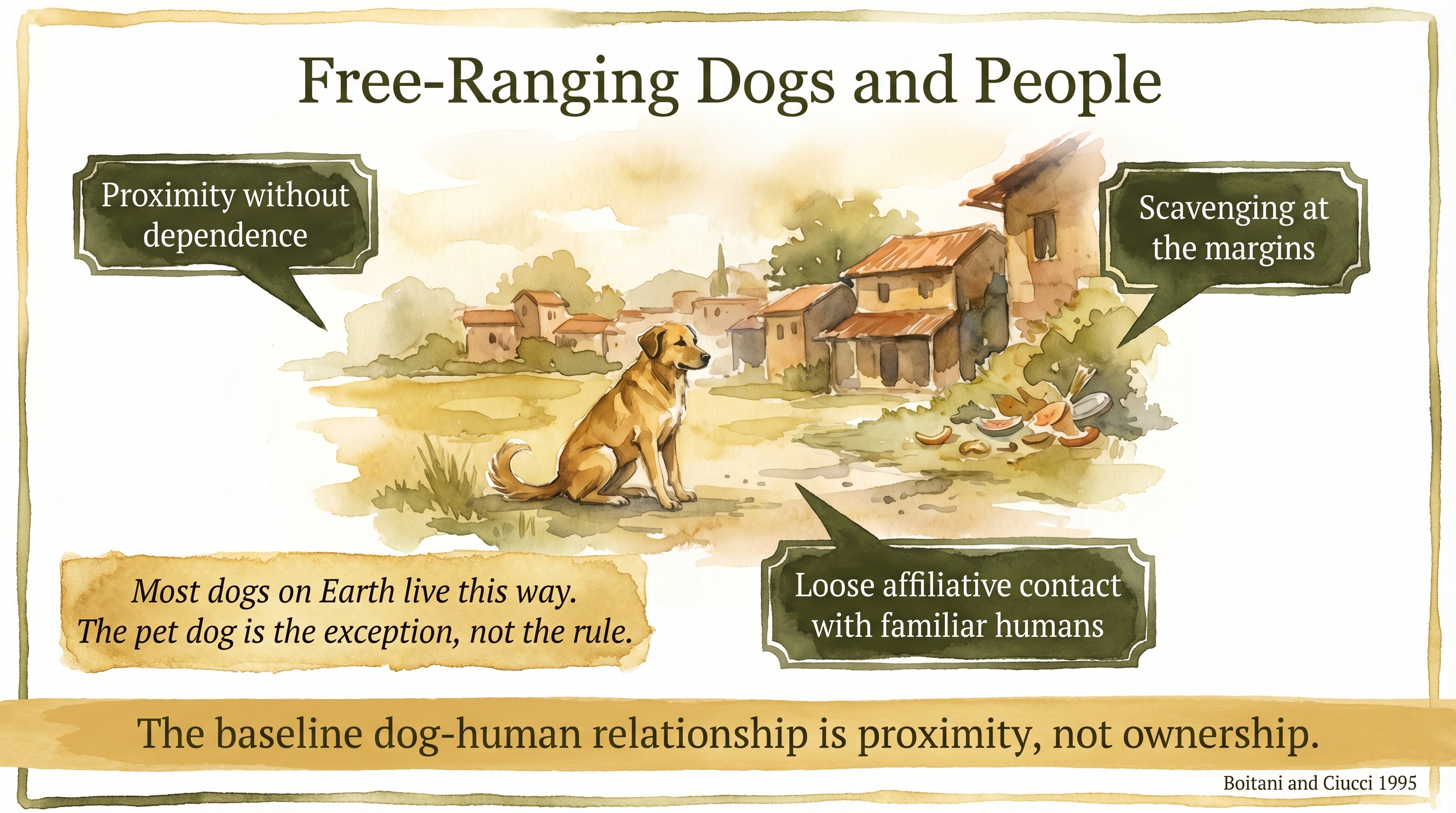
The baseline dog-human relationship is proximity, not ownership.
Key Takeaways
- Free-ranging dogs read people socially even without modern training culture.
- They respond to human intention, not only to visible food opportunities.
- Experience calibrates how dogs use human cues, but it does not appear to create the human-oriented channel from nothing.
- For JB, the practical lesson is that adult legibility and signal honesty matter enormously.
The Evidence
This entry uses documented claim-level tags beyond the dedicated EvidenceBlocks below. These claims should remain tied to the entry Sources and SCR references during the next evidence-chain authoring pass.
This entry uses ambiguous claim-level tags beyond the dedicated EvidenceBlocks below. These tags mark claims where the literature remains unsettled or multiple interpretations coexist.
- Bhattacharjee et al. (2017)free-ranging dogs in India
Found age-related plasticity in following human pointing and trial-to-trial adjustment based on outcome. - Bhattacharjee, Sau, and Bhadra (2018)free-ranging dogs in India
Showed dogs responded differently to friendly, neutral, and threatening human approaches. - Bhattacharjee et al. (2020)free-ranging dogs in India
Demonstrated use of complex human pointing cues by dogs living outside formal ownership. - Marshall-Pescini et al. (2017)dogs and wolves
Argued that domestication and lifetime experience together shape canine cooperation and social behavior with humans.
No published study directly tests the practical implications of free-ranging dogs and human interaction for domestic dog raising programs. The application to household dog raising remains an interpretive synthesis rather than a directly tested intervention finding.
SCR References
Sources
- Bhattacharjee, D., et al. (2017). Free-ranging dogs show age related plasticity in their ability to follow human pointing. PLOS ONE.
- Bhattacharjee, D., Sau, S., and Bhadra, A. (2018). Free-ranging dogs understand human intentions and adjust their behavioral responses accordingly. Frontiers in Ecology and Evolution.
- Bhattacharjee, D., et al. (2020). Free-ranging dogs are capable of utilizing complex human pointing cues. Frontiers in Psychology.
- Sen Majumder, S., et al. (2016). To be or not to be social: Foraging associations of free-ranging dogs in an urban ecosystem. Acta Ethologica.
- Marshall-Pescini, S., Cafazzo, S., Viranyi, Z., and Range, F. (2017). The role of domestication and experience in canine social behaviour and cooperation with humans. Current Opinion in Psychology.
- Banerjee, A., and Bhadra, A. Time-activity budget and resting-site studies in urban free-ranging dogs.