Topal and the Ainsworth Strange Situation in Dogs
Jozsef Topal and colleagues changed dog science in 1998 by adapting Mary Ainsworth's Strange Situation Procedure for dog-owner pairs. In the human developmental literature, the Strange Situation is one of the central tools for assessing attachment: how an infant responds when the caregiver leaves, when a stranger appears, and when the caregiver returns. Topal et al. brought that structure into dog research and tested 51 owner-dog pairs. The resulting pattern was striking. Dogs sought proximity to owners, explored more in the owner's presence, showed distress during separation, and greeted owners differently from strangers on reunion. Those are the classic secure-base and safe-haven features that attachment theory predicts. Later work deepened the picture. Horn, Huber, and Range 2013 demonstrated owner-specific secure-base effects in a manipulative problem-solving task. Solomon et al. 2018 and 2019 adapted Ainsworth-style classification procedures further and reported 89 percent inter-judge agreement with weighted kappa values around 0.78 in one analysis. Schoberl et al. 2016 then linked secure attachment patterns to lower cortisol reactivity during social stress procedures. Documented
The reason this literature matters so much is that it moved the dog-human relationship out of metaphor. Dogs were not merely being described poetically as attached. They were showing measurable attachment-like organization around specific humans.
For JB, that makes this one of the most biologically important evidence streams under Structured Leadership.
It also means the most important question is not whether dogs are sentimental about people in some vague sense. The important question is what specific regulatory work those people are doing in the dog's mind and body.
That is a much stronger question than dog culture usually asks. Instead of debating whether affection helps or hurts discipline, the attachment literature asks how a caregiver's presence changes exploration, stress, and recovery. Once the question is framed that way, the relevance to raising becomes much harder to ignore.
What It Means
What the Strange Situation Measures
The Strange Situation is not a test of obedience or friendliness in general. It is a structured stress-and-reunion paradigm built to reveal how an organism uses a caregiver under uncertainty. In humans, it asks whether the child uses the caregiver as a secure base for exploration and as a safe haven when distressed. Topal's innovation was to ask whether dogs show the same relational pattern with their owners.
That is a much more precise question than "Does the dog love the owner?" Attachment theory is about functional relationship architecture, not sentiment alone.
What Topal Found in Dogs
The 1998 paper found exactly the sort of pattern attachment theorists would expect if the owner mattered as a caregiver figure. Documented Dogs explored more when the owner was present. They showed more distress when the owner left. They greeted the owner differently from the stranger on return. They stayed nearer the owner than the stranger under relevant conditions. In short, they used the owner as both a launching point and a refuge.
Later work strengthened the claim. Horn et al. 2013 found that dogs persisted more on a difficult manipulable task when their owner was present, even if the owner stayed silent. An unfamiliar human did not provide the same effect. That is one of the cleanest secure-base demonstrations in the literature because it shows the owner's role changes what the dog can do.
Attachment research supports the idea that the adult human is not just a manager of consequences. The adult can function as a secure base and safe haven, which is exactly the kind of role JB means by Structured Leadership.
What Comparative Work Added
Topal's later comparative work with hand-reared wolves was especially important. Topal et al. 2005 found that dog puppies expressed attachment to humans more strongly than similarly socialized wolves. That helped counter the claim that intense human rearing alone fully explains dog attachment. The difference appears tied to domestication, not just to exposure.
Subsequent studies complicated and improved the method. Documented Fallani et al. 2007 showed order effects matter in dog Strange Situation procedures, meaning methodology needs careful control. Solomon et al. 2018 and 2019 demonstrated that attachment-style classification in dogs is possible but not trivial, with some cases requiring consensus discussion and some dogs resisting neat categorization. The field therefore matured without collapsing.
Why This Is Bigger Than Bond Language
Attachment research matters because it changes multiple downstream interpretations. Documented If dogs truly use humans as secure bases, then owner presence can affect exploration, stress physiology, learning, persistence, and emotional regulation. Schoberl et al. 2016 showed securely attached dogs secreted less cortisol during stress procedures. Rehn et al. 2014 linked aspects of relationship interaction to reunion behavior. Thielke and Udell 2019 found shelter and foster dogs showing secure-base-related differences in cognition and behavior. This is not fluff around training. It is a core part of how dogs function.
That is why the attachment literature reaches beyond one paper. It describes the architecture of the dog-human bond itself.
It also helps explain why attachment findings travel so well across other domains. A dog that uses a person as secure base should not only look different during reunion. That dog should also solve problems differently, recover from novelty differently, and sometimes fail differently when the relationship is unstable. The later literature is compelling partly because it keeps uncovering those downstream consequences.
That is one reason owner identity matters so much in this research. The secure-base effect is not simply "a human nearby" in the abstract. Several studies become more convincing precisely because the familiar caregiver does something the stranger does not. The bond is specific, and that specificity gives the whole attachment interpretation more weight.
Why It Matters for Your Dog
For families, the most practical lesson from Topal's work is that your presence changes the dog's nervous system and behavior in meaningful ways. A dog does not simply receive instructions from a caregiver. A dog often uses the caregiver as a base for exploration, confidence, and recovery. That means adult state and adult reliability matter deeply in the household.
This is one reason calm adult conduct can be so powerful. A secure base does not need to be loud, exciting, or constantly interactive. In many contexts, the caregiver's stable presence is enough to alter the dog's exploratory confidence and stress response. Horn 2013 makes that especially clear. The dog does not always need active coaching. The dog may need the right kind of adult nearby.
Goldens show this in daily life constantly. Puppies wander further when they feel anchored. Young dogs rest more fully when the household is predictable. Adolescents often become more disorganized when the adults themselves become emotionally erratic or socially unclear. The attachment literature provides a framework for reading those patterns without reducing them to disobedience.
The research also protects families from an unhelpful idea of independence. Some people treat attachment-like behavior as immaturity to be extinguished. The science is more nuanced. Healthy attachment is often what makes confident exploration possible in the first place. Secure dependence is not the opposite of functional maturity. It is often one of the routes to it.
This matters enormously in transition periods. A newly homed puppy, a dog recovering from illness, a stressed adolescent, or a dog entering a novel environment may look clingier or more disrupted than usual. The attachment literature suggests that strengthening the secure-base function of the adult may matter more in these periods than demanding performative independence.
The same science helps families judge trainers and methods. A method that destabilizes the caregiver as a safe haven may carry costs beyond what simple performance metrics show. A dog can comply outwardly while becoming less secure in the relationship. That distinction does not prove every aversive method destroys attachment, but it does make attachment quality a relevant dimension rather than an afterthought.
Another practical gain is that attachment theory clarifies what "leadership" should mean. If the dog's bond to the human has caregiver-like features, then leadership is better conceived as organized parental guidance than as rank dominance. The science does not support the adult as a rival alpha. It supports the adult as a specific kind of relational anchor.
Families also benefit from the humility this literature creates. The dog's relationship to the adult is not infinitely interchangeable. Different humans are not socially equal in the dog's mind. That is why caregiver consistency matters and why changing caregivers, routines, or emotional tone can affect behavior so strongly.
This becomes especially useful during household transitions. A move, new baby, schedule disruption, boarding stay, or illness can destabilize behavior partly because the secure-base system is being taxed. Families often interpret the resulting clinginess or disorganization as bad manners. Attachment research suggests it may be a predictable sign that the dog is trying to re-find its anchor under altered conditions.
The same point changes how adults should help. Sometimes the most effective intervention is not more stimulation or more commands, but more usable presence. Sitting in the room calmly, making routines legible again, and lowering unnecessary conflict can restore function precisely because the dog's social architecture is organized around the caregiver relationship.
This is especially important for families who fear that support automatically creates dependence. Attachment research suggests the opposite pattern often holds. Observed-JB Better secure-base function tends to help the dog organize, explore, and recover more effectively, which is exactly why reliable adult presence can be developmental rather than indulgent.
Seen clearly, Topal's Strange Situation research is not a cute confirmation that dogs adore us. It is evidence that the dog-human bond has structural features with real developmental and physiological consequences.
It also changes what kind of help families should offer in difficult periods. If the adult is part of the dog's regulatory architecture, then becoming steadier, more present, and more readable is not pampering. It is often part of treatment.
That is why the secure-base idea is so practical in stressful periods. The dog may not need more stimulation or more pressure to recover. The dog may need the caregiver to become calmer, more legible, and more continuously available as an orienting point while the nervous system regains stability.
Transitions therefore deserve so much grace and structure. The more a dog's attachment system is being taxed, the more adult steadiness becomes a real intervention rather than a sentimental preference.
What This Means for a Just Behaving Family
JB families should read the attachment literature as direct support for Structured Leadership. The adult human can function as secure base and safe haven, which is much closer to a parent role than to a dominance rival role.
That also supports Calmness. A secure base is not hyperactive. It works by being stable enough that the dog can organize around it.
Practically, this means the household should protect adult reliability, emotional steadiness, and follow-through. If the dog uses the adult as an anchor, then adult incoherence becomes costly.
JB should still speak carefully about attachment typologies. The existence of canine attachment behavior is documented. Full human-style typology mapping remains methodologically evolving.
Even with that caveat, the field already says enough to matter. Dogs bond to humans in ways that shape stress, exploration, and behavior. Documented That gives the adult role in the home unusual biological weight.
It also raises the standard for what the adult should be. If the dog is using the person as secure base, then steadiness, predictability, and proportion are not optional personality extras. They are part of the function. A chaotic adult cannot easily serve as a reliable anchor no matter how much that adult loves the dog.
For a JB family, this means relationship should be treated as infrastructure, not decoration. Boundaries, routines, and calm follow-through all matter partly because they make the adult easier to organize around. That is how attachment science and household practice start to touch each other directly.
It also means leadership can be judged by the quality of regulation it creates. If the adult becomes more useable as secure base, the dog's behavior should often become less frantic, more exploratory in healthy ways, and easier to settle after stress. That is a better test of authority than visible submission or theatrical compliance.
For JB, that is one of the clearest science-to-philosophy bridges in the whole knowledge base.
That is also why the adult's own conduct is never incidental. If the adult is biologically significant, the adult has to behave like it.
For JB, that means adult reliability is never decorative. If the family wants the dog to organize well under stress, the adults have to become the sort of presence an attached dog can actually organize around.
That is a powerful standard for families because it turns relationship quality into something observable. If the dog's behavior becomes easier to organize around adult presence, the secure-base idea is no longer abstract at all.
That is a profoundly practical result for any family home.
It turns care into a measurable variable.
It gives families a calmer and more testable picture of what leadership should accomplish in a bonded dog.
The implications are unusually concrete.
Families can use that.
It belongs in serious practice.
Very much so.
In practice.
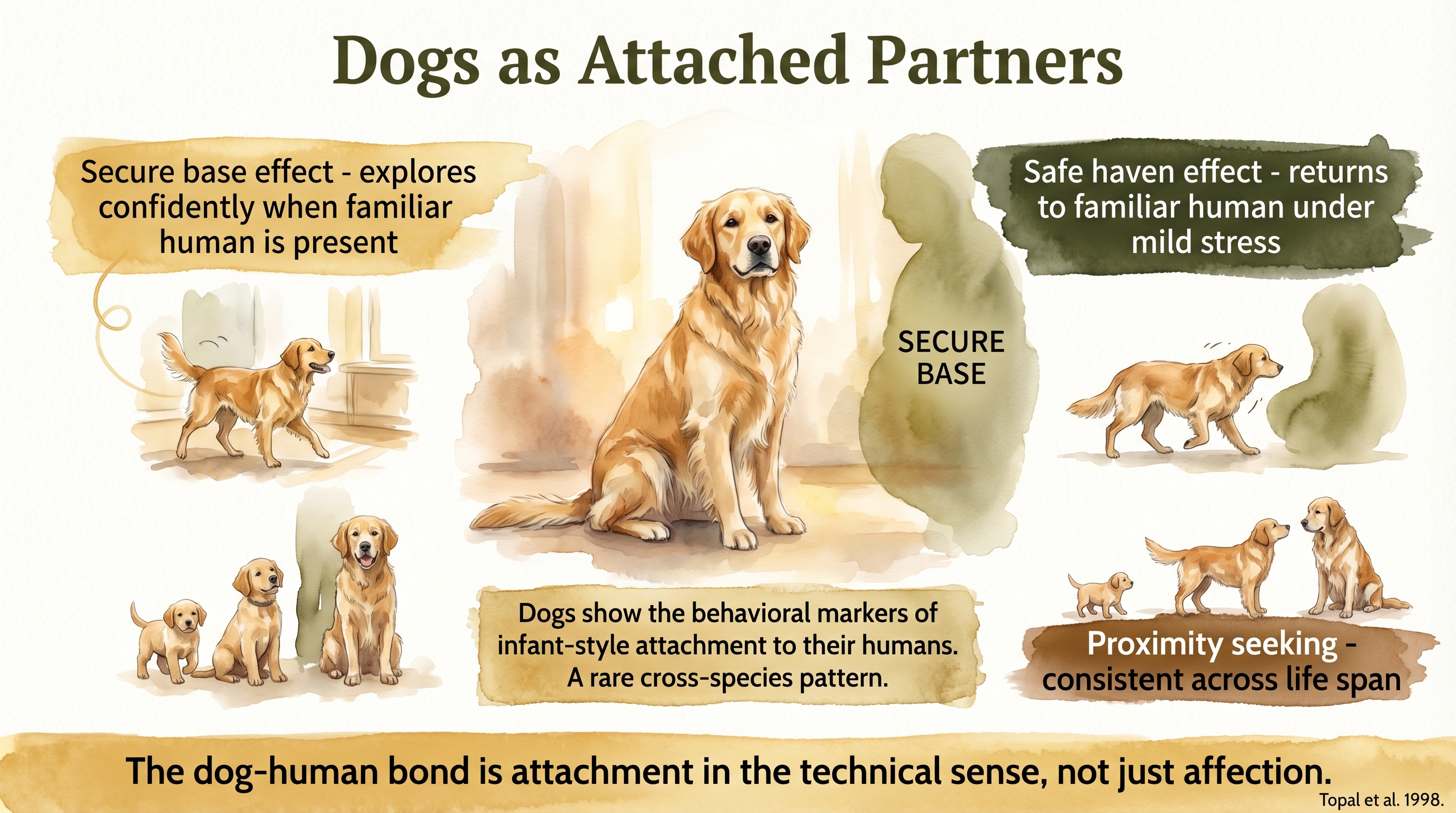
The dog-human bond is attachment in the technical sense, not just affection.
Key Takeaways
- Topal's Strange Situation work moved dog attachment from metaphor into measurable behavioral science.
- Dogs use owners as secure bases and safe havens, and this affects exploration, stress, and problem solving.
- The comparative wolf work suggests domestication, not exposure alone, helps explain the dog pattern.
- For JB, attachment science gives unusually direct support to the adult-as-anchor model under Structured Leadership.
The Evidence
This entry uses observed claim-level tags beyond the dedicated EvidenceBlocks below. These tags mark JB program observation or practice-derived claims that need dedicated EvidenceBlock coverage in a later content pass.
- Topal et al. (1998)51 owner-dog pairs
Adapted the Strange Situation Procedure and found classic attachment-style secure-base and reunion patterns in dogs. - Horn, Huber, and Range (2013)dogs
Showed an owner-specific secure-base effect in a problem-solving task that strangers did not reproduce. - Topal et al. (2005)dog puppies and hand-reared wolves
Found stronger human attachment expression in dogs than in similarly socialized wolves. - Schoberl et al. (2016) and Solomon et al. (2018/2019)dogs
Linked secure attachment to lower cortisol reactivity and demonstrated that more refined attachment classification is possible, though methodologically demanding.
No published study directly tests the practical implications of topal and the ainsworth strange situation in dogs for domestic dog raising programs. The application to household dog raising remains an interpretive synthesis rather than a directly tested intervention finding.
SCR References
Sources
- Topal, J., Miklosi, A., Csanyi, V., and Doka, A. (1998). Attachment behavior in dogs: a new application of Ainsworth's Strange Situation Test. Journal of Comparative Psychology.
- Horn, L., Huber, L., and Range, F. (2013). The importance of the secure base effect for domestic dogs. PLOS ONE.
- Topal, J., et al. (2005). Attachment to humans: a comparative study on hand-reared wolves and differently socialized dog puppies. Animal Behaviour.
- Solomon, J., et al. (2018/2019). Attachment security in companion dogs. Attachment and Human Development.
- Schoberl, I., et al. (2016). Social factors influencing cortisol modulation in dogs during a strange situation procedure. Journal of Veterinary Behavior.