Dog Gaze and Eye Contact: The Oxytocin Loop
Dog gaze is not just eye contact. In the domesticated dog, gaze appears to function as a social-bonding signal that can alter physiology in both species. The key paper here is Nagasawa et al. 2015 in Science, which reported an oxytocin-gaze positive loop between adult dogs and their owners. Dogs in the long-gaze group triggered increases in their owners' urinary oxytocin. Those owners then engaged in more affiliative behavior, and the dogs' oxytocin also rose. The team followed the observation study with intranasal oxytocin administration to dogs and found that boosting dog oxytocin increased gazing toward owners, which in turn increased owner oxytocin. Earlier work by Nagasawa et al. 2009 had already shown that a dog's gaze can increase owner urinary oxytocin during interaction. Handlin et al. 2011 and 2012 complicated the broader contact story by showing that touch type matters, with calmer stroking patterns differing from more activating touch. Romero et al. 2014 then showed oxytocin can increase dog affiliative behavior, and later reviews such as Marshall-Pescini et al. 2019 kept the field anchored in both enthusiasm and caution. Documented
What makes the 2015 paper so influential is not merely that oxytocin changed. It is that the change appeared to operate through a reciprocal social loop that resembles, in broad outline, mammalian caregiver-infant bonding systems.
For JB, this evidence matters because it gives biochemical weight to a claim that can otherwise sound soft: calm, attentive human relationship is one of the strongest regulatory signals a dog's nervous system receives.
That does not reduce the whole bond to one hormone. It does, however, show that an ordinary social act many families would otherwise overlook can sit inside a measurable biological feedback system. That is a meaningful correction to any model of dog life that treats relationship as secondary to technique.
It also changes the status of quietness in dog life. A pause, a look, and a regulated moment together can be biologically active rather than behaviorally empty. That is a very different picture from one where only overt commands and reinforcers count as real influence.
What It Means
What Nagasawa 2015 Actually Showed
The strongest claim from the paper is narrow and impressive. In dog-owner pairs, especially among dogs showing longer gaze, mutual social engagement was associated with increased urinary oxytocin in owners and dogs. Documented When oxytocin was experimentally raised in dogs, gazing increased and owner oxytocin rose in turn. That is why the paper is remembered as the oxytocin-gaze loop study rather than merely as another bonding paper.
This mattered because it connected ordinary social behavior to a measurable neuroendocrine process in both members of the dyad. The dog-human bond was not only behavioral. It had physiological reciprocity.
Why the Wolf Comparison Was Important
The study also included human-socialized wolves, and the wolves did not produce the same loop. Documented That supported the idea that this gaze dynamic is a domestication-linked specialization rather than a generic canid feature. is careful here, however. It notes that later critique questioned whether the wolf comparison was underpowered for some of the paper's more ambitious evolutionary claims. So the safest conclusion is not "the study proved this exact loop drove domestication." The safer conclusion is "the loop is documented in adult dogs and not shown to the same degree in the wolf comparison used."
That boundary matters because it preserves what is strongest in the paper while keeping the larger evolutionary story honest.
The oxytocin-gaze work suggests that quiet, attentive relationship is not an optional extra in dogs. It can function as part of the animal's actual regulatory biology, which helps explain why stable adult presence matters so much.
Gaze Is Part of a Larger Social Regulation System
The gaze loop does not stand alone. Attachment work shows dogs use humans as secure bases. Documented Emotion studies show dogs respond to human vocal and facial affect. Physiological synchrony studies show human state and dog state can co-modulate through cortisol and HRV. The gaze work fits this broader pattern. It tells us that eye contact is one of the channels through which the dog-human bond becomes biologically active.
That is one reason the field avoids treating gaze as merely submissive, controlling, or anthropomorphic. In dogs, sustained social gaze can be affiliative, regulatory, and communicative all at once.
What the Study Does Not Mean
The paper does not prove that every dog should be encouraged into prolonged eye contact all the time. It does not prove oxytocin always rises in every positive interaction. The JB neurochemistry source notes null or variable findings in some paradigms and warns against presenting oxytocin as the one calm hormone or the sole explanation of the relationship. Dog-human endocrine studies are often small and method-sensitive. Observed-JB
So the right reading is disciplined. Mutual gaze in adult dogs can participate in a measurable bonding loop. That is important without becoming mystical.
It is also one of the best examples in the field of a result that is both profound and bounded. The study does not have to explain everything about dogs in order to matter greatly. Documented It only has to show that quiet social attention is biologically consequential, and on that point the evidence is strong.
That boundedness is part of what makes the paper so useful. Families can take the core finding seriously without turning oxytocin into mythology or imagining that every look between dog and person carries the same meaning. The science supports significance, not sentimentality.
It also fits a wider pattern in domestication science. Dogs repeatedly appear ready to use humans as attachment figures, gesture givers, emotional reference points, and now as gaze partners in measurable physiological loops. The gaze work is powerful partly because it slots so neatly into that larger relational architecture.
That makes gaze quality a real husbandry variable, not a sentimental extra.
Why It Matters for Your Dog
For a family dog, the practical meaning of this research is profound. Documented A calm dog looking at a trusted human is not always begging for food, waiting for a command, or showing insecurity. Sometimes the dog is participating in the relationship itself. The species appears built to use eye contact as one route into regulation and social connection.
This helps explain why quiet presence can do so much. Owners often underestimate how biologically significant their calm attention is because it looks inactive from the outside. The gaze literature suggests that stillness, soft attention, and mutual orientation can be active regulators of the dog's state.
Goldens make this especially visible because many are naturally gaze-prone. Families often notice that a Golden will search the face, hold contact, and soften in response to calm engagement. The science provides a plausible mechanism for why that matters. The dog is not merely learning a visual habit. The dog may be entering one of the species' strongest affiliative channels.
This also changes how families should think about interaction style. If calm gaze and affiliative touch help maintain a regulatory loop, then constant commanding, activating petting, or noisy overhandling may interfere with a powerful form of co-regulation. The neurochemistry source explicitly notes that activating touch can drive cortisol up rather than down. That means "lots of attention" is not the same thing as the right kind of attention.
The research further explains why some dogs deteriorate when relationships become socially confusing. A dog built to use human gaze and quiet affiliative presence as regulatory signals may become more unsettled when eye contact is mostly correction, confrontation, or overexcited demand. The channel itself remains open, but what flows through it changes.
Another practical lesson concerns leadership tone. Adults often think firmness requires emotional distance or hard visual presence. The gaze literature suggests something subtler. A dog can be guided strongly through calm, attentive, non-chaotic relational presence. That aligns well with JB's emphasis on clear adult steadiness instead of theatrics.
The studies also help families resist a common false binary. Some people assume affectionate eye contact is indulgent and that serious dog work should minimize it. Others assume all eye contact is dominance or pressure. The evidence points elsewhere. In the bonded dog-human relationship, gaze can be a sophisticated affiliative and regulatory act.
Families should still stay realistic. Not every dog seeks the same amount of eye contact, and some anxious or overaroused dogs can find direct gaze difficult in certain moments. The point is not to force a ritual. The point is to recognize the significance of a naturally offered relational channel.
Seen clearly, dog gaze is one of the best examples of how deeply domestication entered the human-dog bond. Looking at one another is part of how the species now works.
This also means adults should think about what the dog sees in their face when the dog looks up. If the dog is using gaze as a route into orientation, then the adult's expression, breathing, pace, and readiness to recover become part of the lesson. A human face can become an index of safety, impatience, conflict, or steadiness. The gaze studies do not map every one of those outcomes directly, but they strongly support the general idea that face-to-face presence is a real part of canine regulation.
That insight can change daily life in quiet ways. A family may find that calmer check-ins, softer pauses before action, and less visually confrontational correction change the dog's whole tone over time. None of that requires sentimentalizing eye contact. It only requires taking seriously that the dog's social bond is built partly through looking.
There is also a developmental implication. Puppies who repeatedly meet a calm, readable face may be learning that human attention predicts orientation rather than pressure. Dogs who mostly meet hard staring, frantic motion, or demand-heavy eye contact may learn something very different. The gaze literature does not reduce those outcomes to one variable, but it makes the channel important enough that families should care how they are using it.
This can be especially clarifying for families with sensitive dogs. A dog who keeps checking the face may not be fishing for conflict or permission in some manipulative sense. Often the dog is using one of the species' native bonding routes. When adults answer that route with steadiness instead of confrontation, a surprising amount of household tension can disappear.
That is one reason face-to-face moments deserve more care than people often give them. A dog repeatedly checking in through gaze is opening a regulatory channel, not merely asking for a command. What the dog finds there can quietly shape the whole tone of the relationship.
What This Means for a Just Behaving Family
JB families should treat calm, natural eye contact as a meaningful part of relationship rather than as background decoration. It can be one of the strongest low-drama ways the adult helps the dog feel oriented and regulated.
That supports both Mentorship and Structured Leadership. The adult's presence is not only instructional. It is biologically anchoring.
Practically, this means adults should value the quality of attention they offer. Quiet presence, soft gaze, and regulated touch often fit the science better than constant command energy or high-arousal handling.
JB should still keep the rhetoric honest. The oxytocin loop is documented in adult dog-owner studies, but not every evolutionary claim built on it is equally secure, and the exact developmental onset in puppies remains an evidence gap. Ambiguous
Even with that caution, the field already says enough to matter. Relationship itself can be part of canine regulation.
It also gives JB a more concrete picture of adult presence. Being there is not enough on its own. The quality of that presence matters. A calm face, unhurried pause, and non-chaotic pattern of attention appear more compatible with the documented bond biology than constant stimulation or visually loaded pressure.
For families, this means everyday gaze habits deserve intentionality. They do not need to manufacture eye contact exercises for everything. They do need to notice whether their facial presence is mostly inviting orientation, provoking tension, or scattering the dog's attention.
That is a practical standard any household can use. If eye contact usually accompanies impatience, confrontation, or frantic demand, the channel will start carrying those meanings. If it more often accompanies calm check-ins, readable boundaries, and steady presence, the same channel is likely to support regulation instead.
That is one reason JB treats adult state as so consequential in the home.
It also supports a practical discipline for adults: do not waste a powerful channel by flooding it with tension, relentless demand, or visual confrontation. A calm face and a regulated pause can carry more value than people often realize.
For JB, the practical rule is to treat gaze as a living tool of orientation. A calmer face, steadier pause, and less confrontational visual style can make the household more inhabitable for a dog built to use people this way.
That is enough to make quiet attention look newly important in the home.
That is a quiet fact with large implications.
That is worth remembering in every calm check-in.
Few findings make ordinary, quiet presence look more biologically consequential than this one does.
That point deserves attention.
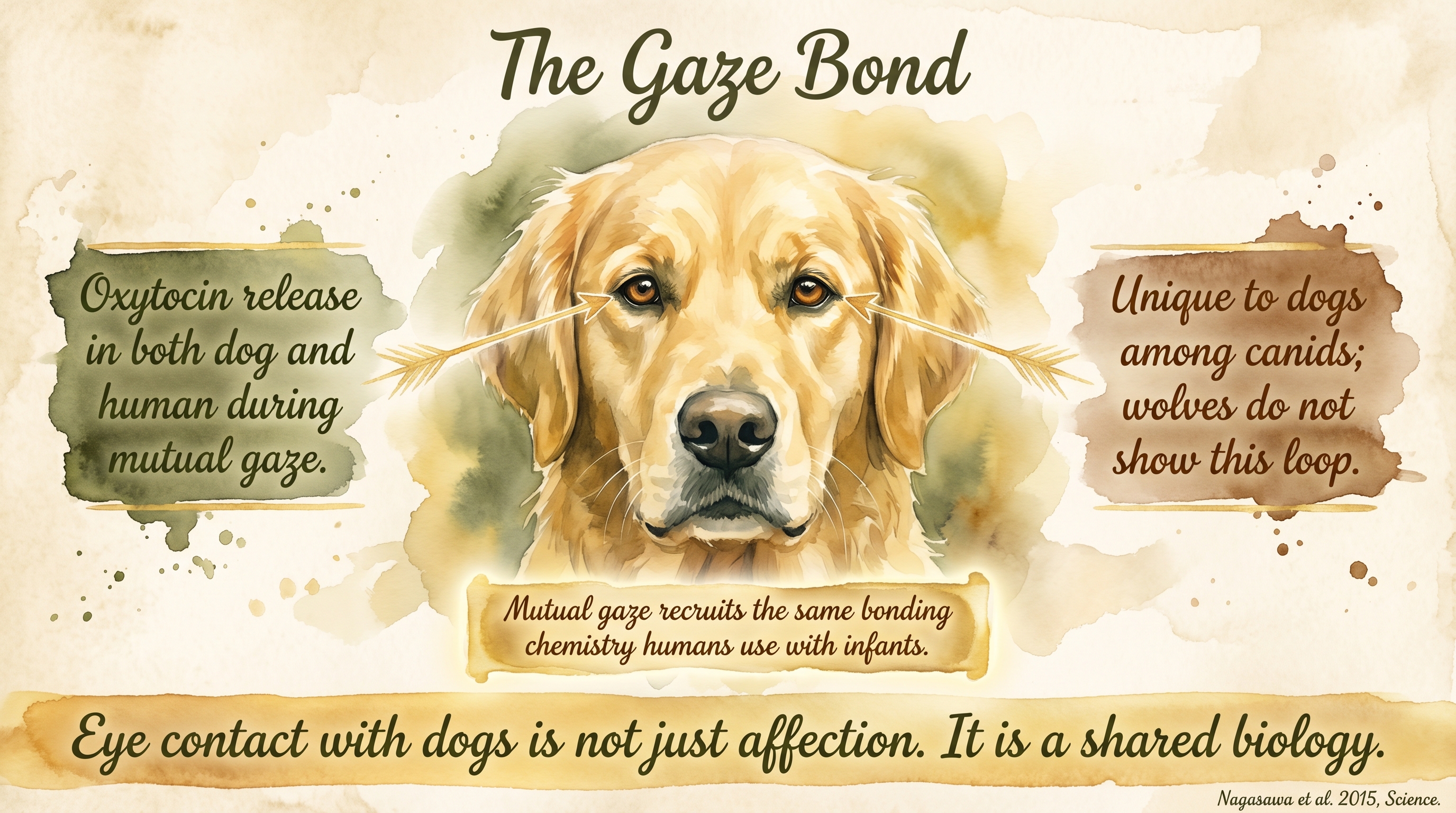
Eye contact with dogs is not just affection. It is shared biology.
Key Takeaways
- Mutual gaze in adult dog-owner pairs is not trivial. It can participate in a measurable affiliative oxytocin loop.
- The documented core finding is stronger than the broader claim that this exact loop alone explains domestication.
- Interaction style matters, which is why calm attention is not interchangeable with activating or confrontational attention.
- For JB, the gaze work gives unusually concrete support to the idea that relationship itself regulates dogs.
The Evidence
This entry uses observed claim-level tags beyond the dedicated EvidenceBlocks below. These tags mark JB program observation or practice-derived claims that need dedicated EvidenceBlock coverage in a later content pass.
This entry uses ambiguous claim-level tags beyond the dedicated EvidenceBlocks below. These tags mark claims where the literature remains unsettled or multiple interpretations coexist.
- Nagasawa et al. (2015)adult dogs, owners, and comparison wolves
Reported the oxytocin-gaze positive loop in dog-owner pairs and increased gazing after intranasal oxytocin in dogs. - Nagasawa et al. (2009)dogs and owners
Showed that dog gaze during social interaction increased owner urinary oxytocin. - Handlin et al. (2011, 2012)dogs and owners
Showed that interaction style and touch type shape hormonal patterns, cautioning against treating all contact as equivalent. - Source_JB neurochemistry and owner-state reviewsdogs
Preserve the core dog finding while warning that some larger coevolutionary claims remain sensitive to sample and interpretation.
No published study directly tests the practical implications of dog gaze and eye contact: the oxytocin loop for domestic dog raising programs. The application to household dog raising remains an interpretive synthesis rather than a directly tested intervention finding.
SCR References
Sources
- Nagasawa, M., et al. (2009). Dog's gaze at its owner increases owner's urinary oxytocin during social interaction. Hormones and Behavior.
- Nagasawa, M., et al. (2015). Oxytocin-gaze positive loop and the coevolution of human-dog bonds. Science.
- Handlin, L., et al. (2011). Short-term interaction between dogs and their owners. Anthrozoos.
- Romero, T., et al. (2014). Oxytocin promotes social bonding in dogs. PNAS.