Canine Social Cognition: An Overview
Canine social cognition is the research field that asks what dogs know about social life, especially social life with humans. The field began to crystallize in the late 1990s and early 2000s around work from researchers such as Brian Hare, Adam Miklosi, Jozsef Topal, Juliane Kaminski, and later many others. Its central finding is not that dogs are universally smarter than wolves, chimpanzees, or humans. The central finding is narrower and more interesting: dogs are unusually specialized for reading human social information. Hare et al. 2002 showed that dogs outperformed wolves and chimpanzees in using human gestures to locate hidden food. Topal et al. 1998 adapted Ainsworth's Strange Situation and showed that dogs use owners as secure bases and safe havens. Miklosi et al. 2003 showed that dogs look back to humans when a task becomes unsolvable in a way wolves do not. Andics et al. 2014 used awake fMRI on 11 dogs and 22 humans and found functionally similar voice-sensitive auditory regions, with emotional-valence sensitivity in both species. Muller et al. 2015 showed that pet dogs can discriminate angry and happy human facial expressions, while Albuquerque et al. 2016 found cross-modal matching between emotional faces and vocalizations. Salomons et al. 2021 then reinforced the developmental side by showing that 44 dog puppies, compared with 37 wolf puppies, were more attracted to humans and better at reading human gestures early in life. Documented
Taken together, these studies describe a species cognitively tuned for human partnership. Documented Dogs are not better than other animals at everything. They are better than many species at the specific problem of living with us.
That is why this subcategory matters so much for JB. It provides one of the strongest scientific bridges between domestication history and present-day family life.
It also gives families a better lens for daily interpretation. Many behaviors that look mysterious under a simple obedience model look much less mysterious once dogs are understood as animals built to notice, track, and use human social information continuously.
What It Means
Dogs Read Human Communication Efficiently
One of the field's best-supported claims is that dogs are unusually good at using human social cues. Pointing, gaze direction, ostensive signals, and face orientation all matter. Hare 2002 made this famous by showing dogs could use human pointing better than wolves and chimpanzees. Salomons 2021 reinforced the same pattern early in development. The field does not interpret this as a party trick. It interprets it as evidence that domestication altered how dogs treat humans as communicative agents. Documented
This matters because it means dogs are not starting from zero every time a human tries to guide them. The species arrives already biased toward using human signals in a cooperative way.
Dogs Form Human Attachment Bonds
The second major domain is attachment. Topal 1998 adapted the Strange Situation Procedure to dogs and found the same broad attachment markers used in human developmental psychology: proximity seeking, secure-base effects, distress on separation, and differential response to caregiver versus stranger. Documented Later work by Horn et al. 2013, Solomon et al. 2018 and 2019, and Schoberl et al. 2016 deepened the picture by linking secure-base effects to problem solving and lower cortisol reactivity.
This is crucial because it means the human-dog relationship is not only about cue reading. It is also about bond structure. Dogs do not simply notice humans. They use specific humans as regulatory anchors.
The secure-base literature is one of the clearest places where JB's emphasis on the adult human as a stable guide meets direct empirical support. Dogs do not merely obey humans. They organize around them.
Dogs Track Human Emotion and Voice
A third major domain is emotion perception. Andics 2014 found voice-sensitive regions and emotional-valence sensitivity in the dog brain. Documented Muller 2015 showed dogs could discriminate happy and angry human facial expressions and generalize beyond the exact training images. Albuquerque 2016 found that dogs looked longer at faces whose expression matched the emotional valence of a sound, suggesting cross-modal processing rather than one isolated sensory trick. Nagasawa 2015 added a biochemical dimension by showing a gaze-linked oxytocin loop in adult dog-family pairs.
This does not mean dogs conceptually understand emotion exactly as humans do. It does mean they are sensitive enough to human affective cues that household emotional climate becomes behaviorally and physiologically relevant.
What Dogs Do Not Dominate In
The field is strongest when it keeps its honesty. Dogs do not obviously outperform wolves in all cognition. Wolves often show stronger persistence on some physical problem-solving tasks and may outperform dogs in some conspecific imitation or independent mechanical challenges. Observed-JB Dogs are also not miniature humans. Their strengths are selective. They are best described as specialists in interspecies social cognition rather than as globally superior thinkers.
That caveat is not a weakness. It is what makes the field credible. Dogs are good at the problems domestication appears to have selected them to solve.
The field becomes especially persuasive because the same conclusion arrives through multiple routes. Gesture studies, attachment procedures, brain-imaging work, emotion-perception experiments, and developmental comparisons do not use the same methods or the same laboratories. Even so, they keep converging on a species that is unusually prepared to make humans central.
That convergence matters more than any single spectacular result. It suggests canine social cognition is not one clever trick but a cluster of related capacities that hang together: dogs notice us, recruit us, regulate through us, and often perform differently depending on whether we are available and intelligible.
This is one reason the field has matured so well. Early excitement around one dramatic result could have turned into overclaiming, but instead multiple lines of work have slowly built a more stable picture. Dogs are not socially magical. They are socially specialized, and that specialization shows up repeatedly across different laboratories and methods.
Why It Matters for Your Dog
The reason this field matters to families is that it changes the baseline picture of what a dog is doing all day in a human home. A dog is not only waiting for explicit commands. A dog is monitoring faces, movement patterns, tone of voice, emotional valence, attachment availability, and the general coherence of adult behavior. Once families understand that, many ordinary problems become easier to interpret.
For example, a dog who becomes more disorganized when adults are erratic is not necessarily being stubborn or dramatic. That dog may be struggling because the species is tuned to use humans as reference points. If the reference points are noisy, the organism can become noisy too. The social cognition literature does not excuse every behavior problem, but it makes this mechanism far more plausible than common-sense intuition alone might.
The same is true for human guidance. A dog who checks your face, pauses at uncertainty, or works more confidently when you remain calm is not merely performing a trained routine. Those reactions fit the documented package of attachment, social referencing, and human-oriented cognition. That is one reason good adult conduct matters so much more than many behavior plans openly acknowledge.
Goldens make these patterns particularly visible. Many families experience the breed as deeply people-oriented, emotionally absorbent, and unusually eager to recruit humans into both comfort and problem solving. The science helps explain why that feels so obvious. Breed selection sits on top of species-level domestication, and the resulting dog is often highly tuned to the human household.
This field also protects families from a common category mistake. People often confuse social cognition with blind compliance. A dog may be exquisitely good at reading people and still make choices the family dislikes. Those are different issues. A dog who understands your gesture is not necessarily a dog who is mature, regulated, or ready to choose well in every context. That distinction matters because it keeps families from overselling cue-reading as total behavioral health.
Another practical benefit is that the field explains why relationship quality changes training quality. If the dog-human bond includes secure-base effects, emotional reading, and attention biases toward the human, then the relational context is not fluff around technique. It is part of the working system in which technique succeeds or fails.
The same research helps explain why some homes make easy dogs harder. Documented A dog that is built to monitor faces, tone, and attachment availability will be affected by chronic adult agitation in ways a simpler machine model would miss. In that sense, behavior plans that ignore the emotional organization of the household are often leaving out a major part of the animal's lived environment.
Families can also use canine social cognition to resist both sentimentality and mechanization. The dog is not a small human child, but neither is the dog a reward-seeking machine with no social interpretation of what the human is doing. The research supports a middle picture: the dog is a socially specialized domesticated species built to use humans in biologically significant ways.
This middle picture is useful during adolescence and stress because it keeps families from misreading social sensitivity as manipulation. Dogs who become clingier, noisier, or more disorganized under uncertainty are often showing the costs of disrupted social orientation, not some sinister strategy. Recognizing that does not excuse bad behavior. It helps adults choose interventions that restore clarity instead of multiplying tension.
It also changes how families think about so-called training readiness. A dog may be highly ready to process human social information long before the dog is fully ready to regulate arousal, tolerate frustration, or make mature choices in difficult environments. That mismatch is normal and helps explain why guidance quality still matters so much even in very socially tuned dogs.
That picture can make adults calmer. It reduces the urge to overperform, overexcite, or overcommand. If the dog is already monitoring the adult closely, then adult stability itself becomes part of the guidance.
In that sense, canine social cognition is not just an academic field. It is a better description of the kind of animal sharing the house.
That broad picture matters because it changes what the household is trying to become. A socially specialized species does not only need more technique. It needs adults, routines, and emotional patterns that remain useable to an animal constantly reading human social information.
That is why a readable adult world matters so much. The more socially tuned the species is, the more costly unnecessary human noise becomes and the more valuable coherent human presence becomes.
What This Means for a Just Behaving Family
JB families should take canine social cognition seriously because it gives strong evidence that dogs are prepared to use humans as attachment figures, information sources, and emotional reference points.
That directly supports why Mentorship, Calmness, and Structured Leadership are central in the philosophy. Those pillars are not floating free from biology. They fit what the species appears especially ready to respond to.
JB should still remain honest about the limits. Dogs are not universally superior thinkers, and the field does not prove every philosophical conclusion directly. What it does prove is that human social life matters to dogs at a deep cognitive level.
For the home, that means adult behavior is never background. The dog is reading it, organizing around it, and often regulating through it.
It also means the adult does not need to manufacture importance through endless verbal output. A socially tuned dog is already paying attention. Often the more productive move is to make signals clearer, rarer, and more consistent rather than louder, busier, or more emotionally loaded.
That has a quieting effect on the whole household. When families stop assuming the dog needs nonstop stimulation in order to stay connected, they can focus on becoming reliable points of orientation instead. The dog still needs play, exposure, and practice. What changes is the recognition that stability itself carries informational value.
For JB, that is a powerful reframe. A calm household is not merely less annoying. It is more cognitively usable to a species that appears built to track humans this closely. The overview literature does not prove every downstream philosophical claim, but it strongly justifies taking adult steadiness seriously as part of the dog's actual information environment.
That is one reason JB places so much weight on the adults becoming stable first. The science says the dog is likely to notice more than the adults think.
Once families understand that, the household can become more intentional without becoming theatrical. That is a very good outcome for both people and dogs.
That is why stability belongs so close to the center of the JB picture. For a dog built to track people this closely, a steadier human world is not just nicer. It is cognitively easier to live inside.
That is already enough to change the way a household behaves around a dog. The science does not need to be mystical in order to be deeply consequential.
That picture is already enough to change adult behavior.
That alone justifies a quieter, clearer home.
That broad conclusion is strong enough to justify substantial changes in how adults think about the dog's daily experience.
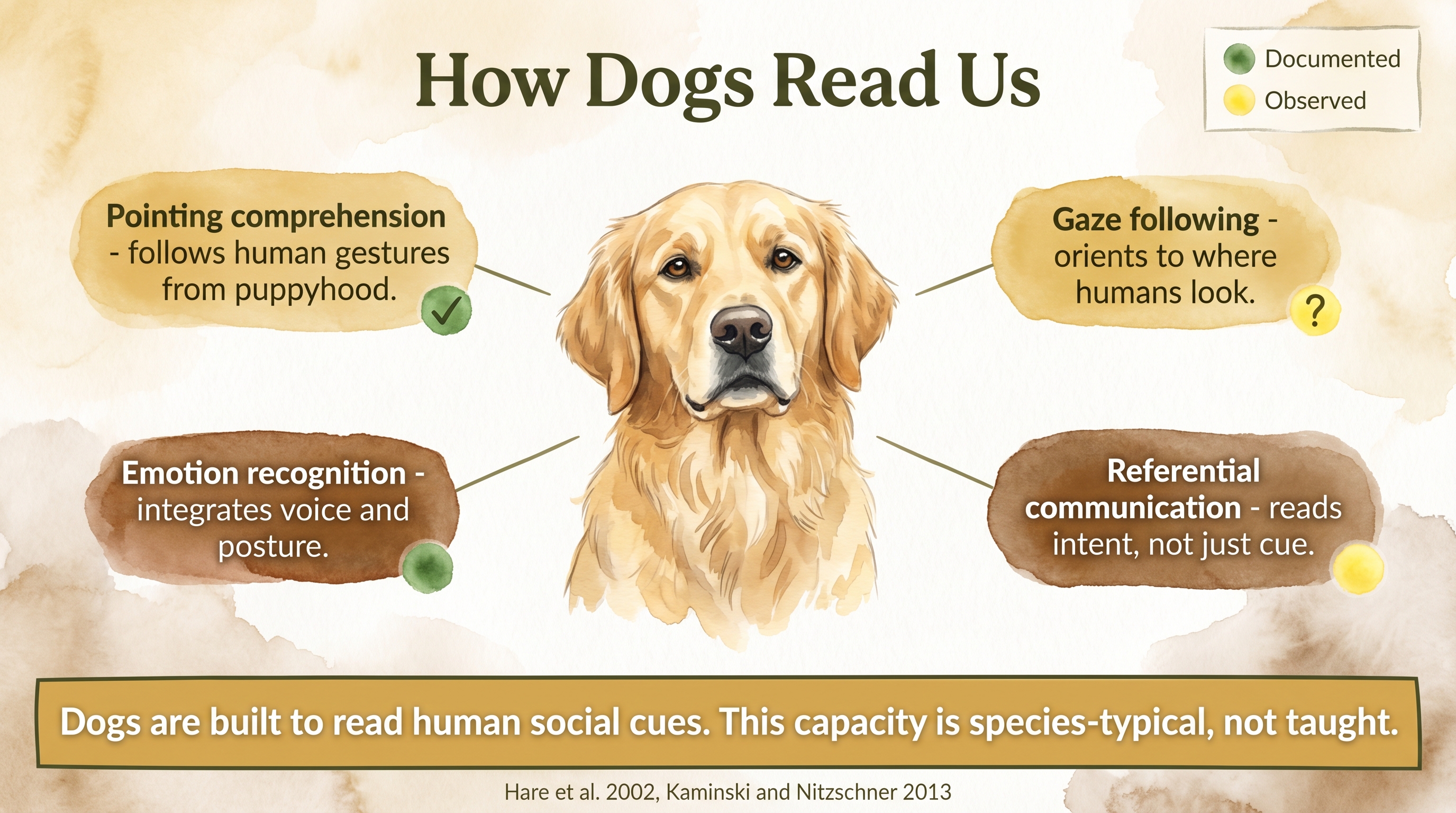
Reading human social cues is species-typical for dogs, not taught.
Key Takeaways
- Dogs are not general cognitive champions. They are specialists in social life with humans.
- The strongest documented domains are gesture reading, attachment, emotional cue use, and early attraction to human social partners.
- These strengths coexist with limits in some non-social or mechanical problem-solving domains.
- For JB, the field strongly supports taking adult human behavior seriously as part of the dog's actual developmental environment.
The Evidence
This entry uses observed claim-level tags beyond the dedicated EvidenceBlocks below. These tags mark JB program observation or practice-derived claims that need dedicated EvidenceBlock coverage in a later content pass.
- Hare et al. (2002) and Salomons et al. (2021)dogs and wolves
Show that human-directed cue use and attraction to humans emerge strongly in dogs and early in development. - Topal et al. (1998) and later attachment studiesdogs
Demonstrate secure-base and safe-haven effects in dog-human relationships. - Andics et al. (2014), Muller et al. (2015), and Albuquerque et al. (2016)dogs
Support dogs' sensitivity to human vocal and facial emotion cues across multiple sensory channels. - Miklosi et al. (2003)dogs and wolves
Showed that dogs are more likely than wolves to recruit humans during unsolvable tasks.
No published study directly tests the practical implications of canine social cognition: an overview for domestic dog raising programs. The application to household dog raising remains an interpretive synthesis rather than a directly tested intervention finding.
SCR References
Sources
- Hare, B., et al. (2002). The domestication of social cognition in dogs. Science.
- Topal, J., et al. (1998). Attachment behavior in dogs: a new application of Ainsworth's Strange Situation Test. Journal of Comparative Psychology.
- Miklosi, A., et al. (2003). A simple reason for a big difference: wolves do not look back at humans, but dogs do. Current Biology.
- Andics, A., et al. (2014). Voice-sensitive regions in the dog and human brain are revealed by comparative fMRI. Current Biology.
- Muller, C. A., et al. (2015). Dogs can discriminate emotional expressions of human faces. Current Biology.
- Albuquerque, N., et al. (2016). Dogs recognize dog and human emotions. Biology Letters.
- Salomons, H., et al. (2021). Cooperative communication with humans evolved to emerge early in domestic dogs. Current Biology.