Cognitive Differences Between Dogs and Wolves
The fairest modern summary of dog-wolf cognitive difference is not that dogs are smarter or that wolves are smarter. It is that they are specialized for different social and ecological problems. Dogs tend to outperform wolves on human-directed tasks: using pointing, treating human ostensive cues as meaningful, forming attachment-like bonds with human caregivers, and looking back to humans when a challenge becomes unsolvable. Wolves often outperform dogs on tasks that reward independent persistence, direct environmental problem solving, or certain conspecificly relevant social skills. Miklosi et al. 2003 made the looking-back contrast famous. Hare et al. 2002 did the same for pointing. Topal et al. 2005 showed stronger attachment expression in dog puppies than in hand-reared wolves. Range and Viranyi's cooperation literature then argued that dogs' evolutionary shift is best understood as re-anchoring social skills toward humans. Documented
This pattern matters because it keeps comparative cognition honest. The dog did not become a failed wolf. The dog became a different kind of social intelligence.
For JB, this entry helps connect the raw science to an everyday intuition many families already have: dogs do not merely live near people. They think with people in the loop.
That is why this literature is best read as a niche story. The question is not which animal wins in the abstract. The question is what each animal has been shaped to rely on when social and practical problems appear.
Reading it that way has a useful moral effect too. It removes the temptation to treat dogs as admirable only when they resemble wolves or to treat wolves as failures because they are less human-oriented. Comparative cognition becomes a story about evolutionary fit rather than about prestige.
What It Means
Dogs Excel in Human-Directed Social Tasks
The strongest difference is in tasks where human communication is central. Dogs are unusually good at following pointing, reading gaze, responding to ostensive signals, and using humans as social resources. Hare 2002 showed this in gesture comprehension. Documented Topal 2009 showed dogs, unlike wolves, can be drawn into human-like communicative traps such as the A-not-B error under ostensive signaling. Miklosi 2003 showed dogs recruit humans during unsolvable tasks rather than persisting independently.
These are all clues about the same shift: dogs treat human communication as part of the problem space itself, not as incidental noise around it.
Wolves Often Win When Independence Matters
Wolves are not lesser dogs in these comparisons. In several studies and reviews, wolves show greater persistence on independent problem-solving tasks, better performance in some mechanical contexts, and stronger conspecific-oriented skills under the right rearing conditions. Documented Range and Viranyi have emphasized this repeatedly to prevent the public from collapsing the story into canine triumphalism.
That matters because it shows the dog's strengths are niche strengths. Domestication traded some kinds of independence for some kinds of social partnership. That is not a defect. It is a specialization.
The reason Mentorship is plausible in dogs is not that dogs lack minds of their own. It is that their minds are unusually prepared to recruit human guidance into how they solve problems and regulate uncertainty.
The Social Tool Hypothesis
One productive way to summarize the literature is the "social tool" idea: dogs have evolved to use humans as environmental resources. That resource can be informational, emotional, or practical. A person can point, reassure, regulate, open access, and stabilize the context. The dog does not merely coexist with the human. The dog cognitively works through the human in ways wolves are much less biased to do.
This also helps explain why dogs can look less impressive in some laboratory puzzles. If the species is adapted to recruit a social partner, independent puzzle persistence is not always the natural default strategy.
The Caveats Matter
The field is more nuanced than some popular accounts. Hand-raised wolves can become skilled in many human-directed tasks. Rearing conditions matter enormously. Some dog-wolf differences shrink or even reverse depending on the exact design. Dogs are not universally more social in every domain, and wolves are not simple antisocial foils. That is why the best reviews avoid grand claims and focus on patterned bias.
The patterned bias, however, is robust enough to matter. Dogs are more prepared to let humans into their problem-solving and social-regulation loops.
That last sentence is what gives the comparison its practical force. If the bias were tiny, it would not deserve such a large place in domestication theory. But the bias appears across communication, attachment, help-seeking, and emotional coordination. Even after all the caveats, the field still returns to the same core picture of dog cognition as socially human-oriented in a way wolf cognition is not.
That cross-domain consistency is why the interpretation holds up so well. A single pointing study could be a curiosity. Documented A single attachment result could be an artifact. But when gesture use, looking-back behavior, attachment expression, and social referencing all lean in the same direction, the niche shift stops looking accidental.
It also clarifies what not to copy from wolves. A wolf's strength in independence does not mean the dog's human orientation is a flaw to be corrected. It means the two lineages were pulled toward different forms of competence. Companion-dog success should therefore be judged by mature use of human partnership, not by resemblance to a less domesticated cognitive style.
This is also why comparative work is so useful for ordinary expectations. A dog that keeps trying to use the adult as a social and problem-solving resource is not malfunctioning because it is not more wolf-like. In many cases it is expressing one of the species' clearest domestication differences, which means the adult's job is to guide that tendency into maturity rather than punish it for existing.
Why It Matters for Your Dog
In the home, these differences matter because they explain why many dogs seem to work better when adults become clearer rather than harsher. A dog often does not need to be forced into noticing you. The species is already inclined to use you. What matters more is whether what it finds there is useful, stable, and readable.
That is one reason chaotic households can be especially hard on dogs. If the dog is built to recruit humans into uncertainty, then adult instability does not stay in the background. It enters the dog's working system. A wolf-like independent solver might just keep acting on the environment. A dog is more likely to become socially entangled in the disorder.
Goldens make this vivid. They often watch people, search faces, and use proximity almost as a management strategy. That is not pure sentiment. It is a cognitive style shaped by domestication and amplified by breed history. When families respect that style, the dogs often become easier to live with. When families fight it by demanding artificial independence too early or by being socially inconsistent, behavior can become noisier.
These differences also help families rethink what counts as progress. Some households want a dog that solves everything alone because independence feels impressive. Yet for a companion animal, a dog that calmly checks in, uses the adult as reference, and recovers through social guidance may be showing exactly the sort of intelligence that matters most in domestic life.
The literature also protects families from feeling embarrassed about needing to matter. Some people hear "don't micromanage" and conclude that their own presence should be irrelevant. Dog cognition says otherwise. Human presence often is relevant, and sometimes necessarily so. The issue is not whether the adult matters. The issue is what kind of adult the dog is finding.
Another practical implication concerns punishment and pressure. If dogs are unusually prone to recruit humans into the cognitive and emotional loop, then harsh human behavior can have bigger systemic consequences than a simple consequence chart would imply. It can corrupt the very resource the dog is built to use. Again, that does not mean dogs can never handle frustration. It means relationship quality and signal quality are part of the cognitive ecology.
This also explains why dogs can be poor candidates for certain fantasies of rugged self-sufficiency. A domesticated dog left to sort every social problem alone is not being returned to authenticity. It may be being deprived of one of the species' main evolutionary strengths.
Families often experience relief when they understand this. Their dog is not weak for checking in. Their dog is being dog-like. The task is to help that dog-likeness mature rather than to punish it out of existence.
There is another benefit to this perspective. It helps owners stop misclassifying socially driven difficulty as willful defiance. A dog who stalls, looks back, seeks contact, or loses fluency in a confusing moment may be showing a cognition built to recruit humans, not a scheme to manipulate them. Documented That does not erase accountability. It changes what kind of adult response is most likely to help. The dog may need better structure, clearer information, or calmer reference points more than harder pressure.
That insight also affects how families think about independence work. Teaching a dog to rest alone, recover from separation, or solve small frustrations without panic is important. But the route to that maturity may still run through secure relationship rather than around it. The comparative literature makes that easier to understand because it shows the human-oriented dog does not mature by becoming wolf-like. Documented The dog matures by becoming a well-regulated dog.
This is also why daily friction can accumulate so quickly in some homes. A dog that keeps trying to use the human as a resource and instead finds contradiction, impatience, or emotional volatility can become noisier not because the dog lacks intelligence, but because its preferred problem-solving channel is degrading. Once families see that, many interventions become less punitive and more clarifying.
Viewed this way, good raising is partly the art of making the human worth using. A dog that repeatedly finds calm guidance, clear patterning, and proportionate response in the adult can lean into its domesticated strengths. A dog that repeatedly finds noise, force, or contradiction may still cope, but often at much higher cost.
That framing also helps adults set better goals for maturity. The point is not to erase the dog's social orientation toward people. The point is to turn that orientation into steadier recovery, better judgment, and more flexible behavior under everyday pressure. A well-raised dog remains human-oriented, but uses that orientation more skillfully.
What This Means for a Just Behaving Family
JB families should understand that dogs and wolves differ most meaningfully in where they place humans inside their cognitive world. Dogs let humans in far more deeply.
That supports the whole idea of adult guidance as developmental architecture. Mentorship, Calmness, and Structured Leadership all become more plausible when the species is known to recruit humans this strongly.
It also shapes everyday practice. The adult should aim to be socially useful, not merely forceful. Clarity, steadiness, and readable structure matter because the dog is already using the human as a tool for orientation.
JB should still resist exaggeration. The field supports strong bias differences, not magical binaries. Wolves remain social canids, and dogs remain variable individuals.
But the bias difference is enough. It means the household does not need to apologize for being central to the dog's functioning. It needs to be worthy of that centrality.
That is a demanding standard, but a useful one. It asks adults to become calmer, clearer, and more proportionate because the dog is already structured to let them matter. In that sense, comparative cognition does not flatter humans. It gives them homework.
It also gives JB a better way to talk about independence. Mature dogs should certainly tolerate small frustrations and ordinary absences, but those capacities are best built without denying the species' human-oriented design. Independence becomes a product of secure development, not a rebellion against domestication.
That is why the JB picture can stay both firm and humane. The adult remains central, but not as a rival to defeat or erase. The adult matters because dogs are cognitively built to let a trustworthy human matter. Comparative cognition is one of the clearest places where that distinction becomes visible.
That is one of the cleanest practical lessons in comparative cognition.
That sentence is worth lingering on because it changes posture. The adult does not have to dominate the dog to matter, and does not have to disappear to be ethical. The adult has to become a useful social resource for a species built to use one.
For JB, that means relationship should be judged by usefulness rather than by theatrics. If the dog's cognition keeps becoming easier to organize around adult clarity, the family is likely moving in the right direction. The literature makes that a far more defensible benchmark than imitating wolf independence or celebrating mere visible control.
That is a far healthier target for households than trying to make the dog cognitively resemble a wolf. Domestic maturity should still look recognizably dog-like.
That is the kind of difference ordinary homes should care about.
That is a meaningful standard for any family dog.
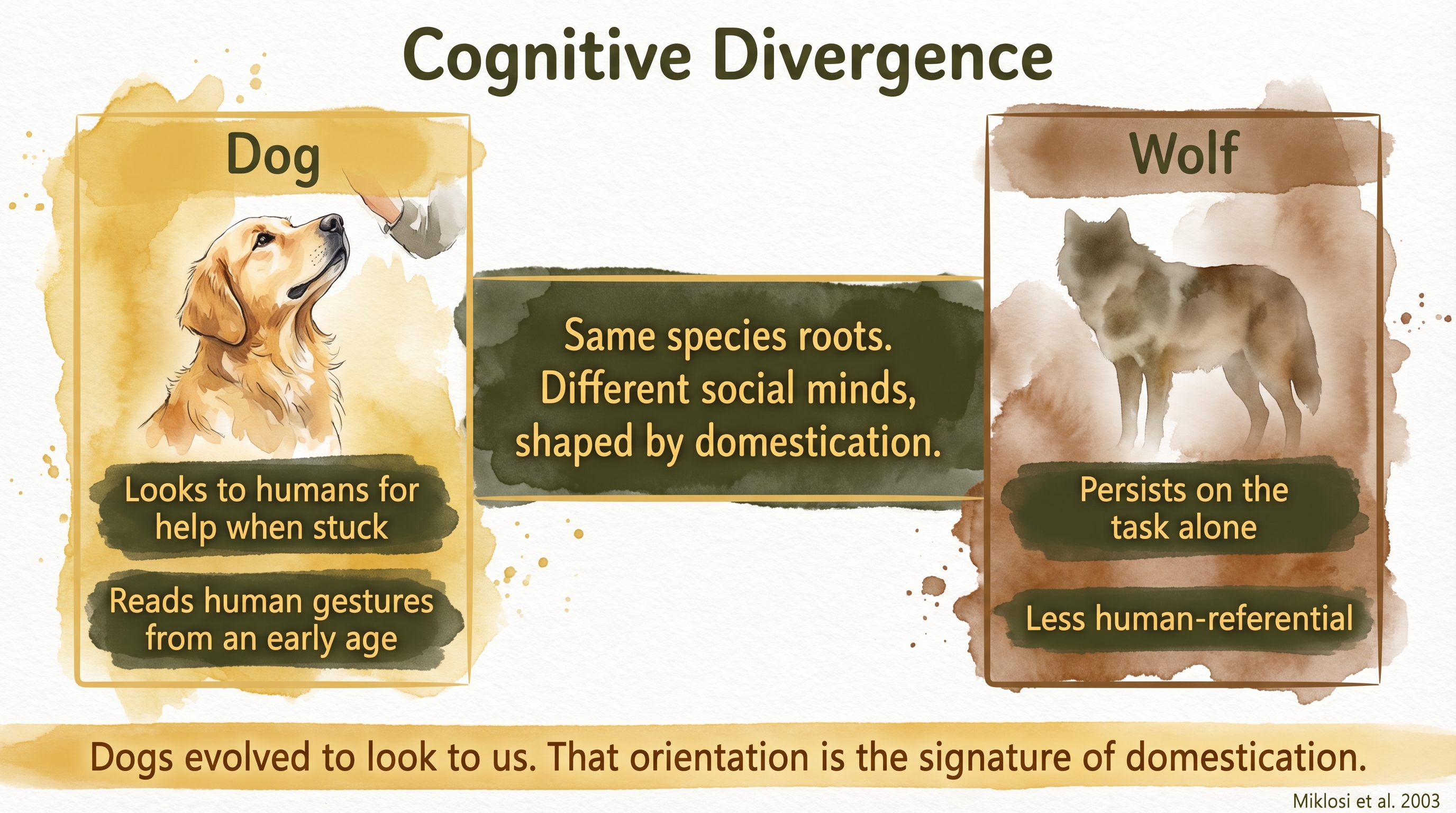
Dogs evolved to look to us. That orientation is the signature of domestication.
Key Takeaways
- Dogs and wolves differ more in social orientation than in some single global intelligence measure.
- Dogs are biased toward using humans as communicative and regulatory resources.
- Wolves often remain stronger in independent persistence and some non-social problem-solving tasks.
- For JB, the key practical point is that dogs are built to let adults matter.
The Evidence
- Hare et al. (2002)dogs, wolves, and chimpanzees
Found stronger dog performance on human gesture tasks. - Miklosi et al. (2003)dogs and wolves
Showed that dogs, unlike wolves, typically looked back to humans during unsolvable tasks. - Topal et al. (2005)dog puppies and hand-reared wolves
Demonstrated stronger attachment-style orientation to humans in dogs. - Range and Viranyi review traditiondogs and wolves
Emphasizes specialization and niche shift rather than simplistic hierarchy claims.
No published study directly tests the practical implications of cognitive differences between dogs and wolves for domestic dog raising programs. The application to household dog raising remains an interpretive synthesis rather than a directly tested intervention finding.
SCR References
Sources
- Hare, B., et al. (2002). The domestication of social cognition in dogs. Science.
- Miklosi, A., et al. (2003). A simple reason for a big difference: wolves do not look back at humans, but dogs do. Current Biology.
- Topal, J., et al. (2005). Attachment to humans: a comparative study on hand-reared wolves and differently socialized dog puppies. Animal Behaviour.
- Range, F., and Viranyi, Z. (2022). Comparing wolves and dogs: current status and implications for human self-domestication. Trends in Cognitive Sciences.