The Modern Wolf Is Not the Ancestor of the Dog
One of the most important corrections in modern domestication science is simple to state and easy to forget: the modern gray wolf is not the direct ancestor of the domestic dog. Dogs and modern wolves are sister lineages descending from a now-extinct or still-unsampled wolf-like ancestral population. Ancient DNA studies including Frantz et al. 2016, Botigue et al. 2017, Bergstrom et al. 2020, and Bergstrom et al. 2022 all push in that direction. Bergstrom's 2022 analysis of 72 ancient wolf genomes is especially clarifying because it greatly widened the comparative map and still did not find a sampled ancient wolf that could be named as the direct progenitor of dogs. That means modern dog-versus-modern wolf comparisons are useful, but they are not comparisons between a descendant and its unchanged ancestor. They are comparisons between two lineages that have both continued evolving for thousands of years. Documented
This sounds like a technical point, but it corrects several common cultural errors all at once. It weakens naive "ancestral wolf diet" arguments, weakens simplistic pack-dominance analogies, and forces more caution in how people use wolves to explain pet dogs.
For JB, that correction is foundational because it keeps evolutionary thinking from sliding back into mythology.
It is also a good example of why better science often feels less cinematic. The true story is more complex than a single living ancestor standing in for the whole past, but it is also much more useful.
Once that complexity is accepted, several arguments in dog culture lose their automatic prestige. Saying "wolves do this" stops being enough by itself. The comparison has to be shown to matter for dogs rather than borrowed as a substitute for dog-specific evidence.
What It Means
Dogs and Wolves Share Ancestors, Not Identity
When people say "dogs descended from wolves," they are using a shorthand that is partly right and partly misleading. Dogs did descend from a wolf-like lineage, but not from the modern gray wolf as it exists today. The dog lineage split away, and modern wolves continued on their own path. The ancestral population itself appears to be extinct, unsampled, or both. That is the position most consistent with current ancient-DNA work.
This matters because direct-ancestor language invites people to treat the modern wolf as a preserved snapshot of dog prehistory. The evidence does not support that use.
Why the Distinction Matters in Practice
If modern wolves are not direct ancestors, then appealing to them as if they provide a complete blueprint for pet dog life becomes much weaker. Wolves remain important comparators. They tell us about canid continuity, family structure, hunting ecology, and some social capacities. They do not provide a perfect template for what proto-dogs ate, how proto-dogs organized socially, or what pet dogs are "really" trying to do underneath domestication.
This is especially important in popular discourse because wolf comparison is often used rhetorically rather than scientifically. People invoke wolves to add drama, toughness, or ancestral authority to whatever modern preference they already hold.
One of the biggest historical mistakes in dog culture is treating wolf comparison as identity rather than reference. Once that mistake is made, whole training and feeding ideologies start borrowing authority they have not earned.
What This Corrects About Diet
Raw-feeding rhetoric often leans on an "ancestral wolf diet" as if modern wolves provide the exact nutritional standard dogs were designed for. The science is more complicated. First, modern wolves are sister lineages, not preserved ancestors. Second, Axelsson 2013 showed dogs carry starch-related adaptation not seen in the same form in wolves. Third, the domestication process itself likely involved significant use of human-derived foods, whether through commensal scavenging, settlement-edge foraging, or later agricultural diets.
So even if wolves remain relevant for understanding broad carnivorous ancestry, they cannot simply be substituted for the actual proto-dog ecological history.
What This Corrects About Social Theory
The same problem appears in training culture. The popular alpha framework came largely from captive studies of unrelated wolves forced together in artificial conditions. Documented Mech 1999 later clarified that natural wolf packs are better understood as family units led by breeding parents, not as endlessly contested rank ladders. Even that correction, however, still concerns wolves. It does not automatically describe domesticated dogs living in human homes.
Once the dog-wolf ancestor confusion is fixed, the logic becomes cleaner. Modern wolves are already an imperfect comparator for proto-dogs, and captive wolf packs are an even worse comparator for companion dogs. That should make families much more suspicious of any training philosophy that claims direct wolf authority.
This is one of the most important downstream benefits of the sister-lineage view. It does not eliminate wolf comparison. It makes wolf comparison earn its place instead of functioning as borrowed mystique.
That is a healthier scientific standard in general. Comparative species work is strongest when it clarifies both continuity and divergence. The trouble begins when continuity is treated as identity and all later evolutionary change is ignored.
Once that mistake is removed, wolf comparison becomes more useful rather than less. Families can ask narrower and better questions such as which family-structure features remain informative, which communication patterns still matter, and which claims collapse once the dog is recognized as a separate domesticated lineage.
The sister-lineage correction also improves how families read evidence claims more broadly. Instead of asking whether a wolf analogy sounds primal enough to be persuasive, they can ask whether it survives contact with dog-specific genetics, domestication history, and social-cognition findings. That small change in method strips a lot of pseudo-evolutionary authority away from weak arguments very quickly.
Why It Matters for Your Dog
This matters in the home because families are constantly told that some current problem in their dog reveals an ancestral wolf truth. A Golden growls over a toy, and someone says the dog is showing pack rank. A puppy prefers fresh meat, and someone says dry food defies wolf biology. An adolescent ignores a cue, and someone says the human must become the alpha. The modern-wolf-is-the-ancestor mistake is doing a lot of hidden work in those claims.
Once that mistake is removed, the dog looks different. Your dog is not a wolf minus discipline. Your dog is a domesticated canid with its own lineage history, its own genomic changes, and its own human-shaped social repertoire. That does not erase canid continuity, but it changes the default frame from identity to comparison.
This is especially relieving for families who feel trapped between "treat the dog like a wolf" and "treat the dog like a furry child." The science points toward a third path. The dog is a domesticated species with real evolutionary continuity and real divergence. Good raising respects both. It does not need wolf cosplay to feel serious.
Goldens make this point obvious because so much of what families love in them would be bizarre to interpret through strict wolf identity. Strong human orientation, easy social checking, comfort with handling, and desire for inclusion in domestic life are all dog traits amplified through breed history. Treating those qualities as deviations from a truer wolf nature misses the point of domestication entirely.
The distinction also helps families read behavior problems more intelligently. Documented A reactive dog is not proving that domestication is fake. A reactive dog is a domesticated animal whose regulation, development, pain, stress load, or environment has gone wrong in some way. That is a much more useful frame because it keeps the family working with the animal they actually have instead of an imagined ancestral creature.
There is a nutritional benefit too. Families no longer have to choose between respecting biology and respecting domestication. The biological history of dogs includes domestication. A feeding plan can therefore be judged against dog evidence rather than against a romantic image of the modern wolf.
Another practical gain is that it refines how families use wolves at all. Wolves can still teach us things about family-unit social structure, parental investment, and ritualized communication. What they cannot do is serve as a totalizing manual for domestic dogs. The sister-lineage distinction lets families keep the useful parts of wolf comparison while discarding the overreach.
This matters especially when adults are trying to sound firm. Wolf language often gives people a feeling of authority, but false authority is expensive. It can push homes toward unnecessary harshness, dietary rigidity, or theatrical rank games. A more accurate evolutionary picture usually leads to steadier and more grounded decisions.
It also gives families permission to trust the dog's visible domesticated traits instead of treating them as embarrassing departures from a truer canid essence. Human orientation, social checking, responsiveness to household tone, and desire for inclusion are not deviations from the species story. They are part of it.
That shift can be especially calming when a dog is sensitive. Social softness no longer has to be interpreted as weakness or overdependence by default. Often it is a normal expression of a lineage shaped to live in human company, which means the adult's task is to mature it well rather than shame it out of existence.
This also protects households from authority laundering. Many harsh or theatrical practices sound stronger when they are wrapped in wolf language, even if the actual relevance to dogs is weak. The sister-lineage correction forces those practices to stand on their own evidence instead of borrowing prestige from a species that is no longer the right blueprint.
In everyday life, that often looks surprisingly ordinary. It looks like raising the dog in the conditions of a domesticated social species: stable adults, clear patterns, thoughtful food decisions, and realistic expectations about development. Documented None of that requires pretending the modern wolf is the master key.
It also encourages a better kind of curiosity. Families can still learn from wolves about canid history and family structure, but they no longer have to squeeze every dog question through a wolf filter before they trust their own observations of a domesticated animal.
That is often the difference between comparison and confusion. Comparison asks what wolves can still illuminate about dogs. Confusion asks wolves to settle questions that really belong to dog-specific evidence. Once families learn that difference, they can stay interested in canid history without letting it overrule what domestication science has already shown about the animal in the house.
What This Means for a Just Behaving Family
JB families should treat wolf comparison as informative but limited. It is useful for broad canid context and often for correcting bad alpha myths. It is not useful as a direct substitute for dog biology.
That means the household can reject both raw-diet absolutism and dominance theater without becoming anti-science. In both cases, the correction comes from better science, not softer sentiment.
This also supports Structured Leadership. If the dog is not a would-be wolf rival but a domesticated human-associated species, then the adult role in the home is better understood as stable parental guidance than as rank enforcement.
The same distinction strengthens Mentorship. Dogs are built to look to humans in ways modern wolves are not. That does not make wolves irrelevant. It makes dogs distinct.
It further strengthens Prevention, because many wolf-based myths encourage households to rehearse unnecessary conflict in the name of realism. Once the dog is understood as a domesticated species rather than a disguised wolf rival, there is less pressure to provoke confrontations simply to prove authority.
For the family, that means better science usually results in quieter behavior. Observed-JB Adults can stop staging ancestry rituals and focus on whether the dog is developing regulation, trust, and ordinary domestic fluency. That is a far more defensible standard than trying to mimic a species the dog is not.
For JB, that shift is valuable because it makes room for firm but ordinary adulthood. The human does not need to imitate a wolf, outstare the dog, or perform pack theater. The adult needs to be a stable center for a domesticated social species, which is a different and usually calmer job.
For JB, the modern-wolf correction is one of the most practically important evolutionary cleanups in the entire category. It removes a major source of pseudo-ancestral confusion and makes room for a much saner picture of what dogs are.
Once that picture is in place, families can act with more backbone and less mythology.
That is a valuable trade. Real backbone gets stronger when it is not borrowing its authority from the wrong ancestor.
It also keeps firmness in the right place. Adults can still set clear boundaries, interrupt bad behavior, and expect maturity, but they no longer have to justify those acts through wolf mythology. Documented Good authority becomes easier to practice when it is grounded in what dogs are rather than in what people imagine wolves represent.
That is a good trade for any family to make. Better history removes drama and leaves behind a firmer, saner picture of the dog.
That correction is worth carrying into every later dog question.
That one correction removes a remarkable amount of bad dog advice.
That is an excellent trade.
That is useful sanity.
It clears away just enough mythology to let the real dog come into focus.
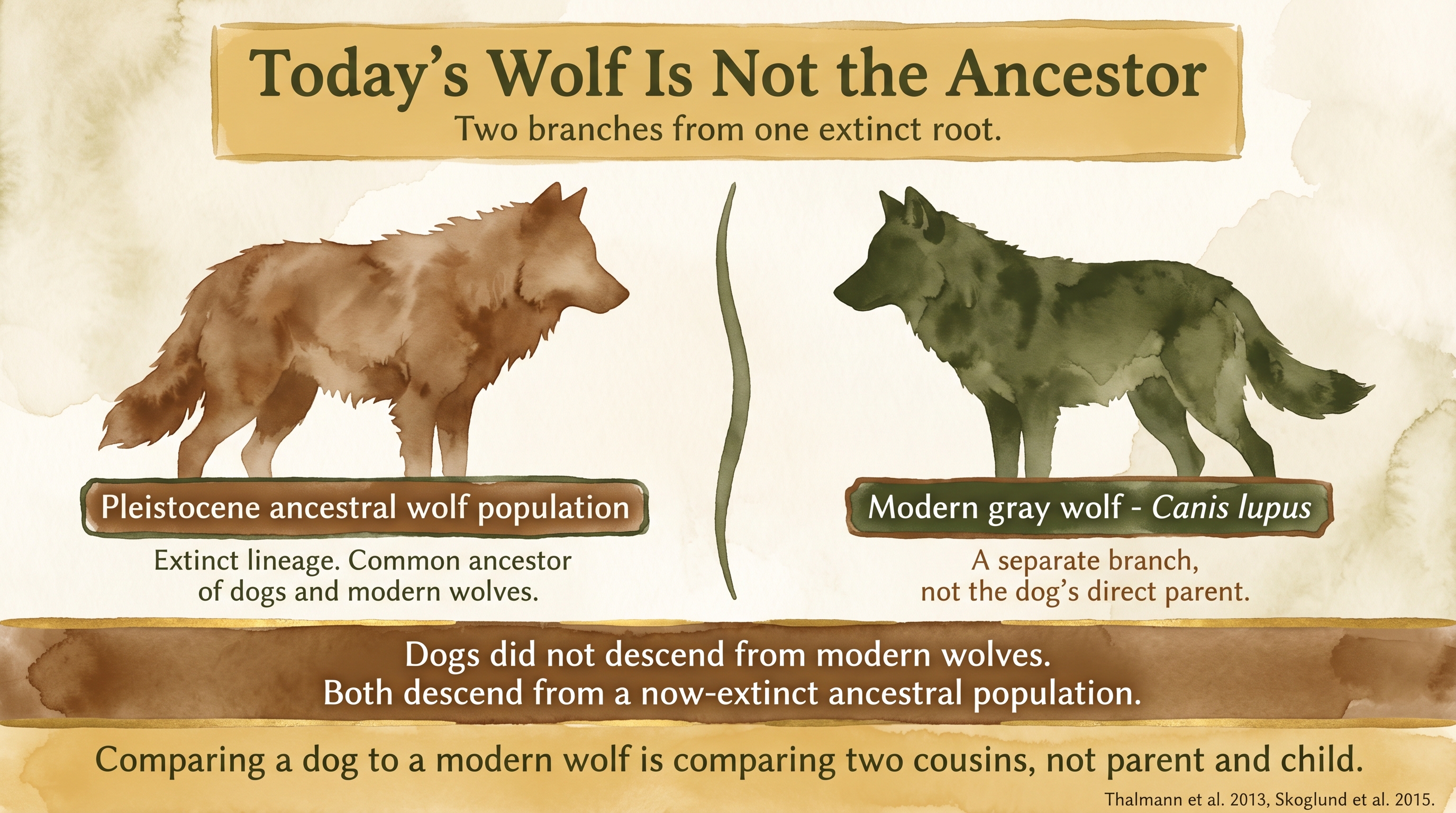
Comparing a dog to a modern wolf is comparing cousins, not parent and child.
Key Takeaways
- Modern gray wolves are not the dog's direct ancestors. Dogs and modern wolves are sister lineages.
- That distinction weakens simplistic wolf-based arguments about dog diet, motivation, and household social structure.
- Wolves remain useful comparators, but not as total blueprints for companion-dog life.
- For JB, this correction clears space for treating dogs as a distinct domesticated species rather than as household wolves.
The Evidence
This entry uses observed claim-level tags beyond the dedicated EvidenceBlocks below. These tags mark JB program observation or practice-derived claims that need dedicated EvidenceBlock coverage in a later content pass.
- Frantz et al. (2016)ancient dogs and wolves
Showed complex dog ancestry and helped move the field away from simple direct-ancestor readings. - Botigue et al. (2017)ancient European dogs
Supported continuity in ancient dogs while reinforcing the complexity of domestication history. - Bergstrom et al. (2022)72 ancient wolves and ancient dogs
Found no sampled ancient wolf that could be named the direct progenitor of domestic dogs. - Axelsson et al. (2013) plus later dog genomicsdogs and wolves
Showed dogs carry domestication-related biological adaptations that make strict modern-wolf substitution misleading.
No published study directly tests the practical implications of the modern wolf is not the ancestor of the dog for domestic dog raising programs. The application to household dog raising remains an interpretive synthesis rather than a directly tested intervention finding.
SCR References
Sources
- Frantz, L. A. F., et al. (2016). Genomic and archaeological evidence suggest a dual origin of domestic dogs. Science.
- Botigue, L. R., et al. (2017). Ancient European dog genomes reveal continuity since the Early Neolithic. Nature Communications.
- Bergstrom, A., et al. (2022). Grey wolf genomic history reveals a dual ancestry of dogs. Nature.
- Mech, L. D. (1999). Alpha status, dominance, and division of labor in wolf packs. Canadian Journal of Zoology.