Single-Origin vs Multiple-Origin Domestication Debate
The single-origin versus multiple-origin debate asks one of the most deceptively hard questions in dog evolution: did dogs emerge from one domestication event that later diversified, or did more than one wolf-derived population independently cross into dogness before later admixture blended the results? For a time, the multiple-origin case seemed especially strong. Frantz et al. 2016 argued for dual origins in eastern and western Eurasia based on genomic splitting between early dog lineages. Later work complicated that picture. Botigue et al. 2017 emphasized continuity in ancient European dogs. Bergstrom et al. 2020 supported a single origin followed by early diversification, and Bergstrom et al. 2022 used 72 ancient wolf genomes to show that no sampled ancient wolf was a direct match for dog ancestry even while dogs clearly carried deep structured ancestry. Added to that are newer claims from 2024 Japanese wolf genomic work and 2025 ancient dog analyses in Eastern Eurasia that connect dog ancestry shifts to human movement without fully resolving the initiating event. Documented
This is why the debate persists even in a field with much better data than it had a decade ago. Ancient DNA has not simply answered the question. It has made the question more precise, and therefore harder to settle cheaply.
For JB, that precision matters because the philosophy can use the evolutionary foundation without pretending the map pin or event count is already closed.
The debate is therefore valuable even when it stays unresolved. It forces everyone working in this area to separate what is securely known about dog-human coevolution from what is still provisional about geography, timing, and ancestry structure.
That separation is healthy because origin-count debates are especially vulnerable to overdrama. A paper about east-west ancestry structure can easily get retold as if the whole species story has been overturned overnight. In reality, most new findings refine the branching pattern without undoing the basic fact of deep dog-human evolutionary partnership.
What It Means
Why Multiple Origins Once Looked Plausible
The dual-origin argument gained traction because early genomic datasets revealed deep east-west structure in dogs that looked difficult to explain by one founding event alone. Frantz et al. 2016 interpreted that structure as evidence that eastern and western Eurasian dog populations may have arisen separately and later mixed. On that reading, one regional dog lineage may even have replaced another in some parts of the world.
This was not a wild claim. When lineages are deeply split and the archaeological record is sparse, independent domestication events are a real possibility. The dog story is not automatically obliged to be neat just because neatness is emotionally appealing.
Why the Single-Origin Case Strengthened
As datasets improved, some researchers found that a single origin followed by very early diversification and later admixture could explain much of the same pattern. Documented Botigue et al. 2017 pushed against a simple replacement model by showing continuity in ancient European dogs. Bergstrom et al. 2020 and related work supported one domestication origin with subsequent geographic structuring. Bergstrom et al. 2022 then went even deeper into ancient wolf diversity and still concluded that the exact progenitor population was unsampled, extinct, or both.
That move matters because it changes what "single origin" means. It does not mean one perfectly isolated founding pair in one perfectly known place. It means one initial domestication lineage or event cluster that later diversified, admixed, and spread in ways complicated enough to mimic multiple origins when the dataset is incomplete.
The origin-count debate changes the map details, not the larger point that dogs emerged through a long evolutionary relationship with humans and later diversified across human worlds.
What Ancient DNA Still Cannot Give Us
Ancient DNA is powerful, but it is not omniscient. It depends on what survives, what is sampled, and what comparative populations exist. Bergstrom et al. 2022 is a perfect example. An enormous ancient-wolf dataset clarified ancestry structure while also making clear that the direct ancestral wolf population has not been found. Documented That means even large genomic studies can rule out simplistic stories without yet handing us the final one.
This is where many public summaries go wrong. They treat the latest major paper as if it erases the previous decade. More often, each study narrows the range, shifts which hypothesis is favored, and reveals which missing samples still matter most. Observed-JB
The Honest State of the Debate
The center of gravity has moved somewhat toward single-origin or single-origin-plus-early-structure models, but the debate is not over. The location of the likely origin remains unresolved. East Asia, Central Asia, Siberia, and broader Eurasian frames all still appear in the literature. What has become harder to defend is the idea that any currently sampled modern wolf population is simply the ancestral source, or that one clean geographic slogan can summarize the full history.
So the best present-tense answer is modest. The evidence may lean away from strong dual-origin claims and toward a more unified origin story with later branching and admixture, but the decisive proof will require more ancient genomes from more places and times.
That modesty is not a failure of the field. It is what serious ancient-DNA work looks like when the sample map is still incomplete. Better evidence often narrows the question before it settles it, and that narrowing has already made several older oversimplifications much harder to defend.
One quiet benefit of this debate is that it keeps the field honest about complexity. A species can have one domesticated identity while still carrying deep ancestral structure, regional branching, and later admixture. Families therefore do not need a simplistic origin myth in order to understand why modern dogs can be both broadly similar and individually diverse.
Why It Matters for Your Dog
This debate matters to families because it shows what kind of certainty the domestication story can and cannot support. Ambiguous Many people want evolution to provide a single ancestral scene that explains everything about modern dogs. The single-versus-multiple-origin literature refuses that simplicity. Dogs may have one origin and still carry a deeply mixed history. They may have later lineages shaped by local human cultures, climate, and movement patterns while still belonging to one domesticated species history.
That matters in the home because it encourages a more realistic picture of variation. Modern dogs are not all copies of one ancestral type any more than humans are copies of one ancestral village. Population history matters. Breed formation matters. Selection after domestication matters. A Golden Retriever is therefore carrying both deep dog ancestry and much later, much more recent human selection layered on top of it.
The debate also protects families from overusing wolves as explanatory shorthand. If the exact ancestral wolf population is unsampled or extinct, then appealing to modern wolves as the definitive key to a pet dog's motives becomes even weaker. The comparison can illuminate broad canid continuity, but it cannot be treated as a direct identity claim. Your dog is not a delayed modern wolf. Your dog is the product of a domesticated lineage whose own branching history is still being reconstructed.
Another practical consequence is intellectual humility about ideological narratives. Some people want a single-origin story because it sounds cleaner and more "scientific." Others enjoy the drama of multiple origins because it sounds more epic. The dog in the kitchen does not care which emotional preference humans bring to the ancient DNA literature. What matters more for family life is the shared consensus underneath the debate: dogs evolved in close relation to humans and became distinct from wolves in biologically meaningful ways.
That shared ground is enough to shape raising. A species formed through long human association should be expected to care about human social structure, human emotional tone, and human predictability. Those claims do not depend on whether there was one origin event or two early domestication centers.
The debate can even help families understand why dogs vary so much across contexts. If early dog history included deep structure, admixture, and later human-linked migrations, then flexibility and diversity are part of the big story. That does not mean every difference in temperament comes from ancient population structure, but it does make it easier to understand why the species is broad and why later breed histories could build on such a flexible base.
Goldens again offer a useful example. Their specific temperament profile is recent in evolutionary terms, but it sits on top of an older domesticated architecture. So when a family sees strong human orientation in a Golden, they are looking at both layers at once: deep dog history and much later breed refinement. The single-versus-multiple-origin debate changes how we imagine the deepest layer, but not the fact that the layer exists.
Families can also learn a methodological lesson here. Good science often reduces false certainty before it delivers final certainty. That is what ancient DNA has done. It has made simplistic answers harder. In the long run, that is a gain, because a more honest origin story produces better reasoning everywhere else.
There is a practical emotional benefit to that honesty. Families do not need one sacred prehistoric vignette in order to trust the everyday reality that dogs are built for life with humans in ways wolves are not. Releasing the demand for a cinematic origin story often makes room for better observation of the actual domesticated animal in the house.
The debate also helps families see why modern dogs can be both one species and an extremely broad one. Deep ancestral structure followed by migration, admixture, and later breed formation helps explain why dogs share core social capacities while varying so widely in style, intensity, resilience, and working tendency. That breadth is part of the species story, not a contradiction of it.
This is useful in the home because it keeps variation from feeling like evidence against domestication itself. A dog can share the species-level social architecture and still express it through very different temperamental styles depending on breed history, individual biology, and environment. Complexity in ancestry is one reason that breadth should be expected rather than treated as suspicious.
That perspective keeps the history useful. Families can live well with unresolved branching details as long as they keep hold of the deeper truth that dogs emerged through long human association and still carry that history into the home.
What This Means for a Just Behaving Family
JB families do not need the origin-count debate fully settled in order to use it well. They need to understand that dogs belong to a domesticated lineage with complex ancestry and that modern wolves are limited comparators, not perfect ancestral stand-ins.
That helps the philosophy stay careful. JB can speak confidently about long human-dog evolutionary partnership while staying agnostic about whether the initiating event count was one or more than one.
Practically, this means the household should not build its posture on origin mythology. The useful takeaway is the broad one: dogs became a human-associated species through deep time, then diversified in ways that still leave modern ancestry patterns hard to untangle.
That broad takeaway supports the Evolutionary Foundation without forcing fake closure. It also reinforces Structured Leadership and Mentorship, because a human-associated species history makes the adult human role biologically meaningful rather than optional. Documented
It also protects JB from overreaching. The philosophy does not need to claim certainty about one ancient hearth or one exact founding event in order to speak coherently about dogs as a domesticated social species. Staying inside that boundary makes the larger argument more credible, not less.
For a family, this means the practical center does not move every time a new ancestry paper appears. Good raising still means offering a readable human world to a species shaped by long association with humans. The details of ancient branching may sharpen the history, but they do not overturn that working truth.
That is a reassuring kind of scientific humility. Families can stay curious about new data without becoming chronically destabilized by each revision in the origin map. The dog in the house remains a domesticated social species even while the earliest ancestral branching remains partly unresolved.
When families understand that, they stop waiting for a perfect prehistoric vignette to justify present-day good sense. They can raise the dog well on the strength of what the field already knows.
The debate remains worth following, but it does not need to be theatrically resolved for JB's larger argument to stand.
For JB, the right lesson is restraint with confidence. The map is still being refined, but the species picture is already strong enough to support calm, human-centered raising without pretending the ancestry file is closed.
That makes the debate useful even before it is finished. It keeps ancestry humble, but it leaves the practical species picture strong.
That alone makes the debate worth understanding.
It is still a worthwhile discipline in uncertainty.
That keeps curiosity alive without letting unresolved prehistory become a source of confusion in present-day raising.
That is still plenty to work with.
The distinction is useful.
That is enough.
Still useful.
Still important.
For now.
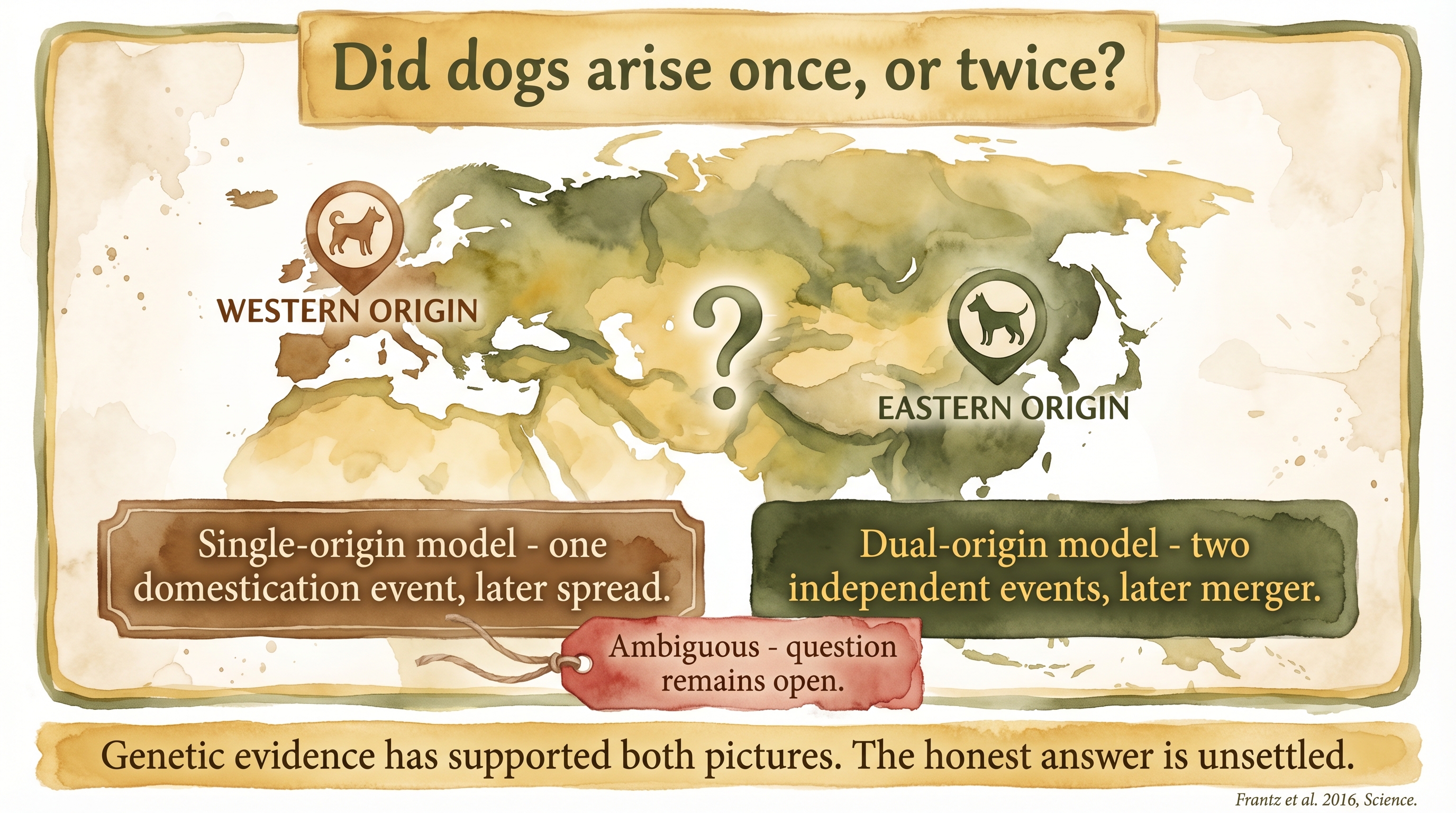
Genetic evidence has supported both pictures. The honest answer is unsettled.
Key Takeaways
- The multiple-origin case once looked especially strong, but later ancient-DNA work complicated that conclusion.
- Current evidence leans away from simple slogans and toward a picture of deep structure, admixture, and missing ancestral populations.
- The exact initiating event count is still unresolved, even as the field becomes more precise about what is unlikely.
- For JB, the debate matters mainly because it reinforces that dog origins are complex and that modern wolves are limited proxies for the ancestral source.
The Evidence
This entry uses observed claim-level tags beyond the dedicated EvidenceBlocks below. These tags mark JB program observation or practice-derived claims that need dedicated EvidenceBlock coverage in a later content pass.
This entry uses ambiguous claim-level tags beyond the dedicated EvidenceBlocks below. These tags mark claims where the literature remains unsettled or multiple interpretations coexist.
- Frantz et al. (2016)ancient dogs and wolves
Advanced a dual-origin model based on genomic and archaeological evidence across Eurasia. - Botigue et al. (2017)ancient European dogs
Argued against a simple replacement story by showing continuity in ancient European dog genomes. - Bergstrom et al. (2020, 2022)ancient dogs and 72 ancient wolves
Shifted the field toward a more structured single-origin or dual-ancestry reading while showing the direct progenitor wolf population is still unsampled. - integrated domestication literature
Concludes that the number and location of domestication events remain unresolved and require more ancient DNA.
No published study directly tests the practical implications of single-origin vs multiple-origin domestication debate for domestic dog raising programs. The application to household dog raising remains an interpretive synthesis rather than a directly tested intervention finding.
SCR References
Sources
- Frantz, L. A. F., et al. (2016). Genomic and archaeological evidence suggest a dual origin of domestic dogs. Science.
- Botigue, L. R., et al. (2017). Ancient European dog genomes reveal continuity since the Early Neolithic. Nature Communications.
- Bergstrom, A., et al. (2020). Origins and genetic legacy of prehistoric dogs. Science.
- Bergstrom, A., et al. (2022). Grey wolf genomic history reveals a dual ancestry of dogs. Nature.