When Were Dogs Domesticated?
The question "When were dogs domesticated?" sounds like it should produce a date. Instead, it produces three overlapping timelines that do not line up perfectly: genetic divergence between dog and modern wolf lineages, the appearance of clearly dog-like anatomy in the archaeological record, and the emergence of unmistakably domestic behavior inferred from burial context, proximity to humans, or later comparative biology. That is why the field can sound contradictory without actually being sloppy. Frantz et al. 2016, Botigue et al. 2017, and Bergstrom et al. 2022 all support deep divergence somewhere in the rough 20,000 to 40,000 year range. Bonn-Oberkassel, at about 14,000 years ago, remains the earliest widely accepted morphologically domestic dog burial. The Goyet canid, often placed around 36,000 years ago, remains controversial because its morphology and its place in the dog lineage are not universally accepted. Recent cranial work cited in the dispatch source review argues that distinctly dog-like skull morphology and substantial diversity were established by around 11,000 calibrated years BP, while direct genomic evidence from Veretye sits near 10,900 BP. Documented
So the safest summary is not a single number. It is a phased answer: lineage splitting likely began well before 15,000 years ago, the full emergence of clearly domestic dogs occurred later, and the interval between those events remains one of the most debated parts of the field. Ambiguous
That matters because timing is not trivia here. It changes which domestication stories remain plausible and which ones become harder to defend.
It also teaches a basic rule for reading this whole field: different kinds of evidence answer different timing questions, so apparent disagreement is often disagreement about threshold rather than about reality.
That is one reason the timing debate is more productive than it first looks. It forces the field to ask what stage of dogness is actually being dated each time a paper makes a claim. Without that question, readers can mistake different milestones for mutual contradiction.
What It Means
Archaeology and Genetics Are Not Measuring the Same Event
One major source of confusion is that fossils and genomes speak to different thresholds. Ancient DNA can identify lineage divergence before bones look clearly dog-like. Archaeology usually needs skeletal pattern, context, or both before a specimen is accepted as domestic. That means a genetic estimate of 25,000 or 30,000 years ago does not automatically contradict a 14,000-year-old burial being the earliest widely accepted domestic dog. Those markers are tracking different stages of the same long process.
The dispatch source review is explicit on this point because popular summaries often flatten it. If people treat genetic divergence and morphological domestication as identical events, they end up thinking one side of the field must be wrong. More often, the disagreement is about what counts as "a dog" at different phases.
The Archaeological Anchors
Bonn-Oberkassel remains central because it combines age, morphology, and context in a way many earlier candidates do not. A dog buried with humans around 14,000 years ago is hard to dismiss as an incidental wolf. Estimated That is why it often serves as the conservative anchor for "earliest clearly accepted dog." Goyet matters for the opposite reason. At roughly 36,000 years ago, it raises the possibility of much earlier dog-like canids, but its status is disputed and its interpretation has shifted across studies.
The lesson is not that archaeology knows nothing. It is that the further back we go, the harder it becomes to separate unusual wolves, early dogs, and populations sitting in between. Early domestication likely produced mosaics rather than sharp category lines.
The timing debate matters to JB because it shows domestication was a long evolutionary transition rather than a sudden invention. The relationship is ancient before it is formalized.
What Genetics Adds
Genetic work widened the time horizon considerably. Frantz et al. 2016, Botigue et al. 2017, and Bergstrom et al. 2022 all support substantial depth to dog-wolf divergence, even while differing on origin structure. Molecular clock estimates vary depending on calibration choices, reference populations, and assumptions about admixture. That variability is frustrating for people who want one clean date, but it is exactly what one would expect in a lineage shaped by gene flow, extinct source populations, and long transitional phases.
The most defensible takeaway from genetics is that domestication almost certainly began before the earliest uncontroversial dog burials. The more ambitious claim that one can pinpoint a single year or even a narrow millennium from genetic data alone remains much harder. Documented
Why Most Researchers Land in the Middle Range
Because the data streams do not converge on one neat point, many serious summaries now use a layered estimate. The process probably began sometime between about 20,000 and 35,000 years ago, with clearly morphologically modern dogs emerging by roughly 15,000 years ago. That middle position has the virtue of fitting both genetic depth and archaeological caution. It also preserves the strongest consensus point of all: dogs were domesticated before agriculture became the dominant human niche.
That last point is more important than the last decimal of any molecular clock. A pre-agricultural domestication process makes a purely farming-waste origin story too late on its own. Documented It pushes researchers toward hunter-gatherer ecologies, commensal tolerance, pup-adoption models, or multistage hybrids rather than a simple village-grain explanation.
That is why timing remains conceptually central even when the exact date range is unresolved. It filters which broader narratives survive.
It also keeps the origin story anchored in process instead of event. A lineage can begin diverging genetically, continue sorting ecologically around humans, and only later become archaeologically obvious as dog. Once that phased structure is accepted, many supposed contradictions in the literature become easier to understand.
That phased picture is also easier to live with conceptually. Families are accustomed to thinking in birthdays and thresholds, but evolution does not usually work that way. Dog timing makes more sense when understood as long sorting under human influence rather than as a single ancient moment when wolf instantly became dog.
Why It Matters for Your Dog
Timing matters for pet owners because it tells them what sort of human world shaped the species in the first place. If domestication began before settled agriculture, then dogs did not emerge inside suburban order, formal kennels, or even farming villages. They emerged inside older human social ecologies where movement, camp life, social dependence, and interspecies tolerance mattered enormously. That changes the plausibility of different stories about what dogs are for and how they became that way.
One practical consequence is that dogs should not be understood as animals made dog-like by recent human training sophistication. The deep timing of domestication means the human-dog partnership is ancient in species terms. Modern training systems are late arrivals on top of that ancient relationship. A Golden puppy who orients to people is expressing a lineage history that predates the training market by millennia.
The timing question also protects families from weak analogies to wolves. If the lineage split from modern wolves is tens of thousands of years deep, then a present-day wolf is not a living fossil showing families how their dog "really" is underneath civilization. Modern wolves and modern dogs have both continued evolving. Bergstrom 2022 reinforces this by showing that sampled ancient wolves do not simply hand us the direct ancestral population. The comparison remains informative, but it is not a time machine.
Another practical implication is ecological. A domestication process that began in mobile human worlds suggests dogs were selected to function in dynamic social settings, not only in static property boundaries. Documented That can help families understand why attachment, guidance, and environmental predictability remain so important. A dog lineage shaped across long coexistence with humans is likely sensitive to the quality of human social organization, not merely to material reward.
The timing debate also makes the market's pseudo-evolutionary certainty look thin. Owners are often sold sharp claims about "ancestral dogs" as if the story were already resolved. In reality, the field is still arguing about when early dogness crossed different thresholds. That does not weaken the science. It strengthens the case for humility. Families should be skeptical of anyone who uses a single imagined ancient date to justify modern ideological rigidity.
Goldens benefit from this clarification because the breed is often read through extremely recent lenses. People talk as if a family dog is basically a Victorian or postwar invention. Breed refinement is recent, but dog domestication itself is ancient. The traits that make Goldens workable companions rest on a far older background of domesticated sociality and human orientation.
Timing also matters because it tells families that development has always happened in phases. Domestication itself unfolded through stages, so it should not be surprising that puppyhood and adolescence do too. A dog can be deeply domesticated at the species level and still immature at the individual level. Understanding that can calm families who expect a puppy's social promise to appear as finished stability overnight.
The uncertainty in the timing question has another practical use. It teaches families to think in ranges and processes rather than in slogans. That style of thinking carries over into raising. Good households often make better decisions when they stop demanding absolute certainty and start working with the strongest available pattern.
In that sense, the timing debate is not a dry academic corner. It trains the right kind of realism. Dogs are ancient human partners, but their origin story is phased, messy, and still partially unresolved. That is a good preparation for raising one honestly.
That realism is useful because it makes families less vulnerable to sales rhetoric built on false evolutionary precision.
It also helps adults pace their own expectations. If species change itself unfolded through long transitions, there is nothing unscientific about expecting individual maturity to be gradual too. Families often become gentler and more consistent when they stop demanding instant finality from a dog whose whole evolutionary history argues against neat single-step transformation.
That process view can steady families in a very practical way. If dogness itself emerged through thresholds, long sorting, and gradual consolidation, then it makes sense that individual development also moves through layered transitions rather than through instant transformation. The history of the species quietly argues for patience with the puppy.
That long historical arc can also calm households in the present. A species formed through deep time beside people is not dishonored by slow development, gradual social maturation, or the need for patient guidance. In some ways those features are exactly what should be expected from a domesticated social animal still growing into itself.
What This Means for a Just Behaving Family
JB families should carry two timing truths at once. First, dog domestication is deep and ancient, which means the human-dog relationship is not a modern invention. Second, the exact timing of each stage remains debated, which means the philosophy should not pretend archaeology has settled every detail.
That combination helps keep JB intellectually clean. The broad evolutionary foundation is strong enough to matter. The last layer of chronological precision is not required to make the larger point that dogs were shaped through long coexistence with humans.
For the home, that means the adults can treat the dog as an ancient partner species while still respecting that development remains gradual. A puppy is not a finished expression of the lineage. The household still has to provide the conditions that let domesticated capacities mature cleanly.
Mentorship and Structured Leadership fit well inside that picture. A species formed through prolonged human association should not be raised as if the human role were incidental. The exact year domestication began is less important in the home than the reality that the process was long enough to shape what dogs are.
JB should therefore use timing as foundation, not as theater. It helps explain why the relationship is old, why wolf analogies are limited, and why humility belongs in how we speak about evolutionary evidence.
That same discipline belongs in daily life. Adults do not need to weaponize ancient dates in order to justify good raising. They only need to understand that the dog in front of them comes from a very long human-associated history, which makes calm guidance and relational steadiness more plausible than rank mythology or pure mechanization.
For JB, that creates a useful kind of confidence. The exact millennium can remain debated while the broader practical conclusion stays strong: this is a species with deep time in human company, and that deep time gives adult behavior unusual developmental significance. Ambiguous
That is enough for the timing question to matter. It places the dog in history correctly and keeps the philosophy from reaching beyond what the field can actually say.
That combination of historical seriousness and rhetorical restraint is exactly what this category is supposed to model.
That historical patience belongs in the home as well.
That is more than chronology. It is a way of learning patience from the species story itself.
That alone can improve expectations.
History can teach patience.
That is a modest lesson, but a helpful one for families trying to think in processes instead of slogans.
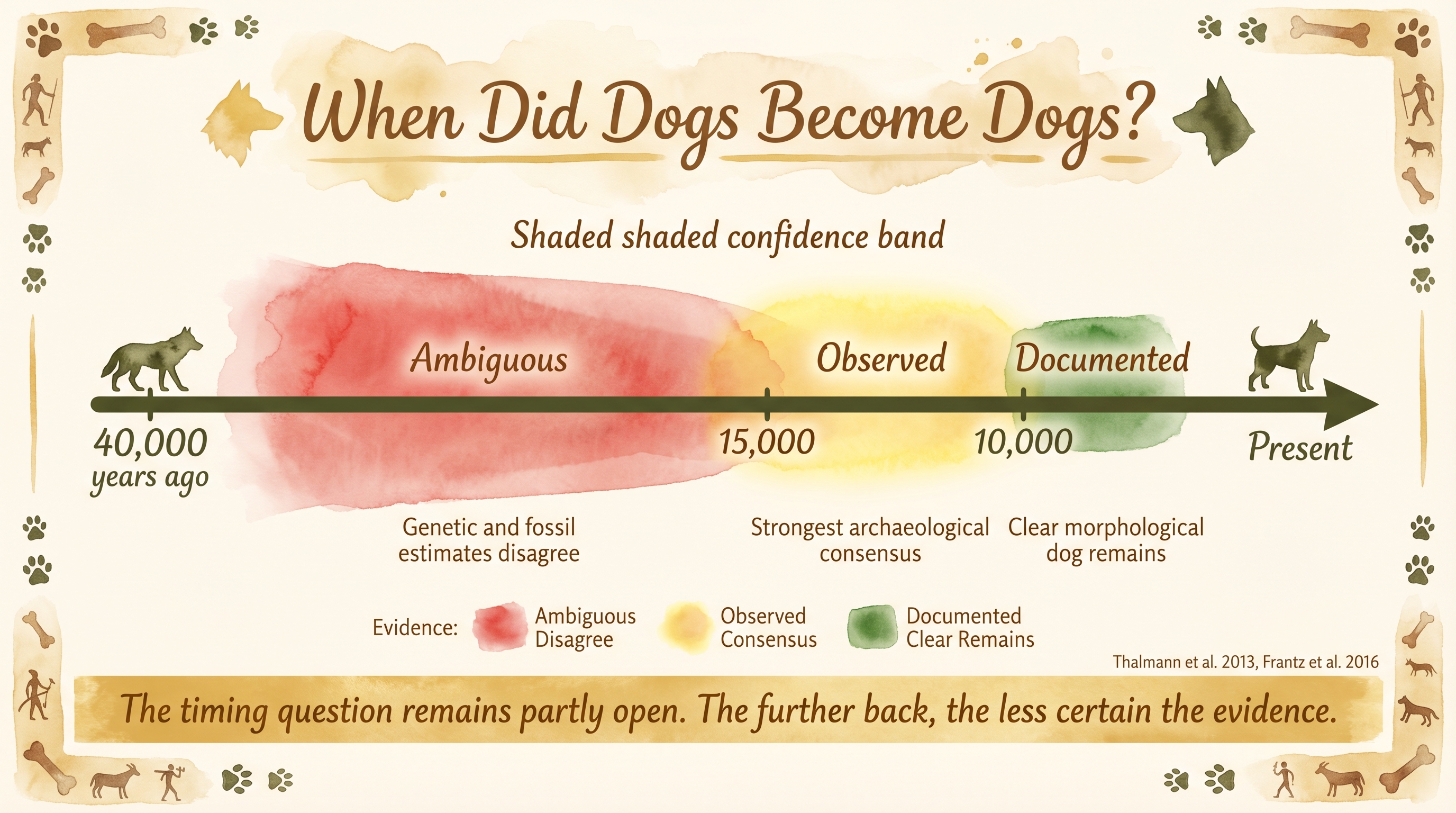
The timing question remains partly open. Further back, less certain.
Key Takeaways
- The timing question has no single agreed date because genetics, morphology, and archaeology measure different thresholds.
- The safest current summary is that domestication began well before agriculture and clearly predates the earliest accepted dog burials.
- Bonn-Oberkassel remains the conservative archaeological anchor, while Goyet remains important but disputed.
- For JB, the main significance is that the human-dog relationship is ancient, phased, and older than any modern training framework.
The Evidence
This entry uses estimated claim-level tags beyond the dedicated EvidenceBlocks below. These tags mark approximate ranges or timing claims that should remain bounded by the cited sources.
This entry uses ambiguous claim-level tags beyond the dedicated EvidenceBlocks below. These tags mark claims where the literature remains unsettled or multiple interpretations coexist.
- Bonn-Oberkassel evidenceancient dog remains
Provides the earliest widely accepted morphologically domestic dog at roughly 14,000 years ago. - Frantz et al. (2016), Botigue et al. (2017), and Bergstrom et al. (2022)ancient dogs and wolves
Support deep lineage divergence preceding the earliest uncontroversial domestic-dog burials. - Goyet canid debatesPleistocene canids
Show that very early dog-like specimens remain actively contested rather than universally accepted. - integrated domestication literature
Argues for a phased interpretation that separates genetic divergence from full morphological domestication.
No published study directly tests the practical implications of when were dogs domesticated? for domestic dog raising programs. The application to household dog raising remains an interpretive synthesis rather than a directly tested intervention finding.
SCR References
Sources
- Frantz, L. A. F., et al. (2016). Genomic and archaeological evidence suggest a dual origin of domestic dogs. Science.
- Botigue, L. R., et al. (2017). Ancient European dog genomes reveal continuity since the Early Neolithic. Nature Communications.
- Bergstrom, A., et al. (2022). Grey wolf genomic history reveals a dual ancestry of dogs. Nature.
- Sutter, N. B., et al. (2025). Cranial morphometric analysis of canid skulls spanning 50,000 years. Journal of Human Evolution.