Livestock Guardian Dog Traditions
Livestock guardian dogs are one of the clearest counterexamples to the idea that reliable dog behavior must be manufactured primarily through formal training systems. The tradition stretches across Eurasia and the Mediterranean, with regional lineages such as the Great Pyrenees and Pyrenean Mastiff, the Maremma, the Kangal and Akbash, the Caucasian Ovcharka, the Central Asian Shepherd, and related mountain and steppe guardian dogs. Raymond and Lorna Coppinger's field and working-dog writing repeatedly emphasized that guardian behavior is produced chiefly by developmental placement: the puppy is bonded to livestock early, grows up among stock, observes older guardian dogs, and matures into the role. Robin Rigg's reviews of livestock guarding dogs described the same practical tradition across pastoral systems, while applied predator-management studies by Gehring and colleagues showed that guardian dogs can measurably reduce depredation in modern settings. The common thread across old and new literature is striking. The guardian dog is formed by a life with the flock, not by a curriculum designed in a classroom. Documented
That fact matters because LGDs are not marginal. They are one of the oldest, most successful, and most economically consequential working dog types in human history.
They also reveal something important about development. A puppy becomes a guardian because the environment assigns identity early and reinforces it continuously through proximity, routine, adult example, and social consequence.
For JB, this is one of the most concrete real-world cases where "the environment is the method" stops sounding philosophical and starts sounding empirical.
It is hard to overstate how unusual that is in modern dog conversation. Here is a historically durable, economically serious, scientifically examined working-dog tradition whose central developmental logic is placement, bonding, and repeated life in context rather than a stack of abstract lessons.
What It Means
The Role Begins with Bonding, Not with Obedience
Traditional guardian-dog rearing usually starts by placing the puppy with sheep, goats, or other livestock at a young age. The point is not merely exposure. The point is social attachment and identity formation. Coppinger's work argued that the guardian pattern emerges when the developing dog treats the flock as its social field rather than as prey or irrelevant background. That is a radically developmental way of thinking about dog function. The human does not first install a long behavior list and then assign the dog to stock. The stock and the working environment are present during development.
This is why LGDs are such an important challenge to modern training assumptions. Some of the most reliable dogs in the world are raised into their role rather than instructed into it.
Adult Dogs and the Flock Provide the Ongoing Curriculum
Pastoral traditions rarely depend on a puppy alone. Mature guardian dogs are often already in the system, modeling territorial movement, barking patterns, predator assessment, and calm coexistence with stock. Livestock themselves also function as social anchors. The puppy learns which beings belong, which spaces matter, and what sort of vigilance is required by living inside the role from the start. Rigg's reviews and Coppinger case material both stress that inappropriate human socialization can interfere with this process, which further highlights how role specificity is built developmentally.
That is a very different teaching picture from the modern "teach first, generalize later" model.
Guardian Function Depends on Low-Drama, Repeated Behavior
A guardian dog is not primarily valuable because it performs flashy sequences. It is valuable because it stays, patrols, notices, blocks, barks, and establishes presence consistently over time. JB's communication source base notes that body blocking and spatial pressure are heavily documented in LGD environments. Predator deterrence often works because the guardian dog occupies space and changes the predator's cost landscape before a violent event occurs. This makes LGDs especially relevant to thinking about prevention and indirect social pressure.
The ecology of the job rewards constancy, low-arousal watchfulness, and early interruption more than theatrical intensity.
Livestock guardian traditions are one of the strongest working-dog examples of prevention in action. The dog's value lies less in reacting after harm and more in shaping the environment so that predation is less likely to occur at all.
Modern Evaluation Still Supports the Old Developmental Insight
Contemporary predator-management studies did not erase the older logic. Documented They often strengthened it. Gehring's work and related evaluations show that guardian dogs can reduce depredation, but successful programs still depend heavily on matching dog type, rearing method, stock exposure, and management context. In other words, even modern evidence keeps circling back to environment and development. The dog is not a generic technology that can simply be dropped into any context after technical training.
That makes LGDs more than a pastoral curiosity. They are a durable demonstration that the way a dog is raised into a niche determines what kind of adult it becomes.
They also show that stability can be productive without being flashy. A guardian dog's reliability comes from repetition, low-drama vigilance, and ordinary embeddedness in a role. That is a very different image of canine excellence from the one celebrated by much modern pet culture.
A further implication is that role clarity reduces internal conflict. Guardian dogs are not constantly asked to switch identities minute by minute. They belong somewhere, know what beings are theirs, and learn a stable social job. That stability is part of why the tradition is so instructive for companion homes.
LGDs make one lesson unusually hard to miss: dogs become steadier when the social world around them is steadier. That principle travels.
Why It Matters for Your Dog
For families, livestock guardian dogs may seem remote from ordinary companion life, but the developmental lesson is extremely close to home. LGDs show that one of the world's most reliable dog roles is produced by early social placement, environmental continuity, and adult example rather than by training culture alone. Documented That should make families much more attentive to what the home is socializing the puppy into every day.
A Golden Retriever is not a Maremma, and no one should pretend otherwise. Yet the underlying principle travels. A puppy becomes what its daily world repeatedly teaches it to belong to and care about. If an LGD learns flockness by living with flock animals, a family dog learns householdness by living inside a stable human social order. That means the family home is not a neutral backdrop. It is the role-making environment.
This changes how adults think about behavior problems. Documented When a dog is disorderly, many families reach immediately for technique. The LGD example suggests that a better early question is: what identity and rhythm has this dog actually been raised into? A puppy raised into chaos, chronic excitement, and weak boundaries may not need more commands first. The puppy may need the household itself to become more coherent.
Goldens make this lesson unusually usable because they are so relational. They take social assignment seriously. If the home makes them the baby, the entertainer, the emotional sponge, or the center of all movement, they will often develop accordingly. If the home makes them a calm participant in family routine under steady adult guidance, they usually develop very differently.
The guardian tradition also helps families rethink what leadership should look like. The successful shepherd does not usually create a guardian by staging daily dominance contests. The shepherd provides placement, repetition, boundaries, and an environment where the right behavior has somewhere to grow. That is a powerful alternative image for family dog raising.
Another practical gain is respect for low-drama competence. Guardian dogs are valuable because they are steady. Families frequently under-value steadiness because it is less visible than tricks and less exciting than speed. The LGD record suggests that steadiness may be the deeper foundation of reliable adult behavior.
This tradition also reinforces the importance of prevention. Guardian dogs do not wait for catastrophe as their main job description. They create conditions that make catastrophe less likely. Companion households can borrow that logic by organizing rest, access, greeting patterns, food management, and social exposure so that trouble is less likely to build in the first place.
The caution remains. LGD traditions can involve rough conditions, selective breeding pressures, and management demands that do not belong in a suburban home. The transferable lesson is not the whole pastoral world. The transferable lesson is that ambient role-building works.
That is a large practical gift. It tells families that mature function grows best where life itself is aligned with the role they hope the dog will inhabit.
It also suggests that role confusion may be one of the hidden welfare problems of companion homes. A dog who is pulled back and forth between mascot, baby, athlete, and amusement device may never receive the steady developmental message that guardian dogs receive so clearly. Families can use the LGD example to become more deliberate about what kind of presence they are actually asking the dog to become.
That does not make the family home a pasture. It makes the family responsible for creating the same kind of developmental coherence that the pasture provides so naturally: stable place, repeatable belonging, meaningful boundaries, and adults whose behavior does not keep changing the job description.
It also reminds the household that belonging has to be made concrete. A dog understands role less through slogans than through repeated placement. Where the dog rests, what the dog accompanies, what gets protected from chaos, and how adults respond to ordinary life all help define what kind of animal the dog is being raised to become.
That is a demanding household project, but it is much more realistic than imagining the dog can be methoded into deep role coherence after the fact.
The family translation is straightforward even if the context is different. Make the dog's role in the home clearer, more stable, and less contradictory. Let belonging be repeated in place, routine, and expectation. The guardian record suggests that consistency of social assignment may be doing far more developmental work than modern households often appreciate.
A family can borrow that principle by making the dog's place in domestic life less contradictory. The clearer the social assignment, the easier it is for maturity to consolidate instead of constantly being pulled back into confusion.
What This Means for a Just Behaving Family
JB families should treat livestock guardian traditions as one of the strongest cross-cultural supports for environment-first raising. Here is a major working-dog tradition where the puppy becomes reliable largely through developmental placement, adult example, and repeated lived context.
Mentorship, Prevention, and Structured Leadership all find real traction here. Adult dogs matter. The organizing human matters. The environment matters. Harm is reduced most effectively by shaping conditions early instead of waiting to react after failure.
For a family home, the practical translation is not to imitate a sheep pasture. It is to understand that the dog's role in the household is formed by daily placement. Where the puppy rests, what the puppy follows, what the puppy watches, what the adults normalize, and what the adults prevent all matter enormously.
JB should still keep the evidence ceiling explicit. LGD literature documents development-through-placement and nontrivial predator-control outcomes. The further claim that the Five Pillars name the universal logic beneath those outcomes is a JB interpretation rather than a direct field statement from the pastoral literature.
Even with that limit, the lesson is unusually forceful. If one of history's most reliable working dogs is built mainly by ambient life, the modern household should take ambient life much more seriously.
That is why the LGD tradition remains so strategically valuable for JB. It demonstrates at scale that reliable canine function can emerge from developmental coherence rather than from method saturation. Even if the home role is different, the underlying lesson about formation remains powerful.
In that sense, guardian traditions are one of the strongest real-world reminders that development can do work no protocol can fully replace later. Documented
That is the lasting lesson of guardian traditions. They show that developmental coherence can produce trustworthiness at scale, which is exactly why they keep surfacing in any serious challenge to the idea that formal training culture is the primary source of adult canine function. Documented
That is one reason guardian traditions keep surfacing in serious dog arguments. They provide a concrete, high-stakes example of development shaping behavior more deeply than modern method culture often acknowledges.
It is also a reminder that reliability is usually grown before it is displayed. That developmental order is one of the most important lessons the tradition offers modern homes.
Families can use that order as a steadying principle. Reliability usually grows from living in a coherent role before it appears as visible performance, and that sequence is worth protecting carefully in family life too. The family does not need a pasture to understand the lesson. It needs enough steadiness to let the lesson take hold.
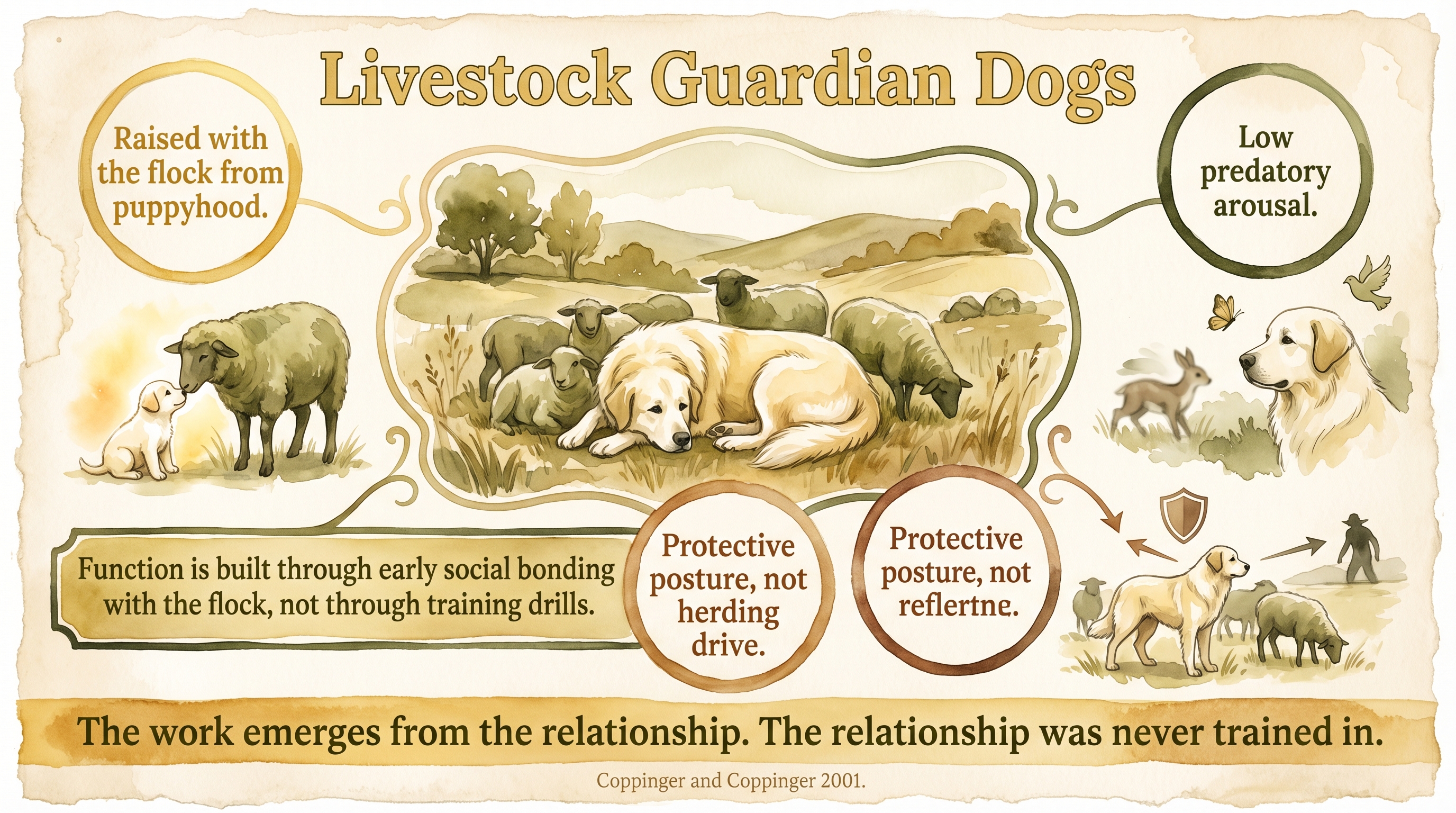
The work emerges from the relationship. The relationship was never trained in.
Key Takeaways
- LGDs are one of the clearest cases where environment is the method.
- Early social bonding to stock is central to guardian identity and function.
- The adult dog and the flock together provide the ongoing curriculum.
- For JB, LGDs offer strong real-world support for development-first role formation, especially around Prevention and Mentorship.
The Evidence
- Coppinger and Coppinger (1995, 2001, 2016)livestock guardian dogs
Argued that guardian behavior is chiefly a developmental product of early placement with livestock and correct social bonding. - Rigg (2001, 2002 reviews)livestock guardian dogs across pastoral systems
Described the broad traditional use of LGDs and the importance of appropriate rearing context. - Gehring et al. applied predator-management studiesguardian dogs and livestock
Found that LGDs can reduce depredation in modern contexts when matched and managed appropriately. - JB canine communication source setworking guardian dogs
Documents body blocking, patrolling, and spatial disruption as central nonlethal components of LGD function.
No published study directly tests the practical implications of livestock guardian dog traditions for domestic dog raising programs. The application to household dog raising remains an interpretive synthesis rather than a directly tested intervention finding.
SCR References
Sources
- Coppinger, R., and Coppinger, L. (1995). Interactions between livestock guarding dogs and wolves. In Ecology and Conservation of Wolves in a Changing World.
- Coppinger, R., and Coppinger, L. (2001). Dogs: A New Understanding of Canine Origin, Behavior, and Evolution.
- Coppinger, R., and Coppinger, L. (2016). What Is a Dog?
- Rigg, R. Livestock guarding dogs: their current use worldwide.
- Gehring, T. M., VerCauteren, K. C., and Landry, J. M. Applied studies on livestock protection with guardian dogs.