Indigenous Hunting Partnerships with Dogs
Indigenous and subsistence hunting partnerships with dogs are among the oldest and most ecologically serious human-dog relationships on Earth. Jeremy Koster's 2009 review of hunting dogs in the lowland Neotropics argued that dogs can substantially improve hunting returns for particular prey types and that they remain widely used across tropical forest societies. Koster and Tankersley reported that among Mayangna and Miskito hunters in Nicaragua, dogs accompanied a large share of day hunts and contributed materially to mammal harvest success. Cross-cultural comparative work cited by Lord 2021 and Kirby 2023 places those partnerships in a broader frame: hunting dogs appear across multiple Indigenous and traditional societies, including lowland South and Central America, northern hunting cultures, and parts of Asia, and they are usually raised through companionship in ordinary work life rather than through modern method packages. Serpell 2021 emphasized that the dog's practical role in human subsistence is historically foundational, not peripheral. Ethnographic parallels from the Makushi, Ainu, Evenki, and other hunting societies vary in detail, but they converge on one broad fact: dogs become hunting partners by growing up in hunting worlds. Documented
That sentence matters because it corrects how modern households think skill develops. Hunting dogs in these traditions are not usually assembled by certification bodies, isolated lesson plans, or an endless appetite for abstract obedience. They learn because the work is around them, older dogs are around them, capable humans are around them, and the role exists as a normal part of life.
This does not mean all traditional hunting dog practices are humane by modern standards. Mortality can be high, food may be inconsistent, and correction may sometimes be harsh. The relevant lesson is narrower and more important: functional working dogs often arise from ambient developmental immersion more than from formal method culture.
That is why this entry matters for JB. It does not prove the Five Pillars directly. It does show that one of the oldest practical dog roles on Earth is built through mentorship, participation, and environmental fit. Documented
What It Means
Hunting Dogs Are Raised Into a Role
Koster's synthesis of lowland Neotropical hunting makes the central point vividly. Dogs are useful because they track, flush, corner, trail, and help recover prey in dense habitats where humans alone are less efficient. Yet the important developmental point is how they get there. Puppies accompany hunters. They move with older dogs. They experience the sounds, terrain, scents, and rhythms of the hunt from an early age. Their education is embedded in participation.
That differs sharply from the modern tendency to imagine skill as something transferred mainly through decontextualized lessons. In many subsistence contexts, the role itself teaches.
Adult Dogs Often Carry the Local Knowledge
The hunting literature repeatedly suggests that not all dogs are equally capable and that talent is recognized socially. Documented Koster notes that good hunting dogs often receive preferential care. That fact is interesting for two reasons. First, it shows humans are not indifferent to quality. Second, it implies that the skill of the older successful dog matters enough to shape breeding, sharing, and ownership patterns. Ethnographic sources from the Neotropics and elsewhere also describe dog exchange between households, which suggests recognized hunting ability is culturally legible.
This matters because mentorship is not only human-to-dog. In many hunting contexts, adult dogs are part of the apprenticeship ecology.
Formal Method Is Often Secondary
The key historical contrast is not that nobody ever corrects, rewards, or handles hunting dogs intentionally. Of course they do. The contrast is that formalized method is not the heart of the system. Koster's review explicitly notes wide cross-cultural variation in care and training, but the dominant pattern is not a training-school pattern. Serpell's wider anthropological writing supports the same conclusion. Dogs are integrated into labor and subsistence before they are integrated into explicit pedagogy.
That is a very important correction for modern dog thought. The world's long-running evidence base for useful dogs does not begin with professionalized training culture. It begins with shared life and repeated work.
Indigenous hunting partnerships do not experimentally prove the Mentorship pillar, but they provide one of the clearest cross-cultural examples of dogs learning complex work through accompaniment, observation, and life beside capable adults rather than through isolated method stacks.
The Record Requires Moral Honesty
A disciplined account must also name the costs. Hunting dogs in subsistence contexts can be underfed, injured, exposed to predators, or culled. Some traditions use correction in ways a JB home would not imitate. High mortality is a recurring theme in Koster's Neotropical review. So the lesson is not that traditional hunting partnerships are uniformly ideal. The lesson is that the developmental pathway to usefulness is different from the one modern commercial dog culture often markets.
That difference is the thing worth learning from.
It is also what makes the hunting-dog record so strategically important. If dogs can acquire genuinely high-stakes useful behavior in ecologically demanding contexts through immersion and accompaniment, then the modern assumption that formal methodology is the necessary birthplace of competence becomes much harder to defend. Documented
A second implication is that competence grows best where the task is visible and repeated. Hunting cultures do not usually ask the dog to store behavior in abstraction for long stretches and then retrieve it only when cued in artificial drills. The work lives in the day, which makes the day itself educative.
The deeper lesson is that competence is often absorbed through participation before it is abstracted into method. That is an important reversal for modern homes to take seriously.
Why It Matters for Your Dog
For families, Indigenous hunting partnerships matter because they shatter a common assumption: that complex dog competence must be built mainly through explicit technical instruction. Hunting dogs in these traditions often learn in the middle of ordinary practice. That does not make training irrelevant, but it does make ambient exposure and adult example look much more important than many pet households realize.
This is useful even for a suburban Golden with no hunting job. A family dog also becomes what daily life teaches. If dogs in real working partnerships acquire reliable role behavior through accompaniment and repeated immersion, then the home should take seriously what its own routines are teaching. Documented A puppy watching adults move through the kitchen, yard, car rides, guests, and calm transitions is learning a role too.
Goldens make this especially concrete because many lines still retain strong social orientation and retrieve-chase patterns. Families often imagine that because the dog is not doing field work, the developmental principles behind working competence no longer matter. The hunting record suggests otherwise. A dog becomes coherent through living inside coherent practice.
Another practical lesson is that adults should stop underestimating the power of example. Modern pet culture often talks as if the dog learns only when humans deliberately "train." Hunting partnerships imply a wider field. The dog learns by following, witnessing, attempting, failing, and adjusting in context. That is a more serious developmental picture than the modern session model alone.
The record also helps families think better about intensity. Dogs doing real work are not usually sustained by nonstop excitement. They spend much of life waiting, moving, and then acting when context demands it. That should make pet homes suspicious of approaches that depend on permanent hype to keep the dog "engaged." Real usefulness often sits on top of steadier baseline states.
A second benefit is clarity about relationship. Hunting dogs are not typically treated as autonomous equals in a sentimental sense. They are valued partners, but the relationship includes expectation, role, and practical coordination. That combination can help modern families hold affection and structure together instead of imagining they must choose.
This literature also weakens the fantasy that knowledge always begins with human verbal explanation. In many hunting contexts, the terrain, the older dog, the prey, and the repeated outing are all teachers. Pet households can borrow that principle by giving dogs more meaningful participation and less artificial abstraction. Walks can become observation. Routines can become instruction. Adult steadiness can become curriculum.
The moral caution remains important. No family should use this literature to justify neglect, hunger, or rough treatment. The transferable lesson is not hardship. The transferable lesson is immersion. Dogs often become useful because they are raised inside a real world where their role is visible and repeated.
That is a deeply helpful lesson for companion homes. Even when the role is not hunting, the same developmental logic applies. The dog needs a coherent place in the life of the group.
This also suggests a better standard for household guidance. Instead of evaluating the dog mainly by how it performs in artificial episodes, families can ask whether the dog is learning how to accompany adults through ordinary life with increasing steadiness and role awareness. Documented That is much closer to the kind of learning the hunting literature describes.
That comparison also encourages humility about what counts as a serious lesson. A calm walk beside adults, a steady wait during household work, or quiet observation of routine may be more developmentally meaningful than households assume. Hunting-dog evidence gives those ordinary apprenticeship moments more status.
It also means the family should stop dismissing ordinary apprenticeship moments as if they were secondary to "real training." The cross-cultural record suggests they may be far closer to the real engine.
A companion household can apply that without pretending to be a subsistence camp. The transferable principle is that role, steadiness, and repeated accompaniment are developmental teachers. When those teachers are absent, adults often try to replace them with method intensity. The hunting record suggests that replacement is usually incomplete.
This also means the household should not underestimate the educational value of ordinary shared action. Following adults through meaningful routine may teach the dog more about role than a great deal of abstract rehearsal ever will.
The same principle can reshape how a family thinks about puppyhood. The young dog does not only need planned exercises. It needs repeated access to adults moving through meaningful life with steadiness. That is a different standard from entertainment-heavy dog culture, and the hunting record suggests it may be a more serious one.
What This Means for a Just Behaving Family
JB families should read Indigenous hunting partnerships as strong historical support for Mentorship. One of the oldest practical dog relationships on Earth depends heavily on dogs learning alongside adults in ordinary work life.
The implication for a family home is not to manufacture a hunting culture. It is to stop underestimating ambient teaching. A puppy should grow up near competent adults, meaningful routines, and clear expectations instead of being treated as a disconnected project.
Structured Leadership also fits naturally here. Hunting dogs are valued and cared for, but they are not centered as playmates. They live in a relationship with role clarity. That is far closer to JB's parent-like framing than to modern permissive companion ideology.
JB should still keep the evidence boundary explicit. The ethnographic and ecological record documents accompaniment, role learning, and limited dependence on formal method. The further claim that this validates the full JB philosophy remains interpretive.
Even with that limit, the lesson is powerful. Functional dogs often emerge where life itself is structured enough to teach them.
For a JB family, that means the best question may not be "What is the dog being taught today?" but "What sort of life is teaching the dog every day?" The hunting record gives that question a great deal more authority than modern training culture usually does.
It also keeps one big principle in view: when life itself is structured enough to teach, the dog does not need every important capacity to be manufactured in artificial episodes. That is a disruptive lesson for modern method culture and a helpful one for families.
That is why this entry belongs in Category 7. It pushes the evidence base away from ideology and back toward lived developmental reality.
What makes this literature matter so much to JB is that it turns accompaniment from a sentimental preference into a historically serious developmental mechanism. Even when the household role is different, the structure of learning-through-life remains a powerful analogue.
That does not make life itself sufficient in every case. It does make life itself central. The hunting record repeatedly suggests that once the world is organized to teach, the dog can learn far more from participation than modern method culture usually expects.
That gives families a strong reason to respect the ordinary apprenticeship hidden inside domestic routine. The work may differ, but the developmental logic still travels well across contexts and households, especially where adults live the role clearly and steadily. That is one reason the hunting record feels so current even when the setting is historically or geographically far away. It still generalizes.
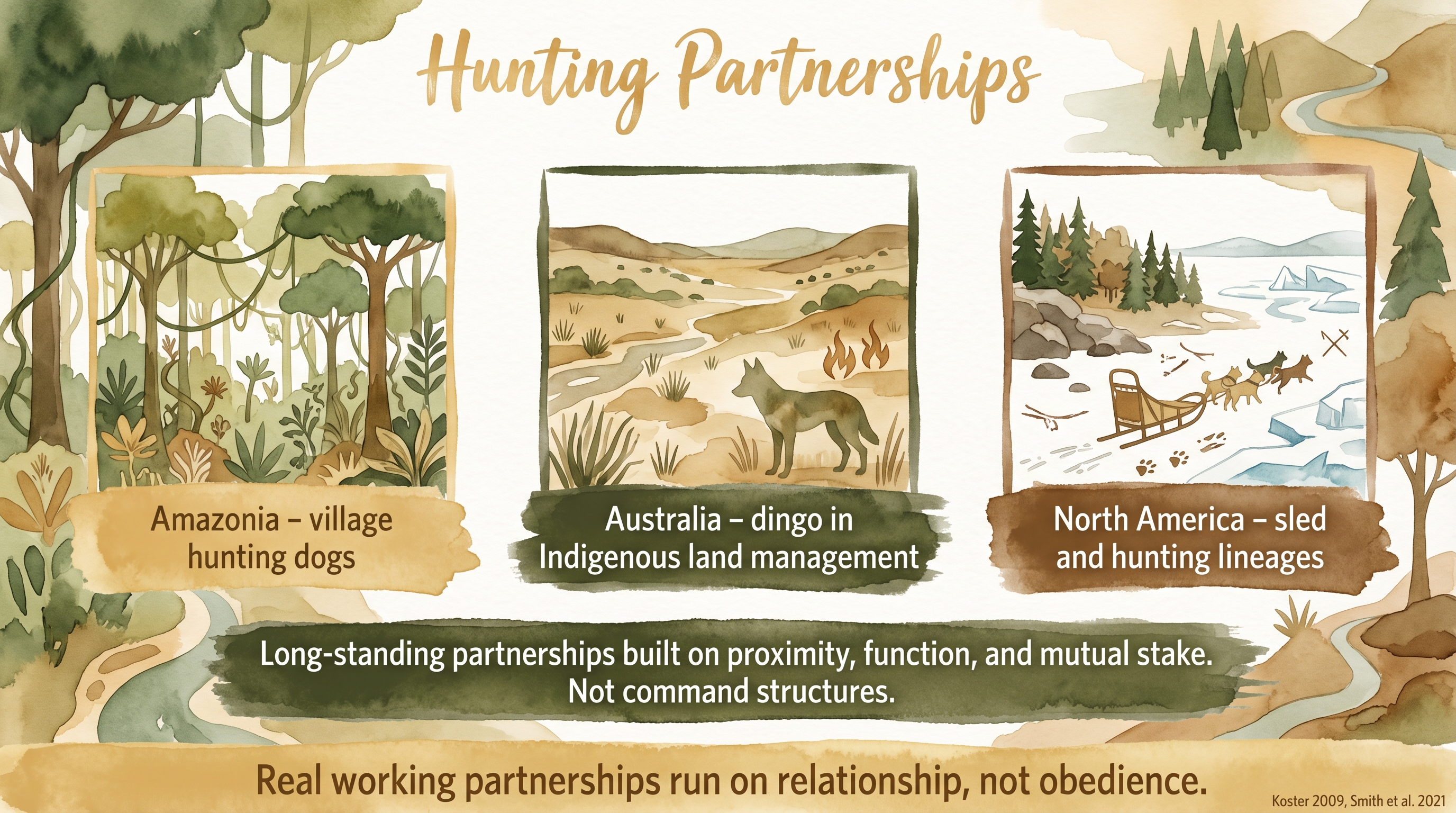
Real working partnerships run on relationship, not obedience.
Key Takeaways
- Hunting dogs in traditional contexts usually learn in the middle of work rather than in modern training-school conditions.
- Adult dogs and capable humans both appear to be part of the apprenticeship environment.
- The moral lesson is not to copy hardship but to respect immersion, role clarity, and daily participation as developmental forces.
- For JB, this is one of the strongest cross-cultural parallels supporting Mentorship.
The Evidence
- Koster (2009)lowland Neotropical hunting dogs
Reviewed widespread use of dogs in subsistence hunting and found that dogs can improve returns for several prey types. - Koster and Tankersley (2012)Mayangna and Miskito hunters and dogs
Reported substantial contribution of dogs to day hunts and mammal harvest success in Nicaragua. - Serpell (2021)cross-cultural dog roles
Argued that dogs have long occupied indispensable practical roles in human life beyond modern pet sentiment. - Kirby and colleagues (2023)global cross-cultural sample
Showed that working roles such as hunting predict different treatment patterns from companion-only roles.
No published study directly tests the practical implications of indigenous hunting partnerships with dogs for domestic dog raising programs. The application to household dog raising remains an interpretive synthesis rather than a directly tested intervention finding.
SCR References
Sources
- Koster, J. M. (2009). Hunting dogs in the lowland Neotropics. Journal of Anthropological Research.
- Koster, J. M., and Tankersley, K. Hunting success with dogs among Mayangna and Miskito hunters in Nicaragua.
- Serpell, J. A. (2021). The indispensable dog. Frontiers in Psychology.
- Chira, R. M., Kirby, K. R., et al. (2023). Function predicts how people treat their dogs in a global sample. Scientific Reports.
- Lord, K. A. (2021). Most Dogs Are Not NATIVE Dogs. Integrative and Comparative Biology.