Hare 2002: Pointing Comprehension in Dogs
Brian Hare, Michelle Brown, Christina Williamson, and Michael Tomasello's 2002 Science paper, "The Domestication of Social Cognition in Dogs," is one of the landmark studies in the entire dog-cognition field. The paper asked a deceptively simple question: when a human indicates the location of hidden food with a gesture such as pointing, can dogs use that social cue better than wolves and chimpanzees can? The answer, in the authors' hands, was yes. Pet dogs spontaneously used human pointing and related gestures to find food. Hand-raised wolves performed worse, and chimpanzees also lagged behind on the relevant tasks. The interpretation was not just that dogs learned a trick faster. It was that domestication had selected for an unusual readiness to treat human gestures as informative social signals. Later work, including Salomons et al. 2021 on 44 dog puppies and 37 wolf puppies, strengthened the developmental side of the same idea by showing that these cooperative-communicative tendencies appear early in dogs. Documented
The study became famous because it made a strong claim in a clean behavioral form. Documented Dogs were not only easier to train than wolves. They appeared biologically prepared to understand a type of human communication that even our close primate relatives did not use as effectively in the experiment.
For JB, that matters because it turns the dog's tendency to look to a person for guidance into something deeper than a training artifact.
It also mattered historically because it changed what kind of question people began asking about dogs. Instead of asking only how quickly a dog could be conditioned, researchers began asking what dogs arrive already ready to notice about us.
That shift was more radical than it first appeared. It implied that the most important thing about dogs might not be how well they can be made to respond after the fact, but how their minds are already biased before formal training ever begins. That reframed a large part of later canine cognition research.
What It Means
The Experimental Question
Hare and colleagues used object-choice tasks in which food was hidden and a human gave a cue indicating where it could be found. Pointing was the most famous cue, but the design also included related social signals and control conditions to make sure simple non-social explanations were less likely. If dogs merely followed odor or random proximity, they should not consistently succeed when the human cue was the informative part.
The study mattered because it focused on spontaneous performance. Documented The most interesting result was not what dogs could do after long teaching. It was what they could already do in the social situation itself.
Why Wolves Were the Crucial Comparison
The wolf comparison was the conceptual heart of the paper. If hand-raised wolves exposed intensively to humans still performed worse than dogs, then human contact alone could not explain the dog result. Something about domestication had changed the social starting point. This is why the paper's title framed the issue as domestication rather than as pet experience.
That comparison did not make wolves cognitively inferior in every domain. It made them differently oriented. Wolves could be socialized. They were simply not as ready to treat the human gesture as an intuitive cooperative signal.
Hare 2002 is one of the clearest demonstrations that dogs come to human social life with unusual cooperative preparedness. That does not prove the entire Mentorship pillar, but it strongly supports the idea that looking to a human for information is biologically natural for dogs.
The Chimpanzee Comparison and Why It Shocked People
The chimpanzee comparison gave the paper its dramatic force. Chimpanzees are evolutionarily much closer to us than dogs are, so many people expected primates to dominate any human-cue task. Instead, the dogs did better in the relevant setup. The result did not mean dogs are smarter than chimpanzees in general. It meant they are better specialized for this specific kind of cross-species communication.
That is a crucial lesson in comparative cognition. Intelligence is not one ladder. Species can be excellent at different things depending on what evolution prepared them to notice.
What Later Research Added
Later research refined rather than erased Hare 2002. Documented Salomons et al. 2021 showed that dog puppies, even with less intense human immersion than wolf puppies, were more drawn to humans, made more eye contact, and used human gestures more effectively. Udell and others complicated the story by showing that experience still matters: some shelter dogs perform worse on gesture tasks than pet dogs, and performance can improve with appropriate social exposure. So the modern reading is slightly richer than the original headline. Dogs appear biologically prepared for cooperative communication, and the expression of that preparedness can still be shaped by experience.
That makes the conclusion stronger, not weaker. A predisposition that needs normal social experience is still a real predisposition.
This is one reason the paper still stands up well despite later complexity. The original claim was not that every detail was final. It was that domestication changed the social starting point. The later literature has largely reinforced that framing.
That durability matters because landmark papers are often remembered for their most dramatic headline and forgotten for whether the headline survives scrutiny. Hare 2002 has stayed important precisely because later work has complicated the details without removing the central point that dogs come equipped with unusual cooperative readiness toward people.
That makes the paper more than a historical curiosity. It remains one of the cleanest demonstrations that dog cognition cannot be understood only as accumulated reinforcement history. The dog arrives already biased toward treating a human gesture as worth using, which changes how every later teaching system sits on top of that bias.
Why It Matters for Your Dog
For families, Hare 2002 matters because it explains why so many dogs seem to orient naturally to human intention. A puppy following a point, reading a gesture, or using your body line to solve a small problem is not simply displaying clever obedience. The species appears primed for this sort of interaction. That means guidance through body, gesture, and calm social clarity often fits canine cognition better than families realize.
This is practically useful because it changes what adults emphasize. If dogs are ready to use human communication, then adult signal quality matters enormously. Frantic repetition, noisy contradiction, and emotional inconsistency can obscure a channel the dog is already motivated to use. Clearer humans often help because the species is built to listen in this way.
Goldens show this vividly. Many families experience them as dogs who watch, check in, and recruit people into almost everything. The Hare finding helps explain why that feels like a breed trait rather than just a training outcome. The breed amplifies a species-level domestication bias toward human social cue use.
The study also protects families from misreading dependence as weakness. A dog who looks to a human before acting is not always insecure or spoiled. Sometimes the dog is using the species-appropriate strategy that domestication favored. Context matters, of course, but a social check-in is not inherently a pathology.
At the same time, the paper helps families understand why poor adult conduct can be so disruptive. A dog prepared to read human signals is also vulnerable to confusing human signals. Inconsistent gestures, emotional volatility, and constant cue inflation can all make life harder for an animal whose cognition is tuned toward cooperative interpretation.
This is also where the study intersects with trainer claims. Some methods assume the human must first manufacture the dog's interest through excitement or compulsion. Hare 2002 suggests dogs already arrive with an unusual readiness to engage with human communication. That does not eliminate the need for teaching. It does suggest the starting platform is richer than a blank-behavior model allows.
Families can also take comfort in what the paper does not say. It does not say dogs understand every human intention perfectly. It does not say every dog will read every gesture in every context. It says the species has a strong cooperative-communicative bias. That is a realistic and very useful claim.
Another practical lesson is patience during development. A puppy may be highly prepared to read human social cues and still be immature in impulse control, frustration tolerance, or household manners. Owners should not confuse the presence of one social-cognitive strength with full behavioral maturity. The dog can be gifted in communication and still need a lot of adult scaffolding.
Seen that way, Hare 2002 is not a trivia study about pointing. Estimated It is one of the clearest windows into the kind of social partner a dog is.
This also changes what adults should practice in themselves. If dogs are ready to use human gestures and intention signals, then cluttered signaling becomes expensive. Repeating cues mechanically, moving incoherently, or using gestures that do not match emotional tone can waste a biologically privileged communication channel. The study therefore supports not only optimism about dogs, but discipline about humans.
It further explains why some dogs improve dramatically when households get quieter. The dog's cognitive bias toward human information means that better timing, cleaner gestures, and steadier movement can remove a surprising amount of confusion. Families often think they need a more advanced technique when what they really need is to stop drowning an already useful channel in noise.
This also protects dogs from unfair interpretations. A puppy who looks back, pauses, or waits for a body cue is not necessarily hesitating out of stubbornness. The dog may be trying to use the communication system domestication prepared it to use. When adults answer that effort with clarity instead of irritation, progress usually becomes much easier to build.
It also helps explain why some training problems are really signaling problems. A dog that is ready to use human communication can become surprisingly messy when gestures, body orientation, and emotion all say different things at once. Owners often think the solution is more repetition. The Hare literature suggests the better first move may be to make the original signal cleaner.
That is why gesture use belongs in ordinary life, not only in controlled tests. The dog's readiness to use body direction and social indication helps explain why calmer movement, cleaner posture, and less verbal clutter can matter so much in a home that is trying to become easier for a dog to understand.
What This Means for a Just Behaving Family
JB families should read Hare 2002 as strong support for the idea that dogs are prepared to look to humans for guidance. The human does not have to create that channel from nothing.
That supports Mentorship directly. Calm adult demonstration, readable gesture, and social clarity make sense because the species is already inclined to use them.
It also creates responsibility. A household full of noisy, conflicting, high-arousal human signals can confuse precisely the system that domestication appears to have tuned so strongly toward us.
JB should still speak carefully. The study supports cooperative-communicative preparedness, not mind reading and not total proof of any whole philosophy. Documented
But even that narrower claim is powerful. It helps explain why adults matter so much and why their behavior can shape the dog's world far beyond explicit commands.
It also gives JB a more disciplined reason to prefer calm guidance over signal flooding. If dogs are already biased toward reading human gesture and intention, then the adult does not need to become louder to become relevant. The adult needs to become clearer and more consistent.
For the family, that means communication starts before the named cue. Posture, orientation, pacing, and the way the adult enters a situation all become part of the lesson. A dog built to watch humans closely is learning from those details whether or not the human intended to teach anything.
That is why this paper still matters far beyond object-choice tasks. It gives adults permission to treat their own clarity as a serious developmental variable. In a species tuned toward human gestures, cleaner human conduct is not a soft extra. It is part of the dog's ordinary cognitive fuel.
That is one reason this paper still sits near the center of the field.
For a JB family, that means good human guidance begins before formal technique. The adult's clarity is part of the dog's opportunity to use an evolved strength well.
For JB, the practical commandment is simple: do not waste a species strength. When dogs are already biased toward reading human communicative cues, the adult's job is to make those cues more coherent, not more crowded.
The paper keeps echoing so far beyond the lab for a good reason. A dog species built to use human communicative information is a species that can be raised through calmer, cleaner, and more intentional adult conduct than much of dog culture still assumes.
That should make adults more respectful of the quiet power in simple communicative clarity.
That is a foundational gift for a human-guided species.
It also means adults should take their own communicative discipline more seriously than the training market usually asks them to.
It remains an unusually practical paper.
It still teaches well.
It still does.
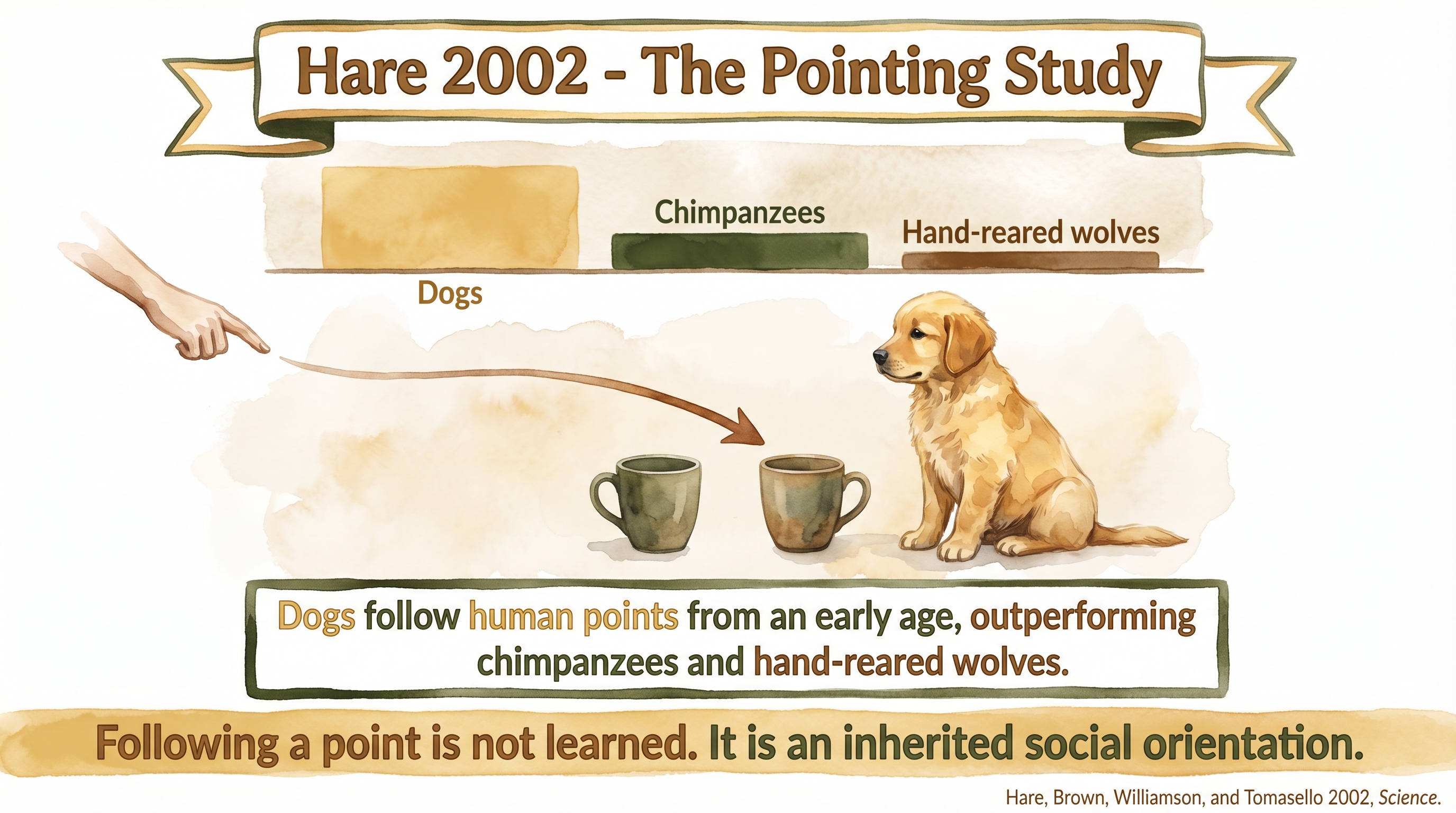
Following a human point is inherited social orientation, not learned behavior.
Key Takeaways
- Hare 2002 became famous because it showed dogs are unusually good at using human gestures to find hidden food.
- The wolf comparison mattered because it suggested human rearing alone cannot explain the dog advantage.
- Later work has strengthened the early-emergence story while also showing that experience still modulates performance.
- For JB, the study is one of the strongest scientific reasons to take upward-looking social learning seriously.
The Evidence
This entry uses estimated claim-level tags beyond the dedicated EvidenceBlocks below. These tags mark approximate ranges or timing claims that should remain bounded by the cited sources.
- Hare et al. (2002)dogs, wolves, and chimpanzees
Found that dogs spontaneously used human gestures better than the comparison groups in object-choice tasks. - comparative dog-cognition literature
Frames the pointing result as evidence for evolved cooperative communication rather than simple training history. - Salomons et al. (2021)44 dog puppies and 37 wolf puppies
Showed that attraction to humans and gesture reading emerge strongly and early in dogs. - Udell-related experience findingsdogs
Indicate that social experience shapes expression of the predisposition without erasing the predisposition itself.
No published study directly tests the practical implications of hare 2002: pointing comprehension in dogs for domestic dog raising programs. The application to household dog raising remains an interpretive synthesis rather than a directly tested intervention finding.
SCR References
Sources
- Hare, B., Brown, M., Williamson, C., and Tomasello, M. (2002). The domestication of social cognition in dogs. Science.
- Salomons, H., et al. (2021). Cooperative communication with humans evolved to emerge early in domestic dogs. Current Biology.
- Udell, M. A. R., et al. (2010). What did domestication do to dogs? Animal Behaviour.