Dog Recognition of Human Emotions
Dogs do not merely react to our movements. A substantial body of research suggests they also distinguish emotionally relevant patterns in our faces and voices. Muller et al. 2015 showed that dogs can discriminate human facial expressions that humans categorize as happy or angry. The task required dogs to generalize from partial training images to novel photographs, which is one reason the study drew so much attention. Andics et al. 2014 used awake comparative fMRI with 11 dogs and 22 humans and found functionally analogous voice-sensitive regions in nonprimary auditory cortex, with sensitivity to emotional valence cues in both species. Albuquerque et al. 2016 then used a cross-modal design and found that dogs looked longer at faces whose expression matched the emotional tone of a simultaneously presented vocalization. Together, these studies support a narrower but strong conclusion: dogs detect emotionally meaningful differences in human and dog signals and can integrate information across modalities. Documented
The strongest honest version of the claim is not that dogs read minds. It is that dogs are attentive to structured emotional information in ways that are behaviorally useful and likely adaptive.
For JB, that matters because calmness or volatility in the home is not hidden from the dog. It is one of the channels the dog is already reading.
That point becomes even more compelling when the studies are placed side by side. Documented A discrimination task with faces, a comparative fMRI study with vocal stimuli, and a cross-modal matching task are very different methods. When all three still point toward dogs extracting emotionally relevant human information, the convergence becomes more persuasive than any single experiment alone.
That convergence is important because emotion recognition is easy to oversell and easy to dismiss. Multiple methods landing in the same general area make a middle position more defensible: dogs are not mystical empaths, but neither are they indifferent to the affective structure of human life.
What It Means
Faces Carry Information for Dogs
Muller et al. 2015 became important because it suggested dogs do more than notice whether a face is familiar. They can sort at least some affective categories in human facial expression. The study's design asked dogs to learn a discrimination and then generalize the rule to novel combinations of faces and face halves, which made the result stronger than a simple picture preference. Documented
That does not prove dogs experience human emotion conceptually the way humans do. It does show that they detect enough structured information in faces to behave differently depending on emotional display.
Voices Matter Too
Andics et al. 2014 added a neural dimension by showing that dogs and humans both have voice-sensitive auditory regions and that these regions respond to emotional valence cues. This result matters because domestic life is full of vocal tone long before it is full of explicit instruction. A dog does not need to understand every word to be affected by how the word sounds.
The study is also useful because it avoids a common false binary. Documented Dogs are not relying only on smell or only on movement. They are processing a multi-sensory human presence that includes affective sound.
Emotion-recognition research supports one of JB's simplest practical claims: the dog is continuously taking the emotional temperature of the household, whether or not the adults intend to communicate anything.
Cross-Modal Matching Is Especially Interesting
Albuquerque et al. 2016 pushed the field further by pairing emotional vocalizations with faces and asking whether dogs preferred the congruent pairings. Documented They did. That result matters because cross-modal matching is cognitively richer than isolated cue reaction. It suggests dogs do not merely flinch from one angry sound or stare at one smiling picture. They can connect affective information across channels.
This is one reason the field has become more confident that dogs track emotional state in a meaningful way, even while staying cautious about what kind of internal representation that implies.
The Limits of the Claim
The caution matters. Most of these studies use relatively small samples. Documented Laboratory tasks simplify real emotional life. Dogs might be recognizing salient perceptual features rather than possessing human-like concepts of emotion. None of the key papers justify saying dogs understand our inner lives as humans do. The literature is strongest at the level of discrimination, sensitivity, and adaptive response.
That is still an important level. A species does not need to read minds in order to be deeply affected by emotional climate.
There is also a useful methodological point here. The field becomes more convincing when the same broad claim survives different kinds of evidence. Behavioral discrimination tasks, neural imaging, and cross-modal matching all carry different weaknesses, but they also fail in different ways. When they converge, the safest conclusion is not maximalist human-like empathy. The safest conclusion is that dogs are unusually good at extracting emotionally meaningful structure from human signals.
That is a scientifically healthier conclusion because it stays close to what the experiments actually test. The dog's skill is not best described as supernatural intuition. It is better described as sensitive, adaptive use of patterns in faces, voices, and emotional congruence that matter for navigating a social environment built around humans.
That framing also explains why the work belongs inside social cognition rather than inside sentimentality. These studies are about information use. Documented Dogs appear able to pick up structured affective patterns that help them orient, anticipate, and regulate in human company. The claim is narrower than mind reading and more behaviorally useful.
That alone is enough to make emotional steadiness a serious part of raising.
Why It Matters for Your Dog
In practical home life, these findings mean your dog is likely picking up more from your emotional state than your instructions alone. A tense voice, fast breathing, harsh facial set, or brittle household rhythm can function as real information to the dog. A calm voice, open face, and steady pace can too. That does not mean the dog perfectly understands why you feel what you feel. It means the dog is reading the pattern.
This is especially relevant for family dogs because the emotional weather in a house is rarely neutral. Children are loud, adults are stressed, routines shift, and conflict happens. If dogs are sensitive to emotional expressions and vocal tone, then the household itself becomes part of the developmental curriculum. Calmness is therefore not only an ethical preference. It is an input the dog actually receives.
Goldens often show this dramatically. Many families describe them as absorbent, quick to soften under relaxed attention, and quick to escalate when the house becomes socially hot. Emotion-recognition research helps explain why those descriptions feel so plausible. Heuristic The dog is not making up the climate. The dog is reading it.
This also changes what families should count as communication. People often assume they are "not saying anything" to the dog unless they give a command. In reality, facial tension, vocal sharpness, laughter, frustration, and argument may all be carrying signal value. A dog prepared to use human emotional information may organize behavior around those cues long before it responds to a formal cue.
The research can also lower shame. Families sometimes feel guilty that their dog reacts to stress and conclude the dog is fragile or spoiled. A more accurate reading is that domestic dogs are built to be socially attentive. Sensitivity to human affect is not necessarily pathology. It becomes a problem only when the environment is unstable enough, intense enough, or prolonged enough that the dog cannot recover.
There is also a trainer-selection implication. A professional who treats household emotional tone as irrelevant may be ignoring one of the dog's actual input channels. Method matters, but emotional context matters too. A dog trained inside a volatile emotional atmosphere may struggle for reasons that no technique label captures.
Owners can use this knowledge to become quieter and more intentional without becoming emotionally fake. The goal is not to perform robotic calmness. The goal is to recognize that your dog is reading affective patterns and that reducing unnecessary volatility is likely to help.
This is especially valuable during puppyhood and adolescence. At those stages, dogs are still building the habits by which they regulate themselves. A household that repeatedly teaches emotional whiplash can make that job harder. A household that offers steadier tone and clearer recovery teaches something different.
Read that way, dog emotion-recognition research is not about magical empathy. It is about the ordinary seriousness of emotional signal traffic in the home.
That seriousness also changes what adults should notice in themselves. Many people focus only on whether they gave the correct command or correction, while missing that the dog's experience included the facial set, breath pattern, vocal tone, and recovery rhythm surrounding the moment. Emotion-recognition research suggests those surrounding features are not incidental. They are part of what the dog is actually processing. In a stable home, that becomes a powerful support. In a chronically emotionally noisy home, it becomes a chronic source of ambiguity.
One practical result is that adult recovery becomes as important as adult restraint. Even calm homes have stress, surprise, and occasional sharp moments. What matters is whether the emotional system returns to baseline quickly enough that the dog is not left marinating in unresolved signal noise. Dogs who track affective patterns are likely learning from the recovery arc too.
The same insight helps explain why some interventions seem to fail despite technically correct steps. If the surrounding human atmosphere is tense, contradictory, or brittle, the dog may be receiving two lessons at once. The explicit lesson says one thing, while the emotional traffic says something else. Making those layers more coherent often helps more than adding one more command.
That is one reason emotionally noisy homes can feel strangely unpredictable to dogs even when the rules themselves seem stable to the people inside them. The dog's experience includes tone, pace, face, and recovery, not just the rule content. When those surrounding signals stay jagged, the dog may never receive one clean message strongly enough to settle around it.
That practical lesson grows even stronger when families stop separating "behavior work" from "emotional atmosphere" as if the dog only experiences one at a time. The research suggests those layers arrive together. A dog learning rules inside a calmer affective climate is receiving a clearer overall picture of how to live in the home.
That is why emotional tone should not be treated as invisible background. Dogs appear able to use it as information, which means every calmer recovery, cleaner tone shift, and less chaotic conflict pattern helps make the household more legible from the dog's point of view.
What This Means for a Just Behaving Family
JB families should take emotional signal traffic seriously. The dog is probably reading more from tone, face, and rhythm than the adults are consciously intending to send.
That supports the Calmness pillar directly. Calmness is not silence or flatness. It is a stable signal environment that helps the dog receive the household as coherent rather than volatile.
Practically, this means adults should value emotional recovery as much as they value verbal instruction. A tense correction delivered in a tense house lands differently than the same words delivered by a regulated adult.
JB should still stay within the evidence. The field supports emotion discrimination and cross-modal sensitivity. It does not support claiming dogs understand human inner narratives the way another human does.
Even so, the studies already say enough to change household behavior. Documented Dogs read us affectively. That makes adult state a real part of dog raising.
It also gives JB a cleaner way to talk about calmness without mysticism. Calmness is not valuable because dogs magically absorb human souls. It is valuable because dogs appear able to detect and organize around emotionally relevant human signals across more than one sensory channel.
For families, that means emotional discipline can be practiced concretely. Slower movement, softer recovery after frustration, cleaner tone, and less chronic argument all change the signal field the dog is living in. Those are ordinary acts, but the literature suggests they are not ordinary to the dog.
This is where the research becomes unusually empowering. Families do not need a laboratory to change the emotional information their dog receives. They can begin by changing how they enter rooms, how quickly they escalate, and how well they recover after stress. Those are modest acts, but for a socially attentive species they may have broad developmental effects.
For JB, that is a major reason calm adults matter so much.
It also means calmness should be treated as a practice, not a slogan. The adult who regulates voice, face, pace, and recovery is changing the signal environment the dog has to live inside. That is a small sentence with very large consequences in a family home.
That is a strong enough reason to make calmer recovery part of ordinary dog care.
That is a small insight with household-scale consequences.
The household should act like it.
The practical consequence is that emotional hygiene belongs closer to the center of dog raising than many homes assume.
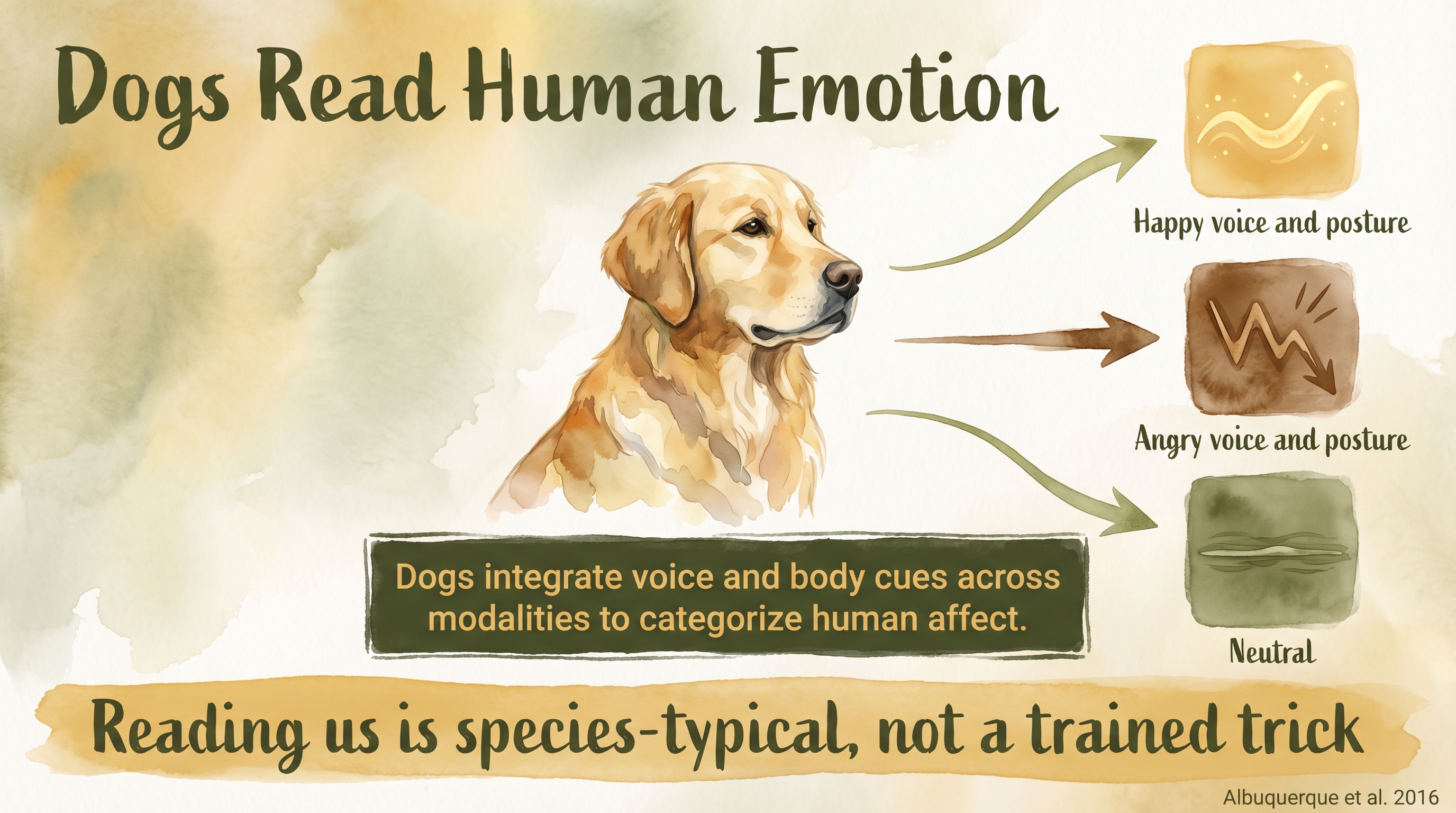
Reading us is species-typical for dogs, not a trained trick.
Key Takeaways
- Dogs detect emotionally meaningful differences in human faces and voices.
- Cross-modal evidence suggests dogs can integrate emotional information across more than one channel.
- The literature supports discrimination and sensitivity more clearly than full human-like emotional understanding.
- For JB, the practical lesson is that household emotional tone is part of the dog's real environment.
The Evidence
This entry uses heuristic claim-level tags beyond the dedicated EvidenceBlocks below. These tags mark JB interpretive application rather than direct study findings.
- Muller et al. (2015)pet dogs
Showed that dogs can discriminate happy versus angry human facial expressions and generalize the discrimination. - Andics et al. (2014)11 dogs and 22 humans
Found voice-sensitive cortical regions and sensitivity to emotional valence cues in both species. - Albuquerque et al. (2016)pet dogs
Showed cross-modal matching between emotional vocalizations and facial expressions. - JB owner-state and neurochemistry source setdogs
Frames these findings as part of a broader pattern of dogs using human emotional information in regulation and behavior.
No published study directly tests the practical implications of dog recognition of human emotions for domestic dog raising programs. The application to household dog raising remains an interpretive synthesis rather than a directly tested intervention finding.
SCR References
Sources
- Andics, A., et al. (2014). Voice-sensitive regions in the dog and human brain are revealed by comparative fMRI. Current Biology.
- Muller, C. A., et al. (2015). Dogs can discriminate emotional expressions of human faces. Current Biology.
- Albuquerque, N., et al. (2016). Dogs recognize dog and human emotions. Biology Letters.