The Axelsson 2013 Amylase Study
Erik Axelsson and colleagues published one of the most cited domestication papers in 2013 under the title "The genomic signature of dog domestication reveals adaptation to a starch-rich diet." The paper mattered because it did something unusually concrete in a field often dominated by broad narratives: it identified specific genomic regions under positive selection in domestic dogs and highlighted genes involved in starch digestion and glucose uptake. The headline result centered on AMY2B, the pancreatic amylase gene. Dogs carried substantially more copies than wolves on average, and later work summarized in JB's nutrition source material showed that copy number can range widely across dogs, roughly from 4 to 30 diploid copies, with serum amylase activity increasing by about 5.4 percent per additional copy. Axelsson 2013 therefore became a pivot point in domestication research. It suggested that dogs were not merely behaviorally close to humans. They were also metabolically adapting to human food ecologies. Documented
That finding had immediate cultural consequences. It pushed back against the popular claim that the "real" ancestral dog is simply a wolf waiting to be returned to a pure carnivore diet. At the same time, the paper did not prove that starch adaptation was the initiating cause of domestication, and later ancient-genome work complicated any simple story that tied AMY2B expansion directly to the very first domestication step.
So Axelsson 2013 deserves both of its reputations: it is a landmark study, and it is often overstated. Observed-JB
That combination is exactly why the paper remains so useful. It is strong enough to change the conversation, yet narrow enough to teach readers how easily one real result can be stretched into claims it never actually made.
It also reminds families that domestication can be visible in very practical systems. Food is not peripheral to the dog story. A lineage that learned to live around humans had to solve energetic problems as well as social ones, and the amylase work is one of the clearest genomic traces of that.
What It Means
What the Paper Actually Found
Axelsson et al. performed a genome-wide comparison of domestic dogs and wolves to identify regions under positive selection in dogs. Among the most famous results were genes linked to starch digestion and glucose transport, especially AMY2B, MGAM, and SGLT1. The broad interpretation was that dogs became better able than wolves to digest starch-rich foods associated with human settlements and later agricultural life.
That mattered because it gave the domestication story a direct metabolic signature. Instead of speaking only about temperament or skull shape, researchers could now point to a functional dietary adaptation that fit an animal exploiting human-derived food sources.
Why AMY2B Became the Headline Gene
AMY2B became the public star because it is easy to explain and genuinely important. Pancreatic amylase helps break down starch. Dogs, on average, have more AMY2B copies than wolves, and later studies summarized in the JB nutrition reference show that copy number relates to measurable amylase activity. Documented This does not mean every dog digests starch equally well or that every wolf digests starch poorly. It means the domestic dog lineage shifted in that direction.
That population-level framing is crucial. The study does not create a clean categorical divide where every dog is one thing and every wolf another. Documented There is within-species variation, breed variation, and likely environmental interaction. But the selection signal is still real and meaningful.
Axelsson 2013 is one of the clearest reminders that dogs did not become themselves by preserving wolf biology unchanged. Domestication changed the species materially, including how it could use food in human environments.
What the Study Supports About Domestication
The paper fits naturally with the commensal pathway. If some early dogs or proto-dogs were exploiting human scraps, refuse, or later agricultural byproducts, then better starch use would become adaptive. That does not require a modern kibble story to be true. It only requires that human-associated foods created a different nutritional landscape than strict wolf predation alone.
This is one reason the paper has been so important outside academic circles. It directly challenges the lazy argument that any dog diet departing from a pure wolf model must be biologically wrong by definition. The domestication story itself includes dietary adaptation.
What the Study Does Not Settle
Axelsson 2013 is sometimes treated as if it proved dogs were domesticated only after agriculture. The later literature does not support that overreach. notes that ancient European dog genomes did not show the extreme AMY2B expansion typical of many modern dogs. The JB nutrition source also points out that some ancient or non-agrarian lineages such as dingoes and Siberian Huskies can show lower copy numbers.
That means starch adaptation may have intensified later than the earliest domestication stage. In other words, the result is real, but its place in the sequence matters. Dogs may have begun diverging from wolves before agriculture and then later accumulated stronger starch-processing adaptations as human food ecologies changed.
This sequencing point matters because it keeps the paper in its proper lane. Axelsson 2013 is best read as evidence that domestication and later dog history included substantial adaptation to human food systems. It is not best read as proof that agriculture single-handedly caused dogs to exist.
That narrower reading is still scientifically powerful. It shows that one of the species-level differences between dogs and wolves sits in a pathway families confront every day whenever they decide what and how to feed. Few domestication papers connect the ancient story to such an ordinary household question so directly.
One practical reason this matters so much is that food is one of the few ancient-domestication questions families reenact every day. Every meal silently expresses a theory of what sort of animal a dog is. Axelsson 2013 does not settle the whole diet debate, but it clearly tells families they are feeding a domesticated species, not a modern wolf in disguise.
Why It Matters for Your Dog
For families, the amylase study matters because it changes what counts as "natural" when people talk about dogs. A common sales story says the biologically proper dog is just a wolf in softer packaging and that any departure from a wolf-like diet represents human corruption. Axelsson 2013 makes that story much harder to sustain. Dogs are not dietary fossils. They are domesticated animals whose lineage has already been reshaped by human ecology.
That does not automatically settle every feeding question for every household. It does mean families should be cautious when marketers build total nutritional ideologies on the phrase "ancestral wolf diet." Modern wolves are not dog ancestors, and modern dogs are not unchanged wolves. The study does not prove that high-carbohydrate feeding is optimal in every context. It proves that dogs acquired real starch-related adaptation.
This is practically useful because it reduces anxiety created by purity narratives. Families are often told that any carbohydrate exposure is biologically absurd for dogs. The evidence is more nuanced. Dogs remain facultative carnivores with meaningful animal-protein needs, but they are also well documented as metabolically distinct from wolves in how they handle starch. That nuance is more faithful to the species and more helpful to families.
The study also matters as a model of how domestication works. Documented A relatively small number of genomic changes can have outsized ecological consequences. When a lineage gains even moderate improvement in using human-associated foods, that can widen the niche available around people. A dog that can live on or supplement from human food streams becomes easier to sustain near settlements. That in turn can reinforce the broader social domestication pathway.
Families can also use the paper as a guardrail against over-romanticizing wildness. People sometimes assume that a more "wolf-like" dog is automatically more authentic or more biologically correct. Axelsson 2013 suggests a different frame. Dog authenticity includes the fact of adaptation to human society. The species did not become less itself by adapting to us. It became itself through that adaptation.
There is a behavioral implication too. Food ecology and social ecology often travel together. A dog lineage that could profit from human scraps, settlements, and routines was not merely evolving a digestive quirk. It was moving into a new way of living around humans. That is one reason the study fits so naturally with the larger domestication literature. Metabolism, settlement proximity, and social tolerance likely reinforced one another.
Goldens make this relevance feel less abstract because they live almost entirely inside human-designed feeding systems. Their everyday nutritional life has nothing in common with a free-living wolf beyond the broad mammalian fact of being a canid. Families who understand that are less likely to get trapped by raw-versus-processed purity wars built on bad evolutionary premises.
The study also teaches a general lesson about evidence quality. Some dog-culture claims are persuasive because they sound old. Axelsson 2013 was persuasive because it identified a measurable genomic difference with functional implications. That is the kind of correction the field needs more often. It moves conversation from mood and myth toward actual biological evidence.
It also encourages better nutritional humility. The finding supports flexibility in how dogs can use food, not a simplistic celebration of starch in all amounts and contexts. A family still has to care about ingredient quality, protein sufficiency, digestive tolerance, body condition, and the individual dog in front of them. What disappears is the false claim that any meaningful starch use is evolutionarily absurd on its face.
Another practical benefit is that the study reduces identity signaling in feeding decisions. Once families see that dogs already carry domestication-related dietary change, the question becomes less "Which diet makes me feel most ancestral?" and more "Which diet fits this domesticated dog well?" That is a healthier question and a more evidence-based one.
That shift can also cool down ideological conflict inside homes. Families do not need to prove seriousness by choosing the most wolf-like feeding story available. They need to make competent decisions for a species that already adapted to human ecology, then adjust those decisions to the individual dog's body condition, digestion, and life stage.
In the home, that means families can feed and think with a bit more realism. They do not have to pretend the dog is a wolf to respect biology. Respecting biology includes respecting domestication itself.
That keeps the feeding conversation cleaner. A domesticated dog should be fed as a dog, with respect for real evidence rather than loyalty to a fantasy ancestor.
What This Means for a Just Behaving Family
JB families should take Axelsson 2013 as a direct correction to the idea that dogs are nutritionally identical to wolves. The species has already changed, and one of the clearest documented changes involves starch processing.
That does not mean any commercial food is automatically good, or that nutrition no longer requires judgment. It means the philosophical starting point should be dog biology, not wolf cosplay.
There is also a broader JB lesson here. Domestication changed real systems in the animal, not just surface manners. That supports the larger claim that dogs are a historically transformed species whose needs must be understood through their actual evolutionary path with humans.
Practically, a JB family should feel free to reject false ancestral purity arguments while still aiming for thoughtful, high-quality feeding. The domestication record does not command one exact menu. It does rule out simplistic claims that carbohydrate adaptation is biologically impossible in dogs.
This entry also fits the Evolutionary Foundation in a larger way. The dog was shaped in relation to human life. Diet is one of the clearest places where that shows up in the genome itself.
It also gives JB a useful rhetorical boundary. The study supports rejecting wolf-identical diet ideology, but it does not justify casual claims that all modern processing is harmless or that nutritional debates are now settled. Documented The real lesson is more modest and more durable than that.
For families, the practical takeaway is confidence without rigidity. They can stop treating wolf mimicry as a moral duty and start judging food by actual dog evidence, individual response, and sound nutritional reasoning. That shift makes feeding less theatrical and more responsible.
It also gives JB a cleaner philosophical footing. The point is not that dogs should eat anything humans happen to provide. The point is that respecting dog biology includes respecting the documented ways domestication changed that biology. Axelsson 2013 is one of the clearest pieces of evidence for that principle.
That is a useful thing for families to know, because it keeps the conversation honest. Biology should be read from evidence, not from nostalgia.
That is why this paper remains such a good guardrail. It does not command one menu, but it does require families to let documented dog biology outrank ancestral nostalgia when those two things come apart.
That is what makes the study so clarifying. The dog's biology has already moved, and families should let their thinking move with it.
That is a correction worth keeping at the dinner bowl.
Dogs deserve that correction.
It is one of the clearest places where domestication reaches right into everyday household choices.
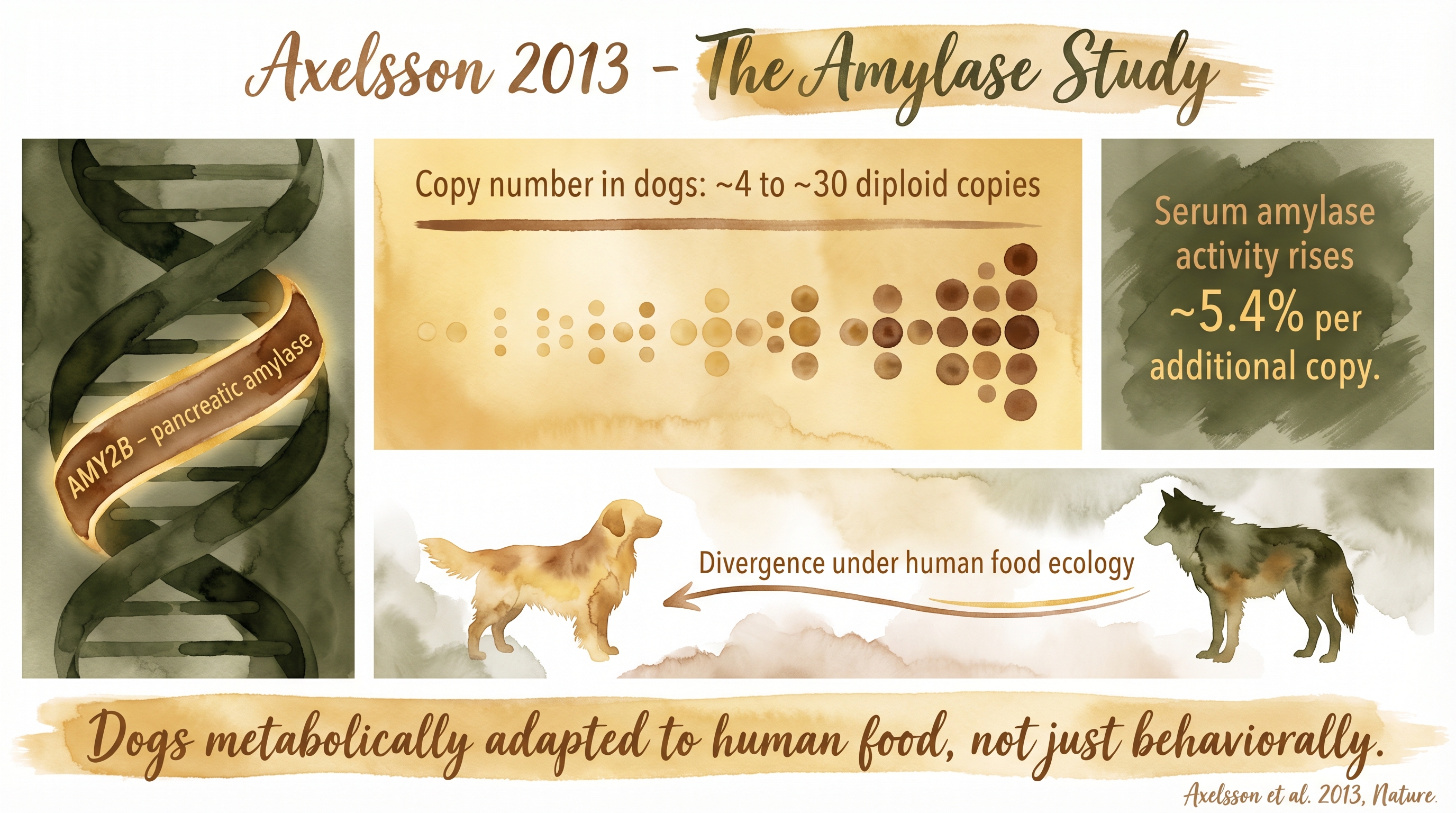
Dogs metabolically adapted to human food ecologies, not just behaviorally.
Key Takeaways
- Axelsson 2013 is a landmark because it tied dog domestication to concrete genomic adaptation, not just broad narrative.
- The AMY2B finding strongly supports the view that dogs adapted to human-associated food ecologies rather than preserving a purely wolf-like metabolism.
- The result is population-level and variable, not an absolute all-dogs versus all-wolves divide.
- For JB, the study is most useful as a correction to simplistic ancestral-wolf diet rhetoric.
The Evidence
This entry uses observed claim-level tags beyond the dedicated EvidenceBlocks below. These tags mark JB program observation or practice-derived claims that need dedicated EvidenceBlock coverage in a later content pass.
- Axelsson et al. (2013)dogs and wolves
Identified domestication-related selection signals involving starch digestion and glucose uptake, especially AMY2B. - Arendt et al. (2014) and later copy-number workdomestic dogs
Showed that AMY2B copy number relates to measurable amylase activity and varies widely among dog populations. - dogs
Summarizes copy-number ranges of roughly 4 to 30 in modern dogs and notes about a 5.4 percent increase in serum amylase activity per extra copy. - Botigue et al. (2017) and related ancient-genome workancient dogs
Complicate any claim that extreme starch adaptation marks the very first domestication phase in all dog populations.
No published study directly tests the practical implications of the axelsson 2013 amylase study for domestic dog raising programs. The application to household dog raising remains an interpretive synthesis rather than a directly tested intervention finding.
SCR References
Sources
- Axelsson, E., et al. (2013). The genomic signature of dog domestication reveals adaptation to a starch-rich diet. Nature.
- Arendt, M., et al. (2014). Amylase activity is associated with AMY2B copy numbers in dogs. BMC Genetics.
- Botigue, L. R., et al. (2017). Ancient European dog genomes reveal continuity since the Early Neolithic. Nature Communications.