The Transitional Period (2 to 3 Weeks)
The transitional period lasts only about a week, but developmentally it is one of the sharpest turns in the whole puppy timeline. Between roughly two and three weeks, the puppy moves out of the closed, reflex-dominated neonatal state and into a world where sight, hearing, movement, and early social responsiveness begin to open at the same time. Documented
What It Means
The transitional period is short enough that it is easy to overlook, especially compared with the much better-known socialization period that follows it. But the name is accurate. This stage is a true handoff from one developmental mode to another.
Historical framing
Classic canine developmental work separated the first weeks into recognizable phases because the changes are not just gradual improvements in the same puppy. Documented The puppy at two and a half weeks is not merely a slightly better neonatal puppy. It is beginning to inhabit a different kind of sensory and behavioral world.
Fox and Scott and Fuller both treated this span as a threshold stage. The reasoning is straightforward the eyes open; the ear canals open; crawling gives way to the first unstable walking; sleep remains dominant, but waking behavior becomes richer; and social interaction begins to emerge as more than contact-seeking.
This is the first time the puppy begins to look like the kind of animal people later recognize as a "real puppy."
The sensory awakening
The defining event of the transitional period is not one single milestone but a cluster of converging openings.
Visual access begins. Auditory access begins. These systems are not instantly adult-like, but they are now entering the puppy's working environment. Information that had previously arrived mostly through smell, warmth, pressure, and proximity is joined by sight and sound.
This changes everything about how experience can start to matter.
A puppy who can see and hear is now positioned for richer orientation, for more varied startle and approach responses, and for the first real social registration of littermates and the dam as more than warm sources of milk and contact.
From reflexive movement to early locomotion
The movement shift is just as important. Neonatal crawling and pushing are replaced by the first attempts at standing and walking. The gait is unstable and the coordination is immature, but the locomotor system is moving toward voluntary action.
That matters because locomotion changes what counts as experience. A crawling puppy is mostly managed by its environment. A wobbly walking puppy has the beginnings of agency. It can approach, follow, withdraw, lose balance, and reorient in new ways.
The period is therefore not only a sensory opening. It is the beginning of active engagement with space.
The neural transition behind the behavior
The best direct canine neuroscience does not map every transitional-period milestone onto one exact neural event, but it does support a rapid developmental change state in these weeks. SCR-040 documents that the early dog brain undergoes major postnatal maturation with MRI-visible gray-white matter transitions tied to decreasing water content and progressive myelination. The transition phase described in the neural source sits squarely across the same three-to-eight-week developmental corridor in which these behavioral changes become visible. Documented
That does not mean myelination "causes" one exact first behavior in a one-to-one way. The safer conclusion is that the puppy's sensory and motor awakening is happening in parallel with a dense period of rapid neural reorganization and tissue maturation.
This is one reason the transitional period feels compressed. A lot is changing at once sensory input channels broaden; postural control improves; cortical engagement increases; and the puppy starts to move through, rather than merely within, the environment.
First social behavior
The transitional period is also where the first obviously social-looking behaviors begin to appear.
These are not the full social competencies of the later socialization period. But they are the beginnings orientation toward littermates becomes richer; the first play-like interactions can appear; vocalizations diversify beyond simple distress; and tail movement and facial engagement become more behaviorally expressive.
The key point is not that the puppy is suddenly "socialized." The key point is that the puppy is now becoming socialization-ready.
The maternal shift
The dam's role changes too. During the neonatal stage, she is almost the whole regulatory environment. During the transitional period, she remains indispensable, but the pattern begins to change. Puppies are still dependent on maternal care for safety, feeding, and regulation, yet the dam begins to spend slightly more time away and the litter's world broadens incrementally.
This is not abandonment. It is developmental pacing.
Across mammals, caregiver presence and caregiver withdrawal do not stay fixed through early development. The caregiver's pattern changes as the young animal's capacities change. Documented The transitional period is the earliest canine example of that gradual shift.
From den-centered life to litter-centered learning
Another reason this stage matters is that the puppy's world is no longer only the mother's body. The litter itself becomes more behaviorally relevant.
That shift sounds small, but it changes the shape of experience. Once puppies can see, hear, and stagger toward one another with more deliberate movement, littermates begin functioning as real developmental partners. Tiny collisions, following, pawing, early mouthing, brief social resting adjustments, and short bursts of play-like interaction all become more available.
This matters because the transitional period begins redistributing developmental influence the dam is still primary; the environment is becoming more legible; and littermates are becoming more behaviorally relevant.
That redistribution is the runway into the socialization period. It is the beginning of a world in which the puppy learns not only from being cared for, but from participating in a small social system.
Why this period deserves its own page
It can be tempting to treat this stage as just the opening paragraph of the socialization period. That loses something important.
The transitional period is its own developmental event because it explains why the socialization period can begin at all. Socialization does not start at three weeks by magic. It starts because the puppy has just undergone the sensory, motor, and neural shift that makes richer learning possible.
Why It Matters for Your Dog
The transitional period matters because it marks the first moment when the puppy's environment starts becoming legible in a more complex way.
Up to this point, the breeder's task is largely one of protection, warmth, hygiene, and stable maternal care. During the transitional period, the task begins to widen. The puppy still needs protection, but it is now capable of being shaped by a broader range of ordinary experiences.
That has a few practical implications.
First, this is a period for steadiness, not spectacle. Because the puppy is only just beginning to process the world through new sensory channels, the aim is not intensity. The aim is a stable developmental runway into the socialization period.
Second, handling and environmental design begin to matter in a new way. Clean surfaces, predictable routines, and quiet exposure to ordinary litter life now register through more than touch and smell.
Third, this is the first phase where people can begin to misread immaturity as resilience. A puppy who just opened its eyes is not robust simply because it is more alert than it was a week earlier. The systems coming online are still fragile and incomplete.
There is also a timing lesson here for later pages in this category. Many developmental transitions in dogs are not clean replacements of one state by another. They are overlaps. The transitional puppy is still profoundly immature, still highly dependent, and still maternally regulated. At the same time, it is beginning to orient, move, and respond in ways that open the door to much richer experience. That overlap is why the stage can be mishandled from both directions: by treating the puppy as too fragile for any ordinary developmental experience, or by treating the puppy as already robust simply because it is more interactive than it was a few days before.
The most useful summary is that this phase rewards steadiness. The puppy does not need a stimulating lifestyle yet. It needs a world that is becoming readable without becoming overwhelming.
The transitional period is the first stage where a puppy can begin to absorb the tone of the environment through widening sensory access. Calmness matters here not as a training preference, but as the quality of the first fully perceived world.
Limits and open questions
The exact timing of first tail wags, first play, first orientation behaviors, and first consistent walking varies among litters and studies. Documented The literature is good enough to defend the phase as a real developmental category, but not good enough to justify false precision about every milestone.
The same caution applies to mechanism. We know rapid neural maturation is happening. We do not have a dog-specific map that says one exact myelination event equals one exact behavioral milestone inside this week.
How this connects to the rest of the wiki
This page is the bridge between neonatal-period and socialization-period.
If the neonatal page explains dependence, this page explains emergence.
If the socialization page explains expansive developmental learning, this page explains why that expansion becomes possible in the first place.
For the neural background, myelination-in-dogs and canine-brain-development-timeline carry the mechanism further. Documented
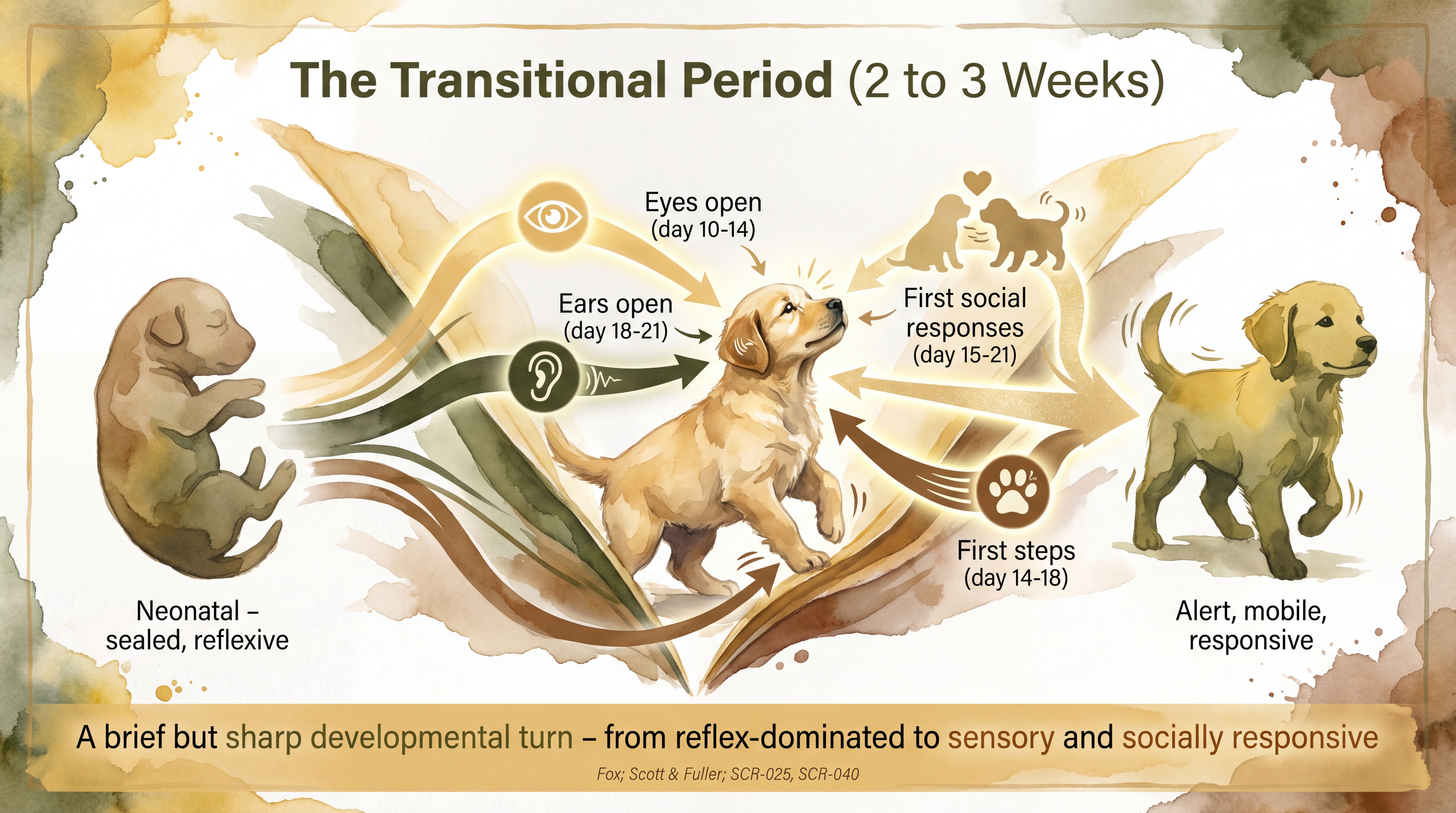
A brief but sharp developmental turn - from reflex-dominated to sensory and socially responsive.
Key Takeaways
- The transitional period is the brief handoff between reflex-dominated neonatal life and the much richer learning state that follows.
- Eyes, ears, and early walking come online together, changing what the puppy can perceive and do.
- Rapid neural maturation provides the backdrop for this shift, but one-to-one claims about exact milestone timing should stay cautious.
- This period matters because it makes the later socialization period possible.
The Evidence
- Fox, M. W. (1964, 1971)domestic dogs
Classic developmental work described the transitional period as the short stage in which sensory systems open, locomotion shifts, and early social responsiveness begins to emerge. - Scott, J. P. & Fuller, J. L. (1965)domestic dogs
Periodized early puppy development and linked the onset of richer social learning to the sensory and motor capacities that emerge around three weeks. - Gross, B. et al. (2010)domestic dogs
Longitudinal MRI and histology work showed rapid postnatal tissue maturation through the early weeks, providing the neurodevelopmental context for transitional-period change.
- Developmental psychobiology synthesismultiple mammals
Across mammals, early sensory opening and locomotor emergence transform what kinds of learning become possible during the next developmental phase. - Hostinar, C. E. et al. (2013)multiple mammals
Caregiver buffering remains central during early development even as the young begin to expand their active engagement with the world.
- Canine developmental boundarydomestic dogs
The phase itself is well established, but exact dog-specific timing for individual transitional milestones varies across litters and has not been mapped with one universal schedule.
SCR References
Sources
- Fox, M. W. (1964). The postnatal growth of the canine brain and correlated anatomical and behavioral changes during neuro-ontogenesis. Growth, 28, 135-141.
- Fox, M. W. (1971). Integrative development of brain and behavior in the dog. University of Chicago Press.
- Gross, B., Garcia-Tapia, D., Riedesel, E., Ellinwood, N. M., & Jens, J. K. (2010). Normal canine brain maturation at magnetic resonance imaging. Veterinary Radiology & Ultrasound, 51(4), 361-373.
- Hostinar, C. E., Sullivan, R. M., & Gunnar, M. R. (2014). Psychobiological mechanisms underlying the social buffering of the hypothalamic-pituitary-adrenocortical axis: A review of animal models and human studies across development. Psychological Bulletin, 140(1), 256-282. DOI: 10.1037/a0032671.