Synaptic Pruning in Dogs
Compound evidence detail1 SCR / 2 parts
- Documentedthe synaptic pruning mechanism documented in cross-mammal developmental neuroscience and confirmed functionally necessary in dogs by canine LGI2 evidence (Seppala 2011)
- Heuristicthe JB-specific application asserting that prevention of behaviors during development translates into pruning of the corresponding neural circuits
Synaptic pruning is the developmental process by which the brain removes weaker, less useful, or less stabilized connections after an early period of high plasticity. Across mammals, this is a core part of how immature nervous systems become more efficient. In dogs, the strongest direct evidence confirms that pruning machinery exists and matters. What remains thinner is the normal developmental timetable. Documented-Cross-Species
What It Means
Synaptic pruning is the developmental process by which the brain removes weaker, less useful, or less stabilized connections after an early period of high plasticity. Across mammals, this is a core part of how immature nervous systems become more efficient. Early development is not only about building more connections. It is also about selecting among them. The basic mammalian pattern is early overproduction or broad synaptic possibility, activity-dependent stabilization of some circuits, and elimination of weaker or less used connections. Modern mechanistic work adds detail. Microglia and complement signaling help tag and remove synapses during development. That biology is well established across mammalian neuroscience.
What Dogs Directly Show
The key direct canine anchor is SCR-043. LGI2 is involved in synaptic pruning and cellular adhesion in the developing dog brain, and loss-of-function mutation causes aberrant connectivity with juvenile epilepsy. That is not just an abstract homology argument. It confirms that pruning machinery is present and functionally necessary in dogs. Documented The source layer also points to developmental regulation of synapse-associated protein systems across newborn, juvenile, and adult dog brains. That is compatible with active remodeling and refinement during development.
The Critical Boundary
What dogs do not yet have, at least in the surfaced literature, is the kind of clean synapse-density timeline that human developmental neuroscience often cites. We do not have a definitive normal-canine chart showing exactly when synaptic density peaks, how fast it declines, and which cortical regions prune on which schedule. That means this page can responsibly say: pruning exists in dogs, pruning machinery is biologically important, and early experience likely biases what gets stabilized. But it should not say: dogs prune behavior-specific circuits on a known weekly schedule, adolescence in dogs has a directly mapped pruning calendar, or one can assign exact pruning milestones to ordinary puppy behavior.
Experience Still Matters
The absence of a canine pruning calendar does not make the broader developmental principle weak. It just changes how specifically it can be stated. Across mammals, experience biases what survives. In dogs, the behavioral socialization literature already shows that early experience has outsized downstream effects. The pruning framework helps explain why that is biologically plausible, even though the exact canine timetable is not fully quantified. This is also why "use it or lose it" is directionally useful but easy to oversimplify. The right lesson is not maximal stimulation. The right lesson is that experience matters while the system is still selecting what to stabilize. Quiet, varied, low-cost experience can shape development just as meaningfully as louder or more intense exposure.
Pruning and Socialization
The socialization window is behaviorally documented in dogs. Pruning is mechanistically documented in broader mammalian science and partially anchored in dogs through LGI2 and developmental protein evidence. What is still missing is a one-to-one bridge that says, for example, "week X of puppy life equals region Y of pruning." That distinction matters because it prevents two common mistakes: treating pruning as if dogs have no evidence at all and treating pruning as if the canine timeline is completely solved. Neither is accurate. The mechanism is real. The dog-specific calendar is still incomplete.
Why It Matters for Your Dog
The pruning framework helps explain why early experience has outsized importance without pretending we can specify every detail of the developmental calendar. Documented-Cross-Species It means that a puppy's early social and environmental experiences are genuinely shaping which neural circuits are stabilized and which fade away. Positive, calm, varied experience during the sensitive period is quite literally helping build the brain the dog will use for life. Prevention matters here: experiences that are NOT initiated - fears not triggered, aggression not practiced, chronic stress not endured - leave fewer circuits embedded. A puppy that experiences only calm, structured, positive exposure to the world is building a different neural foundation than one subjected to chaos, fear, or chronic overstimulation. That is not to say that raising a dog perfectly produces a perfect dog, or that any puppy can be shaped into any outcome. Genetics matter. But the early environment is genuinely consequential at the level of brain organization, not just behavior training.
The prevention layer often uses pruning language to explain why early repetition matters. The science supports that logic most strongly when stated at the mechanism level: experience affects what is stabilized, while the exact canine pruning timetable remains an open question.
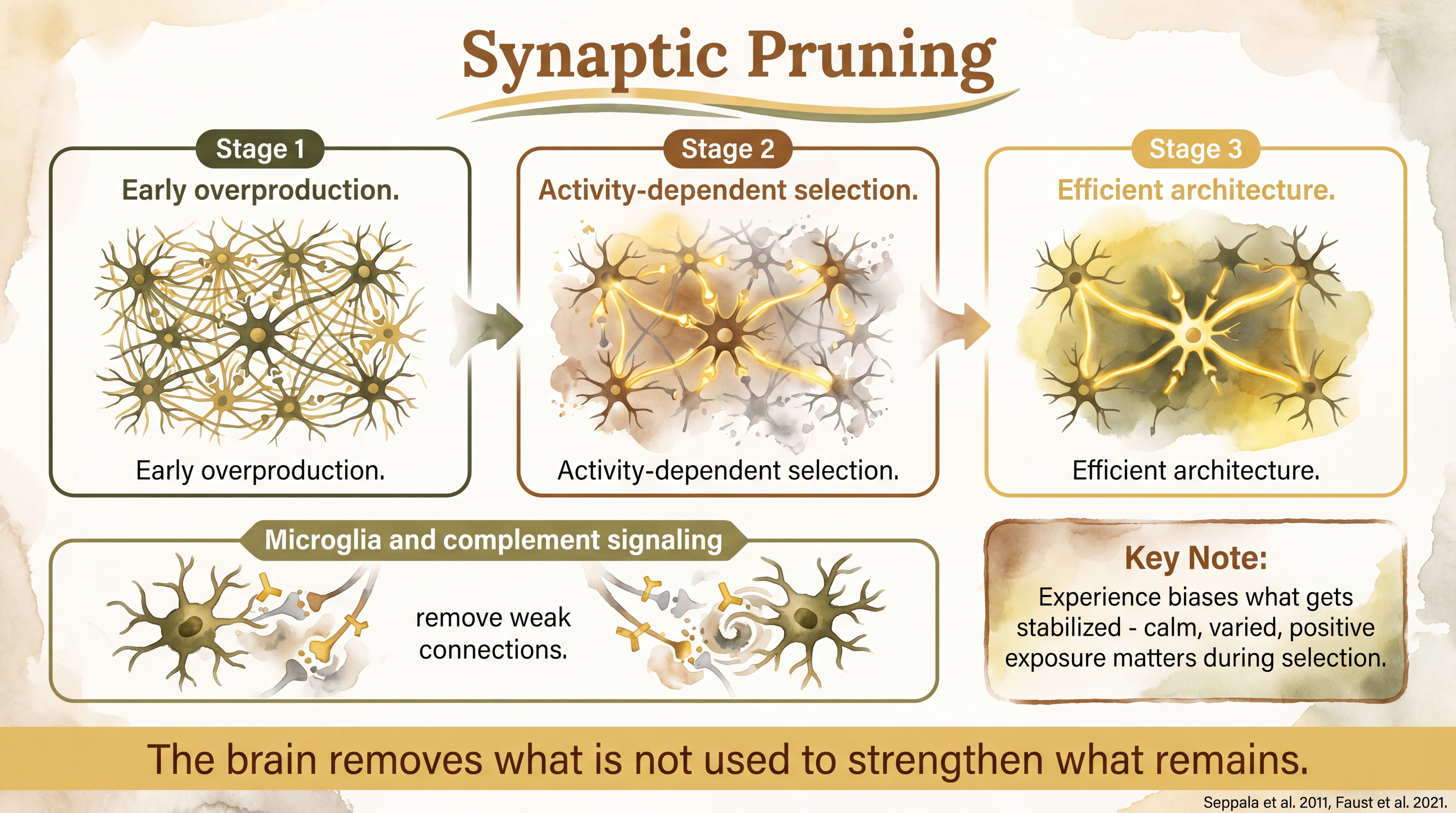
Synaptic pruning eliminates unused neural connections - the circuits you build through experience are the ones that survive.
Key Takeaways
- Synaptic pruning is a real mammalian developmental mechanism, not a metaphor.
- Dogs have direct evidence that pruning machinery exists and matters biologically.
- What remains thin is the exact normal developmental pruning timetable in dogs.
- Early experience can still be understood as developmentally important without pretending the canine pruning calendar is fully solved.
The Evidence
- Huttenlocher, P. R. (1979)humans
Documented developmental changes in cortical synaptic density consistent with overproduction followed by reduction. - Faust, T. et al. (2021)multiple mammals
Reviewed activity-dependent pruning mechanisms including complement tagging and microglial engulfment. - Rakic, P. and broader primate literatureprimates
Established synaptic remodeling and refinement as a central feature of cortical development.
- Seppala, E. H. et al. (2011)domestic dogs
LGI2 truncation caused remitting focal epilepsy and confirmed that pruning-related machinery is functionally necessary in the developing canine brain. - Hong, H. et al. (2022)domestic dogs
Dog brain proteomics showed stage-dependent regulation of synapse-associated systems consistent with developmental remodeling.
- SCR-024 and SCR-043 boundarydomestic dogs
Dogs have confirmed pruning machinery, but a normal canine pruning calendar tied to specific ages or behaviors has not yet been clearly mapped.
No longitudinal study has tracked synapse density or pruning markers in the same dogs across specific developmental ages, making it impossible to establish a canine pruning timetable.
No study has measured whether different environmental enrichment or stress patterns during the socialization window correlate with measurable differences in synaptic pruning or circuit refinement.
SCR References
Sources
- Faust, T., Gunner, G., & Schafer, D. P. (2021). Mechanisms governing activity-dependent synaptic pruning in the developing mammalian CNS. Nature Reviews Neuroscience, 22, 657-673.
- Hong, H., et al. (2022). Comparative proteome and cis-regulatory element analysis reveals specific molecular pathways conserved in dog and human brains.
- Huttenlocher, P. R. (1979). Synaptic density in human frontal cortex: Developmental changes and effects of aging. Brain Research, 163(2), 195-205.
- Seppala, E. H., et al. (2011). LGI2 truncation causes a remitting focal epilepsy in dogs. PLoS Genetics, 7(7), e1002194.