The Sensitive Period for Human Bonding
The sensitive period for human bonding is the part of early puppy development in which human contact can become unusually powerful as a social and affiliative template. It sits inside the broader socialization window rather than replacing it. The question is not whether puppies can bond to humans later, because they clearly can. The question is when the bond becomes easiest to form, deepest to generalize, and most developmentally efficient to establish. Documented
What It Means
Dogs do not begin life as blank slates waiting for a family to turn on social interest. Nor do they leave the breeder with the human bond fully finished. The sensitive period for human bonding names the middle ground: puppies are developmentally prepared to orient toward humans early, and that preparedness interacts with actual human contact during the socialization window.
Historical framing
The classic foundation is still Freedman and Scott and Fuller. Their work showed that puppies who missed timely human contact did not later behave like dogs who simply needed a little extra exposure. The cost of delay could be deep and persistent.
That is what makes this a developmental topic rather than only an attachment topic. The puppy's capacity to treat humans as primary social partners is being organized during an early window of unusual openness.
Human bonding is a subset of socialization, not a separate magic process
This page should not be read as if "human bonding" floats free from the rest of early development.
The puppy's early human relationship is built inside the broader socialization window; the quality of breeder handling; the emotional tone of early human contact; and the transition from litter environment to family environment.
That is why the period is best described as a sensitive period for human bonding rather than as one exact date on which attachment suddenly begins.
Why retriever puppies matter here
SCR-051 is especially useful because it grounds this topic in JB's breed scope. Retriever puppies, including Golden Retrievers, show robust comprehension of human social-communicative gestures at eight to ten weeks without conditioning history and without a learning curve across trials. Documented
That is not proof that the whole human attachment system is complete by eight weeks. It is proof that puppies in JB's breed scope are developmentally prepared for human-oriented social engagement very early.
This matters because it changes the starting assumption. The bond is not an artificial add-on layered onto an indifferent animal. The puppy is already ready to meet humans relationally.
Human contact before and after placement
The strongest early-bonding science does not say that the breeder must do everything or that the family is arriving too late. It says the opposite: early handling matters, and later family attachment still builds on top of that early preparedness.
So the healthy developmental picture is cumulative early breeder handling matters; calm repeated human contact matters; family transition quality matters; and the bond continues deepening after placement.
That is also why the false debate between "the breeder bond matters most" and "the family bond starts from zero" is so unhelpful. Ambiguous Both misread the developmental sequence.
The physiology side
SCR-042 documents the modern dog-human oxytocin and affiliation loop. Mutual gaze and calm affiliative interaction can be associated with oxytocin-related bonding effects in at least some dog-own​er dyads. This is not proof that domestication can be reduced to oxytocin, and it is not proof that every early puppy interaction is running through the same exact pathway. But it does provide a documented physiological bridge between social contact and affiliation in dogs and humans.
That matters because it shows that the human bond is not only behaviorally observable. It is biologically legible.
What the puppy carries from breeder to family
The sensitive period for human bonding also helps explain why breeder handling practices matter so much without becoming the entire story.
The puppy does not arrive in the family home socially blank. It arrives carrying prior expectations about human touch and voice; early emotional tone around handling; habits of orienting toward or away from people; and the beginning of a human-social template.
That template can deepen, widen, and reorganize in the family. But it is not nothing. This is why early calm breeder contact and later calm family contact should be thought of as successive chapters of the same developmental process rather than competing bonds fighting for primacy.
Bonding is not only affection
The sensitive period for human bonding is often misunderstood as a plea for maximum cuddling. The attachment literature suggests something more structured than that.
What supports bond formation is not raw affection alone. It is consistent, predictable, calmly responsive care. That is why the later secure-base pages in this wiki connect so naturally to this one. A bond deepens not only because the puppy likes humans, but because humans become dependable orientation points.
Why It Matters for Your Dog
This page matters because it reframes what the early breeder-to-family transition actually is.
The family is not trying to manufacture an attachment from nothing. The family is taking over a bond-building process already underway in a puppy that is biologically prepared for human social connection.
Why continuity matters so much
Because the puppy is already in an early human-bonding process, abrupt transition can create unnecessary strain. A chaotic homecoming, inconsistent caregiver behavior, or emotionally noisy handling does not just delay house adjustment. Documented It can complicate the early relational picture the puppy is trying to organize.
The secure-base idea matters here because the most useful way to deepen early human bonding is not intensity. It is dependable, calmly responsive adult presence that the puppy can orient to.
What helps the bond most
Within the evidence ceiling, the best summary is that regular calm contact; that predictable caregiving; that low-drama transition; that consistent handling style; and that enough exposure for the puppy to experience humans as ordinary social partners.
This is a more developmental picture than the popular idea that attachment is mainly built through excitement, entertainment, or constant affection display.
It is also a better explanation for why some puppies bond beautifully without ever having had a theatrical homecoming. Bond strength is not measured by how exciting the first day was. It is measured by whether the puppy learns that humans are stable sources of guidance, safety, and intelligible care.
Limits and open questions
The exact week-by-week timeline of full attachment organization in puppies is still less completely mapped than the broader socialization literature. Documented The science is stronger on early human orientation, later attachment-like behavior, and the costs of missing timely human contact than on one perfect micro-timeline of bond formation.
So this page should not claim that attachment is fully settled at eight weeks; that one exact breeder or family protocol has been experimentally proven superior; and that every oxytocin finding scales cleanly to every puppy in every context.
How this connects to the rest of the wiki
This page links the canine-development category to the attachment-science category.
attachment-bond-formation-timeline covers the broader development of attachment capacities across the transition from breeder to family. Documented
oxytocin-and-bonding covers the physiological bonding layer in more detail.
secure-base-and-safe-haven translates this science into the relational language JB uses with families.
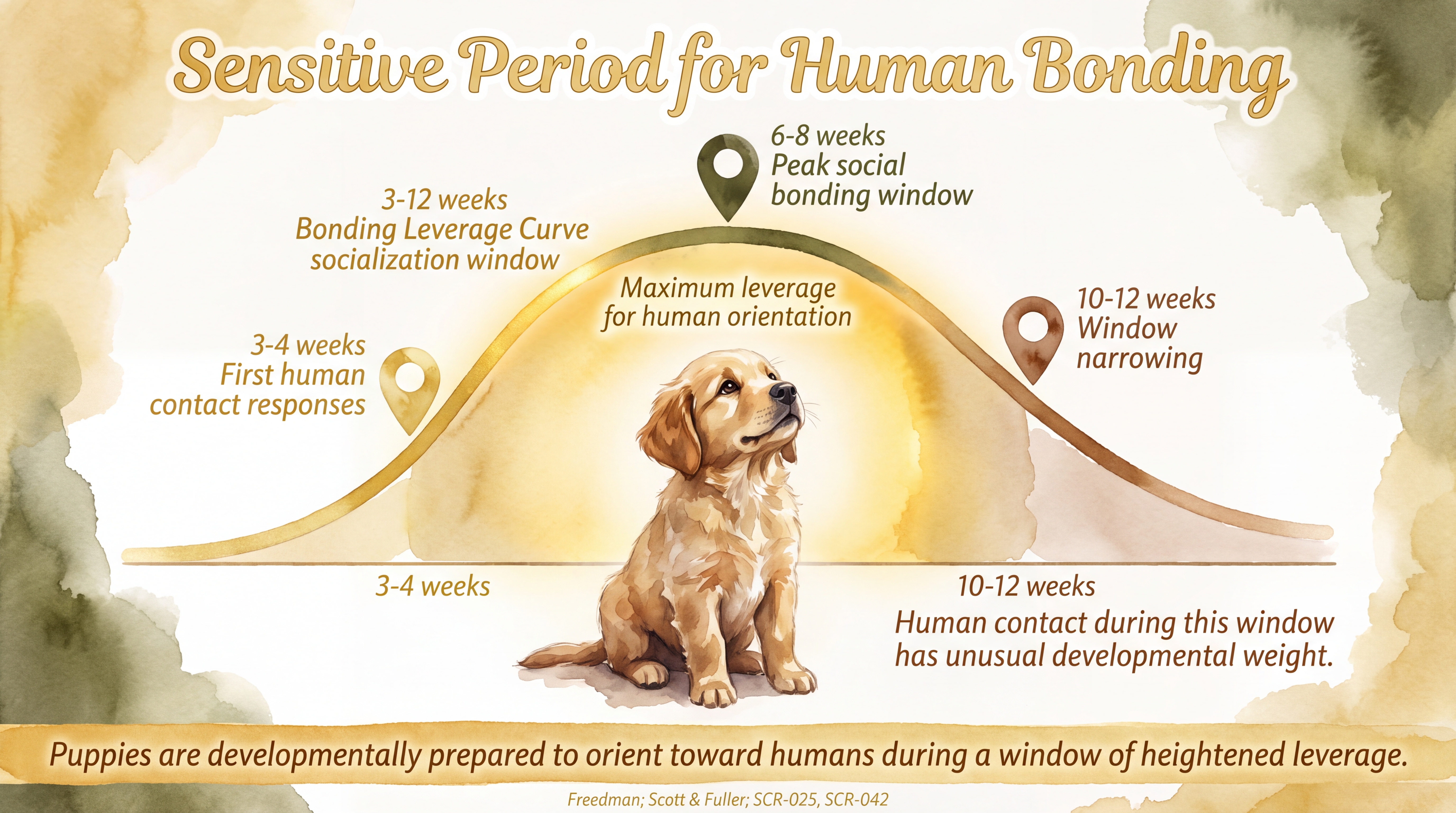
Puppies are developmentally prepared to orient toward humans during a window of heightened leverage.
Key Takeaways
- The sensitive period for human bonding sits inside the broader socialization window rather than replacing it.
- Puppies are biologically prepared for human-oriented social engagement early, especially within JB's retriever breed scope.
- Calm, repeated, predictable human contact supports early bond formation better than excitement or emotional chaos.
- The exact fine-grained timeline of full puppy attachment organization is still less fully mapped than the broader socialization science.
The Evidence
This entry uses ambiguous claim-level tags beyond the dedicated EvidenceBlocks below. These tags mark claims where the literature remains unsettled or multiple interpretations coexist.
- Freedman, D. G., King, J. A., & Elliot, O. (1961)domestic dogs
Showed that delayed human contact produces persistent social consequences, supporting a real early sensitive period for human-oriented social development. - Scott, J. P. & Fuller, J. L. (1965)domestic dogs
Provided the foundational developmental framework linking early social contact and later human social capacity. - Bray, E. E. et al. (2021)retriever puppies including Golden Retrievers
Retriever puppies at eight to ten weeks showed strong human social-communicative readiness without conditioning history. - Mariti, C. et al. (2020)domestic dogs
Attachment-relevant behavior toward humans can be measurable in puppies as young as two months. - Topal, J. et al. (2005)dogs and hand-reared wolves
Early socialization conditions shaped attachment-like behavior toward humans in young canids.
- Nagasawa, M. et al. (2009, 2015)dogs and humans
Mutual gaze and affiliative interaction were associated with oxytocin-linked bonding effects in dog-own​er dyads. - Romero, T. et al. (2014)domestic dogs
Intranasal oxytocin increased social gazing and affiliative behavior in dogs, supporting the physiological reality of the dog-human affiliation loop.
- Attachment-development boundarydomestic dogs
The broad sensitive period for human bonding is well supported, but the fine-grained week-by-week organization of full attachment status in puppies remains less fully mapped than the general socialization literature.
SCR References
Sources
- Bray, E. E., et al. (2021). Early-emerging and highly heritable sensitivity to human communication in dogs. Current Biology, 31(14), 3132-3136.
- Freedman, D. G., King, J. A., & Elliot, O. (1961). Critical period in the social development of dogs. Science, 133(3457), 1016-1017.
- Mariti, C., Lenzini, L., Carlone, B., Zilocchi, M., Ogi, A., & Gazzano, A. (2020). Does attachment to man already exist in 2 months old normally raised dog puppies? A pilot study. Dog Behavior, 6(1), 1-11.
- Nagasawa, M., et al. (2009). Dog's gaze at its own​er increases own​er's urinary oxytocin during social interaction. Hormones and Behavior, 55(3), 434-441.
- Nagasawa, M., et al. (2015). Oxytocin-gaze positive loop and the coevolution of human-dog bonds. Science, 348(6232), 333-336.
- Romero, T., Nagasawa, M., Mogi, K., Hasegawa, T., & Kikusui, T. (2014). Oxytocin promotes social bonding in dogs. PNAS, 111(25), 9085-9090.
- Scott, J. P., & Fuller, J. L. (1965). Genetics and the social behavior of the dog. University of Chicago Press.
- Topal, J., Gacsi, M., Miklosi, A., Viranyi, Z., Kubinyi, E., & Csanyi, V. (2005). Attachment to humans: A comparative study on hand-reared wolves and differently socialized dog puppies. Animal Behaviour, 70(6), 1367-1375.