The Canine Myelination Timeline
The canine myelination timeline matters because behavior depends on circuit speed and integration, not only on motivation. Puppies do not merely "know less" than adults. Their nervous systems are still insulating major pathways, and that changes what kinds of coordinated perception, motor control, and inhibition are realistically available at different ages. Documented
What It Means
What Develops First
The direct canine MRI and histology work supports a staged sequence rather than an all-at-once maturation story. Brainstem and cerebellar structures mature earlier than much of the cerebrum, and early myelination is visible in brainstem auditory pathways by about two weeks. By roughly three to eight weeks, the brain is in a visible transition phase. By about sixteen weeks, MRI appearance is mostly adult-like, but white-matter maturation continues well past that point. Documented
That sequence matters developmentally because earlier systems support more basic tasks brainstem and cerebellar pathways support early sensory and motor organization; broader cerebral white matter supports more integrated perception and response; and later frontal and association-heavy coordination supports restraint, flexibility, and more stable regulation.
This is why puppies can be mobile and socially engaged long before they are neurologically finished.
The Timeline Is About Function, Not Only Anatomy
Myelin increases conduction speed and improves long-range coordination across the brain. In practical terms, that means myelination changes the quality of behavior the dog can produce. Documented
As earlier tracts mature, puppies become more coordinated in movement and more reliable in basic sensory processing. As broader cerebral pathways mature, social responses become less fragmented. As later control-relevant systems keep maturing across the juvenile period, sustained inhibitory control becomes more realistic.
This is the developmental framing that sits underneath the neuroscience page on myelination-in-dogs. That page explains the biology. This page explains what the timeline means for puppy expectations.
Why Sixteen Weeks Is Often Misread
One of the easiest mistakes in canine development is to hear that the brain looks mostly adult-like on MRI by about sixteen weeks and then quietly translate that into "the puppy is basically neurologically finished." Documented The SCR blocks that move.
SCR-040 supports the broad maturation timeline. SCR-041 exists specifically to stop false precision. The often-repeated claim that the dog brain is "70 percent adult by six weeks" is not currently verified, and even the stronger sixteen-week milestone refers to imaging appearance, not complete functional maturity. Estimated
The safe interpretation is that rapid postnatal maturation is real; that MRI-visible milestones are meaningful; that mostly adult-like appearance is not the same as fully mature integration; and that later white-matter development still matters behaviorally. Documented
Why It Matters for Your Dog
What This Means for Behavior
Developmental expectations should track available substrate.
A ten-week-old puppy can already move competently; attend to humans; learn simple patterns; and respond to routine and environment.
But a ten-week-old puppy should not be treated as though adult-level inhibitory control is already online. The substrate for that level of stable restraint is still developing. Asking for it as if it were already there creates confusion at best and chronic overpressure at worst.
This is especially important for family life. A puppy who cannot hold a settled response at the door, disengage from every distraction, or maintain calm through extended stimulation is not necessarily stubborn or oppositional. It may be developmentally immature in exactly the ways the myelination literature would predict.
Myelination is one reason JB treats developmental calmness as a support strategy rather than a moral demand. The brain that will eventually regulate itself is still being wired for speed and coordination.
The Strongest Practical Conclusion
The strongest conclusion is modest and useful: do not confuse visible puppy competence with finished neural maturity.
Early myelination supports real ability. Later myelination still shapes ceiling. That is why developmental guidance should move from simple structure and successful repetition toward more demanding self-control only as the dog's underlying systems become capable of carrying it.
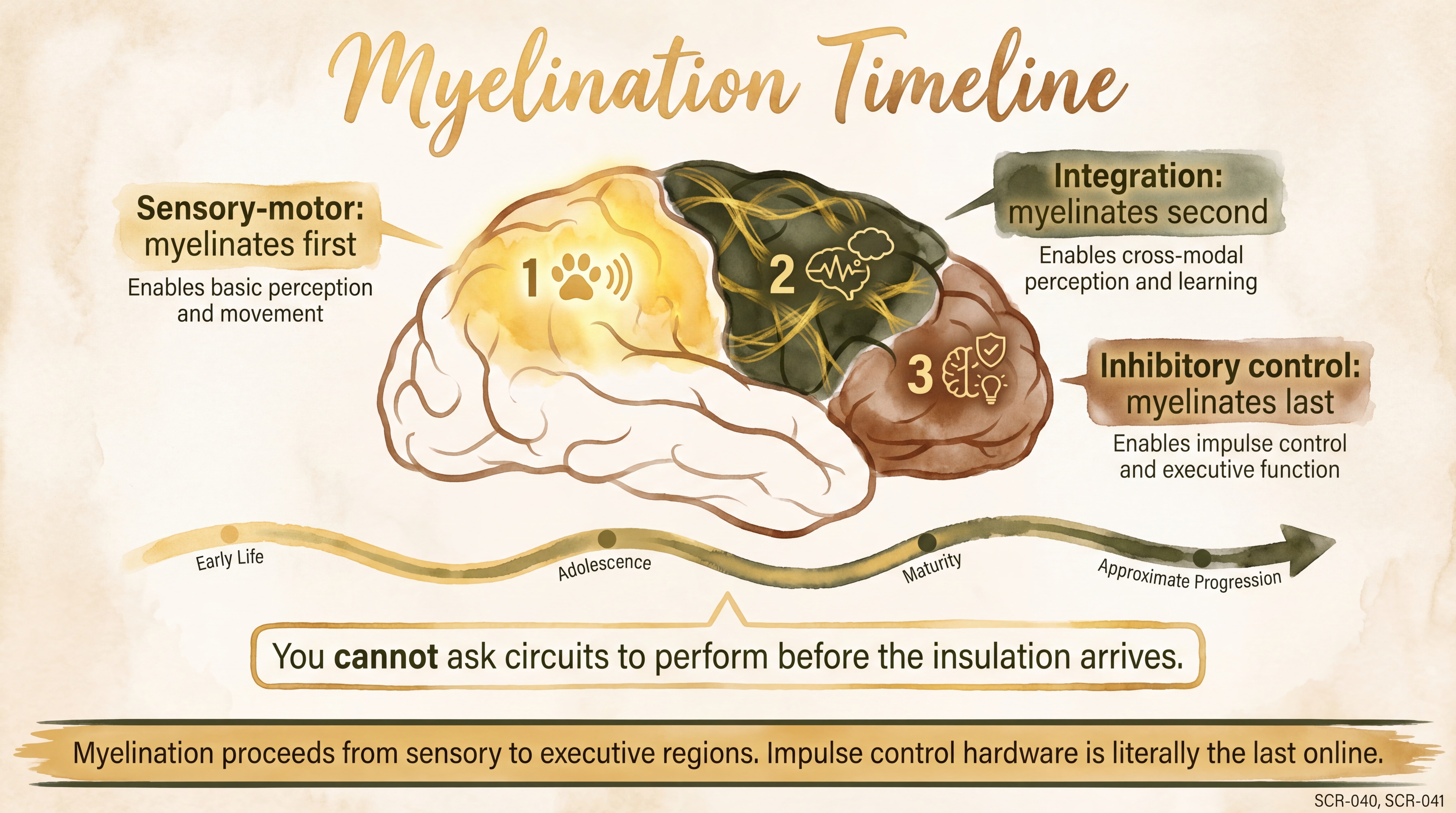
Myelination proceeds from sensory to executive regions - impulse control hardware is literally the last online.
Key Takeaways
- Canine myelination follows a staged developmental sequence rather than appearing all at once.
- Mostly adult-like MRI appearance by about sixteen weeks does not mean fully mature integration or adult-level self-control.
- Earlier systems support basic sensory and motor competence first, while later control-relevant systems continue maturing through juvenile life.
- Developmental expectations should track the maturation of the substrate rather than treating puppies as miniature adults.
The Evidence
This entry uses estimated claim-level tags beyond the dedicated EvidenceBlocks below. These tags mark approximate ranges or timing claims that should remain bounded by the cited sources.
- Gross, B. et al. (2010)domestic dogs
Longitudinal MRI and histology correlation showed brainstem and cerebellar structures maturing earlier than much of the cerebrum, with mostly adult-like MRI appearance by about sixteen weeks and continued maturation beyond. - Wu, Y. C. et al. (2011)domestic dogs
Diffusion work supported ongoing white-matter maturation through later juvenile development. - Hong, H. et al. (2022)domestic dogs
Proteomic evidence showed strong stage-dependent regulation of myelin-related pathways across newborn, juvenile, and adult brains.
- SCR-040 and SCR-041 synthesisdomestic dogs
The developmental implication is strong even though the exact week-by-week behavioral mapping is incomplete: puppies gain capacity as white-matter systems mature, and adult-like restraint should not be assumed from early appearance alone.
- domestic dogs
No published canine study directly ties specific myelination milestones to named behavioral capacities on a week-by-week schedule across development.
SCR References
Sources
- Gross, B., Garcia-Tapia, D., Riedesel, E., Ellinwood, N. M., & Jens, J. K. (2010). Normal canine brain maturation at magnetic resonance imaging. Veterinary Radiology & Ultrasound, 51(4), 361-373. DOI: 10.1111/j.1740-8261.2010.01681.x.
- Hong, H., Zhao, Z., Huang, X., Guo, C., Zhao, H., Wang, G.-D., Zhang, Y.-P., & Zhao, J.-P. (2022). Comparative proteome and cis-regulatory element analysis reveals specific molecular pathways conserved in dog and human brains. Molecular & Cellular Proteomics, 21(8), 100261. DOI: 10.1016/j.mcpro.2022.100261.
- SCR-040 and SCR-041 synthesis. Supports direct canine myelination evidence plus boundary on false precision; does not provide a week-by-week behavioral-capacity timetable.
- Wu, Y.-C., Field, A. S., Duncan, I. D., & Samsonov, A. A. (2011). High b-value and diffusion tensor imaging in a canine model of dysmyelination and brain maturation. NeuroImage, 58(3), 829-837. DOI: 10.1016/j.neuroimage.2011.06.067.