Emotional Regulation Development
Emotional regulation in dogs is the capacity to move out of activation and back toward workable baseline. In development, that capacity is not fully intrinsic at the start. Puppies rely heavily on co-regulation from the dam, litter, and later human caregivers before more stable self-recovery becomes possible. The science strongly supports parts of that story, while the full developmental sequence still involves interpretation. Mixed Evidence
What It Means
Regulation Starts as Co-Regulation
The infant-mammal pattern is that regulation begins socially before it becomes more internal. The young organism is buffered by proximity, familiar contact, rhythm, and predictable caregiving. Dogs fit that broad model well, even if the exact puppy-by-puppy developmental curve is not fully mapped. Mixed Evidence
This is why emotional regulation should not be imagined as a talent puppies either "have" or "do not have." It is a developing capacity scaffolded by environment.
The Direct Dog Pieces
Several SCR entries support the direct canine side of this page.
SCR-048 shows that stronger frontal engagement supports inhibitory control. SCR-049 shows that anxious dogs display abnormal amygdala-centered connectivity. Together, they establish that regulation-relevant circuitry is real and behaviorally meaningful in dogs. Documented
SCR-059 and SCR-106 extend the story into the social environment. Caregiver psychological profile predicts dog HPA-axis flexibility, and HRV coupling is dyad-specific rather than a response to any random human. These findings do not prove one complete developmental model, but they do support a simple and important point: dogs regulate partly inside relationships, not only inside isolated brains.
What Develops Over Time
As puppies mature, several things generally improve recovery after mild activation becomes faster; arousal can be carried for longer without collapse or panic; external support remains helpful but becomes less absolutely necessary; and regulation becomes more context-stable, though not perfectly so.
This should still be stated carefully. We do not yet have a clean single canine curve for "emotional regulation maturation." What we have are converging pieces from inhibition studies, anxiety-network work, attachment and caregiver-state literature, and broader developmental logic. Documented
Why It Matters for Your Dog
Why Caregiver State Matters
The caregiver-state findings matter because they argue against a purely internal view of regulation. Documented A puppy developing inside a dysregulated human or household context is not growing in a neutral emotional climate. That does not mean the adult causes every outcome. It does mean the adult nervous system is part of the developmental environment.
That is one reason the window-of-tolerance framing remains useful even though it is partly interpretive. It captures something the physiological literature keeps pointing toward: baseline conditions shape what recovery looks like. Documented
The Main Boundary
The main limit is that this page cannot honestly claim that one exact canine developmental timetable for emotional regulation has already been directly measured from neonate to adult. It has not.
The strongest supported version is narrower regulation-relevant frontal and limbic systems are documented in dogs; anxious dysregulation has measurable neural correlates; dogs are physiologically influenced by relationship and caregiver state; and development likely involves movement from heavier co-regulation toward greater self-recovery.
That final step is the synthesis. It is strong enough to be useful, but not strong enough to present as a fully settled canine growth chart.
The calmness layer does not need perfect developmental mapping to be scientifically grounded. The evidence already supports that dogs recover in relationship, that state affects control, and that regulation develops rather than arriving finished.
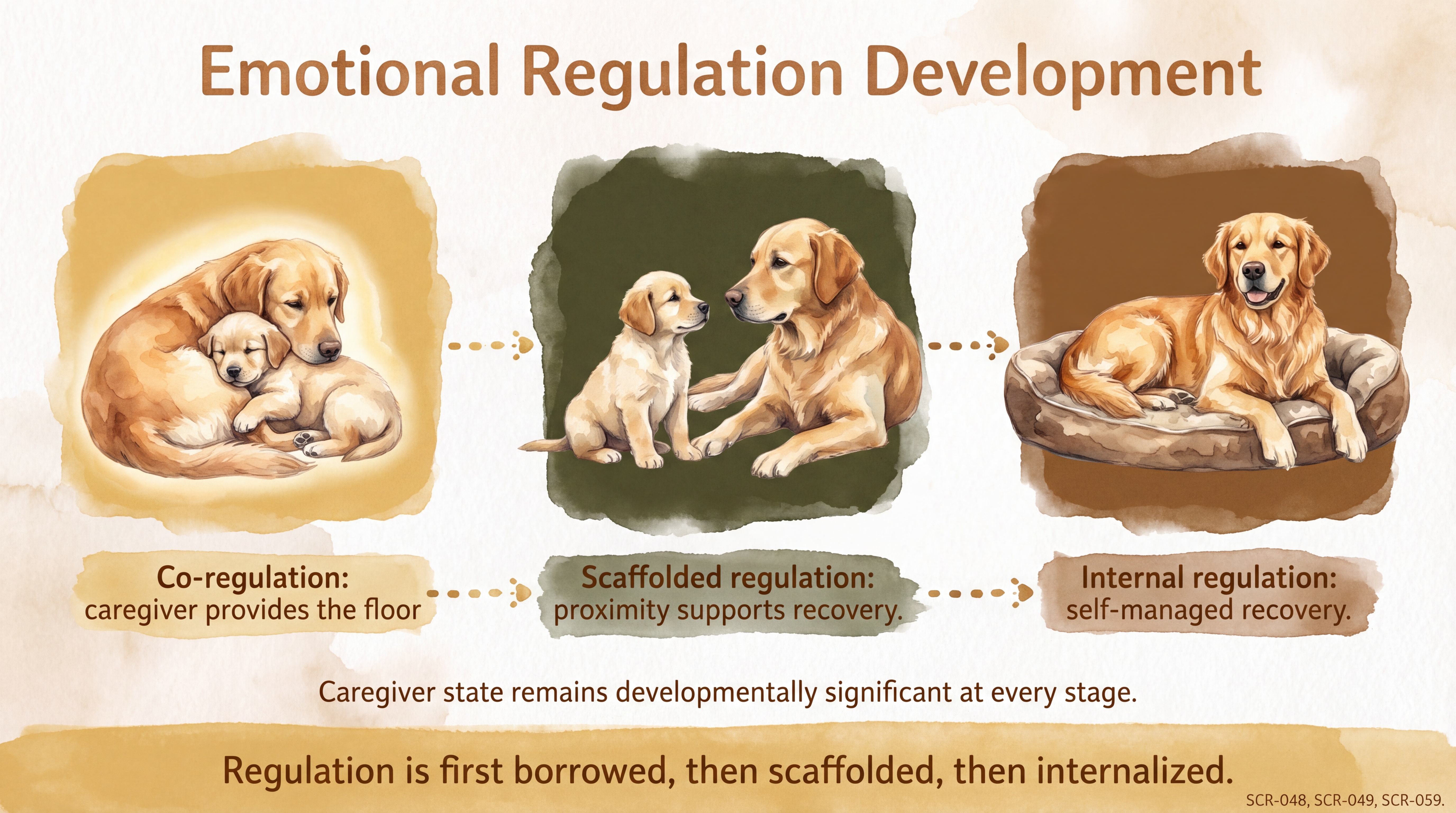
Regulation is first borrowed from the caregiver, then scaffolded by proximity, then internalized.
Key Takeaways
- Puppy emotional regulation begins as a socially scaffolded process rather than a fully intrinsic one.
- Dogs have direct evidence for regulation-relevant frontal and amygdala systems, plus measurable caregiver-linked physiological effects.
- Caregiver state is part of the puppy's developmental environment, not merely a background variable.
- The overall developmental model is strong and useful, but still broader than the currently mapped canine timetable.
The Evidence
This entry uses mixed-evidence claim-level tags beyond the dedicated EvidenceBlocks below. These tags mark claims that combine documented findings with observed practice, heuristic application, or unresolved gaps.
- Cook, P. F. et al. (2016)domestic dogs
Stronger frontal activation predicted fewer impulsive errors in a canine go-no-go paradigm. - Xu, Y. et al. (2023)domestic dogs
Clinically anxious dogs showed heightened amygdala-salience network connectivity linked to fear and excitability. - Schoberl, I. et al. (2016, 2017)dog-human dyads
Own​er variables and relationship quality predicted differences in canine HPA-axis flexibility and cortisol response. - Koskela, K. et al. (2024)dog-human dyads
Dog-own​er HRV coupling was relationship-specific rather than a general human-proximity effect.
- Canine developmental synthesisdomestic dogs
The broad developmental model that puppies move from heavier co-regulation toward more stable self-recovery is strongly consistent with the evidence, even though no single study fully charts the trajectory from birth to adulthood.
- domestic dogs
No published canine study yet maps one standardized developmental curve for emotional regulation maturation from early co-regulation toward more stable self-recovery.
SCR References
Sources
- Cook, P. F., Spivak, M., & Berns, G. S. (2016). Neurobehavioral evidence for individual differences in canine cognitive control: An awake fMRI study. Animal Cognition, 19(5), 867-878. DOI: 10.1007/s10071-016-0983-4.
- Canine developmental synthesis. Supports the page-level synthesis that regulation develops from co-regulation toward self-recovery; no single canine longitudinal study yet maps the full trajectory.
- Koskela, A., Tornqvist, H., Somppi, S., Tiira, K., Kujala, M. V., Vainio, O., Surakka, V., & Kujala, J. (2024). Behavioral and emotional co-modulation during dog-owner interaction measured by heart rate variability and activity. Scientific Reports, 14(1), 25201. DOI: 10.1038/s41598-024-76831-x.
- Schoberl, I., Beetz, A., Solomon, J., & Wedl, M. (2016). Social factors influencing cortisol modulation in dogs during a strange situation procedure. Journal of Veterinary Behavior, 11, 77-85. DOI: 10.1016/j.jveb.2015.09.007.
- Schoberl, I., Wedl, M., Beetz, A., & Kotrschal, K. (2017). Psychobiological factors affecting cortisol variability in human-dog dyads. PLOS ONE, 12(2), e0170707. DOI: 10.1371/journal.pone.0170707.
- Xu, Y., Christiaen, E., De Witte, S., Chen, Q., Peremans, K., Saunders, J. H., Vanhove, C., & Baeken, C. (2023). Network analysis reveals abnormal functional brain circuitry in anxious dogs. PLOS ONE, 18(3), e0282087. DOI: 10.1371/journal.pone.0282087.