Impulse Control Development in Dogs
Impulse control in dogs is the developing capacity to pause, withhold, detour, or redirect an immediately available response. That capacity is not fully present in early puppyhood. It depends on frontal engagement, maturation, practice, and context, which is why the same dog can look highly capable in one situation and impulsive in another. Documented
What It Means
What Counts as Impulse Control
In daily life, impulse control includes behaviors such as pausing before rushing through a doorway; detouring rather than grabbing directly; staying on task despite distraction; and waiting briefly before accessing a desired object or person. Documented
None of those are purely moral qualities. They are partly developmental capacities.
The Direct Canine Anchor
SCR-048 is the strongest direct anchor. Awake fMRI work showed that stronger frontal cortical activation during a go-no-go task predicted fewer impulsive errors in dogs. That means inhibitory control is not only a behavioral label. It has direct canine neural support.
At the same time, the task literature also shows that inhibition is not one simple universal score. Documented Different tasks tap different pieces of control, and performance shifts with arousal and context. That is why development should be discussed as a trajectory rather than as a pass-fail trait.
Why Developmental Timing Matters
SCR-041 exists as a warning against false precision. We do not have a fully verified canine chart that tells us exactly what percentage of frontal maturity exists at each week. But we do have enough evidence to say that adult-like inhibitory control should not be assumed in young puppies.
That distinction changes how expectations should be framed a behavior may be absent because it has not been taught; a behavior may be absent because the substrate for stable control is still immature; and in practice, both are often true at once.
This is why expecting a twelve-week-old puppy to show adult waiting, adult greeting restraint, or adult frustration management is usually a category error.
The Adolescent Phase
Impulse control does not progress in a perfect straight line. Adolescence often looks uneven because motivation rises, novelty sensitivity changes, social conflict can increase, and the dog becomes more physically capable before self-control fully stabilizes. Observed-JB
That is one reason adolescence matters so much as a companion page. A family can misread adolescent inconsistency as defiance when it is often a mix of developmental transition, attachment dynamics, and still-maturing restraint. Observed-JB
Why It Matters for Your Dog
Why Calmness Helps
Impulse control is easiest to misjudge in overstimulating settings. A dog starting high in arousal has less room to regulate. That does not mean arousal is always bad, but it does mean state affects performance.
This is one reason the calmness pillar connects so naturally to impulse control. Calmness is not the skill itself. It is one of the conditions under which the skill can actually be expressed and gradually strengthened.
Impulse control develops more realistically when adults stop treating every failure as a motivation problem. State, age, and substrate matter alongside teaching.
The Practical Conclusion
Impulse control development asks adults to do two things at once teach cleanly and consistently; and expect only what the developing dog can realistically carry. Documented
That is stricter than permissiveness and kinder than overexpectation. It is also more scientific than calling every immature response "stubbornness."
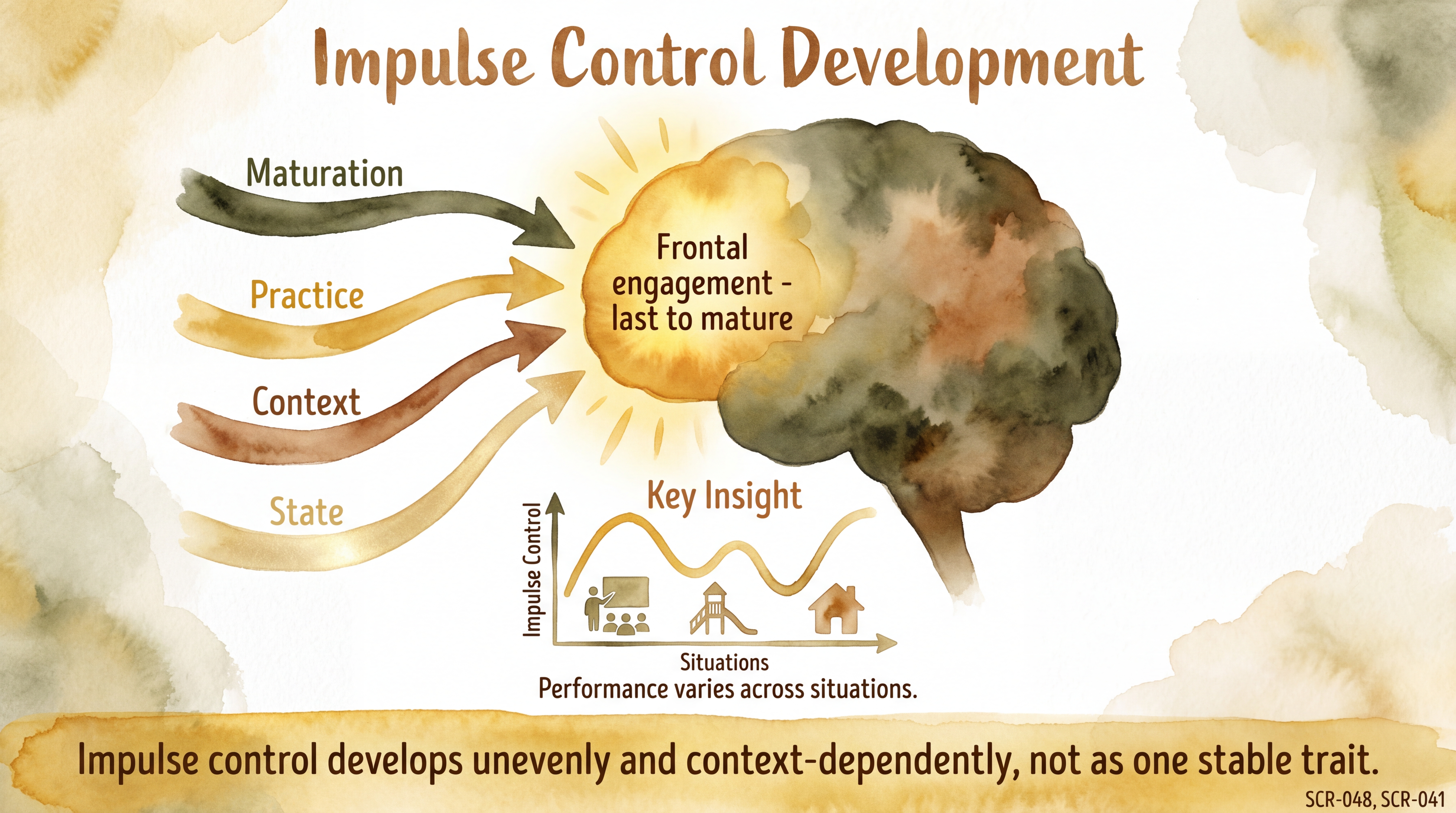
Impulse control develops unevenly and context-dependently, not as one stable trait.
Key Takeaways
- Impulse control is a developmental capacity, not only a matter of willingness or obedience.
- Dogs show direct frontal-cortical involvement in successful inhibitory control.
- Young puppies and adolescents should not be treated as though adult restraint is already fully available.
- Good guidance combines teaching with age-appropriate expectations.
The Evidence
This entry uses observed claim-level tags beyond the dedicated EvidenceBlocks below. These tags mark JB program observation or practice-derived claims that need dedicated EvidenceBlock coverage in a later content pass.
- Cook, P. F., Spivak, M., & Berns, G. (2016)domestic dogs
Stronger frontal cortical activation during a go-no-go task predicted fewer impulsive false alarms. - Brucks, D. et al. (2017)domestic dogs
Different inhibition tasks do not strongly correlate, showing that canine inhibitory control has multiple subcomponents. - Mellor, N. et al. (2024)domestic dogs
Training history and discipline shape cognitive-control performance, reinforcing that inhibitory control develops in interaction with experience.
- SCR-041 boundarydomestic dogs
Exact early brain-maturity percentages are not verified, but the evidence base still supports the practical conclusion that adult-like impulse control should not be presumed in young puppies.
- domestic dogs
No published canine study provides a single developmental timetable for impulse-control maturation across tasks, contexts, and breeds in pet dogs.
SCR References
Sources
- Brucks, D., Soliani, M., Range, F., & Marshall-Pescini, S. (2017). Reward type and behavioural patterns predict dogs' success in a delay of gratification paradigm. Scientific Reports, 7(1), 42459. DOI: 10.1038/srep42459.
- Cook, P. F., Spivak, M., & Berns, G. S. (2016). Neurobehavioral evidence for individual differences in canine cognitive control: An awake fMRI study. Animal Cognition, 19(5), 867-878. DOI: 10.1007/s10071-016-0983-4.
- Mellor, N., McBride, S., Stoker, E., Dalesman, S., & Casey, R. (2024). Impact of training discipline and experience on inhibitory control and cognitive performance in pet dogs. Animals, 14(3), 428. DOI: 10.3390/ani14030428.