Reinforcement Schedules
Reinforcement schedules describe the rule that determines when reinforcement is delivered. That rule matters because different schedules produce different response patterns, different speeds of acquisition, and different resistance to extinction. In everyday terms, a dog is not only learning what pays off. The dog is also learning how often payoff happens and how long it is worth hanging in there. Documented
What It Means
The classic schedule families include continuous reinforcement (CRF), where every correct response is reinforced; fixed ratio (FR), where reinforcement comes after a set number of responses; variable ratio (VR), where reinforcement comes after an unpredictable number of responses; fixed interval (FI), where reinforcement comes after a fixed amount of time has passed; and variable interval (VI), where reinforcement comes after an unpredictable amount of time has passed. These schedules do not just change how fast behavior is acquired. They shape the style of responding.
Continuous reinforcement usually produces fast acquisition and relatively fast extinction when payoff stops. Observed-JB Fixed-ratio schedules often produce high response rates with a post-reinforcement pause. Variable-ratio schedules can produce persistent, steady responding with little pause. Fixed-interval schedules often produce scalloping, where responding accelerates as the expected time approaches. Variable-interval schedules often produce steadier moderate rates.
That schedule logic matters outside the lab. A puppy that is rewarded every time for going to a mat is on something like continuous reinforcement. A puppy that sometimes gets attention for begging and sometimes does not may be living under an intermittent schedule that is much harder to extinguish later. Documented
This is where the partial reinforcement extinction effect becomes practically important. Behaviors maintained on intermittent reinforcement can become more resistant to extinction than behaviors maintained on continuous payoff. Documented That is why intermittently reinforced jumping, barking, pestering, and scavenging can feel stubborn in family life. The unpredictability itself helps sustain persistence.
Dog trainers often explain this with slot-machine language, and the metaphor is directionally useful, though the precise schedule science comes mainly from other species and controlled laboratory conditions. Heuristic
Why It Matters for Your Dog
Schedule science matters because it explains why families accidentally build durable problems.
A dog that never gets a scrap from the table has a clearer world than a dog that gets one "just this once" every few meals. A dog that is occasionally acknowledged for whining or scratching has learned a persistence game: maybe the next try is the winning one.
Intermittent payoff is one reason prevention matters so much. If a behavior never starts earning occasional success, it never becomes that stubborn to begin with.
This is also why schedule thinning is a real skill. Trainers often start with dense reinforcement and then move toward thinner schedules. That can maintain behavior efficiently, but it also changes persistence. Documented Schedule design is not neutral. It shapes how strongly a behavior survives frustration and non-reinforcement.
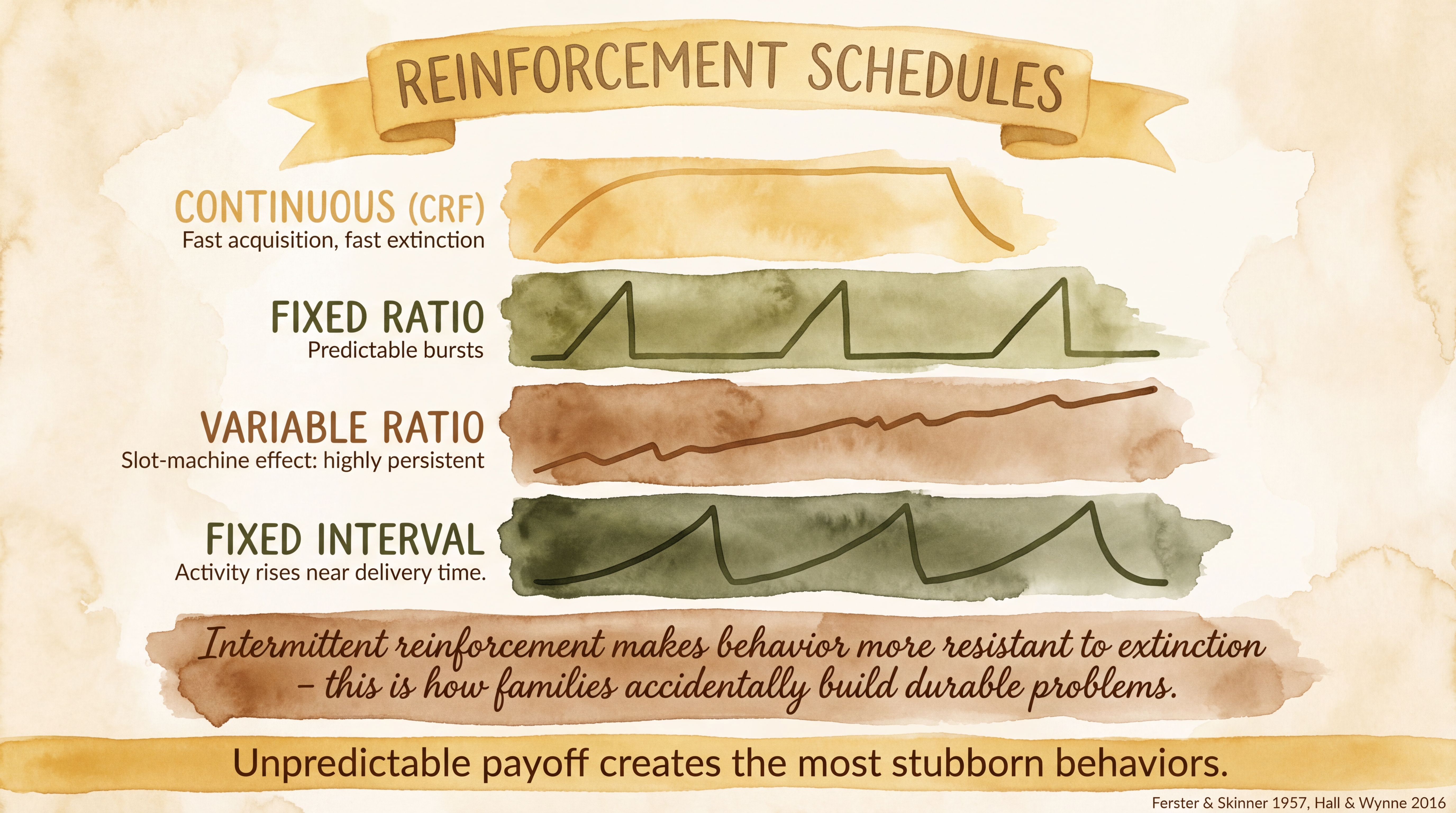
Variable schedules produce the most persistent behavior - which is why intermittent reinforcement makes unwanted behaviors so durable.
Key Takeaways
- Reinforcement schedules determine when payoff happens, and that changes how behavior looks and how long it lasts.
- Intermittent reinforcement can make behavior more resistant to extinction than continuous payoff.
- Many stubborn household problems are maintained by accidental, unpredictable reinforcement.
- Schedule design is one reason prevention is often easier than later correction.
The Evidence
This entry uses observed claim-level tags beyond the dedicated EvidenceBlocks below. These tags mark JB program observation or practice-derived claims that need dedicated EvidenceBlock coverage in a later content pass.
- Ferster, C. B., & Skinner, B. F. (1957)rats and pigeons
Mapped the characteristic response patterns produced by continuous, ratio, and interval schedules with extraordinary precision. - Crossman, E. K. et al. (1987)pigeons
Compared fixed, variable, and random ratio patterns, documenting reliable differences in responding and pausing. - Dews, P. B. (1970)rhesus monkeys
Documented strong within-interval acceleration under fixed-interval schedules, helping establish the scalloping pattern. - Millenson, J. R. (1963)pigeons
Showed steady responding under random or variable interval schedule structures.
- Hall, N. J., & Wynne, C. D. L. (2016)domestic dogs
Reviewed persistence and resistance to extinction in dogs, including the practical relevance of reinforcement history. - Smith, S. M., & Davis, D. L. (2008)domestic dogs
Found that clicker-based training did not shorten training time for a simple task but did increase resistance to extinction under that procedure.
- SCR-004 synthesisdomestic dogs
The claim that engineered schedule-managed reinforcement has no documented analog in natural canine development is an ethological argument rather than a directly verified finding.
No published study has systematically compared schedule effects in domesticated dogs versus dogs in semi-natural or natural contexts, or compared prevention-based and schedule-conscious management against correction approaches with long-term behavioral outcomes.
SCR References
Sources
- Crossman, E. K., Bonem, E. J., Phelps, B. J., & Shull, R. L. (1987). Fixed-, variable-, and random-ratio response patterns. Journal of the Experimental Analysis of Behavior, 47(3), 309-323.
- Dews, P. B. (1970). Studies on responding under fixed-interval schedules of reinforcement. Journal of the Experimental Analysis of Behavior, 14(1), 49-67.
- Ferster, C. B., & Skinner, B. F. (1957). Schedules of reinforcement. Appleton-Century-Crofts.
- Hall, N. J., & Wynne, C. D. L. (2016). Persistence and resistance to extinction in the domestic dog: Basic research and applications to canine training. Behavioural Processes, 129, 67-72.
- Millenson, J. R. (1963). Random interval schedules of reinforcement. Journal of the Experimental Analysis of Behavior, 6(3), 437-443.
- Smith, S. M., & Davis, D. L. (2008). Clicker increases resistance to extinction but does not decrease training time of a simple operant task in domestic dogs. Applied Animal Behaviour Science, 110(3-4), 318-329.