Local Enhancement and Emulation
Local enhancement and emulation are two of the most useful concepts in social-learning science because they explain how observation can matter even when full imitation is not required. Documented In dogs, both mechanisms are well supported and form a large part of the basic evidence for social learning.
This page matters because older debates about canine cognition often treated these mechanisms as if they were disappointments. They are not. They are real social-learning routes, and they explain a great deal about how dogs acquire information from others.
What It Means
Local enhancement means the observer's attention is drawn to a place because another individual acted there. The observer may then explore that place and learn something useful. The key point is that the location, not necessarily the exact action, becomes salient. Emulation means the observer learns about the goal or result of the demonstrator's behavior and then reaches the same result with its own method. Documented In emulation, the learner does not need to copy the motor pattern exactly. It needs to understand, functionally, what was accomplished.
These mechanisms sit between two extremes: simpler than strict imitation because exact motor copying is not required, and stronger than pure individual trial and error because social information changed what the learner noticed or attempted. Documented That middle position is why they matter so much in canine work.
Why It Matters for Your Dog
Why They Were Important in Dog Research
For many years, researchers suspected that dogs used social information but were unsure how far that capacity extended. Documented Local enhancement and emulation offered conservative, testable explanations for many positive findings.
If a dog goes to the same side of an apparatus where another dog just acted, local enhancement may explain it. If a dog reaches the same outcome but uses a different movement pattern, emulation may explain it. These mechanisms let researchers acknowledge real social influence without claiming full imitation too quickly.
That was an important stage in the literature. It kept the field cautious and methodologically disciplined. Only later, with stricter paradigms such as Do As I Do and overimitation studies, did the evidence expand more confidently into true imitation and method-sensitive copying.
What Dogs Are Documented to Do
Dogs clearly use enhancement effects. Watching another individual act changes where they look, what they approach, and which object or location becomes behaviorally relevant.
Dogs also show strong evidence for emulation. Documented In several action-copying tasks, dogs appear to understand the relevant goal while solving the problem with their own action pattern. This is especially important in puppy work, where the learning effect may be strong even when exact imitation is not the most likely mechanism.
The safest current interpretation is that these mechanisms account for a large share of ordinary canine social learning. They are probably common in natural settings because they are efficient. A puppy does not have to duplicate every adult movement to benefit from the adult's example. It may only need to notice where attention belongs or what kind of result matters.
That is why local enhancement and emulation remain important even after stronger imitation evidence entered the field. The newer findings did not replace the simpler mechanisms. They expanded the picture.
Why the Difference Matters
The difference between these two mechanisms is not just technical. If a dog learns through local enhancement, then the demonstrator is primarily directing attention. If the dog learns through emulation, then the demonstrator is also transmitting information about goals and affordances. Those are different levels of information transfer.
Even the simpler mechanisms make adult example consequential. A model does not need to be copied perfectly in order to change what the learner notices, tries, or treats as relevant.
This matters because dog discussion often treats "not full imitation" as if it means "not really social learning." Observed-JB That is a mistake. Enhancement and emulation are both genuine social-learning processes, and in practical developmental settings they may be extremely important.
Boundary
This page should not be read as saying dogs only show local enhancement and emulation. The later literature supports stronger imitation claims under the right conditions. The correct historical point is that for many years these mechanisms explained much of the evidence, and they still explain a great deal of it.
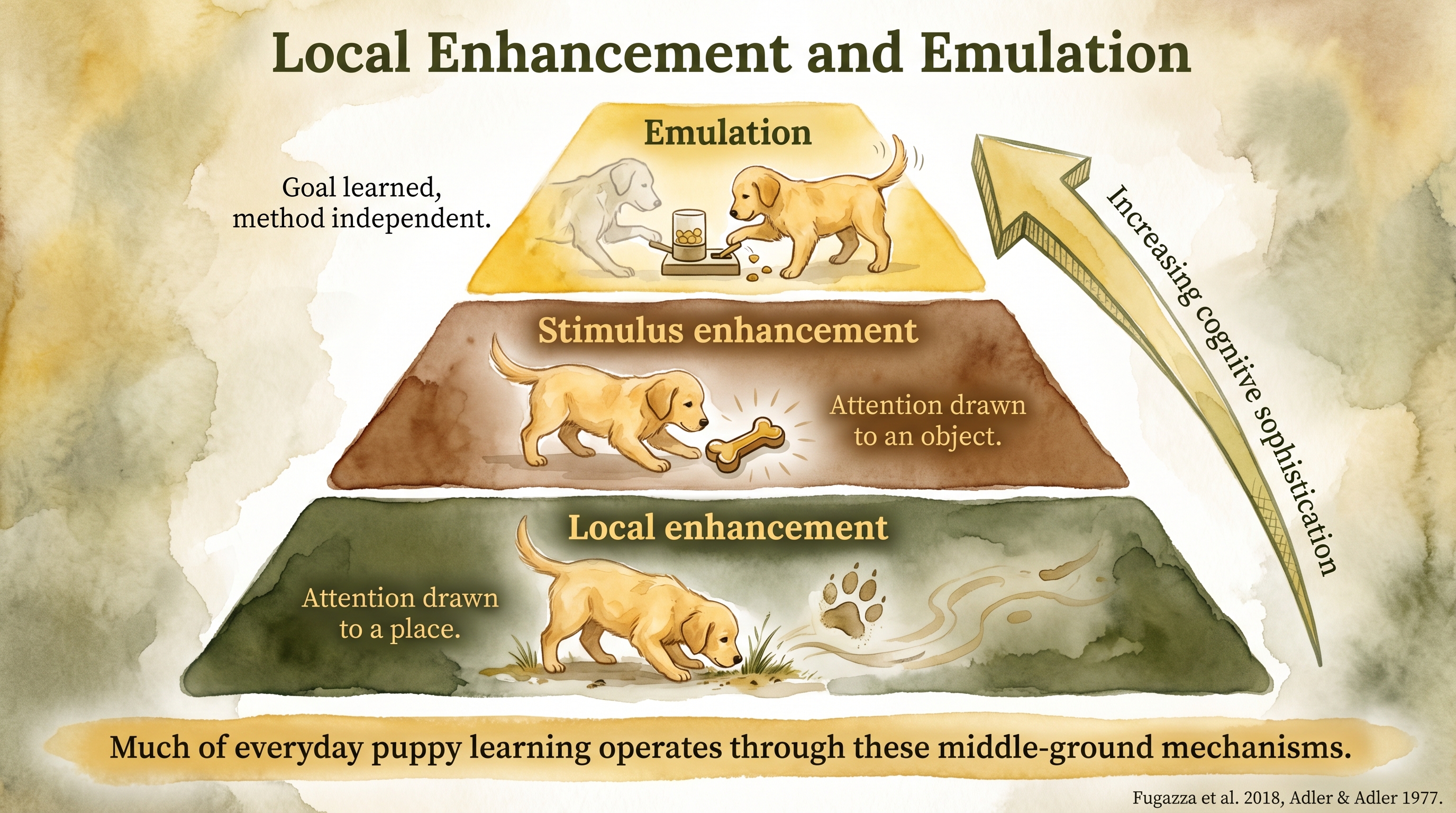
Local enhancement draws attention to locations or objects; emulation copies the result without replicating exact actions.
Key Takeaways
- Local enhancement means another individual's behavior makes a place important to the observer.
- Emulation means the observer learns the goal or result without necessarily copying the exact action.
- Both mechanisms are genuine forms of social learning, not weak substitutes for it.
- Dogs show these simpler mechanisms clearly, and they likely explain a large share of everyday observational learning.
The Evidence
This entry uses observed claim-level tags beyond the dedicated EvidenceBlocks below. These tags mark JB program observation or practice-derived claims that need dedicated EvidenceBlock coverage in a later content pass.
- Fugazza, C. et al. (2018)domestic dogs
Puppies changed problem-solving behavior after demonstration, establishing robust social-learning effects even where the exact mechanism may vary by task. - Adler, L. L., & Adler, H. E. (1977)domestic dogs
Early puppy observational-learning work supported the view that seeing another individual act can change first-trial performance. - Fugazza, C. et al. (2019)domestic dogs
Explicitly examined whether dogs solved goal-directed tasks through imitation or emulation, helping clarify that outcome learning can occur without exact motor copying.
- SCR synthesisdomestic dogs
Local enhancement and emulation likely account for a large portion of everyday social-learning effects in natural settings, even though exact natural-frequency estimates have not been experimentally mapped.
No study has directly partitioned which mechanism (local enhancement versus emulation versus imitation) dominates in naturalistic puppy observation of adult dog behavior during ordinary household interactions.
SCR References
Sources
- Adler, L. L., & Adler, H. E. (1977). Ontogeny of observational learning in the dog (Canis familiaris). Developmental Psychobiology, 10(3), 267-271.
- Fugazza, C., Moesta, A., Pogany, A., & Miklosi, A. (2018). Social learning from conspecifics and humans in dog puppies. Scientific Reports, 8, 9257.
- Fugazza, C., Colbert-White, E. N., and Pongracz, P. (2019). Social learning of goal-directed actions in dogs (Canis familiaris): Imitation or emulation? Journal of Comparative Psychology, 133(2), 244-251. DOI: 10.1037/com0000149.