Dopamine and Canine Reward Systems
Dopamine is central to motivation, reward prediction, action energizing, and learning from outcomes. In dogs, the safest scientific framing is that dopamine systems are real, measurable, and behavior-relevant, but many everyday claims about excitement and "dopamine addiction" go beyond what direct canine evidence currently supports. Documented
What It Means
Dopamine is often described casually as the pleasure chemical. That is too simple. The broader neuroscience literature links dopamine more strongly to wanting, reward prediction, motivation to act, and updating behavior based on outcome. This is why the wanting-versus-liking distinction matters. Dopamine is more closely tied to the motivational pull toward a reward than to the hedonic experience of consuming it.
What Dogs Directly Show
The dog evidence is thinner than the classic rodent and primate literature, but it is not absent. Direct canine studies support measurable D2 receptor binding in the striatum, behavior-linked dopaminergic gene associations, dopamine-transporter abnormalities in compulsive-spectrum pathology, and reward-circuit activation to positive and socially meaningful stimuli. That last point is important. Canine fMRI work shows caudate activation to reward-predicting cues and socially valued stimuli, which is compatible with reward-system involvement even when it does not measure dopamine release directly. Documented
SEEKING and Motivated Behavior
Panksepp's SEEKING framework is useful here because it organizes dopamine around motivated pursuit rather than around crude pleasure. The mammalian idea is that SEEKING drives exploration, investigation, appetitive action, and energized engagement with the environment. Applied to dogs, this fits a great deal of familiar behavior: exploratory sniffing, anticipatory movement toward reward, engagement with task structure, and active pursuit of socially meaningful outcomes. Documented The direct dog mapping is still more conceptual than electrophysiologically complete, which is why this page remains documented-cross rather than purely documented.
Dopamine and Social Reward
One reason dopamine gets oversimplified in dog discourse is that it is often treated as the opposite of social bonding chemistry. The source layer argues for a more accurate picture: social reward is usually not oxytocin or dopamine. It is oxytocin and dopamine interacting. That is the safer scientific view. Oxytocin can shape social salience and affiliation, while dopamine helps energize and reinforce motivated engagement. Social connection is not chemically separate from reward. It recruits reward-related systems.
Why It Matters for Your Dog
Dopamine science is often misused to argue against high-engagement activities or to create false narratives about "dopamine addiction" in normal pets. The reality is more nuanced. Dopamine is central to healthy motivation, exploration, and learning. A dog with a functional reward system is more, not less, capable of flexible behavior and meaningful engagement. The risk is not dopamine itself but dysregulation - when arousal systems run so high that calm, focused thinking becomes harder. The science supports managing arousal levels and building calm baselines, not avoiding all engagement or treating dopamine as an enemy. Documented-Cross-Species Dogs who are motivated, engaged, and able to pursue meaningful activities are healthier and more content than dogs living in chronic suppression.
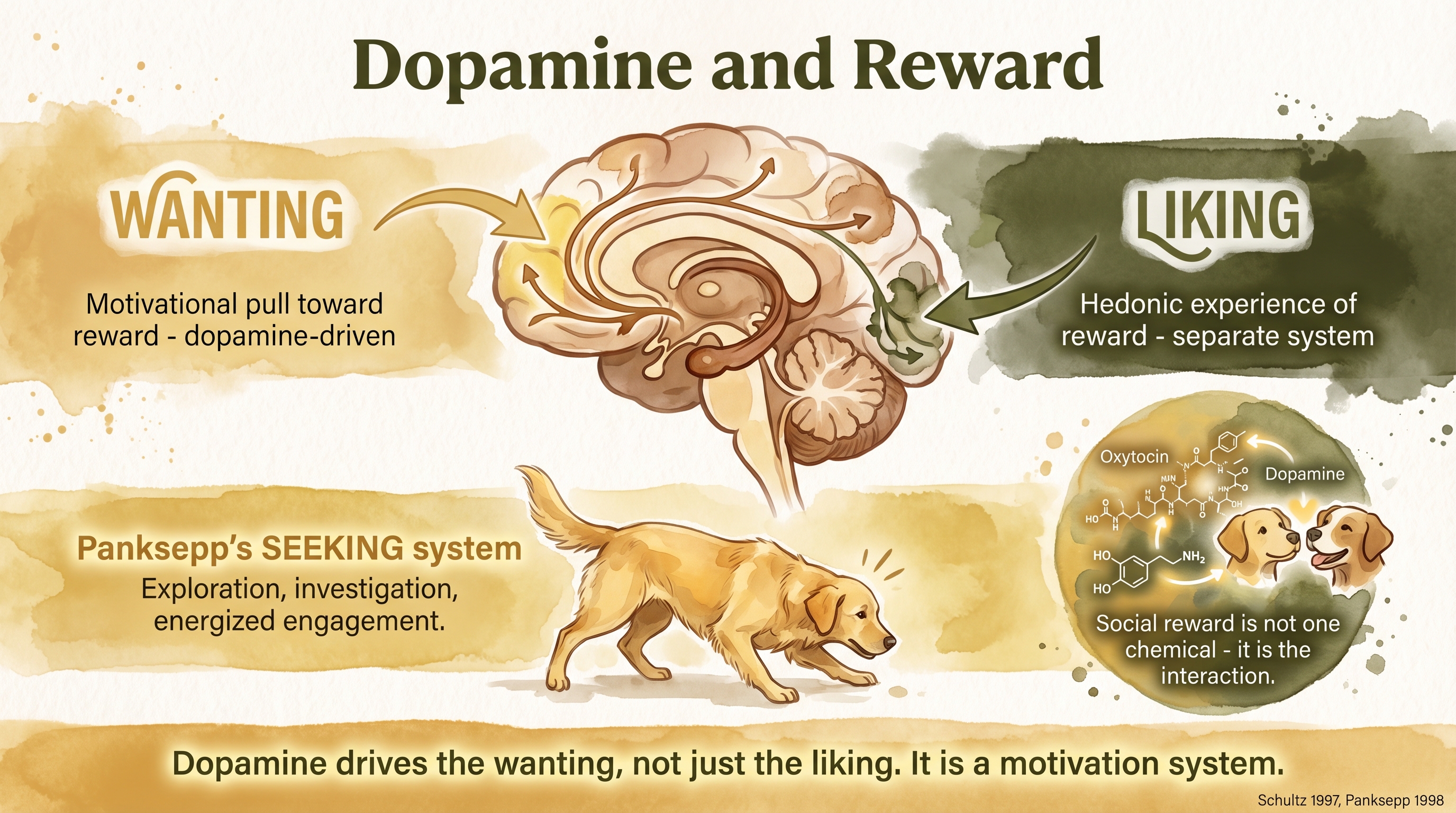
Dopamine drives anticipation and seeking behavior, not pleasure - making prediction, not reward delivery, the active ingredient.
Key Takeaways
- Dopamine in dogs is best understood as a motivation and reward-system signal, not just a pleasure chemical.
- Direct canine studies support dopamine-relevant receptors, gene associations, transporter abnormalities, and reward-circuit engagement.
- Social bonding and reward are not chemically separate; oxytocin and dopamine interact.
- Strong everyday claims about 'dopamine addiction' in pet dogs remain more heuristic than directly demonstrated.
The Evidence Boundaries
The strongest evidence boundary here concerns overreach. This page does not claim that dopamine is inherently bad or pathological, that high-arousal training has been shown to produce dopamine pathology in typical pet dogs, or that one can infer central dopamine state directly from simple peripheral testing. The more careful interpretation is: dopamine matters to motivation and reward systems in dogs, dysregulated or compulsive phenotypes can involve dopaminergic abnormalities, and broad lifestyle narratives about "dopamine addiction" in everyday dogs remain more heuristic than directly measured.
The chronic-excitement layer often argues that dogs can be trained into needing higher levels of activation to stay engaged. The science supports that concern most safely as a regulation hypothesis grounded in reward-system biology, not as a direct canine proof of everyday dopamine pathology.
No published study has directly tested whether high-arousal training in puppies produces measurable chronic dysregulation or altered dopamine responses compared to calm-based training approaches.
The Evidence
- Schultz, W. (1997 and later work)multiple mammals
Established dopamine's central role in reward prediction and learning from outcomes. - Berridge, K. C., & Robinson, T. E. (1998 and later work)multiple mammals
Distinguished motivational wanting from hedonic liking, clarifying dopamine's role in incentive salience. - Panksepp, J. (1998)multiple mammals
Framed SEEKING as the core exploratory and appetitive motivational system in mammalian brains.
- Hatazawa, J. et al. (1991)domestic dogs
Measured D2 receptor-specific binding in the canine brain by PET. - Bellamy, K. K. L. et al. (2018)domestic dogs
Linked DRD2 variation to fear-related phenotype in some dog populations. - Vermeire, S. et al. (2012)domestic dogs
Found dopamine-transporter abnormalities in dogs with compulsive behavior. - Berns, G. S. et al. (2012, 2014)domestic dogs
Showed reward-circuit activation to positive cues and socially meaningful stimuli, compatible with dopaminergic reward-system involvement.
- Neurochemistry source synthesisdomestic dogs
Current dog evidence does not justify treating dopamine as the simple biochemical enemy of calmness or claiming that ordinary high-energy routines produce measured dopamine pathology in typical pets. - SCR-014 and SCR-042 boundarydomestic dogs and multiple mammals
Reward, affiliation, and social motivation should be framed as interacting systems rather than an oxytocin-versus-dopamine dichotomy.
SCR References
Sources
- Bellamy, K. K. L., et al. (2018). DRD2 is associated with fear in some dog breeds. Journal of Veterinary Behavior, 27, 67-73.
- Berns, G. S., Brooks, A. M., & Spivak, M. (2012). Functional MRI in awake unrestrained dogs. PLOS ONE.
- Berns, G. S., et al. (2014). Scent of the familiar: Dog fMRI responses to human and dog odors. Behavioural Processes.
- Berridge, K. C., & Robinson, T. E. (1998). What is the role of dopamine in reward: Hedonic impact, reward learning, or incentive salience? Brain Research Reviews, 28(3), 309-369.
- Hatazawa, J., et al. (1991). Measurement of D2 dopamine receptor-specific binding in the canine brain by PET. Journal of Nuclear Medicine, 32(4), 713-718.
- Panksepp, J. (1998). Affective neuroscience: The foundations of human and animal emotions. Oxford University Press.
- Schultz, W. (1997). Dopamine neurons and their role in reward mechanisms. Current Opinion in Neurobiology, 7(2), 191-197.
- Vermeire, S., Audenaert, K., De Meester, R., Vandermeulen, E., Waelbers, T., De Spiegeleer, B., Eersels, J., Dobbeleir, A., & Peremans, K. (2012). Serotonin 2A receptor, serotonin transporter and dopamine transporter alterations in dogs with compulsive behaviour as a promising model for human obsessive-compulsive disorder. Psychiatry Research: Neuroimaging, 201(1), 78-87.