Generalization and Discrimination
Compound evidence detail1 SCR / 2 parts
- Documentedthe cross-species context-dependent learning principle (Bouton 2002, 2004) demonstrating that learned responses do not transfer freely across contexts in rat models and broader learning science
- Documentedthe canine-direct demonstrations of context-specific behavioral transfer (Bray, MacLean and Hare 2014; Brucks 2017; Silver 2025; Range and Viranyi 2015; Gergely 2014)
Generalization and discrimination describe two opposite learning pressures. Generalization is the spread of a learned response to similar stimuli, places, or situations. Discrimination is the narrowing of that response so it occurs only under specific conditions. Every trained behavior lives somewhere on that spectrum. Documented
What It Means
If a dog learns "sit" in the kitchen and then also sits in the yard, on the sidewalk, and in the living room when hearing the same cue, that is generalization. Documented If the dog only sits reliably in the kitchen, with one handler, using one tone of voice, the response is under narrow stimulus control and discrimination has remained strong.
Neither process is inherently good or bad. Both are necessary.
Discrimination is what allows a dog to tell one cue from another, one context from another, and one rule from another. Without discrimination, behavior becomes fuzzy and overbroad. Generalization is what allows a skill to travel into real life instead of remaining trapped in its original learning bubble.
Classical conditioning research documented these processes very early. Pavlov's work with dogs showed both stimulus generalization and discrimination in conditioned responses. Documented Operant work later showed the same issue at the level of trained actions: a response does not automatically transfer just because the human thinks it should.
This matters because many training successes are more local than they appear. A dog can look excellent in a familiar lesson environment and far less reliable in a new room, with a new person, at a different time of day, or under a different arousal state. Documented That is not necessarily stubbornness. It may simply be narrow stimulus control.
The canine training-transfer literature aligns with this point. SCR-169 documents that trained behaviors often show poor transfer across location, handler, and distraction context unless generalization is trained deliberately. Estimated
JB sometimes adds a broader interpretive claim here: behavior absorbed environmentally may generalize more naturally than behavior trained as a narrow discrete response. That is a meaningful hypothesis, but it should stay in the heuristic lane unless and until directly compared in controlled work.
Why It Matters for Your Dog
Families often think a dog "knows it" because the dog performed the behavior well in one setting. Observed-JB Learning theory warns that this conclusion can be premature.
If a behavior is meant to live in everyday life, it has to survive variation in room, handler, timing, distraction, and state. That is one reason environment-wide patterns can matter as much as single-context drills.
This page matters practically because it explains several common frustrations: the dog sits perfectly in class but not at home, the dog listens to one family member and ignores another, the dog seems to "forget" training outside the original routine, and a behavior extinguished in one place reappears elsewhere. Those are all, at least partly, generalization and discrimination problems.
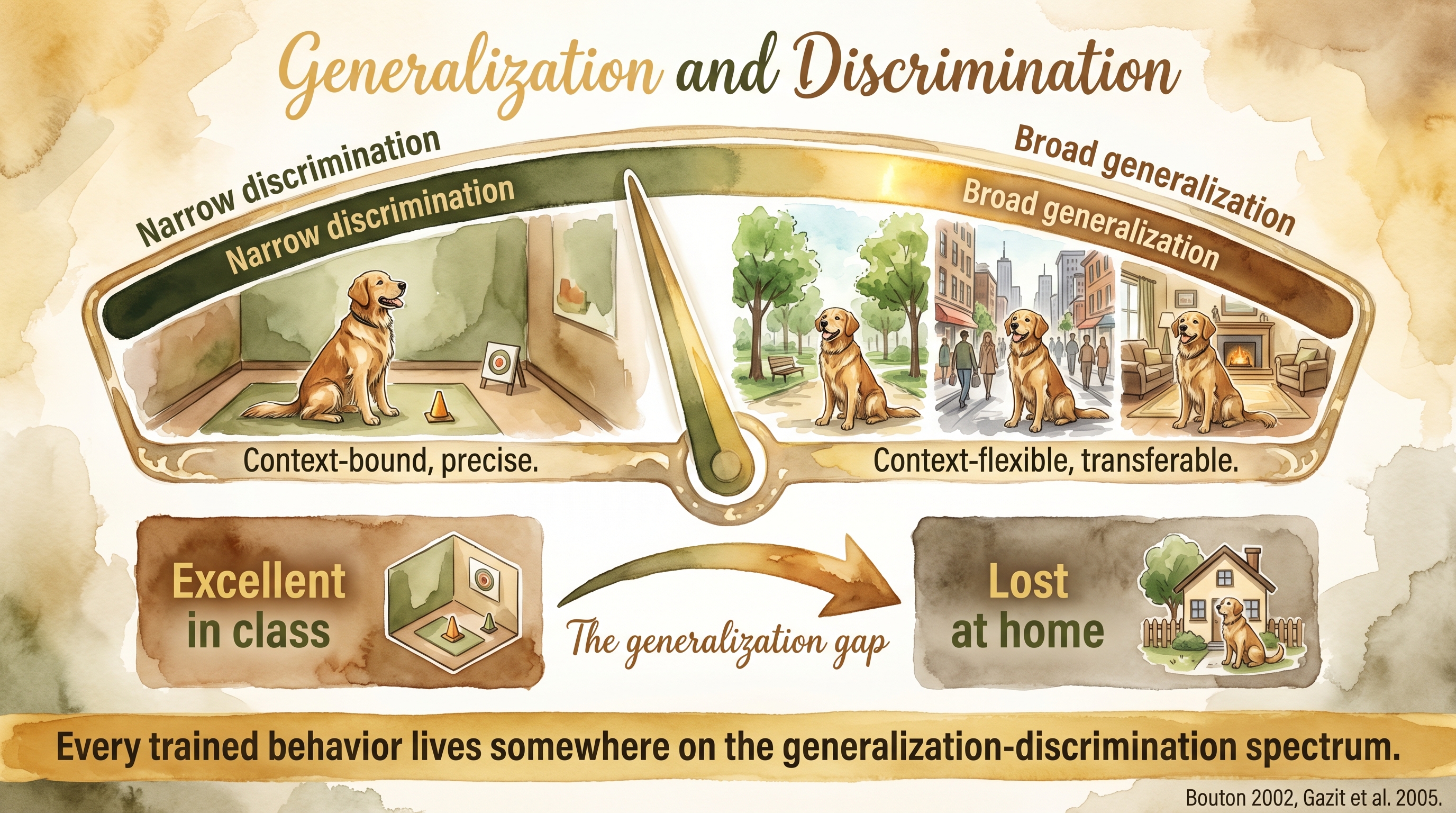
Generalization extends learned responses to similar stimuli; discrimination narrows responding to specific cues.
Key Takeaways
- Generalization spreads a learned response to new but similar situations; discrimination narrows it to specific cues or contexts.
- A dog can perform well in one setting and still have a very context-bound skill.
- Training transfer problems are often learning problems, not moral failures.
- JB's stronger claim about environment-wide behavior generalizing better remains heuristic rather than documented fact.
The Evidence
This entry uses observed claim-level tags beyond the dedicated EvidenceBlocks below. These tags mark JB program observation or practice-derived claims that need dedicated EvidenceBlock coverage in a later content pass.
This entry uses estimated claim-level tags beyond the dedicated EvidenceBlocks below. These tags mark approximate ranges or timing claims that should remain bounded by the cited sources.
- Pavlov, I. P. (1927)domestic dogs
Documented stimulus generalization and discrimination in conditioned responding, establishing these as basic learning phenomena. - Bouton, M. E. (2002, 2004)rats and multiple species
Showed that learning and extinction are deeply context-governed, helping explain why behavior does not automatically generalize across settings.
- Gazit, I., Goldblatt, A., & Terkel, J. (2005)domestic dogs
Showed renewal-like recovery of trained search behavior when dogs were moved to a new context, directly illustrating canine context dependence. - Learning-theory synthesis summarized in SCR-169domestic dogs
Canine training literature documents poor transfer of trained behaviors across context, handler, and distraction level unless generalization is explicitly cultivated.
- JB synthesisdomestic dogs
The claim that environmentally absorbed behavior may generalize more broadly than discretely trained behavior is plausible and consistent with the wider critique of narrow context-bound training, but it is not directly settled by controlled comparison studies.
No published controlled study has directly compared generalization outcomes in dogs raised with environment-wide behavior expectations versus dogs trained with discrete, single-context protocols.
SCR References
Sources
- Bouton, M. E. (2002). Context, ambiguity, and unlearning: Sources of relapse after behavioral extinction. Biological Psychiatry, 52(10), 976-986.
- Bouton, M. E. (2004). Context and behavioral processes in extinction. Learning & Behavior, 32(4), 485-494.
- Gazit, I., Goldblatt, A., & Terkel, J. (2005). The role of context in extinction of searching behavior in dogs. Animal Cognition, 8(2), 91-99.
- Pavlov, I. P. (1927). Conditioned Reflexes: An Investigation of the Physiological Activity of the Cerebral Cortex (G. V. Anrep, Trans.). Oxford University Press.