The Formalization Thesis
Compound evidence detail2 SCRs / 4 parts
- Documentedthe commensal pathway model of canine domestication established as the dominant framework in evolutionary biology, supported by Bergstrom 2020 genomics, Thalmann 2013 mtDNA, Larson and Bradley 2014, and Freedman 2014
- Heuristicthe JB interpretive bridge mapping the Five Pillars onto the selection pressures inferred to have operated during commensal domestication, a synthesis without direct genomic or archaeological support
- Documentedthe historical components: long dog-human cohabitation before formal obedience systems, military-era codification in Most 1910, and village-dog evidence showing social competence outside professional training structures
- Heuristicthe JB formalization thesis that institutional demands, rather than a demonstrated collapse of relational learning, best explain the rise of formal training, with modern pet-context limits kept explicit
The Formalization Thesis is one of JB's central philosophical claims and one of the highest-slippage areas in the whole knowledge base. The documented background is that dogs lived with humans for millennia before modern training was codified into systematic method. The stronger JB conclusion - that formalization changed the relationship and helped create the need for its own methods - is interpretive. Heuristic
What It Means
The thesis begins with a historical contrast.
Dogs were already living with humans, working with humans, scavenging near humans, and integrating into human environments long before modern training manuals, professional trainers, and formal compliance systems emerged. Heuristic That much is background context, not radical revisionism.
JB then asks a sharper question: if dogs and humans were already coexisting successfully without systematic training doctrine, what changed when someone began formally codifying "this is how you train a dog"?
Its answer is the formalization thesis. The relationship shifted. What had previously been organized around social participation, local custom, household structure, and functional cohabitation was increasingly translated into explicit method, command architecture, specialist expertise, and repeatable behavioral technology. Heuristic
That does not mean all formalization was malicious or pointless. It means formalization was not neutral.
In JB's reading, the rise of systematic training particularly reflects institutional needs - military, police, and specialist working contexts - more than a demonstrated failure of ordinary relational living with dogs. Heuristic Once that way of thinking becomes dominant, the human begins to approach the dog less as a developing social organism and more as an object of managed behavior production.
This is the point where JB says, "the method creates the need for the method." That phrase is memorable because it captures a cycle. When life with dogs is reorganized around formal intervention, the dog's behavior is increasingly interpreted through the lens of problems requiring formal intervention. The more method-centered the relationship becomes, the more indispensable method appears.
But the wiki has to stay disciplined here. SCR-158 does not authorize this as proven history. It authorizes it as a heuristic synthesis of documented facts. Heuristic The timeline is real. The causal reading of the timeline is JB's contribution.
Why It Matters for Your Dog
This page matters because it changes the default question from:
- Which training method should I choose?
to:
- Why am I assuming the dog primarily needs a method at all?
That reframing does not eliminate skill teaching or guidance. It changes what sits at the center. Heuristic JB wants the center to be raising: developmental environment, social mentorship, calm structure, prevention, and proportional correction.
The Formalization Thesis is not an anti-history slogan. It is JB's interpretation that codified dog training emerged late, for specific institutional reasons, and then reshaped how ordinary people understood life with dogs.
If that interpretation is even partly right, then many modern dog problems may be read differently. Some are not failures to comply with a method. They are failures of developmental environment, household rhythm, emotional regulation, or social structure - all areas JB places upstream of formal training.
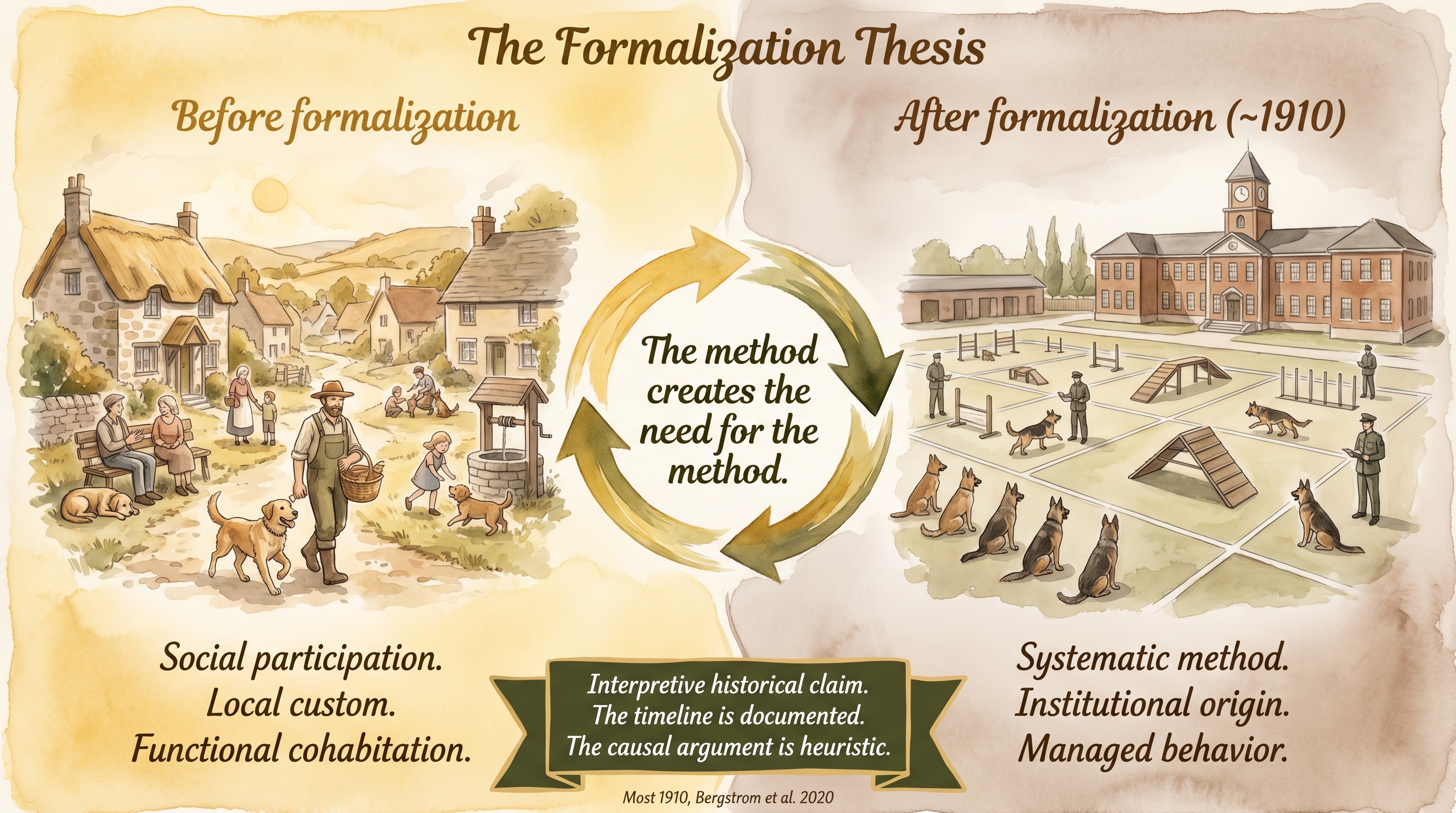
The method creates the need for the method - an interpretive historical claim built on a documented timeline.
Key Takeaways
- Dogs lived successfully alongside humans for thousands of years before modern training methods were formally invented - the relationship did not start with systematic training.
- When dog training became codified into method and doctrine, it shifted the focus from raising (social development and natural cohabitation) to training (formal behavior modification).
- This matters for families because it means many dog problems may be solved by improving the home environment and social development, not by finding the right training technique.
The Evidence
- Bergstrom, A. et al. (2020) and broader domestication literature summarized in SCR-001ancient dogs and wolves
Supports a long pre-modern history of dog-human cohabitation that predates modern formal training systems by many millennia. - Most, K. (1910) and related training-history sources summarized in SCR-158domestic dog, historical training literature
Locates systematic codification of modern dog training within later institutional and specialist contexts rather than at the origin of dog-human life together.
The stronger claim that formalization itself changed the relationship in ways that created a self-reinforcing demand for formal methods is a heuristic thesis. It should be presented as interpretation, not as settled historical proof.
No published study directly tests the specific claims or protocols described in this entry within a controlled canine trial.
SCR References
Sources
- Bergstrom, A. et al. (2020) and broader domestication literature summarized in SCR-001. Documents commensal-pathway evidence and training-history sources. The formalization thesis - that formalization itself was the source of modern dog-behavior pathology - is JB synthesis [Heuristic, high-slippage] (anchor: SCR-158).
- Most, K. (1910) and related training-history sources summarized in SCR-158. Documents commensal-pathway evidence and training-history sources. The formalization thesis - that formalization itself was the source of modern dog-behavior pathology - is JB synthesis [Heuristic, high-slippage] (anchor: SCR-158).