The Commensal Pathway
Compound evidence detail1 SCR / 2 parts
- Documentedthe commensal pathway model of canine domestication treated as a leading working model in evolutionary biology, supported by Bergstrom 2020 genomics, Thalmann 2013 mtDNA, Larson and Bradley 2014, and Freedman 2014
- Heuristicthe JB interpretive bridge mapping the Five Pillars onto the selection pressures inferred to have operated during commensal domestication, a synthesis without direct genomic or archaeological support
The Commensal Pathway is a leading working model in evolutionary biology for how dogs entered human life, not a settled account of every origin detail. Proto-dogs likely self-selected toward human camps, where reduced flight distance, social tolerance, and attentiveness to human environments created an evolutionary advantage. Documented JB then makes a second claim: that the Five Pillars are broadly consistent with the kinds of social and developmental pressures that would have favored successful cohabitation. That second claim is interpretive and held at Heuristic confidence.
What It Means
The older popular image of domestication often implied a mostly human-directed story: people captured wolf pups, deliberately tamed them, and eventually turned them into dogs. Observed-JB The commensal pathway shifts the center of gravity.
In this model, proto-dogs were not primarily dragged into human society. They moved toward it. Human settlements created a niche rich in waste, opportunity, and selective pressure. Animals better able to tolerate proximity, manage arousal, attend to human movement, and remain socially flexible were more likely to exploit that niche successfully. Mixed Evidence
This is why the phrase "they followed us" is so important inside JB. It captures the asymmetry of the model. The domestication process was not mainly humans learning to become more dog-like. Documented It was canids gradually adapting to the realities of life around humans.
The science needs a clean distinction here. The commensal pathway as a widely cited working model is documented in the evolutionary literature. Documented The stronger JB claim, that the Five Pillars describe the kind of developmental grammar that fits those selection pressures, is not documented as an evolutionary result. It is a heuristic synthesis.
That distinction matters because it protects the page from overreach. JB does not need to say that evolution proved Mentorship, Calmness, Structured Leadership, Prevention, and Indirect Correction as named doctrine. It only needs to say that a social species adapting to life around humans would likely benefit from qualities such as reduced reactivity, social attentiveness, tolerance of proximity, and successful developmental integration into human groups. That broader compatibility argument is reasonable, but it is still an interpretation.
Why It Matters for Your Dog
The commensal pathway matters because it changes what kind of animal a dog is assumed to be.
If dogs emerged by successfully living near humans over very long timescales, then the question of raising is not an artificial modern invention. It is close to the center of the species' story. The dog is not merely a wolf waiting for instruction. The dog is an animal shaped by selection for life in human social environments.
JB uses the commensal pathway as an evolutionary backdrop, not as a proof text. The documented part is the model of self-selected integration into human environments. The interpretive part is JB's claim that the Pillars fit that kind of history better than a purely formalized training frame does.
This helps explain why JB keeps returning to calm cohabitation, social orientation, and developmental fit. If the dog-human relationship was built in part through proximity, tolerance, and successful participation in human social space, then a raising philosophy that prioritizes those things is at least evolutionarily intelligible.
What the page must not do is skip from intelligible to proven. The evolutionary model and the JB philosophy are related, but they are not the same kind of claim. Heuristic
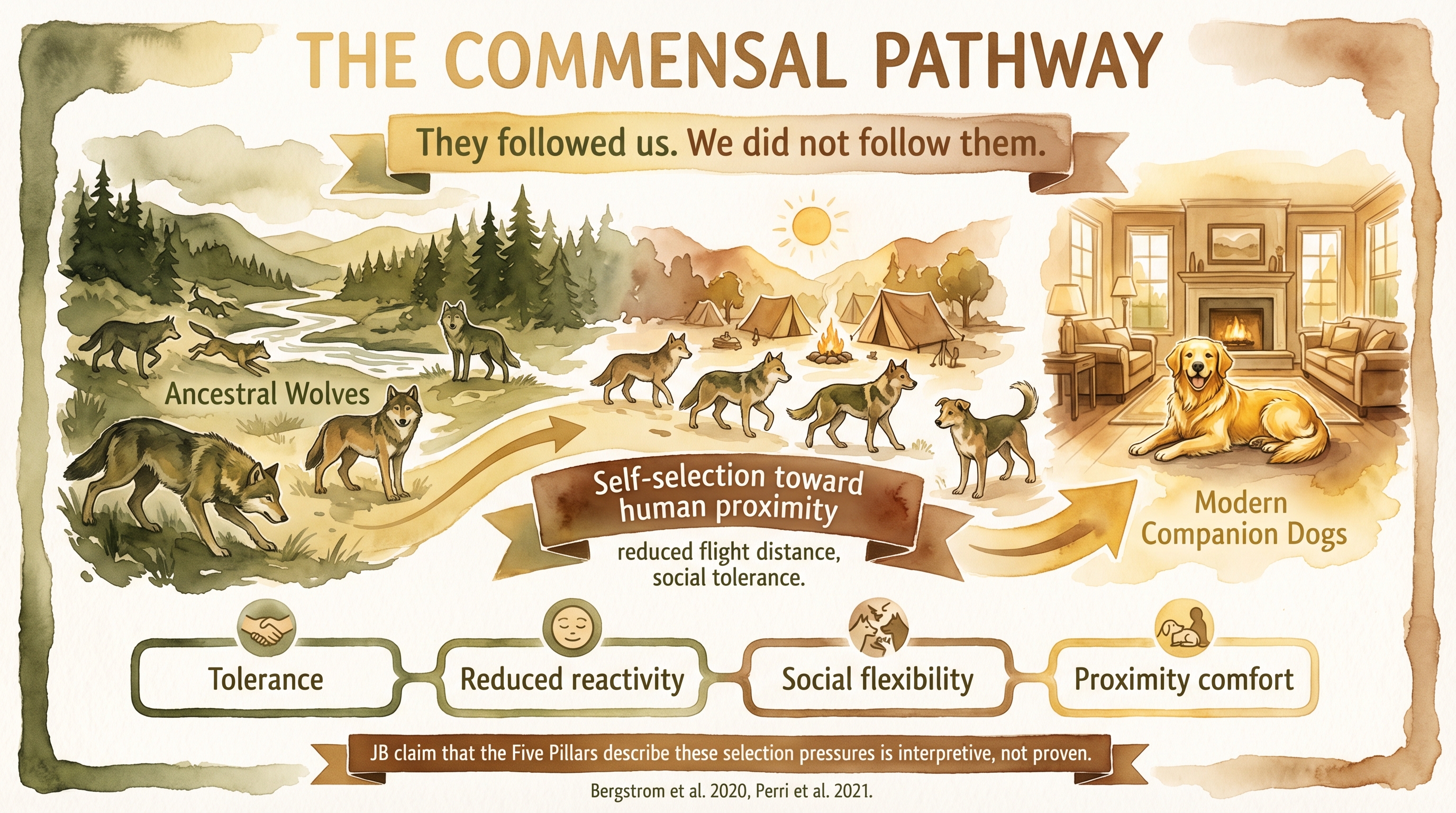
They followed us - proto-dogs self-selected toward human camps through tolerance, reduced reactivity, and social flexibility.
Key Takeaways
- The commensal pathway treats early dog domestication as likely beginning when some wolf-like animals self-selected toward human camps, where food and proximity favored tolerance.
- This model frames tolerance, proximity to humans, calmness, and social flexibility as plausible selection targets, while the exact origin pathway remains debated.
- The Five Pillars (mentorship, calmness, structure, prevention, and indirect correction) are JB's heuristic interpretation of the kind of developmental environment where dogs may have evolved to succeed alongside humans.
The Evidence
This entry uses observed claim-level tags beyond the dedicated EvidenceBlocks below. These tags mark JB program observation or practice-derived claims that need dedicated EvidenceBlock coverage in a later content pass.
This entry uses mixed-evidence claim-level tags beyond the dedicated EvidenceBlocks below. These tags mark claims that combine documented findings with observed practice, heuristic application, or unresolved gaps.
- Bergstrom, A. et al. (2020)ancient dogs and wolves
Provided strong genomic support for an early domestication history consistent with a long pre-modern dog-human relationship. - Perri, A. R. et al. (2021) and related domestication syntheses summarized in SCR-001archaeology and evolutionary biology
Support the commensal pathway as the dominant contemporary framework for dog domestication, while specific geography and timeline details remain debated. - Hare, B., Woods, V., and related social-cognition literature summarized in SCR-001dogs and wolves
Support the idea that tolerance of human proximity and responsiveness to human environments became central features of dog evolution.
The claim that the Five Pillars describe the actual selection pressures operating during domestication is not directly established by evolutionary biology. It is JB's interpretive extension of the documented commensal model.
No published study directly tests the specific claims or protocols described in this entry within a controlled canine trial.
SCR References
Sources
- Bergstrom, A., et al. (2020). Origins and genetic legacy of prehistoric dogs. Science, 368(6498), 1426-1430.
- Hare, B., & Woods, V. (2020). Survival of the friendliest: Understanding our origins and rediscovering our common humanity. Random House.
- Perri, A. R., et al. (2021). Dog domestication and the dual transport of people and purebred lineages across the Indonesian archipelago. Proceedings of the Royal Society B, 288(1948), 20210791.