Epigenetic Effects of Maternal Care
Compound evidence detail5 SCRs / 9 parts
- Documentedthe rat maternal-care methylation mechanism (Weaver et al. 2004 Nature Neuroscience): high-licking/grooming dams alter offspring hippocampal NR3C1 methylation, with cross-fostering reversal and adult HDAC reversibility
- Documentedthe canine adversity-linked peripheral methylation pattern reported by Awalt et al. 2024 Developmental Psychobiology for NR3C1 and OXTR in dogs with documented early-life history
- Heuristicthe JB working hypothesis that ordinary calm raising is a biologically plausible developmental input whose protocol-specific methylation effects in dogs remain a research frontier (RF-035)
- Documentedthe Awalt et al. 2024 finding that early-life-stress dogs show altered NR3C1 and OXTR whole-blood methylation, with age-modulated direction and OXTR-attachment associations
- Heuristicthe JB inference that those documented methylation differences in adverse-history dogs predict the inverse pattern in normal-range calm caregiving
- DocumentedCimarelli et al. 2017 finding that pet Border Collie OXTR buccal methylation associates with dog behavior in a threatening approach test (n=217)
- DocumentedCimarelli et al. 2017 finding that measured owner interaction style was NOT associated with dog OXTR methylation at the primary tested CpG sites
- Documentedacross mammalian models, early-life epigenetic marks are stable, durable, but dynamic - reversible in rats by adult HDAC inhibition and by environmental enrichment; age-sensitive in dogs
- Documentedcurrent direct canine methylation studies use peripheral tissues (Awalt: whole blood; Cimarelli: buccal epithelium); these are systemic biomarkers, not direct readouts of brain methylation in living dogs
How early caregiving shapes stress regulation across mammals is one of the most consequential questions in developmental biology - and one of the most often overstated. This page separates four tiers of evidence: what has been demonstrated causally in rats, what has been observed in dogs with adverse early histories, what has been measured in dog-owner physiological synchrony, and what Just Behaving hypothesizes about calm raising. We say what is settled. We say what is associated. We say what remains an open question. We do not blur the lines.
What It Means
Epigenetics: The Software Layer of Biology
DNA is the hardware of the organism - the fixed sequence of genes that makes a dog a dog and a human a human. But the genome is not destiny. The same genetic code can produce different outcomes depending on which genes are read and which are silenced. Epigenetics is the software layer - the cellular machinery that regulates gene expression without changing the underlying genetic code itself. Documented
The most studied epigenetic mechanism is DNA methylation. A small chemical tag called a methyl group attaches to specific regions of DNA - usually at the beginning of a gene where the cellular machinery reads instructions. When DNA is heavily methylated at those regions, the gene tends to be quieter; when methylation is sparse, the gene tends to be louder. These patterns can be stable, durable, and dynamic across the lifespan - shaped by experience but not necessarily fixed by it.
This is where Calmness becomes biology - carefully, and in language that matches what the evidence actually shows.
Tier 1: What the Rat Work Demonstrated
In 2004, Michael Meaney's laboratory at McGill University published findings in Nature Neuroscience that transformed the developmental biology of stress. They studied rat mothers and pups. Documented
Some mother rats were "high-licking/grooming" mothers - they spent significant time licking, grooming, and arching over their pups. Others were "low-licking/grooming" mothers, providing basic care with less tactile contact. The question: does this difference in maternal behavior shape the pups' biology?
The answer was yes. High-licking mothers produced offspring with measurably different stress physiology. Their pups had higher hippocampal expression of the glucocorticoid receptor gene (NR3C1), the gene that regulates how the body's stress response shuts off. When these pups encountered stress, their HPA axis - the central stress-response system - activated and recovered more efficiently. Documented
The mechanism was epigenetic. High-licking mothers produced pups with lower DNA methylation at the glucocorticoid-receptor gene promoter, meaning the gene was more readily transcribed. The mark emerged in the first postnatal week and persisted into adulthood. Documented
The cross-fostering experiment proved causality. Pups born to low-licking mothers but raised by high-licking mothers developed the calm phenotype; the methylation pattern followed the rearing dam, not the biological dam. The reversibility experiment proved plasticity. Adult rats given central HDAC inhibitor or methyl-donor manipulation showed reversal of the maternal-care methylation effect on behavior and gene expression (Weaver et al. 2005). Documented
This is the strongest evidence in the developmental epigenetics literature that early caregiving leaves a chemical signature on the epigenome without altering the genetic code itself. It is also evidence that the signature is - in Frances Champagne's published 2018 phrasing - stable, durable, but dynamic. Not permanent.
Tier 2: What the Dog Work Shows
The canine literature is younger and operates with the methodological constraints of working with companion animals. Two studies anchor it.
Awalt et al. (2024) studied 47 owner-dog dyads, comparing dogs with documented early-life-stress (ELS) histories - rescue from abuse, hoarding, puppy mills - to matched controls. Using whole-blood DNA, they measured methylation at NR3C1 (the same glucocorticoid-receptor gene as in the rat work) and OXTR (the oxytocin-receptor gene). They found that ELS dogs showed differential methylation patterns. The NR3C1 effect was complex: no simple group difference, but a significant age x initial-environment-duration x ELS interaction, with younger ELS dogs showing higher NR3C1 methylation as time in the adverse environment increased and older ELS dogs showing the reverse. OXTR Region 2 showed lower overall methylation in ELS dogs. OXTR methylation was associated with insecure attachment styles. Documented
Cimarelli et al. (2017) studied 217 pet Border Collies using buccal epithelial cell DNA. They found that OXTR methylation at specific CpG sites was associated with the dogs' behavior in a threatening-approach test (significant after Bonferroni correction). They also tested whether owner interaction style - measured across eight tasks reduced to three factors (Owner Warmth, Owner Social Support, Owner Control) - predicted the dog's OXTR methylation. It did not. In the authors' own words: "Contrary to our predictions, in the present study, we could not find any association between owner behavior and methylation levels of the OXTR gene of their dogs." Documented
Both findings are real. Both are published. Both are associations in peripheral tissue in cross-sectional designs - not demonstrations that a specific intervention causes a specific methylation change in a living dog's brain. Whole blood and buccal epithelium are systemic biomarkers; whether peripheral methylation tracks brain methylation at NR3C1 and OXTR in dogs remains an open question (Research Frontier RF-037). Observed-JB
Tier 3: What Dog-Owner Synchrony Shows
Beneath the methylation question is a separate, well-documented physiological layer: dogs and their humans share regulatory states. Documented
Buttner et al. (2015) measured cortisol synchrony in dog-handler dyads at agility competitions: dog and handler cortisol changes correlated, though the handlers' specific in-context behaviors did not explain the dog cortisol changes. Sundman et al. (2019) measured hair cortisol concentration over months in dog-owner pairs and found long-term synchrony driven by owner personality, not dog personality. Hoglin et al. (2021) showed this pattern is partly modulated by breed selection history - strongest in cooperative working breeds, weaker in ancient and solitary-hunting breeds. Koskela and Katayama et al. (2024) demonstrated heart-rate-variability co-modulation between dogs and owners at rest. Nagasawa et al. (2015) documented a reciprocal oxytocin response to mutual gaze. Documented
This is the layer Just Behaving's program practice rests on directly. When the owner is calm, the dog is calm - measurable in cortisol, in heart-rate-variability, in oxytocin. None of this synchrony evidence is, by itself, evidence of methylation change in the dog. The bridge from physiological synchrony to methylation effect is exactly the bridge that has not been built in dogs.
Tier 4: What Just Behaving Hypothesizes
Just Behaving's working hypothesis is that calm, predictable, mentorship-rich early environments are biologically plausible developmental inputs that may shape canine stress-regulation development through mechanisms analogous to those demonstrated in rats and partially documented in dogs with adverse histories. This is a hypothesis. We say so. It is consistent with the layers below it. It is not demonstrated. Heuristic
We are not the first program to operate from a hypothesis like this; well-run mentorship-based puppy raising has existed for as long as people have lived with dogs in households. What is new is the level of mechanistic detail the developmental epigenetics field has produced over the past two decades, which gives breeders and behaviorists a more precise vocabulary for talking about what early environments do. We use that vocabulary carefully.
What we know with confidence:
- Epigenetic mechanisms governing stress response operate in dogs (Awalt 2024).
- Early-life adversity is associated with altered methylation at stress-response genes in peripheral tissues of dogs (Awalt 2024; Cimarelli 2017).
- Dog-owner physiological synchrony is documented in cortisol, hair cortisol, heart-rate-variability, and oxytocin (Buttner 2015; Sundman 2019; Hoglin 2021; Koskela 2024; Nagasawa 2015).
What remains untested in dogs as of the 2026 literature:
- Whether handler style or training method causally alters canine NR3C1 or OXTR methylation (RF-035).
- Whether normal-range maternal care affects puppy methylation independent of adversity (RF-036).
- Whether peripheral methylation markers correspond to brain methylation at the same loci in dogs (RF-037).
- Whether there is a sensitive period in canine development during which stress-axis methylation is most environmentally responsive (RF-038).
- Whether later enriched environments can modify early-adversity-associated methylation marks in dogs (RF-039).
A methylation-level effect from JB-style calm raising is biologically plausible and directionally consistent with the evidence. It has not been directly tested as an intervention in dogs. Heuristic
The Maternal Care Paradox: Why Maximum Comfort Is Not the Goal
Within the dog literature, there is one finding that sharpens what "calm raising" means in practice.
Bray et al. (2017) followed 138 puppies from Guide Dogs for the Blind - Labs, Golden Retrievers, and Lab/Golden Retriever crosses. They measured maternal care during the pre-weaning period, including nursing posture and the level of challenge presented to developing puppies. Documented
The result was counterintuitive: mothers who provided the highest level of investment - the most comfortable, unchallenging nursing environments - had higher guide-dog failure rates and their puppies showed lower stress resilience at 2 to 2.5 years. Documented
This does not contradict the Calmness pillar. The mothers who produced resilient puppies were still calm. They were not introducing chaos or unpredictability. What they were doing was requiring effort from their puppies within that calm framework. A puppy that must work slightly to position itself for nursing, that encounters mild challenges presented without emotional reactivity, develops differently than a puppy wrapped in maximum comfort. Mixed Evidence
Calmness, as the Just Behaving framework defines it, is the floor of the regulatory environment - not the ceiling of stimulation, and not cotton-wool comfort. Within that calm floor, calibrated challenge is part of healthy development.
Why It Matters for Your Dog
Calm environments and regulated interactions are foundational to development. Not lethargy - attentive, engaged stability. Parasympathetic tone is the target baseline. The caregiving environment is a biologically plausible developmental input whose methylation-level effects in dogs remain a research frontier; what is firmly documented is the dog-owner physiological synchrony layer - cortisol, heart-rate-variability, oxytocin - on which our program practice directly rests.
The Breeder Environment Is a Developmental Input - Not a Genome Editor
Your puppy's first eight to twelve weeks of life happen in the breeder's environment. The calm or chaos that puppy experiences during this period is part of the puppy's developmental input - it shapes behavior, it shapes the regulatory baseline, and at the level of the dog-owner synchrony literature it shapes physiology. Whether it also reaches into the methylation layer the way Meaney's high-licking mothers did in rats is a research frontier we hold open. Heuristic
A breeder who maintains a calm, structured environment - low noise, predictable routines, gentle handling, mentorship by stable adult dogs - is providing a biologically plausible developmental input. They are calibrating the puppy's stress-response architecture toward efficiency and resilience through documented physiological pathways. Whether they are also shaping the puppy's NR3C1 or OXTR methylation patterns is an open question. We hypothesize they may be. We do not claim they have been shown to.
This is why the choice of breeder matters at a developmental level. Not because a calm breeder is a genome editor - no breeder is, and no human is to any other mammal - but because the biologically plausible developmental inputs the breeder provides during a sensitive window are inputs the family environment will inherit and either preserve or disrupt.
The Soft Landing: Continuing Calm Caregiving at Home
When your puppy comes home, the environment changes - new people, new spaces, new sensations. The caregiving principle remains: calm continuation is more powerful than shock or sudden change. Documented
The "soft landing" means continuing the calm caregiving pattern the breeder established. You do not flood the puppy with stimulation because it is now in a family. You do not introduce chaos. You maintain the parasympathetic baseline. You continue to be the calm adult the puppy has learned to expect.
This is not mollycoddling. This is recognizing that the puppy's developing stress-regulation baseline was shaped in the breeder's environment by documented physiological inputs and biologically plausible developmental ones. You are not rebuilding it. You are extending it.
Calibrated Challenge Within Calm
The Bray paradox clarifies what "soft landing" does not mean: it does not mean maximum comfort. A puppy that never encounters any mild challenge, never has to problem-solve, finds everything instantly available, develops different stress resilience than a puppy that encounters calibrated, emotionally neutral challenges within a calm framework. Documented
Calmness as the JB framework defines it is the floor, not the ceiling. Within that calm floor, puppies benefit from modest requirements: working slightly for resources, navigating minor obstacles, encountering novel stimuli presented without human emotional reactivity.
The breeder's calm environment paired with the family's calm continuation is the developmental architecture we believe gives a puppy the strongest start. The breeder's calm environment paired with the family's overprotective smothering caps that ceiling.
Owner Regulatory State Is Part of the Puppy's Physiological Environment
Your regulatory state is part of your puppy's physiological environment. Cortisol, heart-rate-variability, and oxytocin all show measurable dyadic co-modulation between dogs and their humans. An anxious owner does not need to teach the puppy anxiety through behavior alone - the puppy's regulatory systems synchronize with the regulatory systems of the people it lives with. Documented
Whether that synchrony reaches the methylation layer is a research question we keep our eye on. Whether it reaches the day-to-day functional layer of how your dog regulates is settled science. This is why Structured Leadership - calm, assertive parental guidance - is not optional. The puppy's regulatory baseline is being shaped continuously by the regulatory state it lives within.
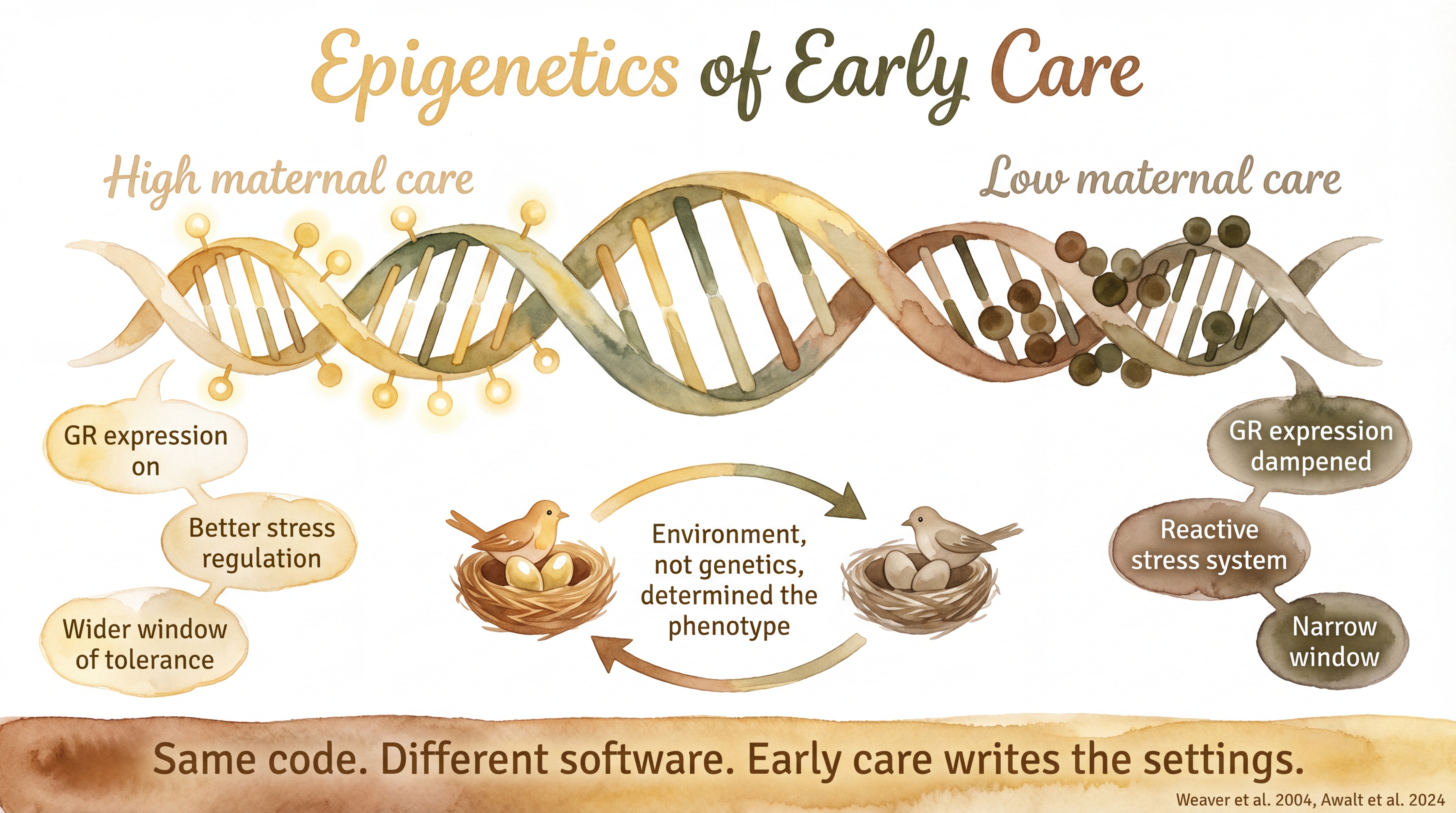
Same genetic code, different gene expression - early caregiving leaves chemical signatures on gene regulation without changing the genetic code itself.
Key Takeaways
- Four tiers of evidence: rat causal demonstration (Weaver/Meaney), canine adversity association (Awalt 2024; Cimarelli 2017), dog-owner physiological synchrony (Buttner, Sundman, Koskela, Nagasawa), and the JB working hypothesis. Each tier has its own confidence level. We do not blur the lines.
- Cross-fostering proved causality in rats: pups born to low-licking mothers but raised by high-licking mothers developed the calm phenotype. The rat methylation marks are also reversible by adult intervention - stable, durable, but dynamic, not permanent.
- In dogs, early-life adversity is associated with peripheral methylation differences at NR3C1 and OXTR, with age-modulated direction and attachment-style associations. The largest peer-reviewed test of owner interaction style and dog OXTR methylation (Cimarelli 2017, n=217 Border Collies) did not find an association at the primary tested sites.
- Dog-owner physiological synchrony in cortisol, heart-rate-variability, and oxytocin is documented and is the working layer of JB program practice. None of this synchrony evidence is, by itself, methylation evidence.
- A methylation-level effect from JB-style calm raising is a hypothesis we hold honestly, not a fact we claim. It is biologically plausible and consistent with the layers below it - and a registered Research Frontier (RF-035 through RF-039).
The Evidence
This entry uses observed claim-level tags beyond the dedicated EvidenceBlocks below. These tags mark JB program observation or practice-derived claims that need dedicated EvidenceBlock coverage in a later content pass.
This entry uses mixed-evidence claim-level tags beyond the dedicated EvidenceBlocks below. These tags mark claims that combine documented findings with observed practice, heuristic application, or unresolved gaps.
- Weaver, I. C. G., Cervoni, N., Champagne, F. A., et al. (2004)laboratory rats
Nature Neuroscience 7(8):847-854. High-licking/grooming mothers produce offspring with lower DNA methylation at the hippocampal glucocorticoid-receptor (NR3C1) gene promoter, higher GR expression, and improved HPA-axis regulation. Cross-fostering confirms the effect is environmental, not genetic: pups born to low-licking mothers but raised by high-licking mothers developed the calm phenotype. The methylation mark is reversible in adulthood by central HDAC inhibition. - Liu, D., Diorio, J., Tannenbaum, B., et al. (1997)laboratory rats
Science 277(5332):1659-1662. Maternal licking/grooming during the postnatal period directly produces offspring with enhanced glucocorticoid-receptor expression, lower baseline corticosterone, and better stress recovery - establishing the specificity of tactile maternal behavior. - Champagne, F. A. (2018)cross-species commentary
Nature Neuroscience 21:773-774. Reviewing the legacy of Weaver 2004 fourteen years on, Champagne explicitly notes that whether a similar mechanism operates to generate inter-individual differences in human (or other mammalian) behavior remains a fundamental question that remains to be answered.
- Awalt, S. L., Boghean, L., Klinkebiel, D., & Strasser, R. (2024)domestic dogs
Developmental Psychobiology 66(3):e22482. doi:10.1002/dev.22482. In 47 owner-dog dyads, early-life-stress dogs showed differential whole-blood NR3C1 and OXTR methylation. NR3C1 effect was an age x initial-environment-duration x ELS-group interaction (no simple group difference). OXTR Region 2 showed lower methylation in ELS dogs. OXTR methylation was associated with insecure attachment (OR 1.96, 95% CI 1.07-4.08). Cortisol change post-stressor did not differ globally between groups but was associated with NR3C1 methylation. Whole blood is a peripheral tissue and not a direct readout of brain methylation. - Cimarelli, G., Viranyi, Z., Turcsan, B., et al. (2017)domestic dogs - Border Collies
Frontiers in Psychology 8:549. doi:10.3389/fpsyg.2017.00549. In 217 pet Border Collies using buccal epithelial-cell DNA, OXTR methylation at specific CpG sites was associated with dog behavior in a threatening-approach test (significant after Bonferroni correction). Critically, measured owner interaction style - assessed across eight tasks reduced to three factors - was NOT associated with dog OXTR methylation at the primary tested sites. The authors wrote that they could not find any association between owner behavior and methylation levels of the OXTR gene of their dogs. - Bray, E. E., Sammel, M. D., Cheney, D. L., Serpell, J. A., & Seyfarth, R. M. (2017)domestic dogs - Labs, Golden Retrievers, Lab/GR crosses
PNAS 114(36):9432-9436. N=98-138 puppies from Guide Dogs for the Blind. Higher maternal investment (unchallenging ventral nursing) associated with higher guide-dog failure rates and lower stress resilience at 2-2.5 years. Maternal care paradox: maximum comfort does not produce maximum resilience. Puppies that encountered calibrated challenges within calm environments showed superior long-term stress regulation.
- Sundman, A.-S., Van Poucke, E., Svensson Holm, A.-C., et al. (2019)domestic dogs - Shetland Sheepdogs and Border Collies
Scientific Reports 9:7391. In 58 dog-owner dyads, hair cortisol concentration showed long-term synchrony across summer and winter sampling. The correlation was driven primarily by owner personality, suggesting dogs mirror owners. First demonstration of interspecific long-term cortisol synchrony in dog-human dyads. - Buttner, A. P., Thompson, B., Strasser, R., & Santo, J. (2015)domestic dogs and their handlers
Physiology & Behavior 147:54-62. In 58 dog-handler dyads at agility competition, dog cortisol changes correlated with handler cortisol changes. Importantly, specific handler behaviors did NOT explain the dog cortisol changes - a parallel guardrail to the Cimarelli OXTR-methylation null. - Hoglin, A., Van Poucke, E., Katajamaa, R., et al. (2021)domestic dogs - ancient and solitary-hunting breeds
Scientific Reports 11:8816. The long-term hair-cortisol synchrony observed in herding breeds did NOT replicate in ancient or solitary-hunting breeds, indicating that synchrony is partially contingent on breed selection for cooperation. Golden Retrievers fall in the cooperative-working cluster where synchrony is strongest. - Koskela, A., Katayama, M., Tornqvist, H., et al. (2024)domestic dogs and their owners
Scientific Reports (PMC11502769). In 29 cooperative-breed dog-owner dyads, heart-rate-variability and activity co-modulation was measured at rest and during structured tasks. Dog HRV correlated with owner HRV during baseline (free-behaving) periods. The authors reported that relaxed owners tended to have relaxed dogs. - Nagasawa, M., Mitsui, S., En, S., et al. (2015)domestic dogs and their owners
Science 348(6232):333-336. In dog-owner dyads in the long-gaze group, both dog and owner urinary oxytocin increased during interaction. Intranasal oxytocin to female dogs increased dog-to-owner gaze. The coevolution interpretation has been contested in published commentary; the within-dog gaze-oxytocin association is robust.
Calm, predictable, mentorship-rich early environments are biologically plausible developmental inputs that may shape canine stress-regulation development through mechanisms analogous to those demonstrated in rats and partially documented in dogs with adverse histories. The handler-to-canine-methylation bridge has not been demonstrated in any published study; the largest direct test (Cimarelli 2017) did not find owner interaction style associated with dog OXTR methylation. We treat this as a research frontier (RF-035 through RF-039), not a demonstrated fact. Our program practice rests on the documented dog-owner physiological synchrony layer (Tier 3), which is sufficient on its own.
Handler style and canine methylation (RF-035): No peer-reviewed study has tested whether human handler calmness, training method, or JB-style mentorship causally alters canine DNA methylation.
Normal-range caregiving versus adversity contrast (RF-036): The major canine maternal-care studies measure behavioral outcomes, not offspring methylation. The rat licking-grooming-style assay has not been ported to canine dam-pup dyads in any published methylation study.
Peripheral-central tissue concordance (RF-037): Awalt 2024 used whole blood; Cimarelli 2017 used buccal epithelium. Whether these markers correspond to brain methylation at NR3C1 and OXTR in dogs has not been directly tested.
Canine methylation sensitive period (RF-038): No published study has identified a developmental window in dogs during which stress-axis methylation is most environmentally responsive.
Reversibility of canine early-adversity marks (RF-039): No canine intervention or reversibility study with methylation as the outcome has been published.
SCR References
Sources
- Awalt, S. L., Boghean, L., Klinkebiel, D., & Strasser, R. (2024). A dog's life: Early life histories influence methylation of glucocorticoid (NR3C1) and oxytocin (OXTR) receptor genes, cortisol levels, and attachment styles. Developmental Psychobiology, 66(3), e22482. https://doi.org/10.1002/dev.22482
- Bray, E. E., Sammel, M. D., Cheney, D. L., Serpell, J. A., & Seyfarth, R. M. (2017). Effects of maternal investment, temperament, and cognition on guide dog success. Proceedings of the National Academy of Sciences, 114(36), 9432-9436.
- Buttner, A. P., Thompson, B., Strasser, R., & Santo, J. (2015). Evidence for a synchronization of hormonal states between humans and dogs during competition. Physiology & Behavior, 147, 54-62.
- Champagne, F. A. (2018). Beyond the maternal epigenetic legacy. Nature Neuroscience, 21, 773-774.
- Cimarelli, G., Viranyi, Z., Turcsan, B., Ronai, Z., Sasvari-Szekely, M., & Banlaki, Z. (2017). Social behavior of pet dogs is associated with peripheral OXTR methylation. Frontiers in Psychology, 8, 549.
- Hoglin, A., Van Poucke, E., Katajamaa, R., Jensen, P., Theodorsson, E., & Roth, L. S. V. (2021). Long-term stress in dogs is related to the human-dog relationship and personality traits. Scientific Reports, 11, 8816.
- Koskela, A., Katayama, M., Tornqvist, H., et al. (2024). Behavioral and emotional co-modulation during dog-owner interaction measured by heart rate variability and activity. Scientific Reports (PMC11502769).
- Liu, D., Diorio, J., Tannenbaum, B., et al. (1997). Maternal care, hippocampal glucocorticoid receptors, and hypothalamic-pituitary-adrenal responses to stress. Science, 277(5332), 1659-1662.
- Meaney, M. J. (2010). Epigenetics and the biological definition of gene x environment interactions. Child Development, 81(1), 41-79.
- Nagasawa, M., Mitsui, S., En, S., et al. (2015). Oxytocin-gaze positive loop and the coevolution of human-dog bonds. Science, 348(6232), 333-336.
- Sundman, A.-S., Van Poucke, E., Svensson Holm, A.-C., et al. (2019). Long-term stress levels are synchronized in dogs and their owners. Scientific Reports, 9, 7391.
- Weaver, I. C. G., Cervoni, N., Champagne, F. A., et al. (2004). Epigenetic programming by maternal behavior. Nature Neuroscience, 7(8), 847-854.
- Weaver, I. C. G., Champagne, F. A., Brown, S. E., et al. (2005). Reversal of maternal programming of stress responses in adult offspring through methyl supplementation. Journal of Neuroscience, 25(47), 11045-11054.