The Koehler Method of Dog Training
Compound evidence detail1 SCR / 2 parts
- Documentedthe Koehler 1962 primary text describing the prescribed method set including emphatic leash corrections, throw chains, slingshots, high-level electric shocks, striking the dog on the muzzle, suspension by choke collar, and airplaning, with the book's documented Arizona ban as a contemporaneous regulatory marker
- Heuristicthe JB framing of the Koehler class format and methodology as the operative template for the American civilian dog training industry of the 1960s through 1980s, an interpretive characterization of widespread influence rather than a formally measured cultural-transmission study
William Koehler was the figure who made systematic dog training feel ordinary to American civilians. If Konrad Most represents the military origin of the method, Koehler represents its mass market civilian normalization. His work connected wartime handling traditions, postwar suburban dog clubs, entertainment industry credibility, and a bestselling training manual that persuaded families the dog should be shaped through formal drill led by a strong human hand. Documented
Koehler's biography explains why he had such reach. The source layer places him in World War II era U.S. Army dog training and then at Walt Disney Studios, where he trained dogs for films including Old Yeller and The Shaggy Dog. By the time The Koehler Method of Dog Training appeared in 1962, he could present himself as both a military professional and a public expert whose dogs visibly "worked." Documented That mix of authority and spectacle mattered in a culture that increasingly wanted family dogs to behave reliably in public.
His method was clear, confident, and uncompromising. It emphasized long lines, choke chain corrections, repetition, and the idea that dogs learn through consequences that are unmistakable. Documented Koehler did not frame food centered work as a promising frontier. He mocked what he saw as sentimental "tid-bit training" and preferred a world in which clarity came from control, not from reward engineering.
The historical facts here are not especially controversial. The harder part is how to read them. JB can say with confidence that Koehler's system was widely influential, unusually forceful, and central to mid-century American dog culture. The stronger claim that his worldview helped cement the training paradigm as the default answer to ordinary family dog life is a historical reading, not a measured experiment.
What It Means
Koehler matters because he translated an institutional training ethos into civilian common sense.
From War Dogs to Main Street
The source document places Koehler in U.S. Army dog training during World War II and then in the postwar American dog world. That matters because the transition itself is part of the story. A method refined in a wartime reliability culture did not stay in that culture. It entered dog clubs, training fields, and household life at precisely the moment when American families were expanding suburban pet ownership.
Koehler's later work at Disney deepened his legitimacy. If the public could watch trained dogs succeed on screen, the trainer behind those dogs appeared validated by outcome. In practical terms, that entertainment connection let a military style training sensibility arrive in civilian life with glamour attached to it instead of austerity alone.
The 1962 Book as a Cultural Object
The Koehler Method of Dog Training became one of the most visible training books of its era. The SCR cautions that exact sales claims need verification, but the broader influence is not difficult to defend. For decades, Koehler's book and club culture helped define what many Americans pictured when they pictured dog training: leash in hand, dog in heel position, handler in charge, correction available, performance expected.
The book also matters because it is explicit. Readers do not have to infer the method from later retellings. Koehler describes how he wants dogs handled, what tools are used, what mistakes owners make, and why firmness must not give way to uncertainty. That directness makes the book historically valuable even where modern readers reject its prescriptions.
The Method Itself
Koehler's system is usually summarized as compulsion based, but that short label does not capture the full shape. It used repetitions, long line setups, environmental control, and consequences designed to make the "wrong" choice costly or uncomfortable. Recall work with a long line, collar correction for position failures, throw chains, and confrontational handling strategies for serious problems all sit inside the method's orbit. The SCR's wording is blunt because the book is blunt: leash corrections, slingshots, striking the muzzle, suspension by choke collar, and "airplaning" appear in the historical record.
That catalogue matters because it prevents a later soft focus retelling. Koehler was not merely a tough coach with good standards. He offered a training system in which aversive force was treated as normal and often central.
His Core Intellectual Claim
At the same time, Koehler was not simply chaos with a leash. One reason he persuaded so many people is that he expressed a true principle within a distorted package. Dogs do learn more easily when consequences are clear and consistent. Handlers who mumble, plead, bribe randomly, and change the rules do create confusion. In that sense, Koehler's attack on vagueness landed on a real weakness in many households.
The problem is that he treated coercive clarity as the natural answer to that weakness. Modern welfare research would later show why many trainers abandoned that assumption. Documented But historically, his method felt powerful precisely because it gave owners a sense that the dog, finally, would have no doubt about what was required.
Why Koehler Set the Stage for Later Conflict
Koehler's hostility to reward centered training helped sharpen the later split. Once Karen Pryor, Ian Dunbar, and later positive trainers argued that dogs could learn well without heavy compulsion, they were not arguing against an empty field. They were arguing against a civilian culture that Koehler had helped standardize. The later positive revolution is easier to understand if you first understand what it was reacting to.
That is why Koehler belongs in this category not merely as a historical villain or a relic of harsh times. He is one of the central reasons the later century split so sharply around method, ethics, and what kind of human presence a dog actually needs.
Koehler was right that inconsistency confuses dogs. JB agrees with that much. The disagreement is over what should deliver clarity: fear of correction, or a stable relational environment in which calm leadership makes the right behavior easier to live.
Why It Matters for Your Dog
This history matters for a Golden Retriever family because mid-century dog training culture still shapes what many people think "real" training looks like. Even families that would never buy Koehler's book can inherit his assumptions secondhand. They may believe that firmness only counts if the dog finds it uncomfortable. They may think food use is weak or childish. They may view puppy mistakes as defiance instead of development. They may assume the handler's job is to win a contest of wills rather than to organize the dog's life so maturity can develop.
Those assumptions do not usually appear in pure form anymore. They survive as residue. A person says a puppy is "blowing them off" when the puppy is overstimulated. A trainer says the dog "knows" and is choosing not to comply, when context dependence or adolescence may explain more. Someone insists that a calm dog must first be taken through a harder correction layer because otherwise the owner is not truly leading.
The Koehler era helps families see that these ideas are historical inheritances, not neutral facts about dogs. They come from a time when the training question was framed as how to produce obedience reliably through command and correction. That frame made sense to many people because it looked decisive and produced visible performances. It does not automatically fit the developmental needs of a growing retriever in a family home.
A family level example makes the difference plain. Picture a six month old Golden who forges on leash when leaving the house, then settles beautifully ten minutes into the walk. A Koehler style reading is tempted to center the initial forging as disobedience requiring emphatic correction so the rule becomes unmistakable. A JB reading starts earlier. What happens before the leash goes on? How charged is the exit ritual? Does the puppy ever leave the house calmly? Is the dog practicing patient movement in low arousal transitions, or only being corrected once excitement is already high?
That difference matters because many family problems are not strongest at the point of failure. They are strongest in the conditions that make failure likely. Koehler's legacy pulls attention toward the failure moment. JB tries to move attention upstream.
The entry also matters because families often confuse the presence of structure with the presence of harshness. Koehler's popularity taught generations of owners that the opposite of confusion was force. JB rejects that binary. The opposite of confusion can also be calm predictability, rehearsed household order, measured freedom, and adults who mean what they signal without escalating the whole emotional temperature.
For Goldens especially, this matters because the breed's softness, sociability, and eagerness can be misread. Some people see a bouncy retriever puppy and conclude stronger correction is needed to get respect. Quite often what is actually needed is more adult steadiness, more controlled exposure, less accidental rehearsal of excitement, and a clearer home rhythm.
That lesson matters in modern Golden homes because the attraction of Koehler is still emotionally understandable. When a dog is large, enthusiastic, and suddenly difficult, mid-century certainty feels tempting. Families can start believing that harshness must be the price of seriousness. Reading Koehler historically helps separate the appetite for clarity from the machinery that once monopolized it.
The family-level danger of Koehler's inheritance is not only harsh technique. It is the mood of the thing. A Golden who is exuberant, adolescent, and inconvenient can make owners crave a style that sounds absolute. Koehler still speaks to that craving across the decades. History helps the family notice that longing without obeying it automatically. Wanting clarity is sensible. Wanting the whole old package because it sounds uncompromising is something else.
There is also a subtler lesson. Koehler was persuasive partly because he made competence look straightforward. Use the consequence, stay firm, and train through the problem. Modern family life is usually messier. The dog is shaped by children, visitors, routines, overstimulation, inconsistent follow-through, and the emotional state of the household. The old certainty can therefore feel attractive precisely when it is least adequate to the full problem.
That is why Koehler is still worth reading historically even for owners who would never use his harshest methods. He shows how easily the wish for certainty can harden into a whole training worldview. JB families need the certainty about adult responsibility without the coercive inheritance that once traveled with it.
For a Golden family, that usually means distinguishing between the need for clear follow-through and the fantasy that a harsher tool automatically makes the adult more credible. Credibility usually comes from steadiness, not spectacle.
That translation is one of the main reasons the history still matters.
What This Means for a JB Family
For a JB family, Koehler should be read as a warning about confusing visible compliance with developmental success. A dog can be pressed into surface order without becoming more socially mature. A puppy can stop a behavior in one setting and still remain dysregulated, overaroused, or uncertain in the wider household.
This is where JB's Prevention pillar becomes more than a slogan. Prevention says the family should build the day so the puppy is not constantly practicing the very behaviors the owner later wants to suppress. Heuristic That is a different starting point from "train through the problem." It asks what kind of life produces fewer problems to begin with.
Koehler also clarifies the JB meaning of Structured Leadership. JB does not believe in vague permissiveness. It believes the adult should be clear, steady, and in charge. The difference is that authority should feel like guidance from a competent parent, not pressure from a superior trying to defeat resistance. Families often think they must choose between being soft and being harsh because that was the binary older training culture offered them. JB offers a third option: structured without intimidation.
So the practical family takeaway is this. When you hear training advice that sounds proud of its own toughness, ask what that toughness is solving and what it may be obscuring. If the answer depends on making the dog feel consequences more than on organizing the dog's developmental environment more intelligently, you are probably standing in Koehler's shadow whether the person says his name or not.
For a JB family, the right move is to reclaim structure without reclaiming the old coercive package. Goldens still need adults who mean what they say, control access to exciting things, and follow through calmly. Documented They do not need the choke-chain worldview that taught earlier generations to equate force with competence.
For a JB family, the right move is not softness without structure and not structure with mid-century harshness. It is to keep the human appetite for clarity while translating that appetite into calm leadership, prevention, and follow-through that does not depend on pain, panic, or force-heavy proof. Reading Koehler historically helps make that translation possible.
That is a useful freedom for any modern retriever household. That shift from force to steadiness is one of the clearest historical gains JB wants families to preserve. It is not a small gain. It is worth naming directly, because it is a calmer legacy than the method itself, and for JB families it is the more useful one.
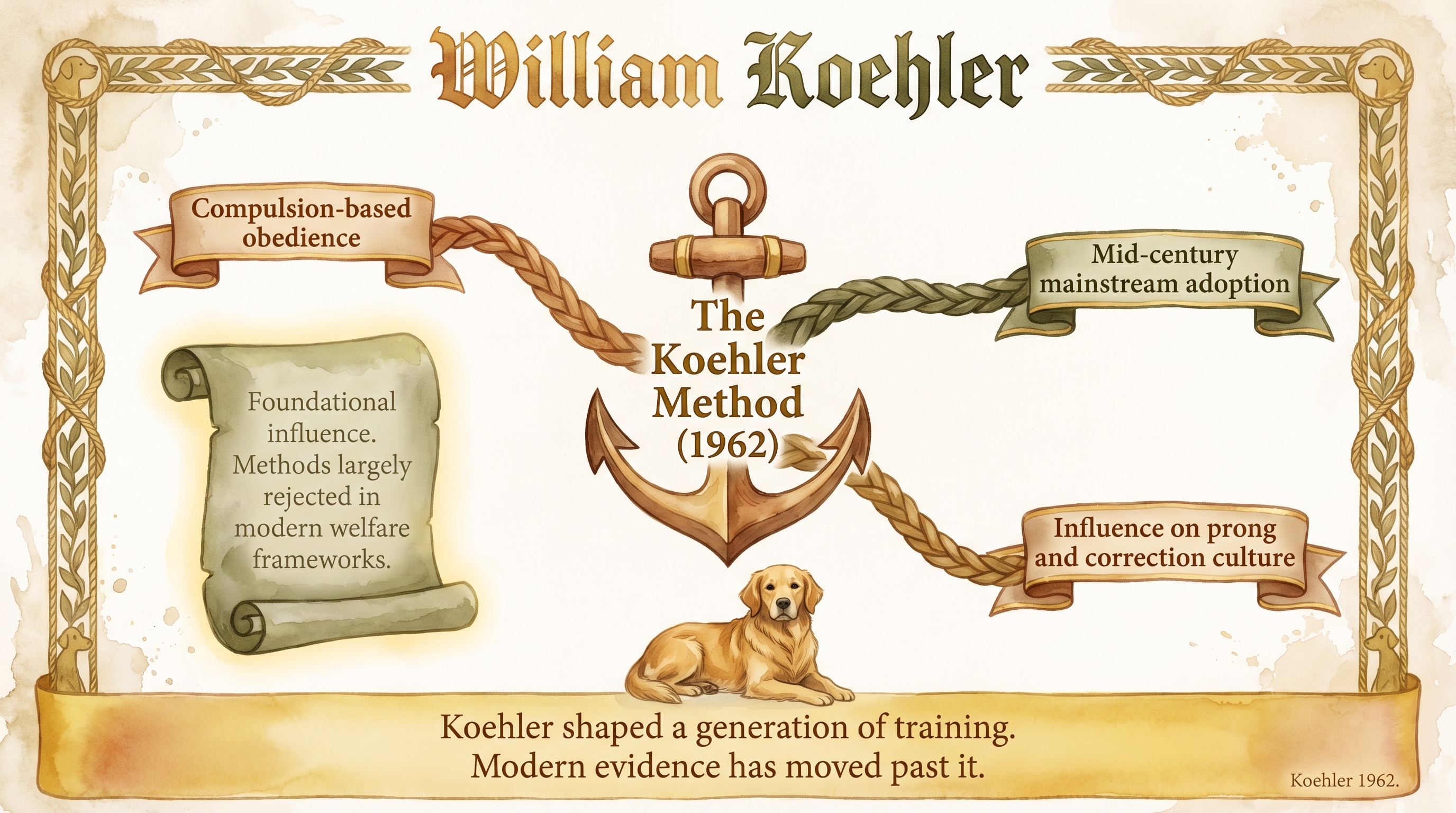
Koehler shaped a generation of training - modern evidence has moved past it.
Key Takeaways
- Koehler helped turn a postwar compulsion system into the default picture of civilian dog training in America.
- His method was explicit, influential, and far harsher than many softened retellings suggest.
- The true element in Koehler's legacy is that dogs need clarity. The mistaken leap is that coercion is the best or only way to provide it.
- JB uses Koehler to distinguish real structure from old habits of force that were inherited from another era and another task.
The Evidence
This entry uses heuristic claim-level tags beyond the dedicated EvidenceBlocks below. These tags mark JB interpretive application rather than direct study findings.
- Koehler (1962)domestic dogs
Primary source documenting the method's correction centered techniques, philosophical hostility to tid-bit training, and explicit handling prescriptions. - Source synthesis on Koehler's Army and Disney backgrounddomestic dogs
Places Koehler at the junction of wartime dog handling, mass culture, and postwar civilian dog club life. - SCR-156domestic dogs
Summarizes the method's specific coercive techniques and its broad influence on the American civilian dog training paradigm. - Later welfare literature including SCR-026 and SCR-027domestic dogs
Provides the evidence base that later challenged the welfare acceptability of the kind of aversive system Koehler normalized.
- domestic dogs
No published study directly isolates the long-term dog-level and family-level effects of the koehler method of dog training across ordinary companion-dog contexts.
SCR References
Sources
- Koehler, W. R. (1962). The Koehler Method of Dog Training. Primary historical source for the Koehler method.
- Later welfare literature and SCRs support the welfare-risk boundary around aversive methods and the historical treatment of the Koehler method. Keep the primary-source historical claim separate from modern welfare evaluation.
- William Koehler's WWII Army Quartermaster Corps dog-training role and his Disney studios film work. Biographical attribution; not the primary methodological source. For Koehler's actual training methodology see The Koehler Method of Dog Training (1962) cited separately on this entry. The biographical background contextualizes the method's origin but does not validate its outcomes.