Cesar Millan and the Dog Whisperer Era
Compound evidence detail2 SCRs / 4 parts
- Documentedthe wolf-side scientific record on the dominance model - Schenkel 1947 captive-pack methodology limitations, Mech 1999 wild-pack family-unit field data, and the AVSAB 2008 position statement against dominance-based training
- Heuristicthe JB application transferring the wolf family-unit framing to the dog-human relational architecture, an interpretive bridge that Mech's wolf data does not directly test in training contexts
- Documentedthe Cavalli and Fenwick 2025 Animals survey evidence on dog-trainer professional learning channels showing mentors, workshops, and self-study as the dominant pathways
- Heuristicthe JB framing characterizing training methods as propagating primarily through media exposure, mentor lineage, and organizational affiliation rather than peer-reviewed evidence, with the qualifier that this describes the dominant pathway, not universal practice
Cesar Millan became the most influential popular dog-training figure of the 2000s because television gave him what the profession itself did not have, a single, widely legible public vocabulary. Dog Whisperer with Cesar Millan debuted in 2004 on the National Geographic Channel and later expanded from half-hour episodes into a longer prime-time format with global reach. By the time the show had entered later seasons, Nat Geo was describing it as Emmy-nominated, and later distribution material would describe it as the network's most popular series for six years. Whether professionals agreed with him or not, millions of owners learned to think about dogs through Millan's lens first. Documented
His public formula was memorable because it was compact. Millan repeatedly framed his approach around calmness, human authority, and the sequence "exercise, discipline, and then affection." He also popularized the phrases "calm-assertive energy," "train people, rehab dogs," and pack leadership. Those ideas spoke directly to owners who felt overwhelmed by excitable, unruly, or aggressive dogs and who did not recognize themselves in the highly mechanical tone of some training literature. Culturally, he gave families a picture of human steadiness and responsibility that many found intuitive. Documented
At the same time, the welfare and scientific critiques were substantial. The source layer places Millan inside the broader dominance-theory problem already corrected by Mech, Bradshaw, Blackwell, Casey, and AVSAB. Criticism did not arise because he talked about leadership or calmness. It arose because some of his techniques and explanations drew on dominance-adjacent assumptions, confrontation routines, flooding-style setups, and forms of correction that many veterinary behaviorists and welfare researchers regarded as unsafe or unsupported. JB's reading is therefore mixed on purpose: Millan's emphasis on calm human leadership touched something real, while parts of his operational method drew legitimate criticism. Heuristic
What It Means
Why He Cut Through the Culture
Millan's rise makes sense once the media and owner context are kept in view. Browne and colleagues in 2024 found that Cesar Millan's books were the most popular training books cited by surveyed US owners and that The Dog Whisperer remained the most popular television show in that same domain. Documented That means his influence cannot be measured only by what trainers thought of him. He mattered because he reached families at scale.
He also reached them with a message that answered a real emotional gap. Many owners were exhausted by dogs that seemed frantic, rude, dependent, or out of control. Millan gave them a simple reversal. Stop pleading with the dog. Stop negotiating. Stop flooding the dog with unstable emotion. Become calm. Take responsibility. Lead. Even families who later rejected his methods often retained those themes because they addressed a genuine weakness in modern dog ownership.
The Core Public Formula
Public record from National Geographic captures the main formula clearly. In a 2009 Nat Geo interview tied to the sixth season of Dog Whisperer, Millan described dogs as needing to be "balanced" and repeated the sequence "exercise, discipline, and then affection." Documented In a 2016 Nat Geo interview, he again framed his work as training people and rehabilitating dogs, insisting that many cases reflected owners who had created the problem through misplaced affection, missing boundaries, and insufficient structure.
That formula had several parts. First came movement and outlet. Second came human direction. Third came affection in the right place rather than at moments that reinforced insecurity or overexcitement. Wrapped around all of it was Millan's famous "calm-assertive" posture, a message about the human's nervous system more than about any one leash technique.
Where the Critique Landed
The problem is that Millan's public philosophy was not delivered in isolation from controversial techniques and questionable biological framing. The source documents place the dominance-model collapse on firm ground. Mech's 1999 correction, Bradshaw and colleagues' 2009 review, and AVSAB's 2008 position statement all undercut the household use of wolf-pack dominance as a master explanation for dog behavior. Documented
Millan's work often lived close enough to that model to attract direct criticism. His use of pack-leader language, physical interruption, leash corrections, intense proximity pressure, and high-stakes rehabilitation setups made many critics argue that the show normalized coercive practice for mass audiences. Herron, Shofer, and Reisner's 2009 findings on aggressive responses to confrontation-based techniques deepened those concerns by showing that alpha rolls and related methods could provoke the very danger they were supposed to fix.
Why the Critique Was Not the Whole Story
Historical honesty requires a second correction. The critique of Millan sometimes became so eager to reject dominance language that it discarded the parts of his message that owners were recognizing for good reason. Calmness matters. Human regulation matters. Household leadership matters. Dogs often do deteriorate when people become frantic, sentimental, inconsistent, or permissive and then try to repair the result with technical tricks alone.
JB sees that as the durable truth inside the Millan phenomenon. He was naming owner instability in a language the public could feel. He was often more persuasive than the profession because he was describing a state of being, not merely a set of techniques. Where JB parts company is that this truth does not rescue every technique used under that banner, and it does not require the dominance story that often accompanied it.
The Lasting Cultural Effect
Millan's lasting importance is therefore double. He spread a flawed dominance-adjacent vocabulary farther than most professionals wanted. He also restored, in mass culture, the idea that dogs need adults who are composed, directional, and responsible. The fact that these two things were fused together is exactly why the Dog Whisperer era was so consequential. Families did not receive pure nonsense. They received a blend of genuine insight and genuine risk.
The public heard something true in Millan's insistence on calm human energy. JB keeps that truth while refusing the idea that calmness must be expressed through dominance theater or force-heavy rehabilitation routines.
Why It Matters for Your Dog
For a Golden Retriever family, this history matters because Millan's influence is still alive in owner expectations even when the family has never watched a full episode. The language lingers. Be calm. Be assertive. Do not baby the dog. Exercise first. Do not reward bad energy. Some of that advice is useful. Some of it becomes dangerous when owners assume it licenses physical confrontation or a rank-based interpretation of every problem.
Goldens show the tension especially clearly. They are often sociable, excitable, and emotionally transparent. Families living with a jumpy, mouthy, overfriendly adolescent Golden often sense that sheer treat delivery is not enough. They want more composure from themselves and more steadiness from the dog. Millan's framework speaks to that desire, which is why it remains culturally sticky.
The risk comes when the family imports the whole package. A Golden that pulls hard toward visitors or loses its mind at the front door does not benefit from human chaos in return. That part of Millan's message is right. But the same dog also does not need a dramatic leash pop, an intimidation routine, or a symbolic battle over rank. The deeper need is usually calmer structure, lower rehearsal, better transitions, and clearer adult control of access to stimulating events.
A practical example makes the split visible. Imagine a one year old Golden who screams, spins, and lunges with joy when guests arrive. A Millan-influenced owner may correctly see that the dog is over-aroused and that the human must stop feeding the frenzy with squealing affection. Documented Good. But if the next move is to crowd the dog, force a submissive posture, or interpret the excitement as a leadership challenge, the family is now mixing true diagnosis with poor method.
JB offers a better extraction of the same situation. Keep the calm human nervous system. Keep the idea that the adult sets the social tone. Keep the responsibility to structure greetings. Then remove the dominance frame and the coercive theater. Guide space. Block access early. Slow the doorway. Use clear disapproval without emotional flooding. Build the dog's capacity to stay regulated instead of trying to "win" a battle.
This matters for aggression cases too, because Millan's television identity was built partly on dogs other professionals would not touch. That made him look heroic to frightened owners. It also set a dangerous consumer expectation that difficult cases can be turned around through charisma, courage, and a few decisive interventions. Real high-risk behavior work is usually slower, more layered, and more management-heavy than television can show.
For Goldens, the bigger lesson is simpler. Do not confuse composure with coercion. Do not confuse authority with physical domination. Do not confuse emotional steadiness with theatrical alpha performance. Millan's cultural footprint still shapes these confusions, which is why families benefit from reading him historically instead of reactively.
There is also a second lesson hidden inside the exercise part of his formula. Owners often hear exercise and conclude that more intensity is always the cure. With Goldens, that can create a fitter but more dysregulated dog if every outing is high-octane and nothing teaches the dog how to come back to neutral. JB keeps the truth that underworked dogs are hard to live with. It refuses the idea that movement alone can replace calm structure.
Goldens make that extraction especially important because they often need more calmness from their humans long before they need anything resembling confrontation. Families who can keep the steadiness and discard the theater usually preserve the useful part of the Millan inheritance.
Goldens in particular can steer a family into the wrong lesson. Adults may see a soft, overfriendly retriever and assume the fix is to become harder. Usually the better translation is to become calmer, slower, and more structurally consistent. The difference sounds small on paper and feels enormous in a living room, which is precisely why the historical sorting work matters. A family that reads Millan with history in mind is less likely to escalate physicality and more likely to escalate steadiness.
Part of why Millan reached so many families is that he named something real. Modern family dogs were becoming emotionally loose in homes where the adults were affectionate but organized nothing, and most professionals had no vocabulary for that pattern. JB agrees with the diagnosis while insisting that the cure is steadier structure spread across the whole day, not domination theater on specific flashpoints. Owner softness and owner instability are not the same thing. The better answer to both is adult steadiness rather than confrontation, and that answer shows up in the small thousand moments of a normal day rather than in the dramatic correction on camera.
What This Means for a JB Family
For a JB family, Cesar Millan should be read with both gratitude and caution. Gratitude, because he helped reintroduce words the public needed, calmness, structure, responsibility, and adult steadiness. Caution, because he packaged those words inside a framework that too often slid into dominance-adjacent explanation and publicly risky technique.
The practical use of this history is to separate the qualities from the mechanics. Calmness is a keeper. Structured leadership is a keeper. Human emotional regulation is a keeper. The idea that affection can be mistimed is worth understanding. What does not need to be kept is the notion that the dog is your pack rival, or that physical confrontation is the honest proof of leadership.
This distinction matters during the breeder-to-family transition. A puppy raised in a composed breeder environment can absolutely unravel in a home where adults are affectionate but dysregulated. On that point, Millan's popularity is understandable because he pointed toward the human's state. JB agrees. But JB adds that the solution is not television-style rehabilitation. It is daily raising discipline, calm routines, mentorship, and precise correction before household chaos hardens into pathology.
So the JB takeaway is not "Cesar was wrong" and not "Cesar was right." It is that he carried a mixed inheritance. He preserved a truth about calmness and leadership that the public still needs. He also wrapped that truth in explanations and techniques the science and welfare literature do not support cleanly. Families raise better dogs when they know how to separate those two layers.
That skill extends beyond Millan himself. The public will keep meeting teachers whose message contains a durable center and a flawed perimeter. The Dog Whisperer era matters because it teaches families how to keep the part that names a real need while declining the parts that distort biology, welfare, or safety.
Millan belongs in history rather than in fan loyalty or anti-Cesar polemic precisely because the inheritance is mixed. He carried a durable message about calmness and leadership alongside methods the welfare literature does not support cleanly. Families who learn to separate those layers become harder to mislead by charisma alone, and that sorting skill is worth carrying well beyond this one figure.
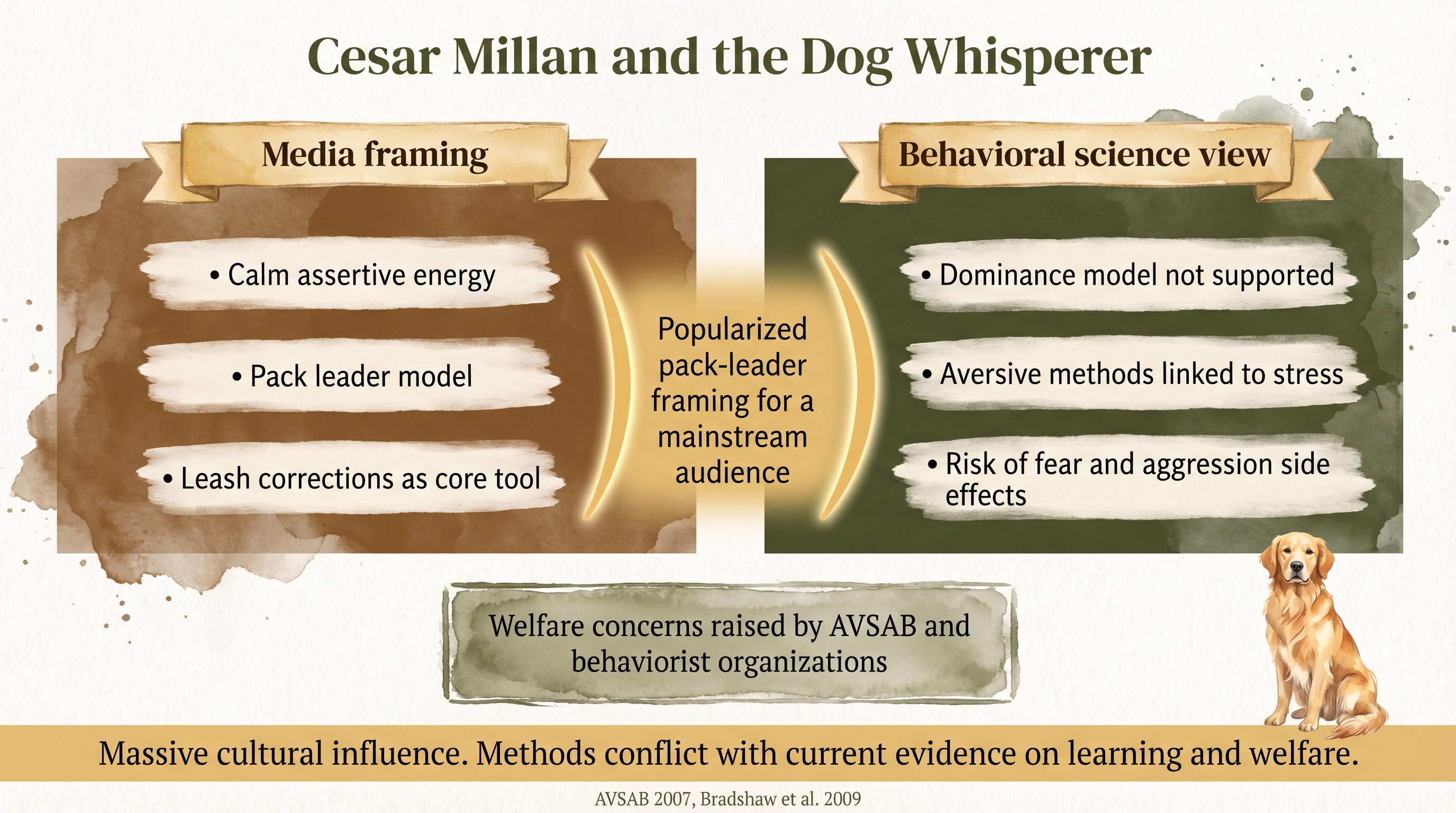
Massive cultural influence - methods conflict with current evidence on learning and welfare.
Key Takeaways
- Cesar Millan mattered because he reached ordinary families at a scale the profession itself rarely achieved.
- His public formula centered on calmness, structure, and human responsibility, which made intuitive sense to many overwhelmed families.
- The strongest critiques targeted dominance-adjacent explanations and confrontation-heavy techniques, not the bare idea that owners should be calm and directional.
- JB keeps the truths about calmness and leadership while rejecting the parts of the Dog Whisperer era that confused those truths with dominance or force.
The Evidence
This entry uses heuristic claim-level tags beyond the dedicated EvidenceBlocks below. These tags mark JB interpretive application rather than direct study findings.
- National Geographic interviews and distribution recordspublic record
Document the 2004 launch and the public formula of exercise, discipline, affection, balanced dogs, and people-focused rehabilitation. - Browne et al. (2024)US dog owners
Shows Millan's books and television work remained especially salient among owners, confirming his mass-market influence. - Mech (1999), Bradshaw et al. (2009), and AVSAB positionswolves and domestic dogs
Support the scientific critique of dominance-based explanations that framed much of the professional pushback to Millan. - Herron, Shofer, & Reisner (2009)domestic dogs
Supports welfare and safety concerns about confrontation-based techniques associated with alpha-style handling.
- domestic dogs
No published study directly isolates the long-term dog-level and family-level effects of cesar millan and the dog whisperer era across ordinary companion-dog contexts.
SCR References
Sources
- National Geographic. Cesar Millan on Traveling with Dogs.
- National Geographic. Why Cesar Millan Loves Being the Dog Whisperer.
- Cineverse. Dog Whisperer with Cesar Millan FAST channel release.
- Bridgegate Films. Dog Whisperer with Cesar Millan.
- Browne, C. M., Cardenas, M. C., Smith, E., Serpell, J. A., & Wynne, C. D. L. (2024). Animals.
- Herron, M. E., Shofer, F. S., & Reisner, I. R. (2009). Applied Animal Behaviour Science.