Leash Laws and Off-Leash Areas
Compound evidence detail1 SCR / 2 parts
- Documentedthe regulatory facts including the National Park Service six-foot leash rule under 36 CFR 2.15, the US Forest Service and Bureau of Land Management public-use frameworks, and the patchwork of state-park and municipal-park leash ordinances that varies by jurisdiction and land manager
- Heuristicthe JB distinct-questions framing separating leash-law compliance from off-leash readiness as a developmental and training question, with the standing constraint that legal permission must not be conflated with developmental readiness in either direction
Leash laws are among the most common dog rules families encounter and among the most casually ignored. That combination is exactly why they deserve clear reading. In most parts of the United States, dogs in ordinary public space are expected to be on leash unless a specific local rule, park rule, or designated area says otherwise. The details vary by jurisdiction, but the baseline is usually restraint, not voice control. Documented
This topic also illustrates how different land managers create different dog rules. A neighborhood sidewalk, a city park, a state reservation, a national park, Bureau of Land Management land, and a national forest are not all governed the same way. The family who treats them as interchangeable is usually the family most surprised by signage, tickets, or conflict.
National Park Service rules are a useful anchor because they are stricter than many families expect. NPS materials commonly state that where pets are permitted they must be restrained on a leash no longer than six feet. That is a very different assumption from the culture of "my dog is friendly and has good recall." On other federal lands, rules can be more permissive, but permissive is not the same as lawless.
For a family knowledge base, the bigger point is simple: leash legality and off-leash readiness are different questions. The law decides what is permitted. Raising decides whether the dog is actually prepared for the freedom the family imagines.
That distinction is useful because leash rules are not only about obedience. They are about sharing space with wildlife, children, fearful dogs, cyclists, runners, and strangers who did not consent to an encounter. The leash is often the legal form of a broader civic idea: your confidence in your dog does not overrule everyone else's right to predictable public space.
What It Means
Most Leash Rules Are Local by Default
Cities and towns usually control ordinary leash requirements in streets, sidewalks, municipal parks, and neighborhood public space. Observed-JB Many local ordinances specify a physical leash requirement and often cap leash length at six feet or another short standard. The family should therefore assume the leash rule is local unless they are on a property managed by a separate park or land agency.
That local control explains why people can be correct and still talk past each other. One owner may be describing a permissive town park. Another may be describing a strict city ordinance. Without the jurisdiction, the conversation is mostly noise.
Park Systems and Public Lands Do Not Match One Another
Families often overgeneralize from hiking culture. They see dogs on trails, then assume the same norm applies everywhere outdoors. It does not. National Park Service units are often restrictive. Many state parks have their own leash frameworks. BLM and U.S. Forest Service lands can be more permissive but still retain local unit rules, wildlife closures, campground restrictions, or requirements that dogs remain under control. Documented
This is why the right legal question is not "public land or not?" It is "which public land manager controls this exact place?" That single habit prevents a remarkable amount of confusion.
Off-Leash Areas Are Exceptions, Not a General Right
Off-leash dog parks, designated beaches, fenced runs, and specially marked open-space hours are legal exceptions to the general leash rule. The existence of those exceptions does not create a broader right to let the dog off leash anywhere the family thinks the dog is trustworthy. It simply means some jurisdictions carve out spaces where off-leash activity is allowed under stated conditions.
That point matters because many owner arguments begin from the wrong premise. Documented "My dog has good recall" is an answer to a training question. It is not always an answer to a legal question. A prohibited off-leash dog can still be prohibited even if it is under perfect voice control.
Reliable recall is a real achievement. It is not a substitute for reading the sign, the ordinance, or the land manager's rule before unclipping the leash.
Leash Law Often Matters After an Incident
Leash law becomes especially important after conflict. Bite cases, dog-dog incidents, wildlife disturbances, and nuisance complaints often look different legally when the dog was off leash in a place where restraint was required. Even where the dog was usually responsive, a violation can shape how responsibility is viewed later.
That is one reason this topic belongs near dangerous-dog law and liability discussions. The leash is not only about courtesy. It is also about downstream legal position.
Posted exceptions can be narrow as well. A trail system may allow dogs but not off leash. A beach may allow off leash only during certain months or hours. A conservation area may reverse its dog access during nesting season or when wildlife pressure is high. Families who rely on local habit instead of the actual rule are often surprised to discover that the permissive culture they have been copying was never the rule in the first place.
Long lines and designated training spaces are useful partly because they let families build freedom without pretending the law has already granted it. There is a meaningful difference between practicing recall on a line in an allowed area and unclipping the leash in a place where the dog is not legally supposed to be loose. Good training works better when it is not built on routine rule-breaking.
Why It Matters for Your Dog
Golden Retrievers are friendly enough that many families get casual about leash rules. The dog is social, loves people, and often runs toward interaction with happy intent rather than threat. That can make off-leash violations feel harmless. They are not always harmless to others, and they are not always harmless to the dog.
A Golden running up to a leashed reactive dog, a child who fears dogs, a cyclist, a nesting wildlife area, or a family picnic can create a problem even when the Golden's motive is sociable. The law often reflects exactly that reality. It governs impact in public space, not private assumptions about intent.
A practical example is common enough to matter. A family hikes with a Golden on a trail they assume is informally off leash because many people do it. The dog runs ahead and startles another leashed dog, who reacts, and a bite incident follows. The family's explanation may begin with friendliness and recall history. The legal and social question may begin with whether the dog was required to be leashed in the first place.
This topic also matters because off-leash readiness is developmental. A dog who can come back in the backyard, at a quiet field, or after one cue is not automatically prepared for birds, joggers, food, children, dogs, and novelty. JB's view that reliable freedom is a product of raising rather than of slogans fits here strongly. The unclipped dog should be the final picture of maturity, not the starting gamble.
Goldens are often trusted too early because they are cooperative breeds and because their social enthusiasm looks easy until stimulation stacks. Families should treat that as a reason for more discipline, not less. A socially outgoing dog can create public problems with joy instead of aggression, but public problems all the same.
The right family question is therefore double. Is it legal here? Is my dog actually ready here? Many off-leash failures happen because owners answer the second question with hope and the first question not at all.
For public parks and shared spaces, the leash can also be a kindness to the dog. It reduces bad encounters, prevents accidental rehearsal of boundaryless movement, and keeps the family from asking too much too early. Freedom is easier to keep once earned than to recover after it has been misused.
Dog parks complicate the conversation further because they are legal off-leash spaces that are not automatically good fits for every dog. A Golden may be legally permitted there and still be socially overwhelmed, too rough, too adolescent, or too distractible for the environment. Legal access solves only one part of the question. The social and developmental readiness question still remains.
Recall reliability also needs a harder test than families often give it. Coming back from ten feet away at a quiet field is not the same skill as disengaging from geese, picnics, cyclists, children with food, or another dog charging in from the opposite direction. Owners often discover the difference only after unclipping the leash in a place where there is no margin for error. That is why JB treats off-leash freedom as the end result of layered maturity, not as a casual vote of confidence.
The leash communicates to other humans as well. A leashed dog signals containment, respect, and predictability in a shared setting. An unleashed dog, even a friendly one, transfers uncertainty onto everyone else nearby because they have to guess whether the handler's optimism matches reality. Families who understand that social effect tend to make better choices even before the law enters the picture.
Wildlife and land stewardship raise the stakes further. A dog may never bite another person and still create real harm by flushing nesting birds, chasing deer, stressing livestock near trail edges, or running through restoration zones. Owners often evaluate off-leash decisions through a social lens alone. Land managers usually have to think ecologically as well, which helps explain why some seemingly open spaces remain leash-required.
Many owners also underestimate how much the leash helps dogs succeed socially. A loose dog meeting every distraction head-on can rehearse overcommitment, frantic greeting, and self-rewarding chase in ways that make later control harder, not easier. Documented A leash or long line lets the family shape better choices before the dog turns public freedom into a habit of rushing first and thinking later. That social shaping function is easy to miss when owners think of the leash only as a restraint and not as guidance, but it is part of what keeps the dog reachable.
What This Means for a JB Family
For a JB family, leash law should not feel like an annoying technicality. It is part of the dog's civic life. Reading the rule accurately and living inside it protects both the public and the dog.
JB also treats off-leash privilege as something adults confer carefully after the dog has shown enough maturity, not something the dog receives because the family feels optimistic that day. Calmness, responsiveness, and social steadiness come first. Distance and freedom come later.
That sequence helps in two ways. It keeps the family on the right side of the law, and it keeps the dog from practicing a level of liberty it cannot yet carry responsibly. Goldens often do beautifully with freedom once raised into it. They just should not be pushed there by impatience or by public-culture shorthand about "friendly dogs."
The practical habit is simple. Read the rule. Clip the leash when required. Use designated off-leash spaces when appropriate. Let freedom be earned twice, once by law and once by the dog.
That double standard is not restrictive in the negative sense. It is protective. A dog who has to earn freedom through both legality and maturity is less likely to rehearse chaotic public behavior, less likely to frighten others accidentally, and less likely to lose privileges later because the family moved too fast.
JB families can therefore treat the leash as a tool of adult steadiness rather than as an insult to the dog's spirit. Used that way, it becomes part of the social language of public life: calm boundaries first, greater liberty second, and no confusion about which one comes before the other.
That mindset also makes off-leash work cleaner when the legal setting truly allows it. The family is not unclipping because impatience won. They are unclipping because the context, the law, and the dog's maturity all line up. Freedom entered that way is usually calmer, safer, and easier to maintain over time.
That is why JB can treat choosing not to unclip as a sign of maturity rather than timidity. Adults who keep the leash on when the picture is marginal are often protecting future freedom, not denying it. They are preserving the dog's success instead of gambling it for a few minutes of careless liberty. Families who adopt that attitude usually discover that the leash stops feeling restrictive and starts feeling clarifying. It tells the adults what job they are in at that moment: not proving how trustworthy the dog is, but creating conditions in which the dog can keep succeeding. That framing makes public freedom feel earned instead of improvised, which is usually safer for the dog and less stressful for everyone sharing the space.
The leash then becomes less a limit on joy than a structure that protects joy from turning chaotic. For many families, that mindset changes everything about how public outings feel because it changes how the dog succeeds there and, often, how the humans show up first. Observed-JB
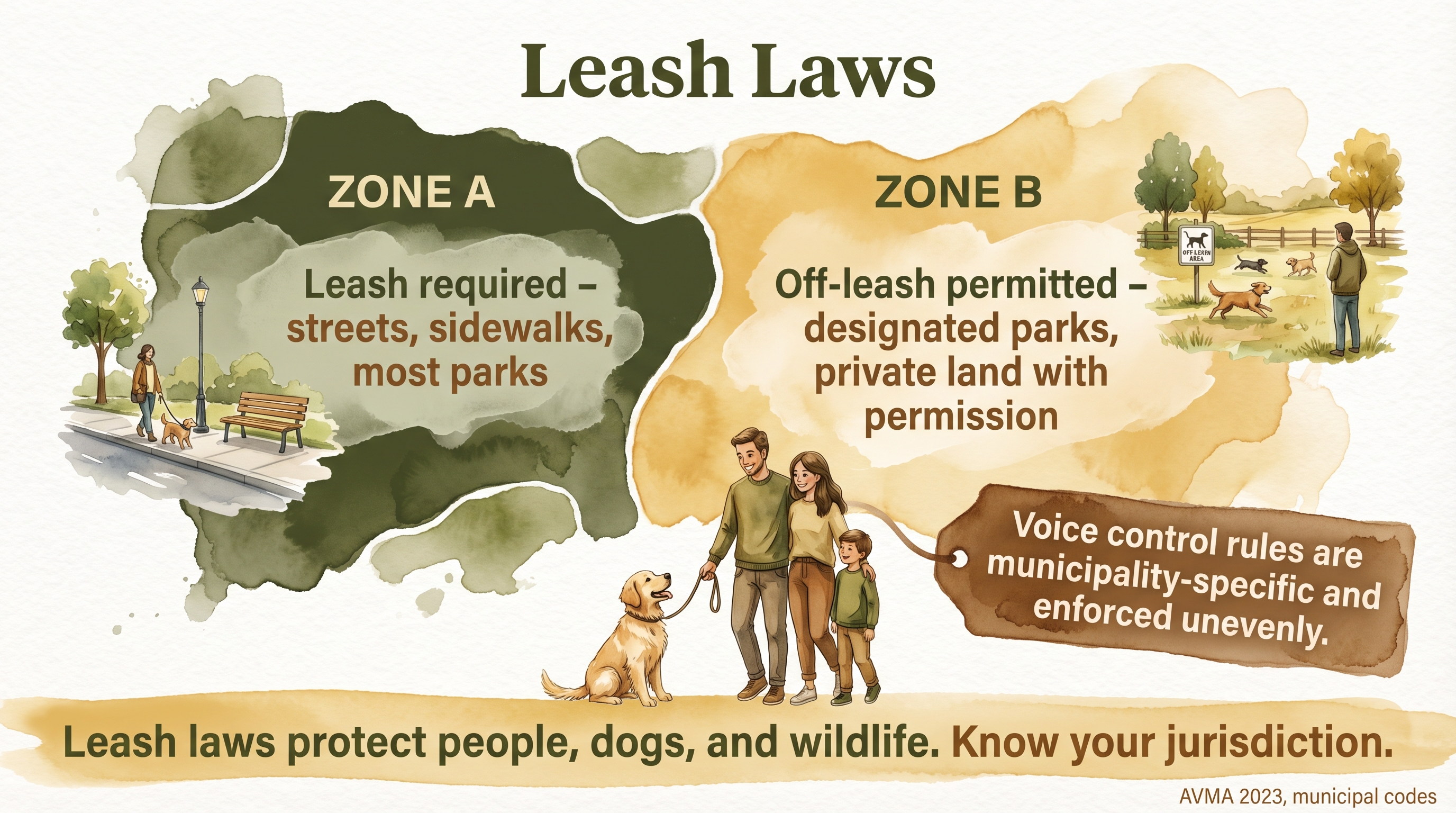
Leash laws protect people, dogs, and wildlife - know your jurisdiction.
Key Takeaways
- Leash law is usually local by default, with park systems and land managers adding their own rules.
- Off-leash areas are legal exceptions, not a general right created by a dog's friendliness or recall.
- A good recall does not replace the need to read the ordinance, posted sign, or land-manager rule.
- For JB families, legal freedom and developmental readiness should both be earned before the leash comes off.
The Evidence
This entry uses observed claim-level tags beyond the dedicated EvidenceBlocks below. These tags mark JB program observation or practice-derived claims that need dedicated EvidenceBlock coverage in a later content pass.
- National Park Service pet guidancepublic-land dog rules
Documents the common six-foot leash requirement where pets are permitted in national-park settings. - dog regulation
Supports the broader claim that everyday dog regulation is usually state or local rather than one uniform national system. - Municipal leash ordinances and park-system ruleslocal dog law
Support the claim that most ordinary leash obligations are jurisdiction specific and often stricter than owners assume. - Public-land management distinctionsfederal land use
Support the narrower point that different land managers create materially different dog rules.
- domestic dogs
No published study directly measures how leash laws and off-leash areas changes long-term dog welfare, family outcomes, and retention across jurisdictions and enforcement contexts.
SCR References
Sources
- National Park Service. Pet guidance and park-specific pet rules.