Behaviorism and the Application to Dog Training
Compound evidence detail1 SCR / 2 parts
- Documentedcanine welfare evidence on aversive training methods (Vieira de Castro 2020, Ziv 2017, Hiby 2004) and attachment-mediated stress modulation evidence (Schoberl 2015, Asher 2020, Brubaker and Udell 2023)
- HeuristicJB claim that secure attachment context measurably alters how dogs experience mechanically operant-identical correction procedures, RF-flagged in the SCR and formally untested in controlled canine studies
Behaviorism gave the dog training industry its most durable language. Even people who have never opened Skinner still talk in behaviorist categories: reinforce what you want, ignore what you do not, change the consequence, manage the antecedent, mark the moment, build the history, extinguish the response. Those phrases came from a research tradition that was trying to explain how behavior changes under controlled conditions. Once that language entered dog culture, it became the basic grammar of modern training. Documented
The historical chain matters. Pavlov worked with dogs and built the idea of conditioned responses. Thorndike formulated the Law of Effect. Skinner formalized operant conditioning through laboratory work with rats and pigeons. Keller and Marian Breland turned those concepts into commercial animal training through Animal Behavior Enterprises, then complicated the whole picture with "instinctive drift" in 1961. Documented Bob Bailey later trained generations of trainers in precise operant practice while also reminding them that classical conditioning always rides along.
That story is often retold as if the laboratory simply discovered how animals work and dog training later applied the findings. The source layer is more careful. Behaviorism truly did reveal something important about consequence based learning. It did not prove that all meaningful canine learning reduces cleanly to operant mechanism, nor did it settle questions about attachment, social referencing, observational learning, arousal regulation, or developmental environment.
That is where JB draws its line. Behaviorism is part of the truth, and it is a serious part. It is not the whole dog. The stronger claim that engineered reinforcement protocols have no documented natural analog, and the stronger claim that relational context changes the meaning of mechanically similar interventions, belong to the heuristic layer and have to stay there.
What It Means
The behaviorist migration into dog training happened in stages.
Pavlov and the Conditioned Response
Ivan Pavlov's name sits near the start because his experiments with dogs became the classic demonstration of conditioned responses. A neutral signal could acquire predictive power when repeatedly paired with food. Later dog training inherited this logic every time a marker, whistle, click, or cue was paired with an outcome and made to carry meaning.
Pavlov matters historically because he shows that dogs were not absent from the laboratory foundation. But Pavlov was not designing a companion dog philosophy. He was isolating response patterns under controlled conditions.
Thorndike and Skinner
Thorndike's Law of Effect supplied the central proposition: behaviors followed by satisfying consequences become more likely, while behaviors followed by unsatisfying consequences become less likely. Skinner then formalized operant conditioning in The Behavior of Organisms in 1938 and Science and Human Behavior in 1953. His research focused primarily on rats and pigeons in apparatus built to control variables tightly and measure response rates cleanly. Documented-Cross-Species
That methodological clarity made the framework powerful. It also created scope limits. The original experiments were not organized around dogs living in attachment relationships with humans inside homes. They were organized around measurable behavior under highly managed contingencies. The source document is careful on this point: the general principle of consequence based learning transfers broadly, but the exact parameters, schedules, and interpretations were established in non-canine laboratory settings.
The Brelands and Instinctive Drift
Keller and Marian Breland are crucial because they were the commercial bridge. As Skinner's students, they founded Animal Behavior Enterprises in 1947 and trained thousands of animals across many species. Their work proved that operant techniques were not just laboratory curiosities. They could be used in shows, commercial displays, and applied animal work.
But the Brelands also produced one of the most important internal critiques of pure operant triumphalism. In 1961, "The Misbehavior of Organisms" documented trained animals reverting to species typical patterns that interfered with the engineered task. Documented Raccoons washed coins, pigs rooted, chickens scratched. The message was not that operant learning was false. The message was that biology pushes back. Animals are not blank substrates waiting for schedules alone to write the script.
Bob Bailey and the Professionalization of Precision
Bob Bailey extended the behaviorist bridge further. His workshops taught trainers how much precision good reinforcement work actually requires. Timing, criteria, rate of reinforcement, clarity of signal, and the interaction between classical and operant processes all became central.
This is one reason behaviorism gained such authority in dog culture. It made training look more scientific than mere intuition, and often it was. A person who understands antecedents, reinforcement history, extinction bursts, and schedule effects is usually seeing more clearly than someone operating on vague folklore.
The Limits Become Impossible to Ignore
The same source layer also records where behaviorism begins to thin. Dobrzecka, Szwejkowska, and Konorski in 1966 provided direct canine evidence that dogs are not endlessly pliable conditioning machines. Documented Miklosi's ethological work argued that dogs have to be understood through evolutionary biology, social cognition, and developmental psychology, not only through schedules. Fugazza's observational learning work and later social cognition research show dogs learning through demonstration, social referencing, and relationship dependent copying in ways that are not well described by a simple reward chart.
So the behaviorist application to dog training should be read as foundational but not exhaustive. It gave the industry a durable toolset. It did not solve the dog.
Behaviorism correctly teaches that timing and contingency matter. JB keeps that lesson. What JB refuses is the next leap: that because consequence matters, the whole of canine development should be organized as a consequence management problem.
Why It Matters for Your Dog
For a Golden Retriever family, behaviorism matters because it gives useful clarity without needing to become a full worldview. If your puppy keeps barking to make dinner arrive faster, jumping to gain touch, or rushing outside because the door always opens during excitement, behaviorism helps explain what is being rehearsed. Consequence matters, and families who do not understand that often accidentally build exactly what they later dislike.
Where trouble starts is when the family lets the framework become too complete. Many household problems are not only questions of reinforcement history. They are also questions of arousal, attachment, demonstration, developmental timing, and whether the puppy is living inside a coherent social order. A puppy may know what earns food in the training corner and still be unable to regulate itself at the front door when guests arrive. That is not a failure of behaviorism. It is a sign that the dog is larger than the model.
This distinction changes what a family notices. Imagine a young Golden that grabs every shoe left near the mudroom bench. A narrow behaviorist reading asks what consequence maintains shoe grabbing. That is a useful question. A wider developmental reading asks additional ones. Is the puppy overtired? Is the mudroom the place where exits happen and arousal spikes? Does the puppy have adult guidance near the door or only correction after the grab? Is the object stealing linked to social engagement, exploration, or excitement?
Families need both lenses, but in the right order. Behaviorism is a strong tool for decoding rehearsal. It is weaker as a complete explanation for why a social mammal matures well or poorly inside a household.
This also matters because modern dog advice often hides its behaviorism. A family hears "reward calm" and thinks it is simple kindness. Sometimes it is. Sometimes it is also a precise technical instruction that assumes careful timing, good value, consistency, and a context controlled enough for the dog to notice the contingency. If the family cannot supply those conditions, the theory may be sound while the application stays fragile.
The reason this entry belongs in a JB knowledge base is not to dismiss behaviorism. It is to stop the family from being intellectually trapped by it. A Golden Retriever puppy is not just a set of behaviors to strengthen or weaken. It is a developing social organism that learns from what adults do, how the home feels, what gets rehearsed, what gets prevented, and what kind of relationship organizes the day.
Another reason this matters for families is that behaviorist language can quietly become the only language in the home. A Golden may then be treated as a sequence of contingencies rather than as a young social mammal living inside a family culture. The dog earns food for correct responses, loses access for mistakes, and rotates through protocols while the deeper household rhythm remains hectic. The family has not done anything irrational. It has simply allowed a useful explanatory tool to become the total frame.
That is where JB parts company with a purely behaviorist household. A Golden can be skillful in sessions and still be unformed in ordinary life. The family who sees only contingency misses tone, modeling, rhythm, and the dog's need for a stable social floor. History matters because it shows where that narrowing came from and why it still exerts such quiet power over modern advice.
A Golden family often discovers the limit of pure behaviorism at the exact point where the dog is not failing at cues, but at life. The dog can sit, down, target, recall in the yard, and respond beautifully to food, yet still become frantic around company, unravel in the evening, or depend on constant human input to stay organized. Nothing in that picture disproves reinforcement science. It shows that the family is dealing with something broader than a training schedule. The dog is living inside emotional weather, household pacing, and social expectations that cannot be fully captured by the question of which consequence followed which behavior.
That matters because behaviorist language is so useful that it can become seductive. Once families learn to think in contingencies, they may start believing every challenge can be solved by adjusting antecedents and reinforcers. Sometimes that is enough. Sometimes the real need is slower meals, quieter arrivals, less social intensity, more predictable routines, and adults who stop narrating every moment. A Golden's maturity often depends on these atmosphere variables at least as much as on the formal training plan.
A Golden who is wonderful in structured work and disorganized in the rest of the day is often the clearest family reminder that learning theory is true but not total. The dog's life is bigger than the schedule of reinforcement. JB asks the family to keep that perspective in front once the mechanics start working.
What This Means for a JB Family
For a JB family, the practical rule is simple: use behaviorist insight where it is strongest and do not ask it to answer questions it was never built to answer. If a behavior is being rehearsed and paid, stop paying it. If a signal is muddy, make it clearer. If the environment keeps triggering the same mistake, rearrange the environment. Those are sound applications.
But do not confuse that competence with a full developmental philosophy. A family still has to ask whether the puppy is over-aroused, under-rested, copying adult chaos, missing calm exemplars, or being placed in situations where the wrong learning channel is dominant. Goldens learn from consequences, yes. They also learn from people.
That is why JB ties behavior science to Mentorship and Prevention instead of replacing those pillars with it. Prevention respects the behaviorist truth that rehearsal builds probability. Mentorship respects the documented truth that dogs also learn from demonstration and relationship. Together they give a fuller map than consequence management alone.
So the family takeaway is neither "ignore learning theory" nor "reduce everything to learning theory." It is to keep the framework in proportion. Let it sharpen your eyes. Do not let it shrink your dog.
For a JB family, the best use of behaviorism is disciplined and limited. Learn the mechanics. Use the insights about reinforcement, antecedents, and rehearsal. Then put them back inside a larger picture of raising. The adult's job is not to become a full-time laboratory technician. It is to become the kind of calm, coherent presence within which those tools can actually support maturity.
That is the difference between borrowing science and becoming ruled by a method. JB wants the first and resists the second. A Golden Retriever can benefit enormously from reinforcement-based teaching while still needing a home that teaches how to live, not only how to perform.
For a JB family, the practical discipline is to keep the quadrants in the toolbox and out of the throne. They help explain why behavior changes. Documented They do not tell the whole story of how a dog becomes settled, secure, and socially mature. JB wants families to use learning theory when it clarifies the picture and to zoom out immediately when the dog is really responding to tone, rhythm, or the shape of everyday life.
That is why the JB close on behaviorism is not anti-science. It is anti-reduction. A Golden Retriever can learn through reinforcement and still need a human who behaves like a stable adult rather than like a full-time protocol manager. That distinction is where the historical lesson becomes practical.
That is also why JB families should not feel embarrassed if a dog needs more than well-run sessions. Often the missing piece is not smarter shaping. It is steadier life.
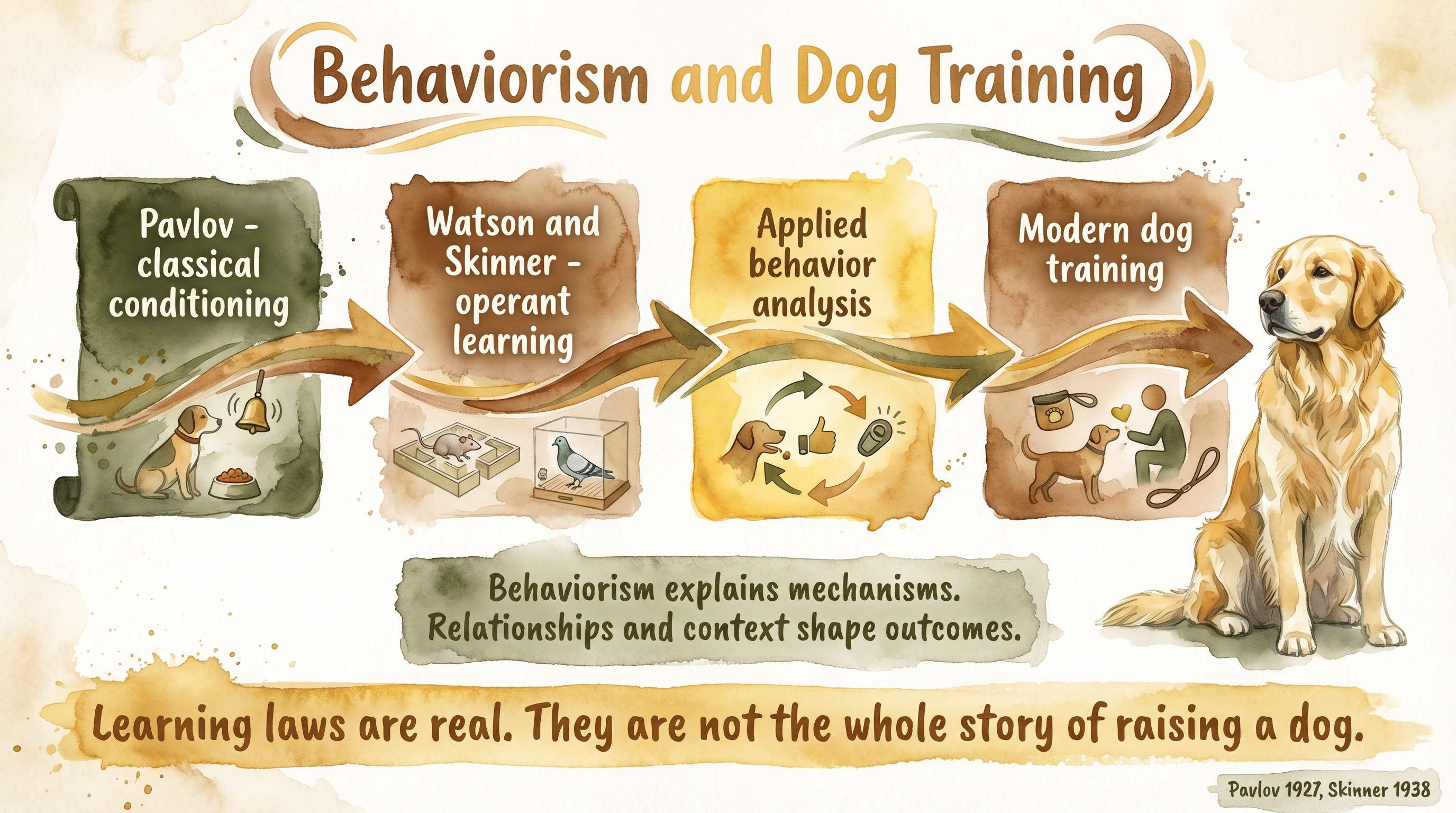
Learning laws are real - they are not the whole story of raising a dog.
Key Takeaways
- Behaviorism gave the dog training industry its most durable conceptual vocabulary.
- The framework is real and useful for understanding consequence based rehearsal, but it was not built as a complete theory of companion dog development.
- The Brelands' instinctive drift findings and later canine social cognition work show where a pure operant reading starts to thin.
- JB keeps the genuine insight of behaviorism while refusing to let the model stand in for relationship, mentorship, and developmental context.
The Evidence
This entry uses documented cross-species claim-level tags beyond the dedicated EvidenceBlocks below. Species and application scope should be checked during the next evidence-chain authoring pass.
- Pavlov, Thorndike, and Skinnerdogs and multiple species
Established conditioned response and consequence based learning as central explanatory tools in behavioral science. - Breland & Breland (1961)multiple species
Documented instinctive drift, showing that species typical behavior can interfere with operant training plans. - Dobrzecka et al. (1966) and Miklosi's later ethological synthesisdomestic dogs
Show that canine learning cannot be treated as infinitely flexible conditioning detached from species specific cognition and social biology. - SCR-004 and SCR-005 boundary claimsdomestic dogs
Mark the heuristic JB position that engineered operant protocols and the relational meaning of correction cannot simply be equated with natural canine development.
- domestic dogs
No published long-term study directly compares behaviorism and the application to dog training against structured relational raising and no-intervention controls across ordinary companion-dog homes.
SCR References
Sources
- Breland, K., & Breland, M. (1961). The misbehavior of organisms. American Psychologist, 16(11), 681-684.
- Dobrzecka et al. (1966) provides direct canine evidence that cue-response mappings are biologically constrained; Miklosi provides later ethological synthesis. Supports the boundary that dogs are not blank operant substrates, but does not by itself resolve the full JB training-versus-raising thesis.
- Pavlov, Thorndike, and Skinner establish foundational learning-theory principles, largely in non-canine laboratory contexts. Canine application requires separate dog-specific evidence or explicit cross-species boundary language.