Retrieve Drive as a Heritable Trait
Compound evidence detail1 SCR / 2 parts
- Documentedbehavioral-genetics research on the heritability of retrieve drive and other functional working traits in dogs
- HeuristicJB position on retrieve-drive heritability as a selection consideration within the breeding program
Retrieve drive is one of the clearest examples of how breed history becomes household behavior in ways that are directly traceable to the genetic consequences of long functional selection. Golden Retrievers were not bred at random and later discovered to like carrying things. They were built as retrieving dogs, which means selection repeatedly favored interest in objects, cooperation with a handler, mouth control, and persistence in the carrying-returning sequence over many generations of breeder decisions. That makes retrieve drive a real heritable trait at the population level, even though the strength and style of that drive still vary meaningfully between lines and individual dogs in ways that affect how families experience daily life with the breed. Mixed Evidence
What It Means
Retrieve drive as a behavioral package
Retrieve drive is not just "likes toys," which is how the concept often gets compressed in casual conversation about dog behavior. In working terms, it includes a package of related behavioral tendencies that evolved together because they were all useful in the functional context that shaped the retriever breeds. Orienting to thrown or moving objects captures the visual attention component, meaning the dog notices and tracks things that fall or move through its visual field in ways that non-retrieving breeds often do not. Willingness to pick up and carry is the motor component, meaning the dog is comfortable taking objects into its mouth without resistance or conflict. Comfort holding an object in the mouth is the soft-mouth component, meaning the dog can carry items without crushing or damaging them in ways that would make them unsuitable for retrieval.
Tendency to bring the object back toward the human is the cooperative component, meaning the dog returns with the object rather than running off with it or dropping it partway, and this component may be the most distinctively retrieving-selected trait because many other carrying-oriented breeds do not share the return tendency. Sustained interest in repeating the sequence is the persistence component, meaning the dog remains engaged in the activity rather than losing interest after one or two repetitions, and this stamina for repeated work is what distinguishes retrievers from breeds that may pick up an object once out of curiosity but lose interest quickly.
That package is behaviorally meaningful because it was directly useful in a retriever breed's functional context. A dog working as a gun dog needed to see the bird fall, move to retrieve it, pick it up gently, bring it back to the handler, and be ready to do it again. Each component of the retrieve drive package serves part of that functional sequence, and the package as a whole was under selection pressure across many generations of breeder decisions. The dogs that showed more of the complete package were preferred for breeding, and the dogs that showed less of it were less likely to pass their genes forward, and the cumulative effect is the breed we have today.
The broader behavioral-genetics lesson
The behavioral-genetics lesson is broader than retrieve drive specifically, and it applies to any breed whose functional history involved sustained selection for particular behavioral tendencies. Traits tied to working function can be inherited in the same population-level way that fearfulness, sociability, or boldness are inherited. They are not all-or-nothing switches that a dog either has or lacks, and they are not simple Mendelian traits that can be tracked through a single-locus test. They are distributions that move over time when breeders select consistently for the desired pattern, and the distributions at any given point in a breed's history reflect the cumulative effect of the selection choices made up to that point.
This is why retrieve-like breeds show retrieve-like behavior, guarding breeds show guarding-like behavior, herding breeds show herding-like behavior, and sight hound breeds show chase-oriented behavior. None of these behavioral patterns is imposed on the puppy by training in the modern era; the tendencies are already present as genetic starting points because the breed's ancestors were selected for them over generations. Training can shape how the tendencies are expressed and channeled, but it does not create them from nothing.
How retrieve drive shows up in modern Goldens
Golden Retrievers still show the consequences of their retrieving history in ways that are often visible even in dogs that have never been formally introduced to retrieving work. Observed-JB Many pet Goldens spontaneously carry objects around the house, sometimes with no apparent purpose beyond the satisfaction of having something to hold. They parade items around when guests arrive or when the dog is excited. They pick things up with unusual gentleness, and many Golden caregivers are surprised by how undamaged items remain when a Golden has been carrying them. They show unusual interest in fetch-like games without being formally taught the underlying desire, and many families discover almost by accident that their Golden will retrieve a tennis ball or toy without any prior instruction.
None of this is an accident. It is the behavioral residue of the selection history that shaped the breed, and it persists even when the functional context that originally selected for it has been completely removed from the dog's life. A Golden Retriever puppy growing up in a suburban household will still show retrieve-oriented behavior that a Labrador or a Chihuahua puppy would not show in the same environment, because the genetic starting points are different even though the developmental conditions are similar.
Within-breed variation in retrieve drive
Within the breed, however, the style and intensity of retrieve drive varies meaningfully in ways that families and breeders both need to understand. Some lines are more intense and workmanlike, producing dogs whose retrieve drive approaches an obsessive level and who will carry, fetch, and work for hours without showing signs of fatigue or disengagement. These dogs are often extraordinary at structured working tasks and can excel in hunt tests, field trials, and advanced training sports, but they can also be challenging to live with in households that are not prepared for the level of activity and engagement the dogs require to remain settled.
Some lines are softer and more moderate, producing dogs whose retrieve drive is clearly present but not overwhelming. These dogs will carry items, enjoy fetch, and show the breed-typical patterns, but their engagement level is more compatible with ordinary family life and their off-switch works reliably when the activity ends. Documented These dogs may be less suited to intense working contexts but are often better suited to the lives most pet families actually lead.
Some lines show high object commitment with high arousal, meaning the dog is deeply committed to the retrieve sequence but becomes visibly activated during the activity in ways that can be difficult to regulate. Some lines carry readily but remain easier to settle in the home, meaning the dog shows the breed-typical behavior when appropriate but returns to calm baseline easily when the activity ends. These are meaningful differences in the expression of the same underlying trait category, and they matter for how families experience living with the dog.
That variation is exactly what breeder-level selection acts on, and it is part of why different Golden Retriever breeding programs can produce dogs that differ visibly in the intensity dimension while still being clearly and correctly Golden Retrievers. The choice of which subrange to select toward is a legitimate breeder decision, but it is a decision with consequences for the families who will live with the resulting dogs, and responsible breeders communicate about their selection target rather than leaving families to discover the intensity level of their line by surprise.
Why It Matters for Your Dog
What This Cannot Predict
Retrieve drive is a population-level trait, not a guarantee for one puppy, and the same individual variation that applies to other polygenic behavioral traits applies here as well.
It cannot tell you that every Golden will love formal fetch with equal enthusiasm, because individual puppies vary in how the breed-typical tendencies express in their particular temperament and in which specific retrieve-related behaviors they show most strongly. Documented
It cannot tell you that every puppy from a retrieving breed will show identical object behavior, because within-litter variation is normal and some puppies in any litter will be more retrieve-oriented than their siblings. Documented
It cannot tell you that a high-drive line and a moderate-drive line differ only in training rather than in inherited tendency, because the literature supports real genetic differences in the distributions produced by different selection targets, and training cannot fully override the underlying genetic starting points in either direction.
The better statement is that selection history changes the odds and the distribution for any particular breed or line, not the destiny of each dog. A high-drive line will produce, on average, higher-drive puppies, but the individual puppies within that line will still vary around the line average in ways that are not fully predictable from parental phenotype alone.
Families often misunderstand retrieve drive in one of two directions, and both misunderstandings can lead to disappointment or difficulty in daily life with the dog.
One mistake is to ignore it and act as though carrying, mouthing, and object interest are just random puppy quirks that will fade with maturity. They usually will not fade, because they are not random quirks but expressions of the breed's genetic heritage, and treating them as temporary is a recipe for being surprised when the adult dog continues to show the behaviors that were present in the puppy. Families who want a dog with no retrieve-oriented tendencies should choose a different breed, because managing the tendencies out of a Golden Retriever is not realistic and not fair to the dog.
The other mistake is to intensify it too aggressively, turning a naturally present working trait into a constant arousal engine through excessive fetch games, intense training regimens, and daily patterns that keep the dog permanently engaged in retrieving activity. This intensification can produce a dog whose baseline arousal is too high for comfortable household life, whose ability to settle is compromised by the constant activation, and whose relationship with the family becomes organized around the retrieve activity rather than around the broader fabric of shared life.
For JB, the healthier target is moderate, integrated retrieve drive that lives in the middle between these two mistakes. Enough breed identity that the dog carries naturally and cooperates with human partners in the retrieve-related activities that come up in family life, because the trait is part of what makes a Golden Retriever a Golden Retriever and removing it would be neither possible nor desirable. Not so much intensity that the home feels like a field trial every day, because the program is producing family dogs rather than specialized working dogs and the intensity required for specialized working performance is different from what families need for daily life.
That is why line choice matters and why families should pay attention to it when evaluating breeders. A breeder who selects only for maximal sporting intensity may produce a very different daily-life dog from a breeder selecting for stable family temperament while preserving breed-typical retrieve behavior. Documented Both breeders may be producing excellent Golden Retrievers for their respective purposes, but the dogs they produce will suit different families, and the mismatch between a high-intensity dog and a family expecting moderate behavior is one of the more common sources of disappointment in the breed.
The goal is not to remove the trait. Removing retrieve drive from a Golden Retriever would produce a dog that is no longer really a Golden Retriever in any meaningful sense, and the program would have abandoned part of what makes the breed worth preserving. The goal is to select the livable expression of the trait, meaning the version of retrieve drive that remains genuinely present in the dog's identity while also being compatible with the kind of stable family life the Five Pillars framework is designed to support. That selection target is harder to communicate in marketing language than a simple "high drive" or "low drive" label would be, but it is what thoughtful breeding actually requires.
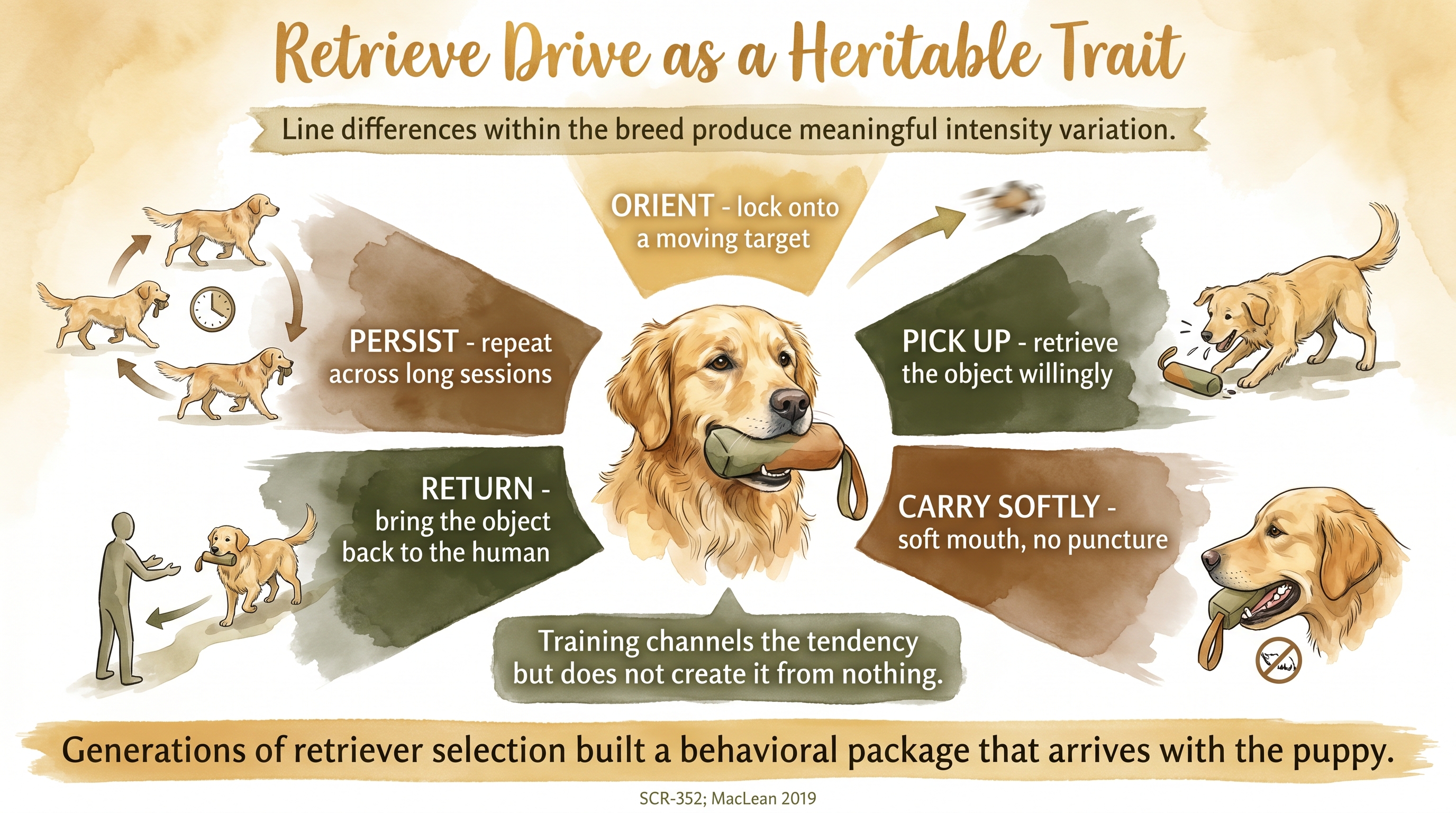
Generations of retriever selection built a behavioral package that arrives with the puppy.
Key Takeaways
- Retrieve drive is a real heritable behavioral trait tied to the functional history of retriever breeds.
- In Golden Retrievers, many pet dogs still show spontaneous carrying and returning behavior without formal training.
- Line differences matter because the same breed can express retrieve drive at very different intensity levels.
- The population-level goal is not to erase retrieve drive, but to select the version of it that remains compatible with stable family life.
- Line choice has consequences families should understand before selecting a breeder, because intensity level is one of the most practically important dimensions of daily life with the dog.
The Evidence
This entry uses mixed-evidence claim-level tags beyond the dedicated EvidenceBlocks below. These tags mark claims that combine documented findings with observed practice, heuristic application, or unresolved gaps.
- Canine behavioral-genetics literaturedogs
Working-related and temperament-related behavioral traits show measurable heritable components, meaning repeated selection can shift population averages over generations. - Retriever and working-dog behavior studiesretriever populations
Cooperation, object interest, and other work-relevant behavioral dimensions vary across populations and are consistent with long selection for functional task performance.
- JB breeder observationsGolden Retrievers
Golden Retrievers commonly show spontaneous object-carrying and retrieve-oriented behavior, while lines differ meaningfully in intensity, arousal, and household livability.
No published study has established a validated quantitative measure of retrieve-drive intensity in pet Golden Retrievers that would allow direct comparison of line averages under standardized conditions.
SCR References
Sources
- MacLean E.L., Snyder-Mackler N., vonHoldt B.M., & Serpell J.A. (2019). Highly heritable and functionally relevant breed differences in dog behaviour. Proceedings of the Royal Society B: Biological Sciences, 286(1912), 20190716. doi:10.1098/rspb.2019.0716
- Morrill K., Hekman J., Li X., McClure J., Logan B., Goodman L., et al. (2022). Ancestry-inclusive dog genomics challenges popular breed stereotypes. Science, 376(6592), eabk0639. doi:10.1126/science.abk0639
- Ilska J., Haskell M.J., Blott S.C., Sánchez-Molano E., Polgar Z., Lofgren S.E., Clements D.N., & Wiener P. (2017). Genetic Characterization of Dog Personality Traits. Genetics, 206(2), 1101-1111. doi:10.1534/genetics.116.192674
- Goddard M.E. & Beilharz R.G. (1983). Genetics of traits which determine the suitability of dogs as guide-dogs for the blind. Applied Animal Ethology, 9(4), 299-315. doi:10.1016/0304-3762(83)90010-X
- Saetre P., Strandberg E., Sundgren P.-E., Pettersson U., Jazin E., & Bergström T.F. (2006). The genetic contribution to canine personality. Genes, Brain and Behavior, 5(3), 240-248. doi:10.1111/j.1601-183X.2005.00155.x
- Scott J.P. & Fuller J.L. (1965). Genetics and the social behavior of the dog. University of Chicago Press.