Frustration Tolerance Development
Frustration tolerance is the developing capacity to remain workable when a desired outcome is blocked, delayed, or withheld. It sits at the overlap of impulse control, emotional regulation, and arousal management. The broad developmental claim is reasonable, but the canine literature is still modest, which is why this page stays at an observed ceiling rather than pretending frustration has already been charted as a fully standardized developmental trait. Observed-JB
What It Means
What Frustration Is
Frustration is not just excitement. It is the affective state produced when goal-directed behavior is blocked. Observed-JB
In dogs, that can show up when when access to a person or object is prevented, when an expected routine is interrupted, when arousal is raised but completion is delayed, and when signals are inconsistent enough that the dog cannot predict what works. Observed-JB
Because frustration sits so close to arousal, it is often mislabeled as "stubbornness" or "energy." Observed-JB In reality it is partly a regulation problem.
Why Development Matters
Young dogs are not born with mature frustration tolerance. They are learning how to carry blocked motivation without escalating into panic, explosive persistence, or disorganized behavior.
That is why frustration tolerance is not built simply by exposing the puppy to more frustration. The developing animal still needs the ability to recover. Observed-JB Repeated uncontrolled triggering without support can just rehearse dysregulation.
The Best Current Canine Support
SCR-047 shows that arousal and performance interact in dogs, and that already-excitable dogs can lose control when pushed higher. SCR-048 adds that frontal engagement matters for successful inhibition. Together, they support the idea that frustration tolerance depends partly on the same control systems that support broader self-restraint. Documented
SCR-053 adds a social-development caution. Dog-human play is not structurally identical to dog-dog play. That matters because many household strategies for "teaching frustration" assume human play can perfectly substitute for the social curriculum puppies normally receive from litter and adult dogs. The evidence does not support that equivalence.
Why It Matters for Your Dog
The Common Mistake
The common mistake is to treat frustration tolerance as a simple trainable virtue: add enough small denials and the dog will become resilient.
Sometimes mild, contained challenge is helpful. Sometimes it is just more rehearsal of failure. The difference depends on baseline arousal, developmental stage, predictability, and whether the dog can come back down after the experience.
That is why frustration tolerance belongs next to emotional regulation rather than as a stand-alone toughness exercise.
The prevention connection is subtle but important. Preventing repetitive high-arousal conflict can be more developmentally useful than repeatedly provoking the puppy and calling the result resilience training.
The Main Boundary
The dog literature on frustration is growing, but it is not yet deep enough to support highly precise developmental claims. The safest conclusion is that frustration tolerance develops, varies widely across individuals, and is shaped by both biology and environment. The least safe conclusion is that one simple household protocol has already been proven to manufacture it.
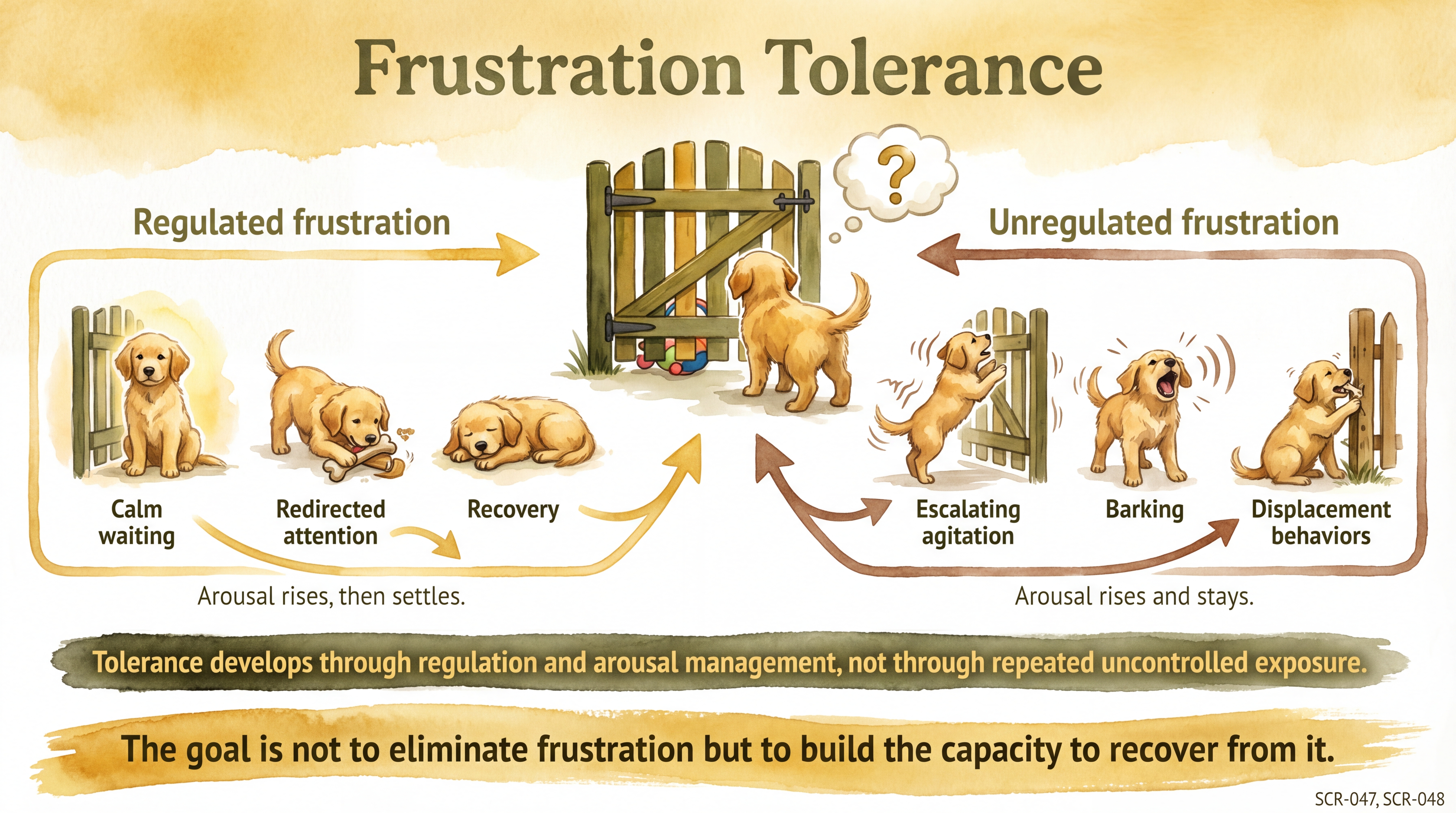
The goal is not to eliminate frustration but to build the capacity to recover from it.
Key Takeaways
- Frustration tolerance is the capacity to stay workable when a goal is blocked or delayed.
- It depends partly on the same control systems that support inhibition and emotional recovery.
- Repeated provocation is not automatically the same thing as building resilience.
- The canine literature is real but still modest, so strong protocol claims should be kept conservative.
The Evidence
This entry uses observed claim-level tags beyond the dedicated EvidenceBlocks below. These tags mark JB program observation or practice-derived claims that need dedicated EvidenceBlock coverage in a later content pass.
- Bray, E. E., MacLean, E. L., & Hare, B. (2015)domestic dogs
Performance on an inhibitory control task depended on baseline excitability and experimentally manipulated arousal. - Cook, P. F. et al. (2016)domestic dogs
Frontal cortical engagement predicted better inhibitory control, which is directly relevant to frustration carrying capacity. - Horvath, Z. et al. and SCR-053 synthesisdomestic dogs
Dog-human play differs structurally from dog-dog play, limiting simplistic substitution claims about how frustration and regulation are learned.
- Canine frustration synthesisdomestic dogs
The field supports frustration as a meaningful affective domain in dogs, but direct developmental mapping is still modest, so broad conclusions should remain careful.
- domestic dogs
No published canine study follows frustration-tolerance development longitudinally from early puppyhood through adolescence in ordinary family settings.
SCR References
Sources
- Bray, E. E., MacLean, E. L., & Hare, B. A. (2015). Increasing arousal enhances inhibitory control in calm but not excitable dogs. Animal Cognition, 18(6), 1317-1329. DOI: 10.1007/s10071-015-0901-1.
- Canine frustration synthesis. Supports frustration tolerance as a useful developmental construct; no single longitudinal canine study yet maps frustration tolerance across puppyhood.
- Cook, P. F., Spivak, M., & Berns, G. S. (2016). Neurobehavioral evidence for individual differences in canine cognitive control: An awake fMRI study. Animal Cognition, 19(5), 867-878. DOI: 10.1007/s10071-016-0983-4.
- Horvath, Z. et al. and SCR-053 synthesis. Supports dog-human play and arousal-regulation context; does not establish that human play fully substitutes for conspecific developmental feedback.