Neonatal Neurological Stimulation (ENS) / Bio-Sensor
Compound evidence detail1 SCR / 2 parts
- DocumentedAwalt-supported canine methylation association showing early-life history can leave measurable biological traces
- Heuristicextension from general early-life adversity biology to ENS-specific resilience or health outcomes
Neonatal Neurological Stimulation, usually shortened to ENS and often marketed as the Bio-Sensor protocol, refers to a short daily handling routine typically performed from days three to sixteen of life. The protocol became popular through breeder culture as a way to produce more resilient, more stress-tolerant, and even healthier adult dogs. The strongest scientific reading is more restrained: ENS has a plausible rationale, seems low risk when done gently, and may offer modest benefit in some settings, but the evidence base is not strong enough to support the dramatic benefit list often attached to it. Mixed Evidence
What It Means
What the Protocol Is
The classic Bio-Sensor version consists of five very brief exercises tactile stimulation between the toes; head held up; head held down; brief supine holding; and placement on a cool surface. Mixed Evidence
The breeder logic is that these tiny, controlled challenges act as mild stress inoculation during a period of high developmental sensitivity. Documented
Why the Idea Is Plausible
The idea is not biologically ridiculous. Early life is a period of unusually high plasticity, and SCR-094 supports the broader point that early conditions in dogs can leave regulation-relevant biological traces. Documented
That broad developmental sensitivity is why ENS remains attractive. If early life matters so much, then perhaps small, carefully dosed challenges could help shape later coping.
But plausibility is not the same thing as proof.
Why the Popular Claims Run Ahead
The classic ENS claims often include improved cardiovascular performance, stronger adrenal function, greater resistance to disease, and substantially better adult stress tolerance. Observed-JB The problem is that the peer-reviewed literature does not cleanly validate that full package.
The Boone kennel study and related work suggest either small effects, context-dependent effects, or null results rather than a transformative, universally replicable benefit. Documented That is why this page is written as mixed rather than endorsed as documented.
There is also a second caution that matters in breeder culture generally. SCR-056 exists because precise, highly repeatable puppy-management claims are often circulated with more confidence than the evidence deserves. That SCR is about sleep totals rather than ENS directly, but it is still relevant as a culture-wide warning sign: memorable breeder numbers and protocol promises often outrun peer-reviewed validation.
The Most Honest Conclusion
The most honest conclusion is that ENS is probably low risk when performed gently and briefly; that it may provide modest benefit in some contexts; and that it is not currently supported as a transformational breeder technology.
That middle position is less exciting than the marketing version and more faithful to the evidence.
Why It Matters for Your Dog
What Families Should Understand
Families sometimes hear that ENS means the puppy has already been given a major neurological advantage that substitutes for later environment. Nothing in the evidence supports that claim.
If ENS helps at all, it most likely helps at the margins and inside a broader developmental system that still includes maternal care, environment quality, sleep, handling, socialization, and transition.
The science-first reading of ENS is that small early interventions may matter, but they do not outrank the total developmental environment. Calm, predictability, and good caregiving remain the bigger levers.
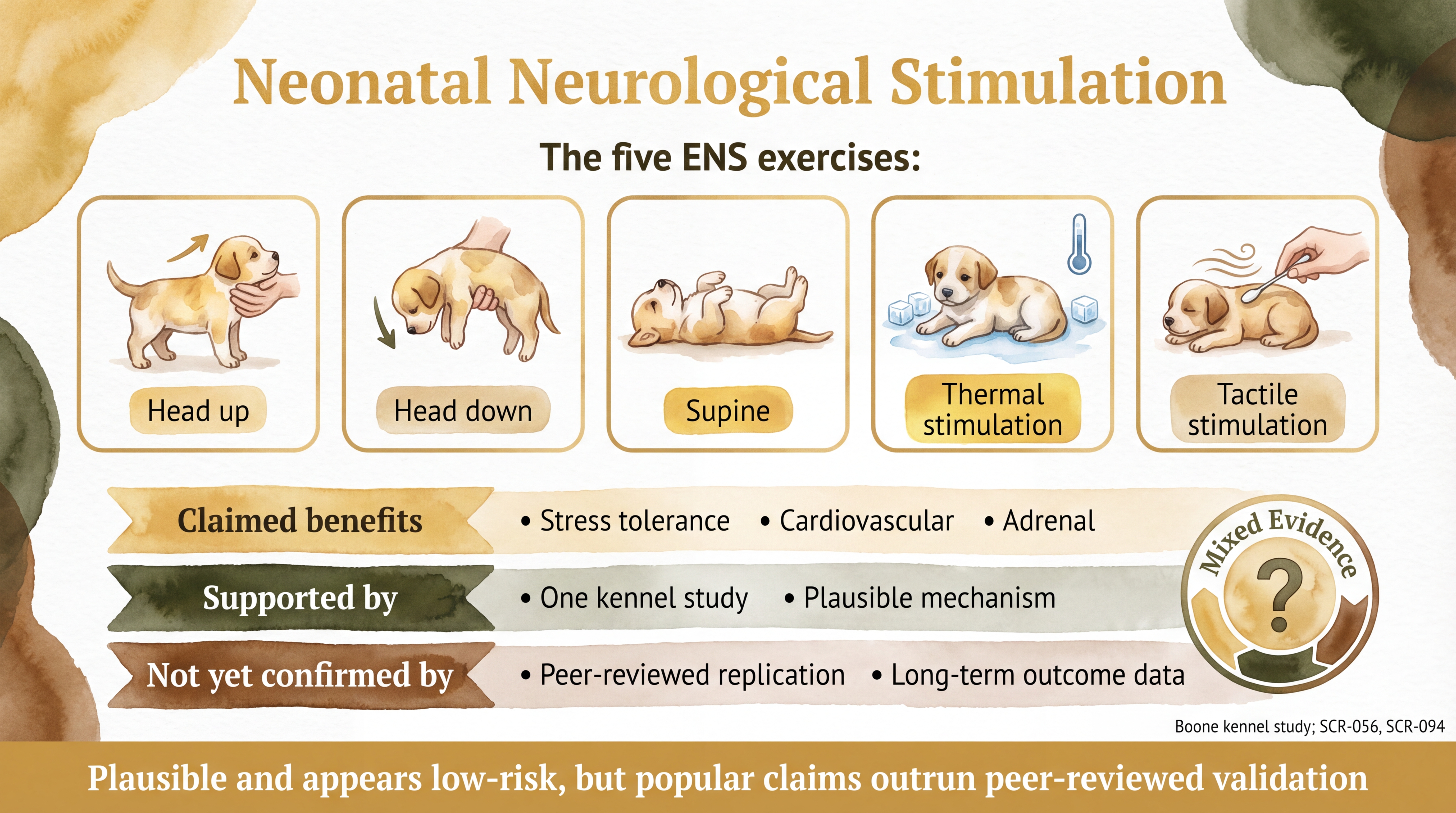
Plausible and appears low-risk, but popular claims outrun peer-reviewed validation.
Key Takeaways
- ENS is a brief neonatal handling routine, not a proven transformational protocol.
- The idea is biologically plausible because early life is developmentally sensitive.
- The direct canine evidence is mixed and does not cleanly validate the long traditional benefit list.
- If ENS helps, it likely matters at the margins inside a much larger developmental environment.
The Evidence
This entry uses observed claim-level tags beyond the dedicated EvidenceBlocks below. These tags mark JB program observation or practice-derived claims that need dedicated EvidenceBlock coverage in a later content pass.
This entry uses mixed-evidence claim-level tags beyond the dedicated EvidenceBlocks below. These tags mark claims that combine documented findings with observed practice, heuristic application, or unresolved gaps.
- Boone, G. et al. (2022)domestic dogs
Commercial-kennel ENS work did not show a broad, dramatic welfare advantage and suggested context-sensitive or modest effects rather than universal transformation.
- SCR-094 developmental sensitivity contextdomestic dogs
Early-life conditions can affect regulation-relevant biology in dogs, which makes mild early intervention biologically plausible without proving the classic ENS benefit list.
- SCR-056domestic dogs
Breeder culture often circulates precise puppy-management claims with stronger certainty than the peer-reviewed record supports. ENS benefit rhetoric should be read with that same caution.
No direct canine research located for this specific topic. Current understanding relies on related research, clinical observation, and cross-species inference.
SCR References
Sources
- Battaglia, C. L. (2009). Periods of early development and the effects of stimulation and social experiences in the canine. Journal of Veterinary Behavior, 4(5), 203-210. DOI: 10.1016/j.jveb.2009.03.003.
- Boone, G., Romaniuk, A. C., Barnard, S., Shreyer, T., Serpell, J. A., & McMillan, F. D. (2022). The effect of early neurological stimulation on puppy welfare in commercial breeding kennels. Animals, 13(1), 71. DOI: 10.3390/ani13010071.