Early Scent Introduction (ESI)
Early Scent Introduction, or ESI, is a breeder practice in which neonatal puppies are briefly exposed to different odors during the same early days often used for ENS. The theory is intuitive: dogs are an olfactory species, early development is sensitive, and controlled scent exposure might broaden later scent confidence or discrimination. The scientific problem is that the direct evidence for those outcome claims is extremely thin. Mixed Evidence
What It Means
Why Breeders Like the Idea
The appeal of ESI is obvious. If a species depends heavily on smell, and if early development is especially plastic, then carefully varied early scent exposure feels like something that should matter. Documented
That is a reasonable hypothesis. It is not yet the same thing as a documented outcome pathway.
What the Strongest Careful Claim Is
SCR-025 tells us that early development includes a documented high-leverage socialization window. That supports the general proposition that early experience can matter disproportionately. What it does not do is directly prove that brief neonatal odor presentations create measurable long-term scent advantages.
That distinction is the whole page. Developmental sensitivity is real. ESI-specific long-term performance claims are still sparse.
Why the Evidence Floor Stays Low
Compared with ENS, ESI has even less controlled outcome literature. Documented Much of the enthusiasm comes from breeder practice networks, analogical reasoning, and intuitive faith in the dog's nose rather than replicated peer-reviewed trials.
That does not mean the practice is useless. It means the wiki should resist the move from "plausible and low risk" to "scientifically established advantage."
SCR-056 is relevant here for the same reason it was relevant to ENS: breeder culture often turns thin evidence into exact confident claims. Observed-JB ESI should be discussed with more caution than that.
Why It Matters for Your Dog
The Most Defensible Practical View
The most defensible position is that ESI is biologically plausible; that it appears low risk when done gently and briefly; and that there is not yet a strong direct literature showing that it reliably improves adult olfactory function, scent discrimination, or stress response to odor novelty. Heuristic
That is enough for a breeder to use it as a modest enrichment tool. It is not enough to sell it as proven neurological optimization.
ESI is best framed as a low-stakes enrichment-style practice inside a larger developmental system, not as the central explanation for later canine competence.
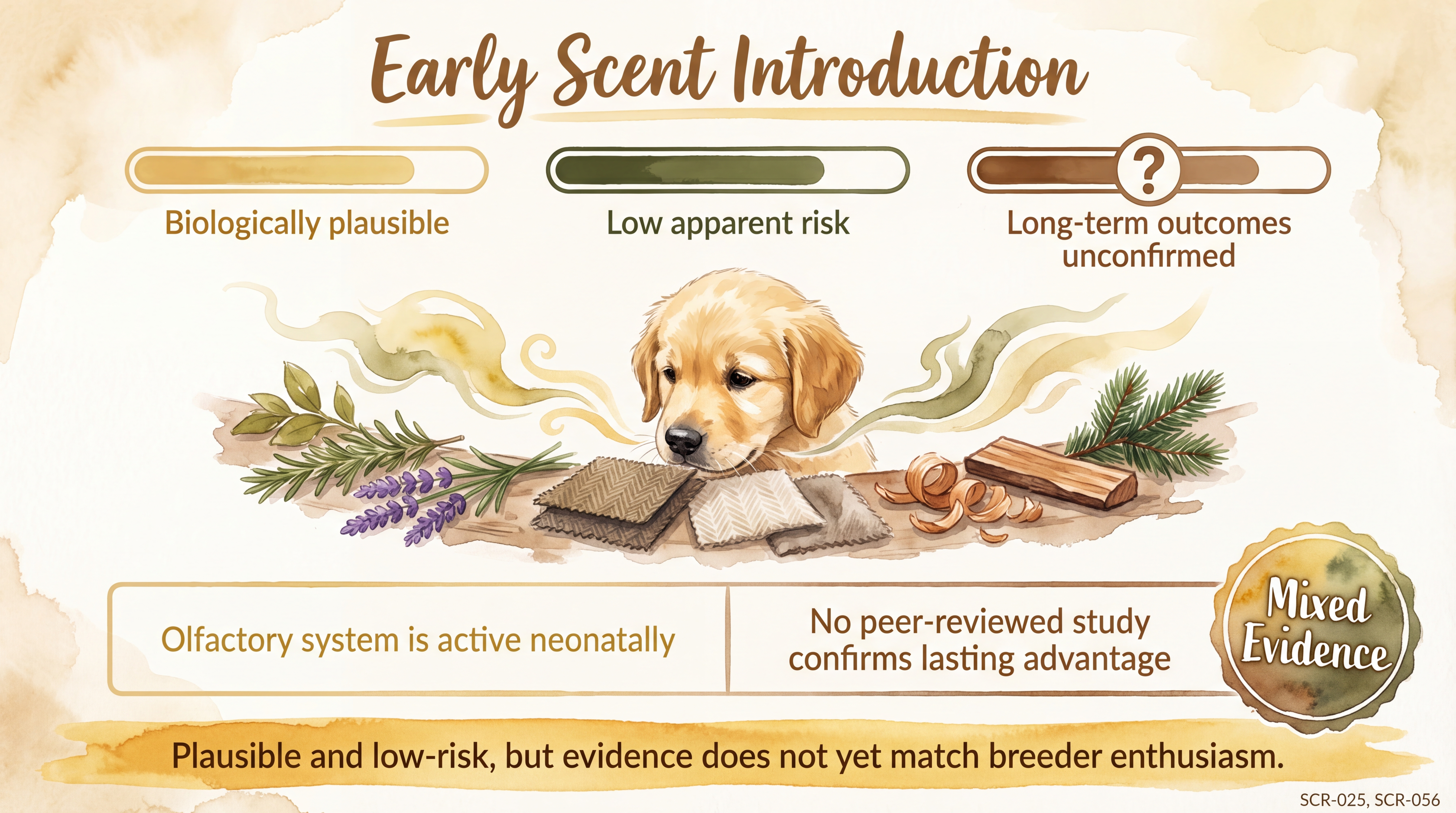
Biologically plausible and low-risk, but popular claims currently outrun peer-reviewed validation.
Key Takeaways
- ESI is a plausible breeder practice, but plausibility is not the same thing as validated long-term benefit.
- The dog's olfactory specialization makes early scent exposure intuitively attractive, but direct outcome studies are still scarce.
- ESI appears low risk when done gently and briefly, which is a different claim from calling it proven.
- The strongest honest framing is modest enrichment, not guaranteed adult advantage.
The Evidence
This entry uses documented claim-level tags beyond the dedicated EvidenceBlocks below. These claims should remain tied to the entry Sources and SCR references during the next evidence-chain authoring pass.
This entry uses observed claim-level tags beyond the dedicated EvidenceBlocks below. These tags mark JB program observation or practice-derived claims that need dedicated EvidenceBlock coverage in a later content pass.
This entry uses heuristic claim-level tags beyond the dedicated EvidenceBlocks below. These tags mark JB interpretive application rather than direct study findings.
This entry uses mixed-evidence claim-level tags beyond the dedicated EvidenceBlocks below. These tags mark claims that combine documented findings with observed practice, heuristic application, or unresolved gaps.
- SCR-025domestic dogs
The existence of a real early developmental window makes it plausible that early sensory inputs can matter disproportionately.
- Breeder-practice evidence reviewdomestic dogs
Controlled peer-reviewed studies directly validating classic ESI claims remain extremely limited, leaving most stronger claims in a provisional zone.
- SCR-056domestic dogs
Breeder culture often circulates neat protocol claims with more confidence than the underlying evidence warrants. ESI should be read through the same caution filter.
SCR References
Sources
- Battaglia, C. L. (2009). Periods of early development and the effects of stimulation and social experiences in the canine. Journal of Veterinary Behavior, 4(5), 203-210. DOI: 10.1016/j.jveb.2009.03.003.
- Breeder-practice evidence review. No controlled experimental study currently establishes specific long-term canine outcomes from early-scent-introduction protocols; the available knowledge base is breeder-program observation and remains [Observed/Heuristic] anchored at SCR-025 and SCR-056.