Maternal Care-Derived Regulation
Compound evidence detail3 SCRs / 6 parts
- Documentedthe canine evidence (Awalt 2024) that early-life environment produces measurable methylation changes on NR3C1 and OXTR
- Heuristicthe JB-specific framing that calm raising, distinct from the absence of abuse, produces durable stress-architecture advantages in dogs
- Documentedthe canine attachment-bond evidence including the secure-base effect and Schoberl-confirmed cortisol modulation under secure caregiving
- Heuristicthe transfer of the full human attachment-theory apparatus, internal working models and the closed Ainsworth-style classification taxonomy, to dogs
- Documentedthe Awalt-anchored canine association between early-life history and methylation marks on the NR3C1 and OXTR genes
- Heuristicthe inference of specific downstream health consequences from those methylation differences in dogs
Maternal care-derived regulation is the idea that puppies do not build stress regulation alone. They acquire part of it from the behavior, physiology, and predictability of the caregiving adult. This is one of the strongest themes in developmental science generally and one that now has direct but still younger canine support. Documented-Cross-Species
What It Means
The Foundational Mammalian Finding
The clearest classic work comes from Meaney and Weaver's maternal-care research in rats. High licking-and-grooming mothers produced offspring with different glucocorticoid-receptor regulation and lower stress reactivity, and cross-fostering showed that the effect traveled through caregiving environment rather than only through inherited sequence. SCR-011 captures that foundation. Documented
That work does not prove that dogs are rats, and it should never be cited as if it had already mapped every canine mechanism. What it does provide is the basic developmental model: early care calibrates later regulation.
The Canine Bridge
The strongest canine bridge now comes from SCR-094. Early-life adversity in dogs is associated with altered methylation in NR3C1 and OXTR along with cortisol and attachment-related differences. That is not yet the same as a full dog version of the Meaney model, but it is enough to say that early caregiving conditions in dogs are biologically consequential in regulation-relevant systems.
SCR-017 adds the attachment side: secure attachment and relationship quality in dogs are linked to different stress responses. Documented That matters because regulation is not only molecular. It is also relational.
What "Derived Regulation" Means in Practice
The concept is easiest to understand if we stop imagining regulation as a trait that simply appears from inside the puppy. In early development, the puppy's regulation is borrowed from the mother's rhythm; from physical proximity and predictability; from her response to disturbance; and from the broader emotional climate of the caregiving environment. Documented
Over time, some of that borrowed regulation becomes more internal. But the starting point is social.
Why It Matters for Your Dog
The Important Canine Boundary
The dog literature is strong enough to support a careful claim and not yet strong enough to support an extravagant one.
The careful claim is that early caregiving quality matters for canine stress and attachment outcomes; that maternal and caregiver context are part of the regulatory environment; and that later regulation likely develops from that scaffold rather than independently of it. Documented
The extravagant claim would be one exact maternal behavior has already been proven to create one exact lifelong adult regulatory profile in pet dogs. Documented
That second version goes beyond the present evidence.
This page supports a narrow JB claim with strong footing: regulation is built socially before it is carried independently. The stronger protocol-specific breeder claims still need more direct testing.
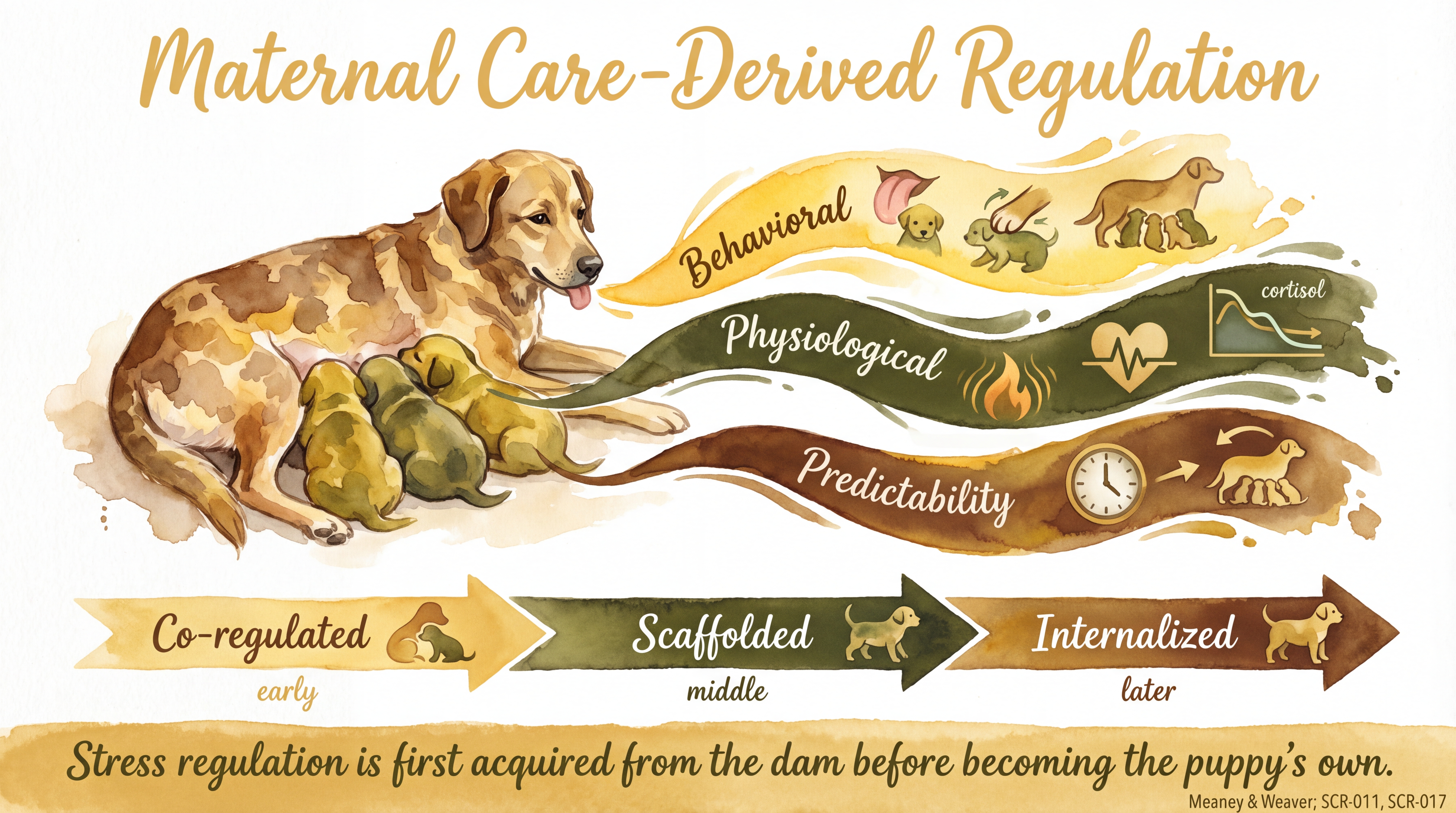
Stress regulation is first acquired from the dam before becoming the puppy's own capacity.
Key Takeaways
- Maternal care-derived regulation means that early stress regulation is scaffolded socially before it is carried more independently.
- The foundational direct evidence comes from broader mammalian maternal-care research, especially rodents.
- Dogs now have direct early-life epigenetic evidence plus attachment-stress evidence supporting the same general developmental direction.
- The broad concept is strong, while exact one-to-one protocol claims in dogs still need caution.
The Evidence
- Weaver, I. C. G. et al. (2004)rats
Maternal care altered glucocorticoid-receptor methylation and later stress responsivity, with cross-fostering showing an environmental pathway. - Hostinar, C. E., Sullivan, R. M., & Gunnar, M. R. (2013)multiple mammals
Reviewed social buffering and caregiver-linked stress regulation across development.
- Awalt, S. L. et al. (2024)domestic dogs
Early-life adversity in dogs was associated with methylation differences in NR3C1 and OXTR together with cortisol and attachment-related variation. - Schoberl, I. et al. and canine attachment-stress literature summarized in SCR-017dog-human dyads
Relationship quality and secure attachment are linked to lower cortisol reactivity in dogs.
- domestic dogs
No published canine study maps which exact maternal behaviors calibrate later regulatory capacity or how those pathways generalize across breeds and home environments.
SCR References
Sources
- Awalt, S. L., Boghean, L., Klinkebiel, D., & Strasser, R. (2024). A dog's life: Early life histories influence methylation of glucocorticoid (NR3C1) and oxytocin (OXTR) receptor genes, cortisol levels, and attachment styles. Developmental Psychobiology, 66(3), e22482. DOI: 10.1002/dev.22482.
- Hostinar, C. E., Sullivan, R. M., & Gunnar, M. R. (2014). Psychobiological mechanisms underlying the social buffering of the hypothalamic-pituitary-adrenocortical axis: A review of animal models and human studies across development. Psychological Bulletin, 140(1), 256-282. DOI: 10.1037/a0032671.
- Schoberl and canine attachment-stress literature summarized in SCR-017. Supports dog-human attachment and cortisol modulation; exact maternal-care-derived regulation pathways in dogs remain narrower than rodent maternal-care models.
- Weaver, I. C. G., Cervoni, N., Champagne, F. A., D'Alessio, A. C., Sharma, S., Seckl, J. R., Dymov, S., Szyf, M., & Meaney, M. J. (2004). Epigenetic programming by maternal behavior. Nature Neuroscience, 7(8), 847-854. DOI: 10.1038/nn1276.