NR3C1 and the Glucocorticoid Receptor
Compound evidence detail2 SCRs / 4 parts
- Documentedthe canine methylation pattern reported by Awalt 2024 for NR3C1 and OXTR in dogs with measured early-life history
- Heuristicthe JB extrapolation that ordinary calm raising produces durable epigenetic advantages in dogs beyond preventing adverse environments
- Documentedthe Awalt 2024 finding that NR3C1 and OXTR methylation in dogs covaries with documented early-life experience
- Heuristicthe JB inference that those documented methylation differences in dogs predict specific later health or developmental outcomes
NR3C1 is the gene that encodes the glucocorticoid receptor. That receptor is one of the main ways the brain and body detect circulating glucocorticoids and shut down stress responses through negative feedback. In developmental stress science, NR3C1 became central because differences in its methylation and expression can help explain why some organisms recover from stress more efficiently than others. Documented
What It Means
The HPA axis does not only need to activate. It needs to stop. Glucocorticoid receptors are part of that stop signal. If receptor availability and expression are robust, the organism can detect cortisol efficiently and bring HPA output back down more effectively. If that signaling is weaker or less efficient, stress responses can remain more prolonged or less flexible. That is why NR3C1 is so important. It sits close to the center of recovery logic in stress physiology.
The Meaney and Weaver Foundation
The classic rodent work showed that differences in maternal care changed methylation at regulatory regions associated with the glucocorticoid receptor, which in turn affected receptor expression and later stress reactivity in offspring. High-care pups showed lower methylation, higher receptor expression, and more efficient HPA-axis regulation. Cross-fostering showed the effect was environmental rather than simply inherited by DNA sequence. Documented-Cross-Species This became a landmark result because it offered a concrete molecular path from caregiving environment to later stress calibration.
The Human Extension
Human research extended the same broad story. McGowan and colleagues found elevated NR3C1 methylation in hippocampal tissue from suicide completers with histories of childhood abuse, compared with controls. That did not prove a simple one-variable explanation for complex life outcomes, but it reinforced NR3C1 as a key stress-regulation locus in adversity research. Documented
Why It Matters for Your Dog
Dogs now have direct evidence in this domain. SCR-094 extends the older cross-species foundation with canine findings showing that early-life adversity is associated with altered methylation on NR3C1 and OXTR. The source layer also ties those differences to cortisol reactivity and attachment-related outcomes. Documented This is a real step forward, but it does not eliminate the need for caution.
The dog literature is still much smaller than the rodent literature, less experimentally controlled, more associative in design, and still developing in its long-term outcome mapping. The strongest canine statement is that NR3C1-related epigenetic association exists in dogs. Stronger claims about exact lifelong consequence, exact developmental mechanism, or exact intervention effect remain more cautious.
Why the Gene Became So Conceptually Powerful
NR3C1 matters scientifically because it connects several layers at once: caregiving and adversity, molecular regulation, receptor availability, negative feedback efficiency, and later stress reactivity. Documented It is one of the cleanest examples of why developmental stress science cannot be reduced to simple genetics-versus-environment arguments. The organism inherits the gene, but experience can influence how that gene is expressed.
What This Page Does Not Claim
Because NR3C1 sits so close to the heart of the developmental story, it is especially easy to overstate. This page does not claim that NR3C1 explains all later stress differences, every caregiving difference creates a stable NR3C1 effect in dogs, or one specific raising protocol has already been shown to optimize canine NR3C1 methylation. Documented The responsible conclusion is narrower and still powerful: NR3C1 is one of the best-supported molecular links between early environment and stress-regulation differences across mammals, and dogs now have direct evidence consistent with that broader pattern.
The calmness layer often argues that early environment helps set the later stress-response floor. NR3C1 is one of the clearest molecular reasons that statement is scientifically credible, while still requiring restraint about how directly current dog evidence maps to specific caregiving prescriptions.
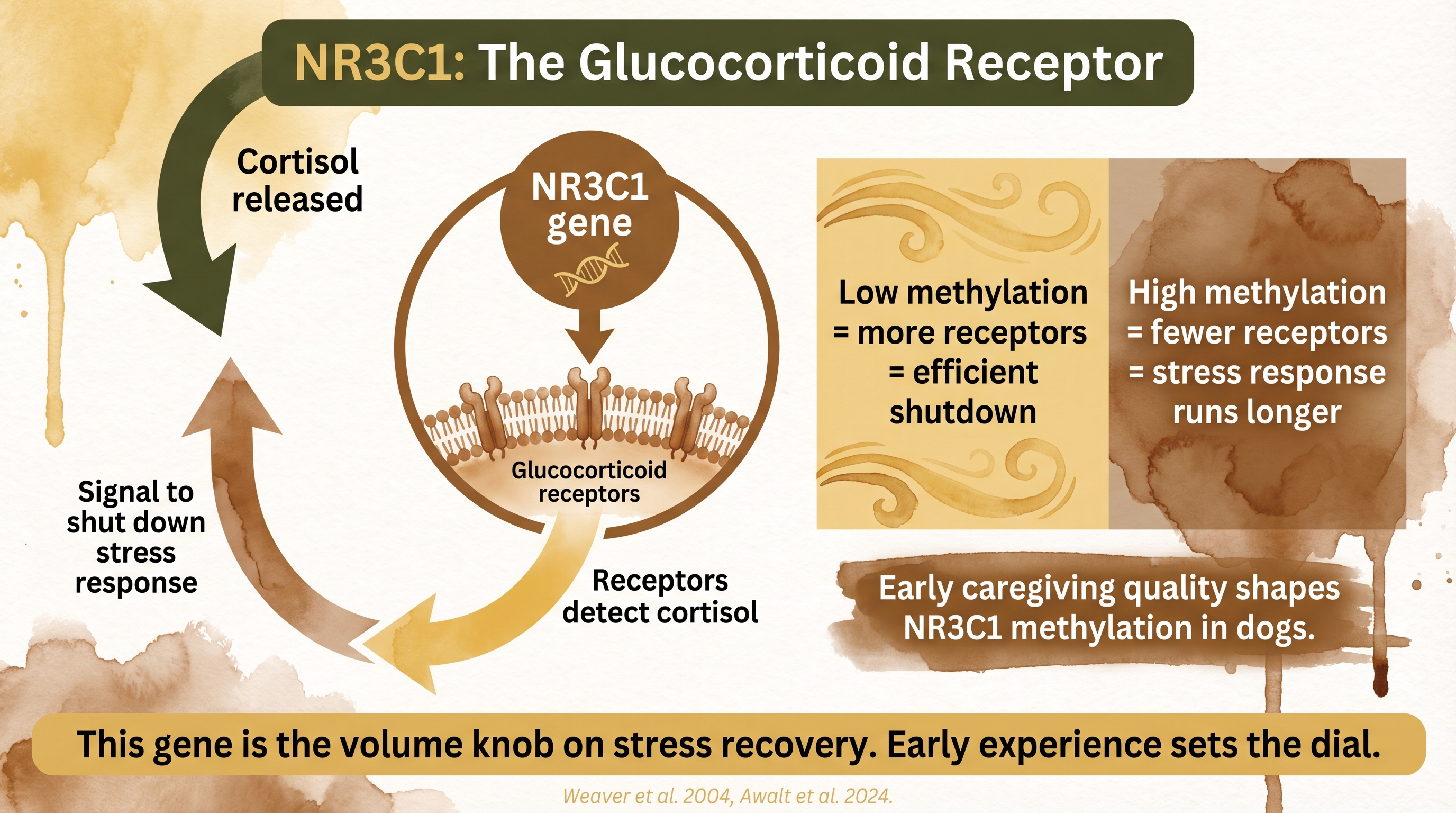
NR3C1 methylation from early stress reduces glucocorticoid receptor density, blunting the cortisol feedback brake.
Key Takeaways
- NR3C1 encodes the glucocorticoid receptor, which is central to HPA-axis negative feedback.
- Rodent maternal-care work made NR3C1 one of the most important genes in developmental stress science.
- Human adversity research strengthened the same general link.
- Dogs now have direct evidence that early-life history is associated with NR3C1 methylation differences, even though the canine literature is still comparatively young.
The Evidence
- Weaver, I. C. G. et al. (2004)rats
Showed maternal-care-linked methylation differences associated with glucocorticoid-receptor regulation and later stress responsiveness. - Liu, D. et al. (2000)rats
Linked maternal care to hippocampal glucocorticoid-receptor expression and altered HPA responses. - McGowan, P. O. et al. (2009)humans
Found altered NR3C1 methylation in human hippocampal tissue associated with childhood abuse history.
- Awalt, S. L. et al. (2024)domestic dogs
Reported early-life-history associations with altered NR3C1 methylation in dogs, alongside cortisol and attachment-related differences. - Stress-immunity source synthesisdomestic dogs
Supports NR3C1 as one of the main canine stress-regulation genes currently linked to early-life epigenetic association.
No study has measured whether dogs with more favorable NR3C1 methylation patterns actually show better long-term stress recovery or reduced anxiety risk compared to dogs with less favorable patterns.
No published study has tested whether optimizing early caregiving conditions in dogs produces measurable improvements in NR3C1 methylation or downstream stress physiology.
SCR References
Sources
- Awalt, S. L., et al. (2024). A dog's life: Early life histories influence methylation of glucocorticoid (NR3C1) and oxytocin (OXTR) receptor genes, cortisol levels, and attachment styles. Developmental Psychobiology.
- Liu, D., et al. (2000). Maternal care, hippocampal glucocorticoid receptors, and hypothalamic-pituitary-adrenal responses to stress. Journal of Neuroscience, 20(23), 9005-9015.
- McGowan, P. O., et al. (2009). Epigenetic regulation of the glucocorticoid receptor in human brain associates with childhood abuse. Nature Neuroscience, 12(3), 342-348.
- Weaver, I. C. G., Cervoni, N., Champagne, F. A., D'Alessio, A. C., Sharma, S., Seckl, J. R., Dymov, S., Szyf, M., and Meaney, M. J. (2004). Epigenetic programming by maternal behavior. Nature Neuroscience, 7(8), 847-854. DOI: 10.1038/nn1276.