Littermate Interactions and Early Social Learning
Compound evidence detail1 SCR / 3 parts
- Observed-JBJB program-observed outcome that human-directed bite inhibition develops in puppies raised without mouth play protocols
- Heuristicthe program-wide interpretation that conspecific calibration combined with consistent human boundaries is sufficient to produce that outcome
- Documentedthe maternal and conspecific calibration pathway, supported by Pierantoni 2011 evidence on early-separation effects on bite-related behaviors
Littermates are not just play companions. They are part of the puppy's earliest social curriculum. Through play, contact, competition, regrouping, and mutual interruption, puppies learn timing, pressure, recovery, and what social feedback means. The broad developmental importance of that social field is easy to observe and reasonably supported, even though the literature is not rich enough to turn every breeder folk belief into a documented rule. Observed-JB
What It Means
What the Litter Provides
The litter gives puppies repeated access to reciprocal play; mouth-pressure feedback; frustration and recovery in small doses; social signaling practice; comfort through physical proximity; and social learning from peers and adults in the same space. Observed-JB
This is one reason litter experience cannot be reduced to nutrition and warmth alone. The puppies are learning how other young dogs behave, how conflict resolves, and how social engagement continues after interruption. Observed-JB
Bite Inhibition Is the Clearest Example
SCR-030 is the clearest anchor here. Early maternal and litter interaction appears to provide the natural pathway for bite-pressure calibration, and the evidence does not support the strong industry claim that human mouth-play protocols are biologically necessary replacements. Observed-JB
That does not mean littermates do everything. It means their role is real and should not be quietly written out of the developmental story.
Why Human Contact Is Not a Full Substitute
SCR-053 matters because it shows dog-human play is structurally distinct from dog-dog play. The puppy therefore does not experience humans as perfect replacements for littermates. Humans are crucial, but they are not providing the same feedback loop.
That is why early litter life should be treated as its own developmental domain rather than as a waiting room before the "real" human relationship begins.
Why It Matters for Your Dog
The "Littermate Syndrome" Problem
Breeder and trainer culture often moves from a true observation to an overstated doctrine. The "littermate syndrome" story is a good example. There are real reasons why raising two same-age puppies together can be difficult, but the strongest popular version of the syndrome claim is much more folklore than settled evidence. Documented
The safer conclusion is simply that littermate dynamics matter, separation timing matters, and later household management matters. That is a long way from claiming that paired puppies are automatically developmentally damaged.
Why This Matters for Placement Timing
The litter is one reason early placement debates cannot be reduced to one sentence. Staying long enough to receive adequate conspecific calibration has value. So does moving while the socialization window is still open enough for the family environment to matter deeply. The point is not that one side of the timing debate wins universally. The point is that the litter contributes real developmental functions while it is present.
The litter is one of the puppy's first mentorship environments. It is not polished or deliberate, but it is still a curriculum.
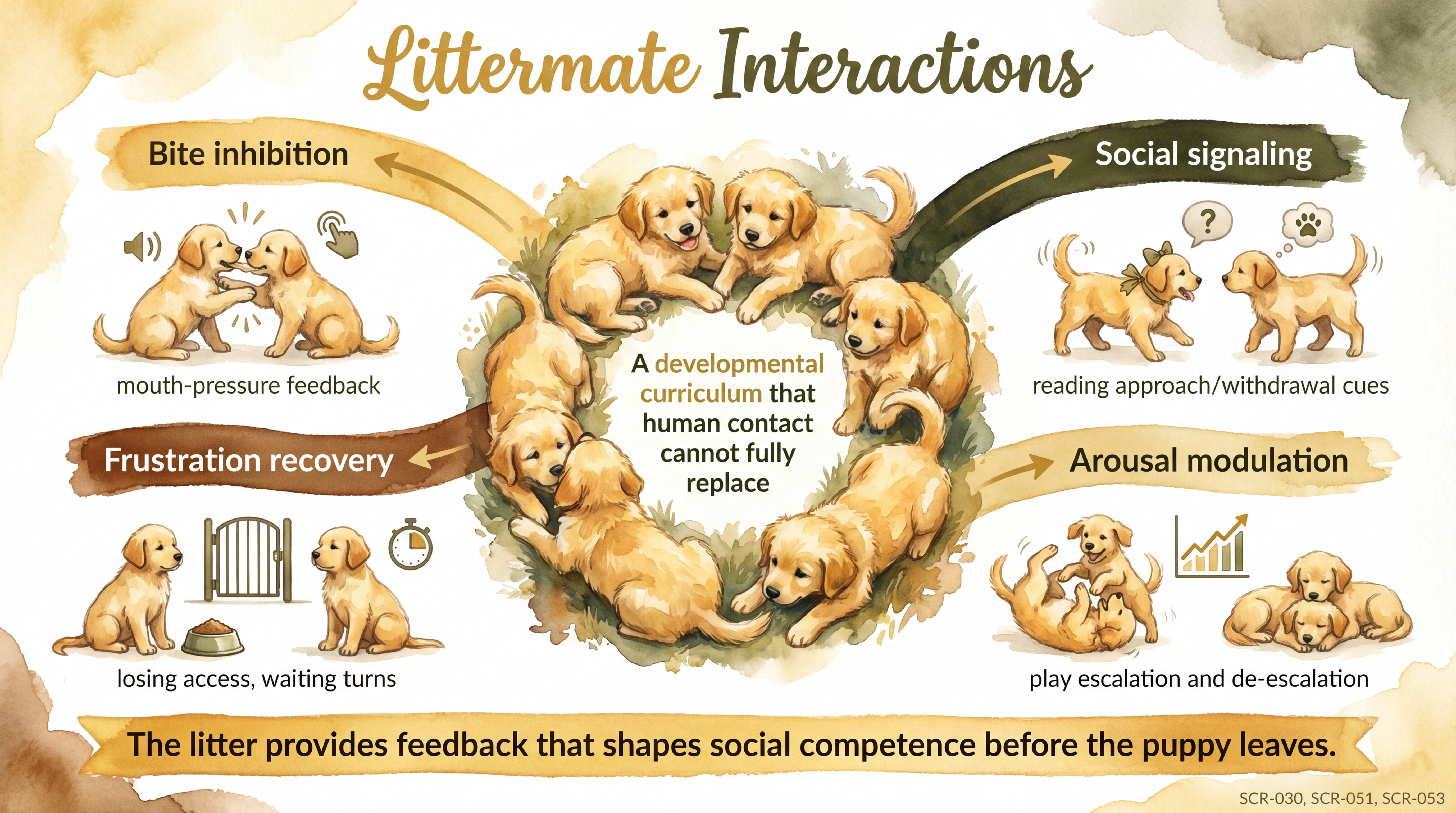
The litter provides developmental feedback - bite inhibition, social signaling, frustration recovery, arousal modulation - that human contact cannot fully replace.
Key Takeaways
- The litter provides a real early social curriculum rather than only companionship or warmth.
- Bite-pressure calibration is the clearest documented example of why littermate and dam context matter.
- Human contact is crucial but does not perfectly substitute for dog-dog developmental feedback.
- Popular littermate folklore often overstates what the current evidence can actually prove.
The Evidence
This entry uses observed claim-level tags beyond the dedicated EvidenceBlocks below. These tags mark JB program observation or practice-derived claims that need dedicated EvidenceBlock coverage in a later content pass.
- Pierantoni, L. et al. (2011) and SCR-030 synthesisdomestic dogs
Earlier separation from mother and littermates was associated with higher rates of later behavioral problems including play biting, supporting the developmental significance of early conspecific context. - Bray, E. E. et al. and SCR-051 synthesisretriever puppies
Very young puppies are already highly responsive to social information, supporting the plausibility of rich early peer learning. - Pongracz, P., & Sztruhala, S. (2019)companion breeding dogs
Alloparental and pup-adult interactions persist under managed breeding conditions, reinforcing the social richness of the early group environment.
- SCR-053 boundarydomestic dogs
Humans do not fully replace the structure of dog-dog play and feedback. At the same time, strong universal 'littermate syndrome' claims remain less evidenced than popular rhetoric suggests.
- domestic dogs
No published study directly tests which elements of littermate life, including play, sleep proximity, mouth-pressure feedback, and social buffering, drive which later outcomes.
SCR References
Sources
- Bray, E. E., Gnanadesikan, G. E., Horschler, D. J., Levy, K. M., Kennedy, B. S., Famula, T. R., & MacLean, E. L. (2021). Early-emerging and highly heritable sensitivity to human communication in dogs. Current Biology, 31(14), 3132-3136.e5. DOI: 10.1016/j.cub.2021.04.055.
- Pierantoni, L., Albertini, M., & Pirrone, F. (2011). Prevalence of owner-reported behaviours in dogs separated from the litter at two different ages. Veterinary Record, 169(18), 468. DOI: 10.1136/vr.d4967.
- Pongracz, P., & Sztruhala, S. S. (2019). Forgotten, but not lost: Alloparental behavior and pup-adult interactions in companion dogs. Animals, 9(12), 1011. DOI: 10.3390/ani9121011.