Genetic and Environmental Interactions in Development
Compound evidence detail2 SCRs / 4 parts
- DocumentedAwalt-supported canine evidence that early environment relates to NR3C1 and OXTR methylation patterns
- HeuristicJB-specific extension from calm developmental conditions to durable stress-architecture advantages in dogs
- DocumentedAwalt 2024 canine association between early-life history and NR3C1 or OXTR methylation patterns
- Heuristicinference from methylation differences to specific downstream developmental or health consequences in dogs
Development is not a contest between genes and environment. It is the product of continuous interaction between them. Temperament is neither written in stone at conception nor freely invented by later experience. In dogs, genetics shapes predispositions, sensitivity, and baseline ranges. Environment shapes how those predispositions are expressed, amplified, buffered, or redirected over time. Documented
What It Means
Why "Nature vs Nurture" Fails
The nature-versus-nurture frame feels intuitive because it asks which factor matters more. Documented Developmental biology keeps giving the same answer: the interaction matters more than either factor considered alone.
Genes set architecture, thresholds, and probabilities. Environment determines which opportunities, stressors, caregivers, routines, and recovery conditions the organism actually encounters. Once that interaction begins, phenotype emerges from both at once.
In dogs, this is obvious in practice even before it is formalized scientifically. Observed-JB Puppies from the same litter can differ, but those differences still unfold inside the same maternal environment, same breeder setup, and same transition history. Likewise, two puppies with similar raw predispositions can diverge when raised under very different conditions.
The Genetic Side Is Real, but Limited
SCR-070 is helpful here because it blocks both determinism and denial. Breed explains a meaningful but modest portion of behavioral variation. That means genetics matters, but it does not mean the dog arrives fully behaviorally finished.
The same logic applies at the family line level. Selection can shift probabilities. It cannot eliminate development. This is why breeder rhetoric that treats pedigree as destiny overstates the evidence, and family rhetoric that treats every puppy as a blank slate also overstates the evidence.
The Environmental Side Is Also Real
Early caregiving, predictability, adversity, handling, transition quality, and chronic stress exposure shape later developmental outcomes. SCR-011 established the foundational mammalian point through maternal-care epigenetics in rodents. SCR-094 brings that principle into direct canine evidence: dogs with adverse early histories show altered methylation patterns involving stress- and bonding-related genes. Documented
That does not mean every environmental difference writes an irreversible life script. It does mean environment is biologically consequential, not merely cosmetic.
Epigenetics as the Bridge
Epigenetics is the simplest way to understand the interaction without collapsing into slogans. Genes provide the sequence. Developmental environment influences how parts of that sequence are regulated and expressed.
This matters especially in early life because developmental systems are still being assembled. The same genotype can therefore lead to different stress-response profiles under different caregiving and adversity histories.
The strongest safe summary is not "environment overrides genetics" or "genetics override environment." The strongest safe summary is that environment gets under the skin partly by altering gene expression and regulatory tuning.
Why It Matters for Your Dog
What This Means for Breeders
Selection and raising are complements, not substitutes.
A breeder cannot solve weak developmental conditions by selecting better dogs and then neglecting the environment. A breeder also cannot erase every inherited vulnerability through perfect raising. Strong developmental work respects both realities choose breeding stock with sound behavioral predispositions; protect the prenatal and postnatal environment; reduce chronic stress and chaotic unpredictability; and provide the kinds of early experiences the puppy can actually use. Documented
That is a stronger and more realistic framework than either genetic fatalism or environmental romanticism.
This page supports a narrow but important JB point: good breeding and good raising should be treated as two parts of one developmental system, not as competing explanations.
The Main Boundary
One boundary matters a great deal. The direct canine evidence for early-life epigenetic association is now real, but it is still early. Documented Downstream writing should not jump from methylation findings to exaggerated claims that one exact breeder protocol has already been proven to create one exact adult phenotype.
The scientific footing is strong enough to say early environment matters biologically. It is not strong enough to claim that every specific practice has already been causally isolated.
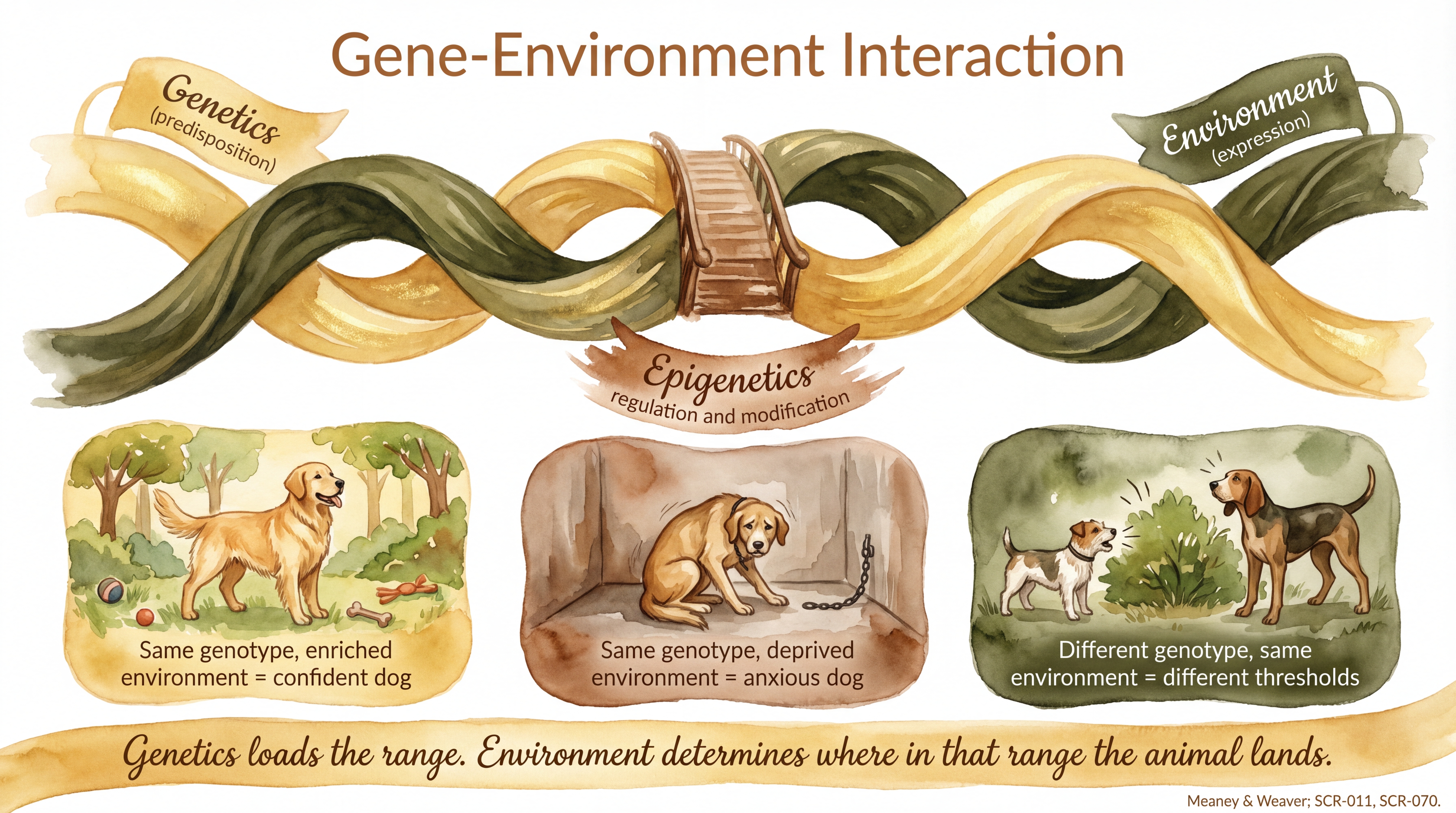
Genetics loads the range; environment determines where in that range the animal lands.
Key Takeaways
- Canine development is produced by genes and environment interacting continuously, not by one replacing the other.
- Genetics shapes predisposition and range, but does not fully determine final phenotype.
- Early environment is biologically consequential, with direct dog evidence now linking adversity to methylation and stress-related outcomes.
- For breeders, selection and raising should be treated as complementary parts of the same developmental project.
The Evidence
This entry uses observed claim-level tags beyond the dedicated EvidenceBlocks below. These tags mark JB program observation or practice-derived claims that need dedicated EvidenceBlock coverage in a later content pass.
- Awalt, S. L. et al. (2024)domestic dogs
Early-life adversity in dogs was associated with methylation differences involving NR3C1 and OXTR together with cortisol and attachment-related variation. - MacLean, E. A. et al. and related breed-behavior work summarized in SCR-070domestic dogs
Breed contributes to behavioral variation, but only modestly, arguing against both breed determinism and blank-slate framing.
- Weaver, I. C. G. et al. (2004)rats
Maternal care altered glucocorticoid receptor methylation and later stress responsivity through environmental rather than purely genetic pathways. - Developmental psychobiology literaturemultiple mammals
Supports differential susceptibility and gene-by-environment interaction as a more accurate model than nature-versus-nurture competition.
- domestic dogs
No published canine study partitions the relative contribution of genetics, early caregiving, epigenetic change, and later environment with the precision breeders would want.
SCR References
Sources
- Awalt, S. L., Boghean, L., Klinkebiel, D., & Strasser, R. (2024). A dog's life: Early life histories influence methylation of glucocorticoid (NR3C1) and oxytocin (OXTR) receptor genes, cortisol levels, and attachment styles. Developmental Psychobiology, 66(3), e22482. DOI: 10.1002/dev.22482.
- Broader developmental psychobiology literature (rodent maternal-care work, human stress-development work, mammalian gene-environment interaction models). Supports cross-species mechanism plausibility for gene-environment interactions in development. Direct dog evidence remains anchored to Awalt 2024 (canine glucocorticoid and oxytocin receptor methylation) and Weaver 2004 (rodent maternal-care epigenetics, mechanism-only for dog application). Cross-species interpolation strength: moderate; not direct dog inheritance evidence.
- MacLean, related breed-behavior literature, and SCR-070 synthesis. Supports modest breed contribution to behavior; does not justify breed determinism or blank-slate framing.
- Weaver, I. C. G., Cervoni, N., Champagne, F. A., D'Alessio, A. C., Sharma, S., Seckl, J. R., Dymov, S., Szyf, M., & Meaney, M. J. (2004). Epigenetic programming by maternal behavior. Nature Neuroscience, 7(8), 847-854. DOI: 10.1038/nn1276.