The Developmental Plasticity Ceiling
Compound evidence detail1 SCR / 2 parts
- DocumentedAwalt 2024 canine association between early-life history and NR3C1 or OXTR methylation patterns
- Heuristicinference that those methylation findings define durable limits on later developmental plasticity
The developmental plasticity ceiling is a heuristic way of describing a real pattern: early developmental windows carry disproportionate leverage, and that leverage tends to decline over time. The claim is not that change becomes impossible after puppyhood. The claim is that the upper limit of easy, broad, durable change is highest early and gradually lowers as development proceeds. Heuristic
What It Means
Why This Is a Heuristic
There is no canine instrument that directly measures "plasticity ceiling" as a numbered variable. The phrase is an organizing concept, not a laboratory endpoint.
The reason it is still useful is that several documented lines of evidence point in the same direction dogs have a genuine early socialization window; early-life experience has measurable later consequences; developmental neurobiology supports high early plasticity and later refinement; and later change remains possible but often costs more. Observed-JB
The ceiling language packages that convergence into an intuitive model.
The Better Image Is a Lowering Ceiling, Not a Slammed Door
People often imagine developmental windows as doors. Open, then shut. That picture creates two errors early panic; and later fatalism.
The ceiling image is better because it allows both truths at once. Early life offers a higher ceiling for broad developmental tuning. Later life still allows learning, but often with lower range, higher cost, and more dependence on deliberate repetition or management. Observed-JB
This fits both the canine socialization literature and the broader mammalian developmental literature more honestly than a dramatic one-day cutoff story. Documented
Where the Support Comes From
SCR-025 gives the most concrete canine anchor. The socialization window is documented and closes gradually. SCR-024 supplies the developmental-neuroscience scaffold by supporting pruning and refinement as real features of developing nervous systems, even though the specific prevention-as-pruning claim is a logical synthesis rather than a directly tested canine outcome. SCR-094 adds a direct dog line showing that early adversity is associated with enduring molecular differences in stress- and bonding-related systems. Documented
Put together, those findings support a careful synthesis early development is unusually malleable; later experience still matters; and later experience often works against a more settled organism. Observed-JB
That is the whole point of the ceiling metaphor.
Why It Matters for Your Dog
Why the Concept Helps
The heuristic becomes especially useful when discussing dogs from under-socialized or chaotic starts.
If the model were "everything is still equally easy later," early neglect would be easy to minimize. If the model were "everything is fixed after puppyhood," later rehabilitation would be pointless. The plasticity-ceiling concept protects against both errors.
It supports three practical conclusions early good environments are worth taking very seriously; later rehabilitation remains meaningful; and later rehabilitation often needs more precision and patience than early support would have needed.
The Main Limits
This page should not be used to smuggle in stronger claims than the evidence supports. In particular, the concept does not prove one exact calendar of canine plasticity loss; one exact neural event marking each behavioral change; that adult dogs cannot make profound gains; and that any specific JB protocol has already been validated as the optimal way to preserve plasticity.
It is a synthesis tool, not a settled canine metric.
The plasticity-ceiling idea fits prevention because it explains why early developmental biasing can be cheaper than later repair. It should still be presented as a synthesis built from documented components rather than as a standalone proven law.
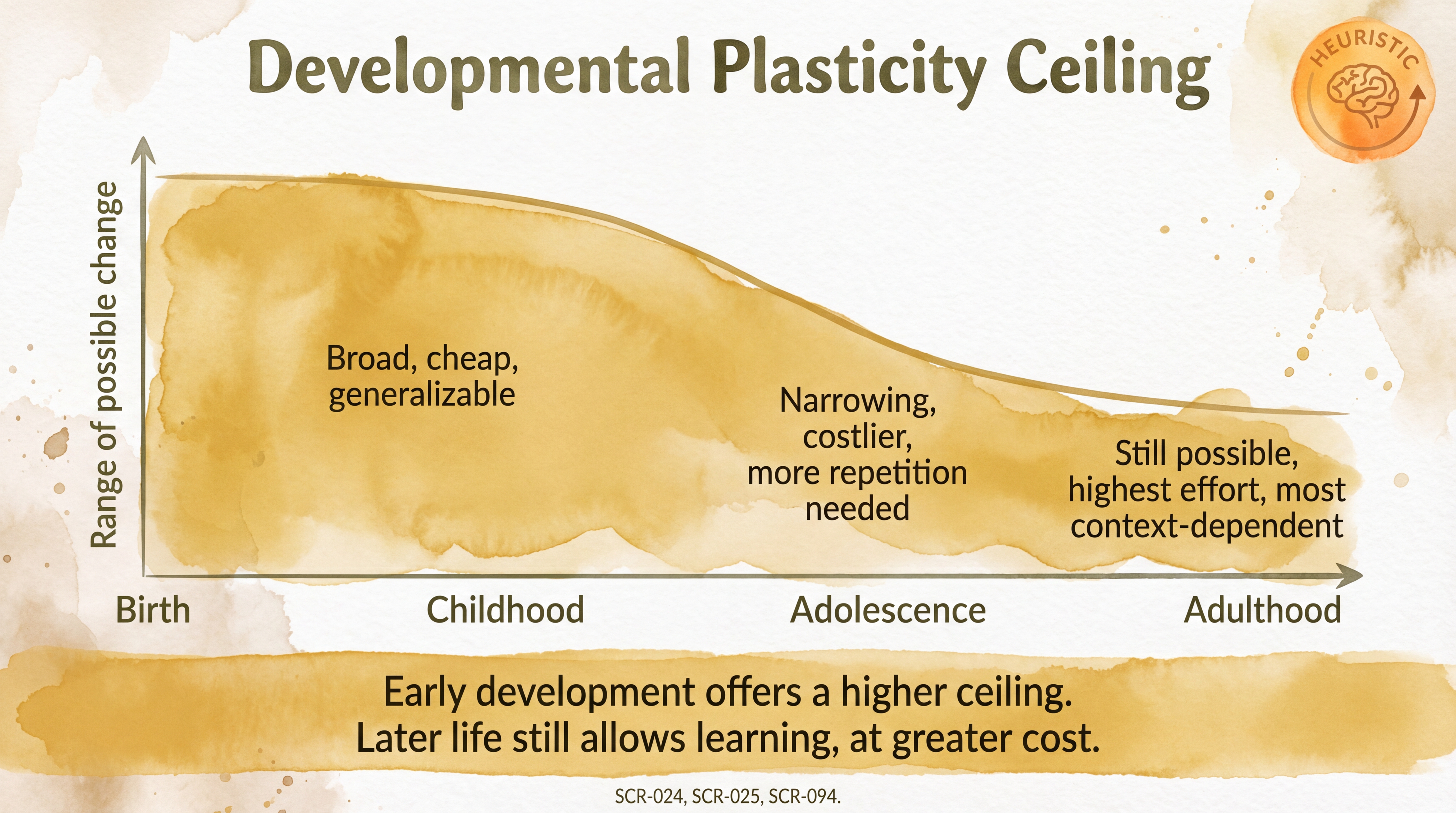
Early development offers a higher ceiling for change; later life still allows learning at greater cost.
Key Takeaways
- The developmental plasticity ceiling is a heuristic, not a directly measured canine variable.
- It is useful because it captures a convergent pattern: early life offers unusually high leverage and later change often costs more.
- The concept avoids both early panic and later hopelessness by replacing slammed-door thinking with gradual decline in leverage.
- It should be used as a synthesis tool, not as proof of a precise canine timetable or a validated protocol claim.
The Evidence
This entry uses observed claim-level tags beyond the dedicated EvidenceBlocks below. These tags mark JB program observation or practice-derived claims that need dedicated EvidenceBlock coverage in a later content pass.
This entry uses heuristic claim-level tags beyond the dedicated EvidenceBlocks below. These tags mark JB interpretive application rather than direct study findings.
- SCR-025 canine socialization literaturedomestic dogs
Supports a real and gradually closing early developmental window for social and environmental learning. - Awalt, S. L. et al. (2024)domestic dogs
Supports a direct dog link between early adversity and later methylation differences in stress- and bonding-related genes.
- Huttenlocher, P. R. and later developmental-neuroscience workmultiple mammals
Early development features unusually high plasticity followed by progressive refinement and selective stabilization. - SCR-024 synthesismultiple mammals
Pruning and refinement support the general idea that later development is more settled than early development, while leaving the exact canine behavioral mapping unresolved.
- domestic dogs
No published canine study quantifies a precise developmental plasticity ceiling or a calendar for how much later behavior-change costs rise over time.
SCR References
Sources
- Awalt, S. L., Boghean, L., Klinkebiel, D., & Strasser, R. (2024). A dog's life: Early life histories influence methylation of glucocorticoid (NR3C1) and oxytocin (OXTR) receptor genes, cortisol levels, and attachment styles. Developmental Psychobiology, 66(3), e22482. DOI: 10.1002/dev.22482.
- Huttenlocher and later developmental-neuroscience work. Supports early plasticity and synaptic-density principles; exact dog behavioral mapping remains bounded by canine-specific evidence.