Epigenetic Plasticity and Development
Compound evidence detail1 SCR / 2 parts
- Documentedthe Awalt 2024 finding that NR3C1 and OXTR methylation in dogs covaries with documented early-life experience
- Heuristicthe JB inference that those documented methylation differences in dogs predict specific later health or developmental outcomes
The epigenome is especially plastic in early development. That does not mean every early event becomes permanent, but it does mean early conditions can have outsized leverage on how stress- and bonding-related genes are expressed later. In dogs, this molecular sensitivity overlaps with the documented socialization window, which makes early development both a behavioral window and a biological one. Documented
What It Means
Early life is when regulatory systems are being assembled rather than only maintained. During that stage, background conditions such as maternal contact, predictability, adversity, and chronic stress can matter more than they would in a fully mature organism. Documented That is why epigenetic plasticity belongs next to development pages rather than only next to genetics pages.
SCR-025 documents the canine socialization window. SCR-094 documents early-life-associated epigenetic differences in dogs. Taken together, they support a careful but important conclusion: the early weeks are not only behaviorally sensitive. They are also a period in which molecular stress-regulation systems appear especially responsive to developmental context. Documented This does not mean the whole window can be reduced to methylation. It means the behavioral and molecular stories point in the same direction.
Why It Matters for Your Dog
The most defensible developmental takeaway is not about dramatic interventions. It is about chronic background conditions. The factors most worth taking seriously are maternal and caregiver contact, predictability, absence of chronic adversity, and stable recovery conditions. That is a better scientific reading than the idea that development depends mainly on spectacular exposure events.
What This Page Does Not Claim
This page does not claim that every week of the socialization window has a mapped epigenetic signature, one exact upbringing creates one exact later molecular profile, or the early window closes all later plasticity. The safer conclusion is that early development combines unusually high behavioral and molecular sensitivity, which makes background conditions matter a great deal.
The calmness layer often emphasizes the chronic background environment over dramatic moments. Epigenetic plasticity supports that emphasis: the developmental system is likely reading ongoing conditions, not just isolated events.
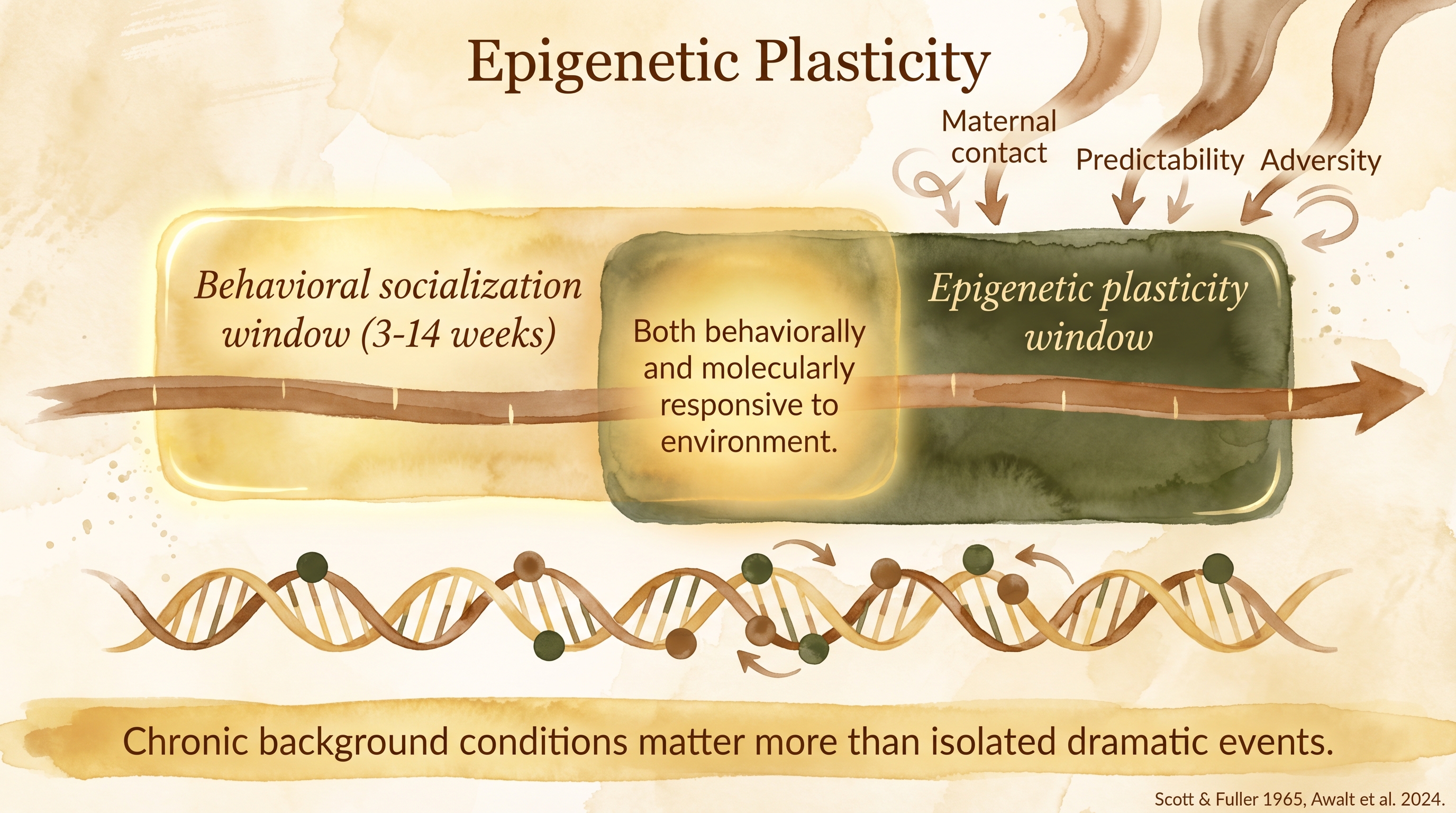
Epigenetic plasticity is highest during early development when environmental signals shape lasting gene expression patterns.
Key Takeaways
- Early development is a period of elevated epigenetic plasticity.
- In dogs, that molecular sensitivity overlaps with the documented socialization window.
- Background conditions such as caregiving, predictability, and adversity likely matter more than isolated dramatic moments.
- The overlap is scientifically meaningful even though the exact canine molecular timetable is still incomplete.
The Evidence
- Foundational mammalian epigenetic-development literaturemultiple mammals
Shows that early development is a period of elevated epigenetic plasticity and environmental sensitivity. - Scott, J. P., & Fuller, J. L. (1965) and later canine socialization literaturedomestic dogs
Documents the canine socialization window as a period of unusually high behavioral sensitivity.
- Awalt, S. L. et al. (2024)domestic dogs
Supports the idea that early-life history in dogs is associated with methylation differences in stress- and bonding-related genes.
No study has mapped the exact developmental windows of heightened methylation plasticity in dogs, making it impossible to say whether weeks 3-14 of the socialization window correspond to weeks of peak epigenetic sensitivity.
No study has measured whether the same dogs living through the entire socialization window show progressive changes in epigenetic marks, or whether epigenetic patterning is fixed early and then stable.
SCR References
Sources
- Awalt, S. L., et al. (2024). A dog's life: Early life histories influence methylation of glucocorticoid (NR3C1) and oxytocin (OXTR) receptor genes, cortisol levels, and attachment styles. Developmental Psychobiology, 66(2), e22482.
- Olsson, I. A., et al. (2008). Ontogeny of aggression in the domestic dog. Applied Animal Behaviour Science, 106(4), 234-245.
- Scott, J. P., & Fuller, J. L. (1965). Genetics and the social behavior of the dog. University of Chicago Press.