Critical vs Sensitive Periods in Development
Critical periods and sensitive periods are often treated as synonyms, but they are not the same thing. A critical period is a narrow developmental window in which a certain input must occur or the outcome cannot be fully established at all. A sensitive period is a window of heightened leverage in which the same input is easier, cheaper, and more durable, but later improvement remains possible. The canine socialization window is much better understood as the second kind. Documented-Cross-Species
What It Means
The Conceptual Difference
Lorenz's imprinting work in geese is the classic image of a critical period: miss the window and the normal outcome does not unfold in the same way. Hubel and Wiesel's visual-development work likewise showed that timing can matter so much that later experience cannot fully reverse early deprivation. Documented
Sensitive periods are less absolute. Human language acquisition is the familiar comparison. Early exposure has outsized effect, but later learning is still possible, only slower, less automatic, and often less complete.
That distinction is exactly what makes the canine literature easier to interpret. The dog socialization window is clearly real, but later rehabilitation is also clearly possible. That pattern fits a sensitive period far better than a strict all-or-nothing critical period.
Why Dogs Fit the Sensitive-Period Model Better
SCR-025 documents the broad socialization window in dogs at about three to fourteen weeks. Delayed social contact carries real cost. Puppies missing broad ordinary exposure during that period are at greater risk for later fear and avoidance. Documented
But the literature does not support fatalism. Documented-Cross-Species Dogs from poor starts can improve. Rescue dogs can form secure bonds. Fearful dogs can gain functionality. Rehomed dogs can stabilize. Those realities are not exceptions to the model. They are evidence that the model is sensitive-period rather than strict-critical-period.
The practical translation is simple early experience matters disproportionately; later remediation remains possible; and later remediation is usually harder and less complete.
Where Pruning Fits, and Where It Does Not
SCR-024 supports synaptic pruning as a real developmental mechanism across mammals, but it also places a boundary on how far the canine claim can be pushed. We do not have a dog-specific pruning calendar that directly times the closing of the socialization window behavior by behavior. Documented
So the safest mechanistic language is not "the dog's social circuits permanently shut at week X." The safer statement is that early development combines heightened plasticity with experience-dependent circuit refinement, which helps explain why early experience carries unusual weight.
Why It Matters for Your Dog
Why the Distinction Matters for Families
If the dog window were treated as a strict critical period, the message to families would become either panic or hopelessness panic if the puppy is still young and every day feels irreversible; and hopelessness if the puppy had a poor start and change is assumed impossible. Documented
Neither response matches the science.
The sensitive-period framing supports a better message. Early life is high leverage. Missing it has cost. Later change is still worthwhile. That is exactly the combination most families need to hear.
The prevention logic fits a sensitive-period model very well. Early good experience is not magic, but it is developmentally cheaper than later repair.
The Strongest Welfare Conclusion
The welfare implication is not that dogs are ruined once the window passes. It is that developmental neglect should be taken seriously precisely because later remediation is harder, slower, and sometimes less complete than early support would have been.
That is a more honest and more useful conclusion than either extreme.
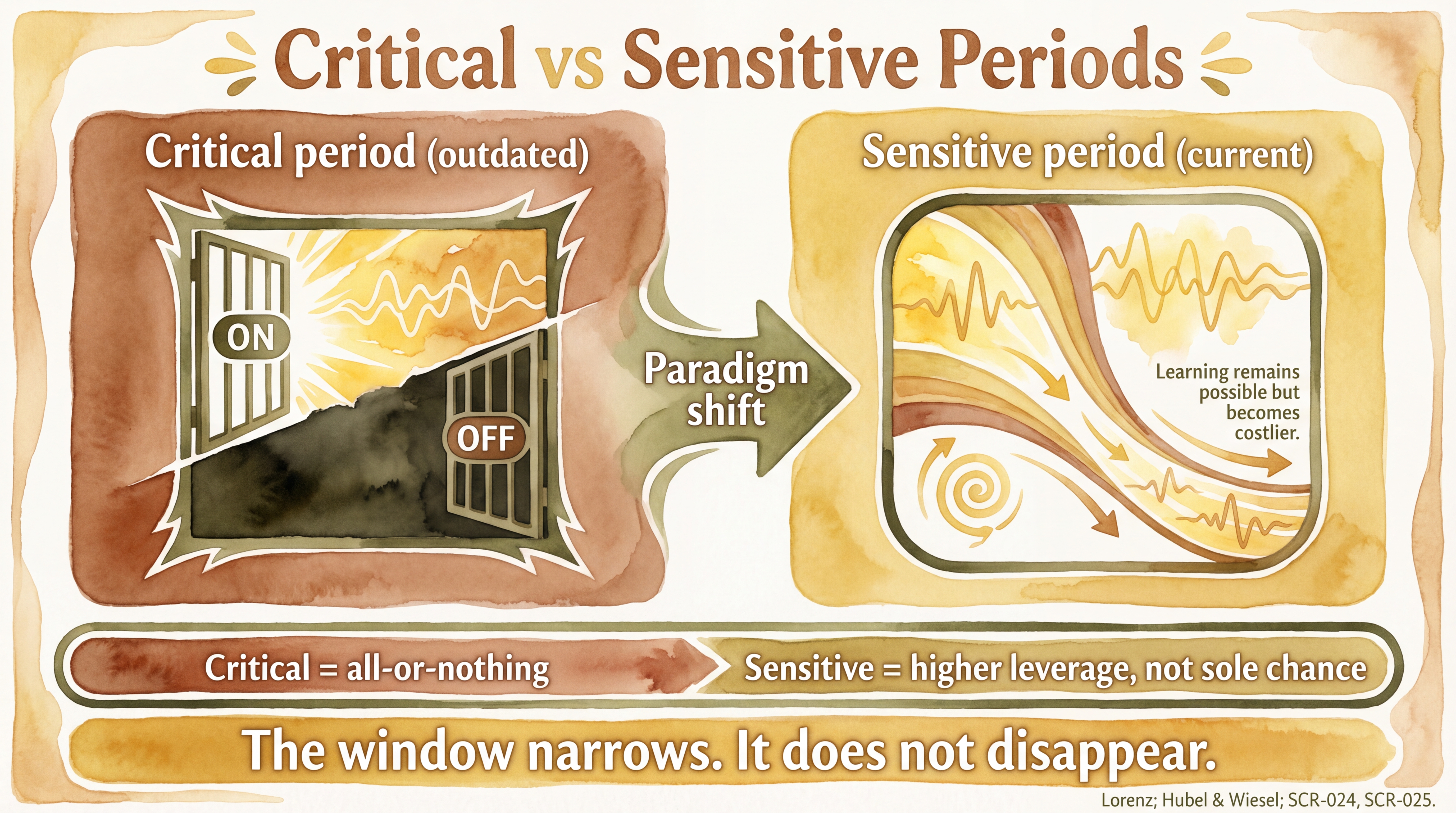
The window narrows but does not disappear - sensitive periods offer higher leverage, not the sole chance.
Key Takeaways
- Critical periods are strict and all-or-nothing. Sensitive periods are high-leverage windows that still allow later change.
- The canine socialization window is better understood as sensitive rather than strictly critical.
- Early neglect carries real cost, but later rehabilitation remains possible and worthwhile.
- The strongest scientific message is neither panic nor hopelessness, but differential cost.
The Evidence
- Lorenz, K. (1930s) and later imprinting literaturegeese and other birds
Established the classic strict critical-period model in which timing is so narrow that later experience cannot fully substitute. - Hubel, D. H., & Wiesel, T. N.cats and other mammals
Showed that early visual deprivation has time-sensitive developmental effects that later experience does not fully erase. - Human developmental and language-acquisition literaturehumans
Supports the broader sensitive-period model in which early experience has unusually high leverage but later learning remains possible.
- Freedman, D. G., King, J. A., & Elliot, O. (1961)domestic dogs
Foundational work showing that delayed early social experience has lasting costs. - Scott, J. P., & Fuller, J. L. (1965)domestic dogs
Established the classic canine socialization framework. - Howell, T. et al. (2015) and McEvoy, V. et al. (2022)domestic dogs
Modern review work supports a gradual closing process rather than a literal hard door.
- domestic dogs
No published canine study identifies a hard all-or-none critical-period boundary that replaces the better-supported sensitive-period model for social development.
SCR References
Sources
- Freedman, D. G., King, J. A., & Elliot, O. (1961). Critical period in the social development of dogs. Science, 133(3457), 1016-1017.
- Howell, T. J., King, T., & Bennett, P. C. (2015). Puppy parties and beyond: The role of early age socialization practices on adult dog behavior. Veterinary Medicine: Research and Reports, 6, 143-153. DOI: 10.2147/VMRR.S62081.
- Hubel and Wiesel critical-period literature. Supports foundational cross-species critical-period neurobiology; canine socialization application remains anchored separately to dog-specific socialization sources.
- Human developmental and language-acquisition literature. Supports sensitive-period concepts in humans; dog application remains a cross-species analogy and should not replace canine socialization evidence.
- Lorenz imprinting literature. Supports classic strict critical-period concepts in birds; canine use is conceptual background, not direct dog evidence.
- Scott, J. P., & Fuller, J. L. (1965). Genetics and the Social Behavior of the Dog. University of Chicago Press.