Cognitive Milestones in Development
Cognitive development in dogs is not one single staircase. Different capacities come online on different schedules. Puppies begin by acquiring basic sensory and social orientation, then show increasingly reliable object tracking, social-cue use, working memory, and inhibition across later puppyhood and adolescence. The strongest practical lesson is not a single universal timetable. It is that cognitive capacities emerge unevenly, and individual variation often outweighs average expectations. Documented
What It Means
Early Capacities Come First
Some milestones emerge surprisingly early. Young puppies already show meaningful human social-cue use in the retriever literature, and early developmental work supports the appearance of basic object permanence and elementary problem solving in the first months of life. Documented
The important point is that early does not mean finished. A puppy can possess the beginnings of a capacity without expressing the adult version of it. Documented Social cue use may appear before working memory is stable. Interest in novelty may appear before regulation is strong. Basic object tracking may appear before flexible detouring or sustained persistence.
Social Cognition Is One of the Earliest Strong Channels
SCR-051 is especially important here because it shows that eight-to-ten-week-old retriever puppies already read human communicative gestures robustly and without a trial-by-trial learning curve. That tells us something specific about early cognition: the human social channel is available very early, at least in the retriever group JB raises. Documented
That finding does not tell us everything about puppy cognition, but it strongly suggests that developmental assessments should not treat young puppies as socially blank organisms.
Why Precision Claims Need Restraint
SCR-041 acts as the useful brake on overprecision. Because the often-repeated brain-maturity numbers are not fully verified, it is better to describe cognitive milestones in broad developmental terms than to assign false week-by-week certainty.
This matters because puppy-culture writing often turns development into fixed calendar doctrine. Observed-JB Real development is noisier than that.
Individual and Breed Variation
SCR-070 reminds us that breed influences behavior, but only modestly. Documented That makes two things true at once breed history can bias some cognitive channels; and individual variation still dwarfs easy stereotypes.
This is why puppy-test rhetoric needs caution. Standardized assessments can sometimes identify clear extremes, but they are not crystal balls. A very confident or very fearful puppy may stay recognizably so. Many middle-range puppies continue changing substantially with environment, maturity, and experience.
Why It Matters for Your Dog
The Practical Takeaway
The most scientific way to think about cognitive milestones is layered look for emerging capacities, not finished adult versions; expect uneven progress across domains; interpret puppies in the context of age, state, and environment; and avoid turning one test result into a full developmental verdict.
That is more useful than either "puppies can do almost nothing" or "everything important is already fixed."
The early availability of the human social channel is one reason developmental guidance matters so much. Puppies are not waiting passively for later formal training before they begin learning how the world works.
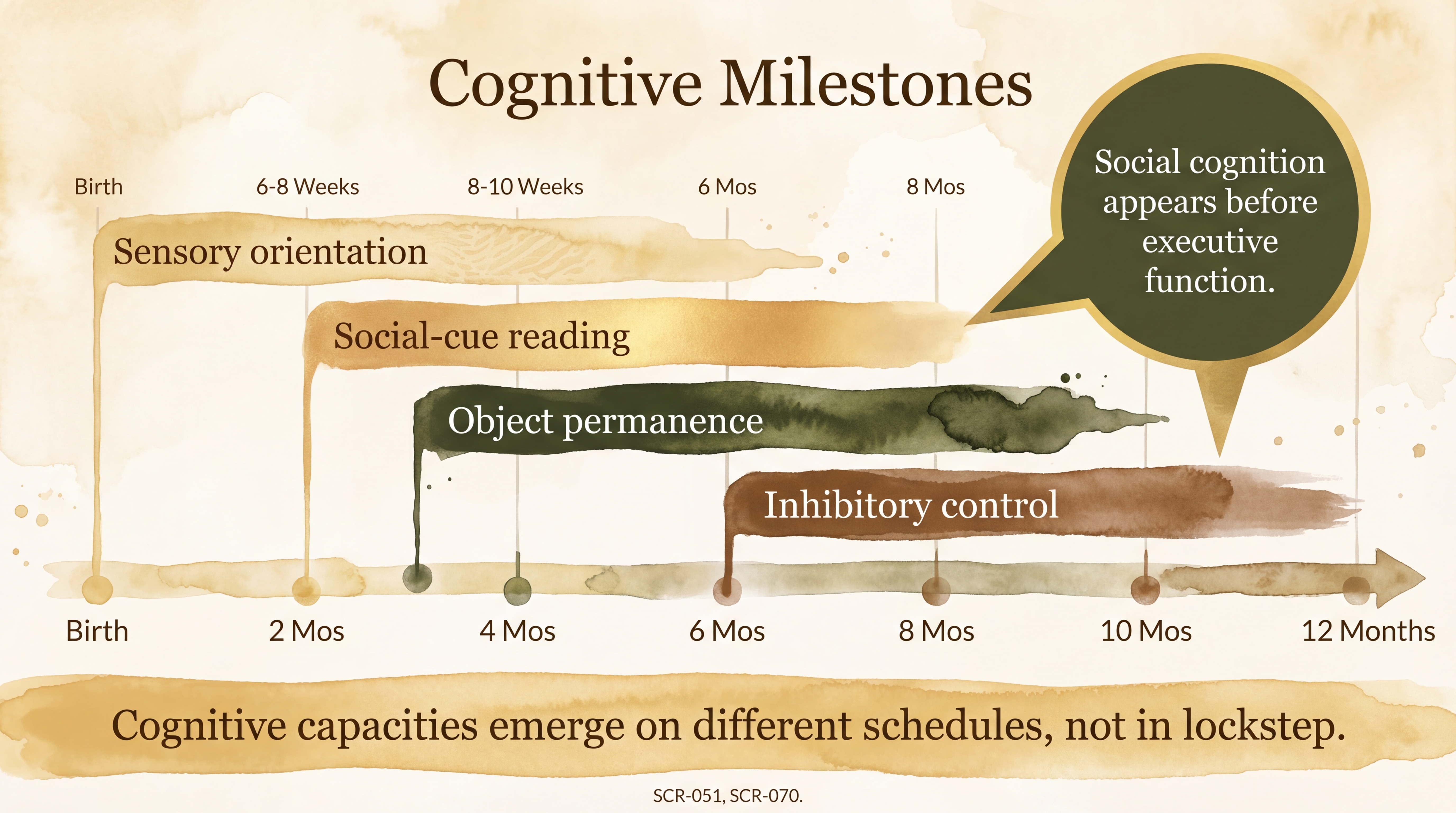
Cognitive capacities emerge on different schedules - social cognition appears before executive function.
Key Takeaways
- Canine cognition develops unevenly across domains such as social cue use, memory, inhibition, and problem solving.
- The human social channel is available very early in retriever puppies, which is directly relevant to Golden Retrievers.
- Puppy cognition should be described in broad developmental ranges rather than with false numerical precision.
- Individual variation is large, which is why puppy tests are informative only within limits.
The Evidence
This entry uses observed claim-level tags beyond the dedicated EvidenceBlocks below. These tags mark JB program observation or practice-derived claims that need dedicated EvidenceBlock coverage in a later content pass.
- Bray, E. E. et al. (2021)retriever puppies including Golden Retrievers
Showed robust early human gesture comprehension without a learning curve across trials. - Topal, J., Miklosi, A., Hare, B., and related canine-cognition literaturedomestic dogs
Supports early-emerging object tracking, social cue use, and later refinement of more complex problem solving. - Puppy-test and longitudinal cognition literaturedomestic dogs
Shows that developmental assessment has some value but is limited in long-range predictive precision.
- SCR-041 and SCR-070 synthesisdomestic dogs
The safe conclusion is broad developmental emergence with large individual variation. The literature does not support rigid universal week-by-week cognitive timetables or simple breed determinism.
- domestic dogs
No published study provides a breed-specific week-by-week cognitive milestone map for Golden Retriever puppies across social, memory, and inhibitory domains.
SCR References
Sources
- Bray, E. E., Gnanadesikan, G. E., Horschler, D. J., Levy, K. M., Kennedy, B. S., Famula, T. R., & MacLean, E. L. (2021). Early-emerging and highly heritable sensitivity to human communication in dogs. Current Biology, 31(14), 3132-3136.e5. DOI: 10.1016/j.cub.2021.04.055.
- Puppy-test and longitudinal cognition literature. Supports bounded developmental-assessment context; no single citation in this row establishes a precise Golden Retriever week-by-week cognition timetable.
- Topal, Miklosi, Hare, and related canine-cognition literature. Supports early-emerging canine social-cognition context; row remains a literature-cluster pointer rather than one resolved citation.