Temperament Heritability in Dogs
Temperament is heritable in dogs, but not in the simplistic way breeder folklore often suggests. Published estimates across fearfulness, sociability, aggression-related traits, boldness, and trainability consistently show that additive genetic differences matter and that selection on parental behavior does leave a real fingerprint on offspring distributions. At the same time, the effect is probabilistic, population-level, and inseparable from development and environment, and no honest reading of the literature treats behavioral heritability as destiny for any individual puppy. That tension between real heritable signal and real individual variability is the whole point of the page, and getting it right is one of the most important skills a breeder can develop when talking to families about what selection can and cannot do. Documented
What It Means
The formal question
Temperament heritability asks how much of the variation between dogs in a measured behavioral trait is attributable to additive genetic differences in the population being studied. The question is framed at the level of the population, not the individual, and the answer depends on how the trait was measured, which population was sampled, and what environmental conditions the dogs experienced during their development. Those conditions are not incidental footnotes; they are load-bearing features of what a heritability estimate actually means.
The strongest behavior-genetics studies do not say temperament is fixed. Documented They also do not say temperament is mostly environment. They say something narrower and more useful: many behavior traits show measurable heritable variation, often in the low-to-moderate range, which means breeder selection can move the population over time in a desired direction even though individual outcomes remain variable around the population trend.
The numerical range and what it really means
In dogs, narrow-sense heritability estimates for many temperament-relevant traits often land somewhere around 0.15 to 0.35, though the exact figure varies substantially with the breed or population being studied, the specific definition of the trait, the measurement instrument used, the age at which dogs were tested, and the training and management context the dogs experienced before testing. Estimated A trait tested in working-dog assessments may produce different heritability estimates than the same trait assessed through owner questionnaires, not because the underlying biology is different but because the measurement is capturing slightly different facets of behavior.
This variation is not a flaw in the concept. It is what heritability is supposed to do. Heritability is always population-specific, and the value of an estimate depends entirely on which population and which trait definition it applies to. A value like 0.30 does not mean 30 percent of your puppy's temperament is "locked in" and the other 70 percent is up for grabs, and that common mistranslation is one of the single biggest sources of confusion when families try to apply heritability literature to their own dog. It means that, in the population studied, about 30 percent of the between-dog variance in that trait was attributable to additive genetic differences under the conditions of that particular study.
That distinction is load-bearing because breeder rhetoric often slides from population statistics into individual prophecy. A breeder who says "temperament is 30 percent genetic, so we can control about a third of it through breeding" is misreading the statistic. The statistic is about variance between dogs in a sample, not about the proportion of any single dog's behavior that came from genes versus environment. Those are two different quantities with different interpretations, and conflating them produces claims the science does not support.
The measurement problem
Temperament also has a measurement problem that orthopedic traits do not have. Hips can be imaged with standardized radiographs that produce scores comparable across dogs and across decades. Hearts can be scanned with ultrasound that measures specific structural features. Temperament has to be inferred through behavior tests, owner reports, standardized working evaluations, or long-term line knowledge, and all of those methods have higher noise than a physical measurement of the body. Documented
Those methods are useful, but they are noisier than an X-ray, and the noise matters for heritability estimation. A noisier phenotype measurement drags heritability estimates downward, not because the underlying heritability is lower but because some of the signal is being lost in measurement error. This is one reason selection for temperament tends to move more slowly than selection for physical traits and requires more humility about what the numbers actually show.
The measurement problem also affects how much confidence any individual test result deserves. A single temperament evaluation at one age, in one setting, by one observer, captures only part of what the dog is. Multiple evaluations across contexts and across time produce a more reliable picture, and that is why programs serious about temperament selection usually combine formal behavioral assessment with extended observation, owner reports, and long-term line knowledge rather than relying on any single test.
Why selection still works
The literature still supports the idea that temperament selection works at the population level. Behavioral genetics work in dogs, including Scandinavian assessment programs that have been running for decades and later questionnaire-based studies across larger populations, shows that traits such as sociability, fear reactivity, boldness, aggression-related traits, and trainability are not random noise. They show enough additive genetic structure for selection to produce measurable changes in breed populations over generations when selection has been consistently applied.
That is the bridge breeders care about. A trait does not have to be highly heritable to respond to selection. It just has to have real additive variance and be measured honestly enough that breeders are actually selecting the trait rather than the illusion of the trait. A trait with heritability of 0.25 can still move substantially over ten generations of focused selection, and the cumulative effect of small per-generation changes is what has shaped the behavioral distinctness of modern dog breeds relative to their common ancestors. Documented
The limit of selection is also worth stating. Selection on a polygenic trait cannot pull the population past the genetic variation currently present in the breeding pool, and it cannot eliminate individual variation within the selected population. Even the most tightly selected line will still produce individuals that sit at the tails of the distribution rather than at the mean, and those individuals are not selection failures; they are a normal consequence of how polygenic traits behave in any finite population.
Translating to the JB program
For JB, this literature matters directly to how the program talks about itself. The JB "math professor" temperament is not a mystical essence or a marketing slogan. It is a cluster of polygenic behavioral traits expressed in a consistent social style: lower baseline arousal, stable social orientation, reduced impulsive drama, and greater capacity for calm presence and observational learning. None of those traits is a single gene, and none is entirely determined by breeding. But all of them have some heritable component, and all of them respond to sustained selection when that selection is combined with a developmental environment that supports rather than undermines the genetic contribution.
The literature supports the idea that such behavior profiles can be selected for over generations, even though the resulting puppies will still vary within a distribution and still require proper raising to express their genetic potential. Documented That is why the program talks about breeding and raising as complementary layers rather than as competing explanations, and it is why the program refuses to promise any individual puppy will exactly match the line average. Line consistency is a population statement; individual outcome is an individual statement, and the two sit at different levels of analysis.
Why It Matters for Your Dog
What This Cannot Predict
Temperament heritability cannot tell you exactly who your puppy will become. It is a population statistic, not an individual forecast, and applying it to a single dog as if it were a deterministic prediction is a category error.
It cannot guarantee that a puppy from stable parents will never become fearful or reactive. The parent behavior loads the odds in favor of a similar distribution of outcomes but does not make any individual outcome inevitable, and environmental factors during the critical developmental windows can move an individual dog in either direction around the line average. Documented
It cannot tell you that a puppy from less ideal parents is doomed to instability. Individual variation exists in every litter from every breeding, and even parents with less desirable temperament distributions can produce individual puppies that turn out well, particularly when the developmental environment is strong.
And it cannot be converted honestly into a personal "percent genetic" score for one dog. The population-level variance partition does not translate into an individual-level breakdown, and any breeder or trainer who offers such a breakdown is overclaiming what the statistic actually measures.
That is why the population-level rule has to be restated clearly and repeatedly: temperament heritability describes the variance structure of the measured population. It does not predict the fate of one puppy with certainty, and it should not be used as if it did.
Families usually ask temperament questions in the language of hope and worry. Will this puppy be calm. Will it be easy. Will it be biddable. Will it fit a family home. Will my children be safe. Will I be able to handle it as it grows up.
Heritability does not answer those questions all by itself, but it changes how seriously breeder selection should be taken. If temperament were not heritable, then sire and dam behavior would matter much less than breeders think, and the pedigree would be essentially irrelevant to the puppy's eventual adult behavior. The literature says the opposite. Parent behavior matters because behavior is partly heritable, and the match between parent temperament and the behavioral goal of the program is one of the most important variables in predicting what the average puppy will look like as an adult.
That does not reduce the importance of raising. It just makes the sequencing more honest. Breeding sets part of the odds structure by selecting which genetic combinations are available in each litter. Early life experiences and maternal effects shape how those genetic tendencies develop during the critical windows when behavioral patterns are being laid down. The caregiver continues the process by providing the environment in which the resulting dog will live its life, and the caregiver's contribution is substantial even when the underlying temperament is strong. Families who understand the sequencing can evaluate breeders fairly, can ask the right questions about parent behavior and raising protocols, and can take appropriate responsibility for the developmental contribution they will make once the puppy is in their home.
For JB, the observed stability of the line is consistent with this literature. The program is selecting toward one corner of the Golden Retriever behavioral range, and the fact that the line repeatedly produces that social style across many litters is what would be expected from a moderately heritable, polygenic temperament target under consistent long-arc selection. The observation does not prove the selection is entirely responsible for the outcome, because the raising environment is also being held consistent, but the two working together is exactly the integrated approach the literature suggests is most effective for complex behavioral targets.
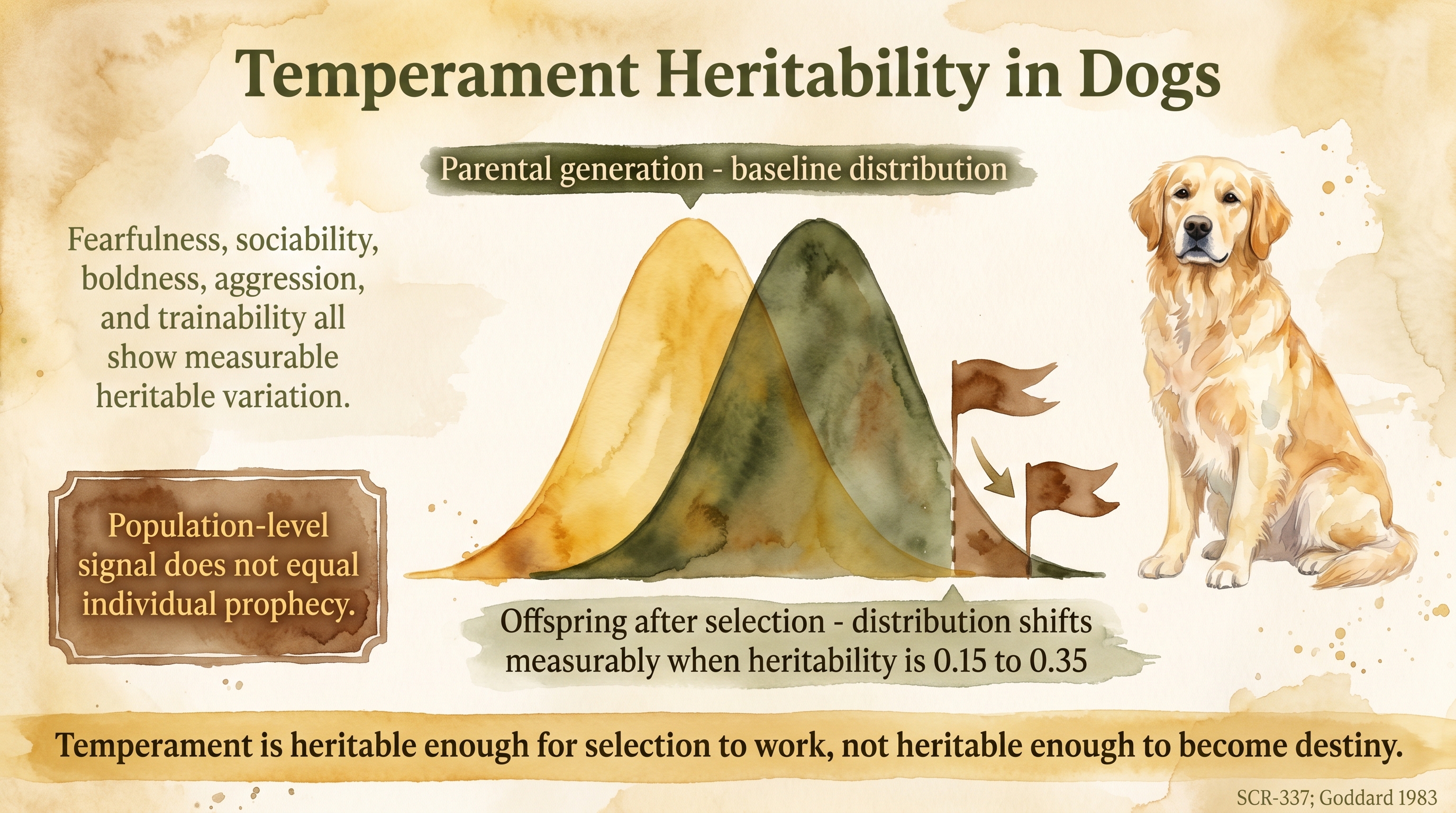
Temperament is heritable enough for selection to work, not heritable enough to become destiny.
Key Takeaways
- Temperament is heritable in dogs, but the effect is polygenic, moderate, and population-level rather than destiny-level.
- A heritability estimate describes variance in a studied population, not how much of one puppy is fixed.
- Behavioral selection can work, but it moves more slowly than selection on many physical traits because temperament is harder to measure cleanly.
- Good breeding and good raising are not competing explanations. They act at different stages of the same developmental story.
- Individual variation around the line average is normal and expected even under successful selection.
The Evidence
This entry uses estimated claim-level tags beyond the dedicated EvidenceBlocks below. These tags mark approximate ranges or timing claims that should remain bounded by the cited sources.
- Saetre, Persson, Ilska, and related behavior-genetics literaturedogs
Published studies repeatedly find non-zero heritability for fearfulness, sociability, trainability, boldness, and aggression-related traits, generally in a low-to-moderate range depending on the population and test design. - Scandinavian and working-dog behavior studiesdogs
Behavioral traits can respond to selection over generations, but estimates vary by breed, context, and the quality of the phenotype measurement.
- JB breeding observationsGolden Retrievers
The recurring low-arousal, high-stability social style observed in the JB line is consistent with the literature showing that temperament is a heritable polygenic target responsive to long-arc selection.
No published study has directly compared the behavioral outcomes of dogs from temperament-selected lines versus conformation-selected lines within the same breed using a randomized or matched-cohort design with standardized assessments.
SCR References
Sources
- Goddard M.E. & Beilharz R.G. (1983). Genetics of traits which determine the suitability of dogs as guide-dogs for the blind. Applied Animal Ethology, 9(4), 299-315. doi:10.1016/0304-3762(83)90010-X
- Saetre P., Strandberg E., Sundgren P.-E., Pettersson U., Jazin E., & Bergström T.F. (2006). The genetic contribution to canine personality. Genes, Brain and Behavior, 5(3), 240-248. doi:10.1111/j.1601-183X.2005.00155.x
- Ilska J., Haskell M.J., Blott S.C., Sánchez-Molano E., Polgar Z., Lofgren S.E., Clements D.N., & Wiener P. (2017). Genetic Characterization of Dog Personality Traits. Genetics, 206(2), 1101-1111. doi:10.1534/genetics.116.192674
- MacLean E.L., Snyder-Mackler N., vonHoldt B.M., & Serpell J.A. (2019). Highly heritable and functionally relevant breed differences in dog behaviour. Proceedings of the Royal Society B: Biological Sciences, 286(1912), 20190716. doi:10.1098/rspb.2019.0716
- Morrill K., Hekman J., Li X., McClure J., Logan B., Goodman L., et al. (2022). Ancestry-inclusive dog genomics challenges popular breed stereotypes. Science, 376(6592), eabk0639. doi:10.1126/science.abk0639
- Strandberg E., Nilsson K., & Svartberg K. (2025). Genetic parameters of personality traits in dogs based on behavioral assessment and questionnaire information. Applied Animal Behaviour Science, 286, 106619. doi:10.1016/j.applanim.2025.106619
- Wilsson E. & Sundgren P.E. (1997). The use of a behaviour test for the selection of dogs for service and breeding, I: Method of testing and evaluating test results in the adult dog, demands on different kinds of service dogs, sex and breed differences. Applied Animal Behaviour Science, 53(4), 279-295. doi:10.1016/S0168-1591(96)01174-4
- Wilsson E. & Sundgren P.E. (1998). Behaviour test for eight-week old puppies - heritabilities of tested behaviour traits and its correspondence to later behaviour. Applied Animal Behaviour Science, 58(1-2), 151-162. doi:10.1016/S0168-1591(97)00093-2